


In Yucatán, southern Mexico, digital attacks against environmental defenders began gaining momentum in 2023. In cases such as those of Sergio Oceransky, director of Fundación Yansa, and Wilbert Nahuat, a community leader from Santa María Chi who succeeded in shutting down an industrial pig farm that was harming his territory, those attacks have steadily intensified. The aggression has not been confined to the digital sphere: both men are also facing legal proceedings.
By Ana Laura Vásquez and Thelma Gómez Durán (Mongabay Latam)
The video opens with a deliberately provocative title in all caps:
“SINISTER SECRET PLAN to DIVIDE and CONQUER MEXICO: GLOBAL ELITE Seeks INDIGENOUS REVOLUTION.”
For more than 36 minutes, the man on screen claims that Mexico is on the verge of disappearing because of what he calls the “false indigenism that has destroyed entire nations.” Adopting the tone and posture of a television news commentator, he warns that the country could end up undergoing an “Africanization”—which, he says, would be akin to “Balkanization or Palestinianization.” According to him, the person responsible for this supposed threat is a Spaniard named Sergio Oceransky. He therefore suggests that “the sooner Mexicans organize peacefully to expel him from their country, the better.”
The video was broadcast on December 10, 2025, on the YouTube channel Los Liberales, run by Argentine commentator Nicolás Morás. It was the first of at least six videos the channel has aired attacking Sergio Oceransky Losana, founder and executive director of Fundación Yansa since 2009. Since 2019, the nonprofit organization has advised communities denouncing the dispossession of their lands, particularly in connection with the expansion of real estate developments in Yucatán, in southern Mexico.
Los Liberales is only one of several digital platforms that have spent the past three years circulating content targeting Oceransky. Much of it emphasizes his status as a foreigner by repeatedly identifying him as “Spanish” or portraying him as a “fake activist” who deceives and manipulates local communities.
Oceransky is not the only environmental defender in Mexico who says he has been targeted by online smear campaigns and hostile content circulated through social media and other digital platforms. The harassment has also affected residents of communities that have organized to defend their territories and resist the destruction of large natural areas across the Yucatán Peninsula.
This region contains the largest expanse of tropical forest in North America: the Maya Forest. It is also one of the few places in the world where vast networks of water-filled limestone caverns can still be found—natural formations known as cenotes, a name given to them by the ancient Maya.
Facebook pages that once served local communities as spaces to advertise products or share public notices are increasingly being used to publish attacks against environmental and land defenders. In some cases, those campaigns have expanded far beyond the local level.
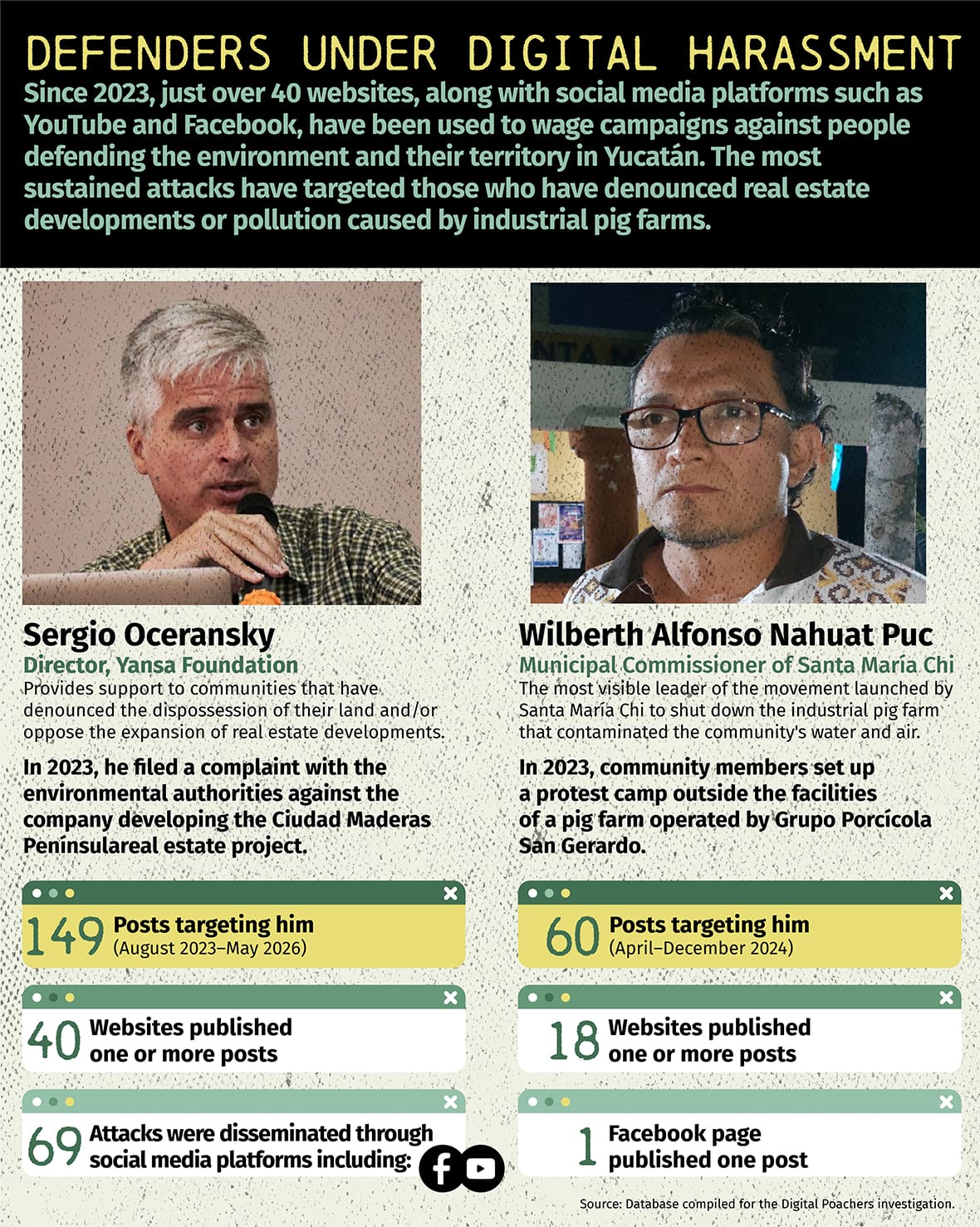
In Yucatán, for example, the digital harassment has focused primarily on two individuals: Sergio Oceransky—who, in addition to advising communities, filed a citizen complaint with environmental authorities against a real estate company for illegally converting forest land—and Wilberth Nahuath Puc, the municipal commissioner of Santa María Chi and the most visible leader of the movement that succeeded in shutting down an industrial pig farm.
According to the database compiled for this investigation, more than 149 posts targeting the director of Fundación Yansa were published between September 2023 and May 14, 2026. Meanwhile, between March and December 2024, at least 60 articles attacking Nahuath appeared across roughly 30 websites.
In both cases, the campaigns followed strikingly similar patterns. Articles were presented as news reports despite lacking sources, and their headlines and content often appeared nearly identical. They were also distributed through many of the same channels—primarily websites that either belong to the same media groups or maintain some form of connection to one another. In Oceransky’s case, additional Facebook pages were created specifically to circulate articles and videos targeting the Fundación Yansa director.
The volume of attacks tended to spike at key moments: when activists achieved victories in their campaigns, reported irregularities involving real estate developments, or appeared in court hearings. The waves of online content frequently coincided with legal actions brought against them.
These are among the findings of this investigation by Mongabay Latam, conducted as part of Digital Poachers, a collaborative project involving seven media organizations coordinated by the Latin American Center for Investigative Journalism (CLIP). The initiative examined digital attacks targeting environmental defenders and grassroots movements across Latin America.
Organizing to Defend the Land
The people of Ixil began organizing in 2018 to prevent what they saw as the dispossession of their communal and ejido lands. The catalyst was a proposed wind farm that a private company sought to build on land it claimed was privately owned.
It was in this context that Sergio Oceransky, through Fundación Yansa, began working with the grassroots collective Defenders and Protectors of Ixil’s Future. Oceransky had previously supported communities in Oaxaca that opposed wind farms in the Isthmus of Tehuantepec—projects operated by multinational companies under contracts widely criticized as unfair to local residents.
Born in Asturias, Spain, Oceransky comes from a family with Mexican roots and holds dual Spanish and Mexican citizenship. He was active in the anti-nuclear movement and in organizations advocating for an energy transition that places communities at its center.
With support from Fundación Yansa, the Defenders and Protectors of Ixil’s Future succeeded in persuading the company to abandon its wind farm plans and in getting environmental authorities to halt the construction of at least two real estate developments. At the same time, the collective has spent years challenging in court actions taken by a man who promised to regularize residents’ ejido land titles. Community members allege that he used their signatures to alter the legal status of communal lands. Those allegations have also been documented by various media outlets and academic studies.
The group is engaged in another long-running battle as well: securing recognition of 324 hectares as community land. Local business owners claim they legally purchased the property, but members of the collective reject the validity of that sale.
According to the community, the land was originally lent to a hacienda that operated in Ixil for decades. The estate produced henequen, a highly durable natural fiber that fueled a major economic boom in the nineteenth century. After the hacienda closed, the land—much of it covered by low tropical forest—was used for growing vegetables. The grandparents and parents of today’s farmers cultivated those fields, and community members continue to grow onions, lettuce, cilantro, and other crops there, which they later sell in the city of Mérida.
“Some people say this is just a land dispute. It’s not,” says a woman we will call María to protect her identity. “It’s about defending what belongs to us.” More than twenty people gathered in the courtyard of a home in Ixil nod in agreement. For over two hours, they recount how they organized and why they oppose the continued clearing of forest for real estate developments. “The developers arriving now are destroying what the land has protected for generations, what the land has preserved for generations,” one resident says.
They regret that their struggle has brought division to the community and exposed them to attacks, including defamatory comments posted on Facebook. “They’ve posted awful things about my daughter.” “They insult us.” “They say we’re being paid, that we’re not real defenders…”
Members of the collective say most of these attacks come from anonymous profiles that cannot be traced to identifiable individuals. The comments are unpleasant to read, they acknowledge, but they are not what worries them most. What concerns them now is the growing criminalization of people involved in the movement.
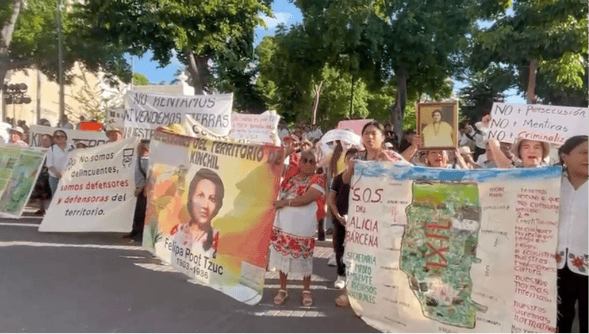
That process began in April 2023, when the Yucatán business owners claiming ownership of the 324 hectares filed criminal complaints against Guillermo Yam Ek, Cecilio Cisneros, and Sergio Oceransky, accusing them of unlawful occupation of the land.
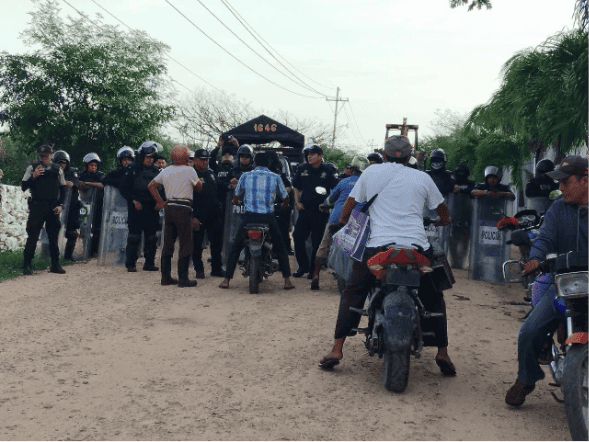
A few months later, in mid-August 2023, state police arrived in Ixil to erect fencing around the disputed property. Community members attempted to stop them, but were unsuccessful. Photographs taken during that confrontation later appeared in some of the first online posts targeting Oceransky.
Publications Begin
On September 8, 2023, the YouTube channel Noticias Teleplay released a video with the provocative headline: “THE IXIL CONFLICT ALLEGEDLY HAS A NAME: SERGIO OCERANSKY.”
The video claims that the director of Fundación Yansa—described as “a man of Spanish origin”—is allegedly responsible for the conflict and acts of violence in Ixil. The narrator repeatedly stresses Oceransky’s status as a foreigner, accusing him of deceiving community members by “making them believe he will help them recover their land.” The video also asserts that the more than 300 hectares at the center of the dispute were sold by the ejidatarios themselves and therefore belong “legitimately to the private sector.”
The Noticias Teleplay YouTube channel is part of Teleplay.tv, whose rights are held by Rojas Sarlat Producciones, a video production company based in southeastern Mexico. Its director, José Luis Rojas Sarlat, states on his LinkedIn profile that he served as head of production at Canal Trece, Yucatán’s public television station, from 2004 to 2007. On the production company’s Facebook page, Rojas Sarlat has posted several photographs of himself alongside Yucatán politicians, including current governor Joaquín Jesús Díaz Mena and Mérida mayor Cecilia Patrón Laviada.
This reporting partnership contacted Rojas Sarlat by email to ask about the publication of the video. He responded that “a resident who lived in Ixil and worked here in the office was the one who brought us the videos.”
According to Rojas Sarlat, the decision to publish the material was made by the person who was then serving as news director, together with an adviser. He added that neither of them still works for the company. He also noted that neither Oceransky nor anyone on his team requested a right of reply.
Rojas Sarlat further stated that a group of Ixil residents later approached him seeking another story on the subject.
“I declined, precisely because I could see there were many interests involved that I knew nothing about. But it remains a land dispute between private parties, and there are many such disputes amid the real-estate boom taking place in Yucatán.”
The images and narrative used by Noticias Teleplay closely resemble those later circulated by a number of digital news sites—and even by the YouTube channel Los Liberales—in their attacks on Oceransky.
Just two days after Noticias Teleplay published its video, at least five websites ran nearly identical articles claiming that a “Spaniard” or “foreigner” was “manipulating the people of Ixil in order to seize their land.”
One of the first outlets to publish stories targeting Oceransky was Observador Gráfico Yucatán. The site was created by José Pallota, a photographer who previously worked for one of Yucatán’s most widely circulated newspapers.
“When the newspapers went through mass layoffs, everyone started launching their own website,” Pallota says from his photography studio, where he has also set up a space for YouTube broadcasts.
Asked about the article his outlet published on September 11, 2023—one that accused Oceransky of manipulating residents of Ixil—Pallota says he no longer remembers where the information came from. Perhaps, he suggests, another journalist passed the text along to him. Many reporters who started their own news websites routinely share ready-made stories, complete with photographs.
“Sometimes they ask you to publish the text exactly as it is,” he explains. “Not to change a thing.”
Other websites that published almost identical articles attacking Oceransky on September 11, 2023, included El Cronista Yucatán, Diario de la Península, Presidio, and Vector Yucatán. None of them published further stories about the Fundación Yansa director after that date.
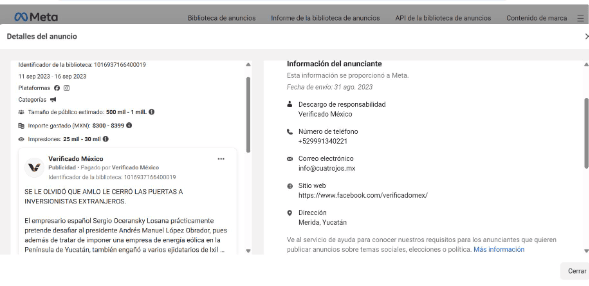
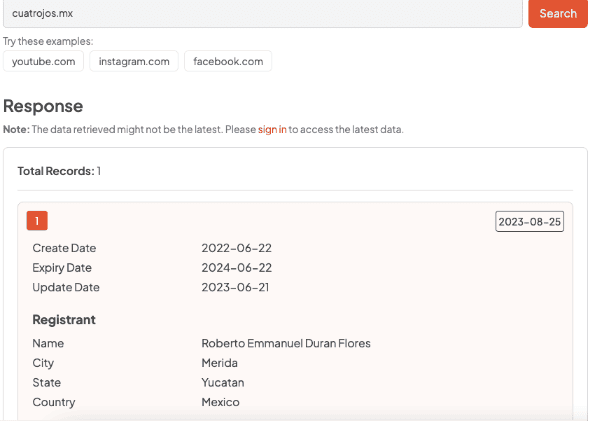
In September 2023, the Facebook page Verificado México—which is not affiliated with the Mexican fact-checking outlet of the same name—also published a post targeting Oceransky. To expand its reach, the page paid Facebook to promote the content. The email address used to purchase the advertisement was info@cuatrojos.mx. Records show that the domain cuatrojos.mx was registered under the name Roberto Emmanuel Durán Flores, who, according to the directory on the Yucatán state government’s official website, serves as director of outreach and communications for the state Public Security Secretariat.
Reporters contacted Durán Flores, who said via WhatsApp that he had not registered the domain. However, he acknowledged: “I collaborated with Cuatrojos between January and March 2018.” When asked about the company or individuals behind the project, he replied: “Honestly, I don’t remember. It was many years ago. It wasn’t a company—it was a group of acquaintances who used that name for an entrepreneurial venture and invited me to collaborate.”
Members of the Defenders and Protectors of Ixil’s Future collective recall that people in the community who were close to the man accused of altering the legal status of the ejido lands were instrumental in spreading the first stories targeting Oceransky.
“One of them would walk around with his phone saying, ‘Look who this Spaniard is. Look at this Spaniard who’s deceiving you,’” one member recalls. “That’s always been the message: that Sergio is going to keep the land for himself, that he’s going to build a wind farm.”
María says she has also heard claims that the Fundación Yansa director already owns property in Ixil.
“We tell them, ‘Show us which land,’” she says.
Members of the collective believe that the attacks on Oceransky—and the hostile comments directed at them on Facebook—became more aggressive once their movement gained momentum.
“It happened when they realized how strong our group was,” one member says. “When they realized there weren’t just a handful of us.”
The campaign against Oceransky has had little effect on the collective itself.
“Nothing they say is true,” says one member. “Sergio has always been transparent with us. He always holds public meetings where everything is discussed openly. We know his work.”
For a time, the attacks subsided. Between January and May 2024, only a handful of stories—fewer than five—were published. But beginning in November 2025, the campaign intensified again.
According to members of the collective, social media users began posting messages such as:
“What information do you have about this Spaniard?”
They also claim that money was being offered to people willing to participate in a march against the Fundación Yansa director.
Several months earlier, in September 2025, Ixil’s Community Council had succeeded in removing the municipality from the agreement creating the Mérida Metropolitan Zone. Council members argued that the community had never been consulted about the decision. In their view, inclusion in the metropolitan zone would have further accelerated the expansion of real estate developments into their territory.
Fundación Yansa provided legal support to the Community Council throughout that process.
Another significant development occurred around the same time: a judge temporarily halted construction on a real estate project in the municipality of Progreso—one that Oceransky had denounced years earlier.
YouTube Scripts
Nicolás Morás, the creator of the YouTube channel Los Liberales, was born in 1994 and lives in Paraguay—a country he frequently praises for what he considers to be “the healthiest form of capitalism.” According to the description on his X account, he identifies as an “anarcho-liberal.” He says he advocates for “free-market capitalism and absolute individual freedom.” He is also a vocal critic of environmentalism, feminism, environmental protection discourse, the United Nations’ 2030 Sustainable Development Agenda, the United Nations itself, and Indigenous land-defense movements.
Morás’s YouTube channel published its first video about Oceransky on December 10, 2025, just days after various websites and Facebook pages stepped up their publication of content targeting the Fundación Yansa director.
In the opening minutes of the video, Morás describes Oceransky as “a professional agitator” who is “brazenly trying to smear legitimate Mexican companies.”
At the 5:36 mark, the screen splits in two. Morás remains visible on the left, while the right side shows a computer screen displaying the script he is reading from:
“Oceransky presents himself as a noble activist who has been denouncing these companies for seeking to privatize land and dispossess the Indigenous residents of Ixil of their ejido lands in the Yucatán region.”
As he reads, Morás emphasizes certain words, improvises, and inserts additional commentary. For instance, instead of saying “these companies,” he expands the phrase to: “These Mexican companies, many of them known for their significant social investment—that is, charitable and philanthropic projects.”
Later, he names specific firms: “Companies such as Ciudad Maderas, which generate thousands of direct and indirect jobs across the region.”
The script visible on screen for roughly three minutes appears in a document titled “Script–Sergio Oceransky–Jury Case.”
Records reviewed in Mexico’s Public Registry of Commerce indicate that Jury is the surname shared by most of the shareholders in two companies: Centro Inmobiliario del Bajío and Inmobiliaria Plaza Querétaro.
The first of these, Centro Inmobiliario del Bajío, was the company that filed the Environmental Impact Assessment (MIA) for the road-construction phase of Ciudad Maderas II, a real estate development in the municipality of Progreso, according to documentation available through Mexico’s Ministry of Environment and Natural Resources (Semarnat). Approval of the Environmental Impact Assessment is only one of several permits required to build a real estate project on forested land.
According to records from the Public Registry of Commerce, Centro Inmobiliario del Bajío’s shareholders and legal representatives include Jaime Salvador Jury Estefan, Gastón Jury Arce, and Daniela Jury Lazo.
In February 2023, Oceransky filed a citizen complaint with Mexico’s Federal Attorney for Environmental Protection (Profepa) against Centro Inmobiliario del Bajío, alleging the illegal conversion of forest land for the construction of Ciudad Maderas Península.
“Construction was already underway in 2022,” Oceransky told Mongabay Latam. “They weren’t just opening access roads—they were already building houses.”
The activist says he filed the complaint in a personal capacity, rather than through Fundación Yansa.
“I filed it as an individual, not even as Fundación Yansa, so as not to put members of the Chuburná community [one of the communities closest to the development] or the Yansa team at risk.”
In 2025, Oceransky also filed an amparo lawsuit against Profepa, arguing that the agency had failed to properly address his environmental complaint. As a result of those legal actions, a judge ordered a temporary suspension of construction at Ciudad Maderas in October of that year while the case proceeds through the courts.
This reporting partnership contacted Nicolás Morás by email to ask why the script for one of his videos bore the title “Jury Case.” No response was received.
Does Ciudad Maderas Have the Required Permits?
Mongabay Latam requested an interview with Mexico’s Ministry of Environment and Natural Resources (Semarnat). The ministry’s press office asked that questions be submitted in writing. Among them was a straightforward inquiry: whether the Ciudad Maderas Península development—both Phases I and II—held authorization to convert forest land to other uses, a permit required before forested areas can legally be cleared.
The response was equally direct: “The Semarnat Representative Office in Yucatán HAS NOT ISSUED ANY authorization for the conversion of forest land for the real estate projects Ciudad Maderas Península I and Ciudad Maderas Península II,” located in the municipality of Progreso, Yucatán.
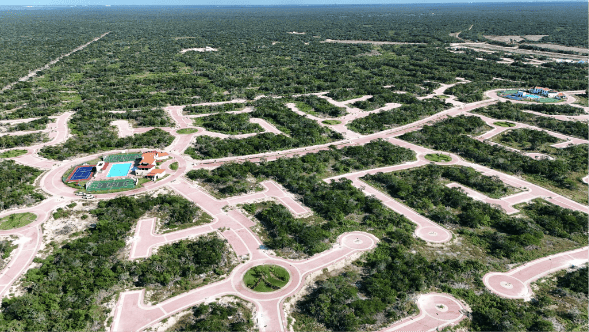
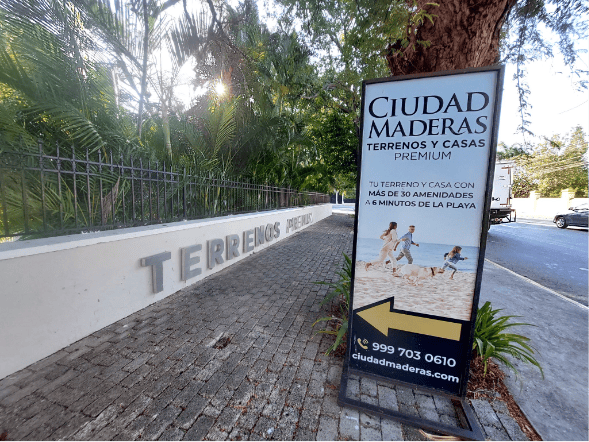
At Ciudad Maderas’ sales offices in Mérida, visitors are greeted by a scale model and promotional plans for the development under construction in Progreso.
“This project is beautiful,” a sales representative explains. “It covers more than 1,200 hectares in total. It includes two artificial lakes, more than 20 amenities—tennis courts, swimming pools… The beach is only six or seven minutes away.”
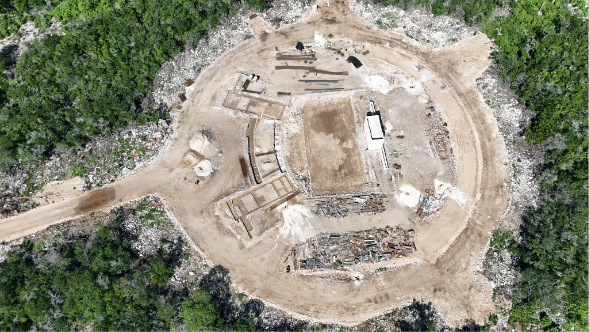
Satellite imagery reveals the transformation of the area where Ciudad Maderas Península Phases I and II are being built, showing conditions before and after construction began.
Throughout December 2025, Nicolás Morás released three additional videos targeting Oceransky. One of them was published on the final day of the year.
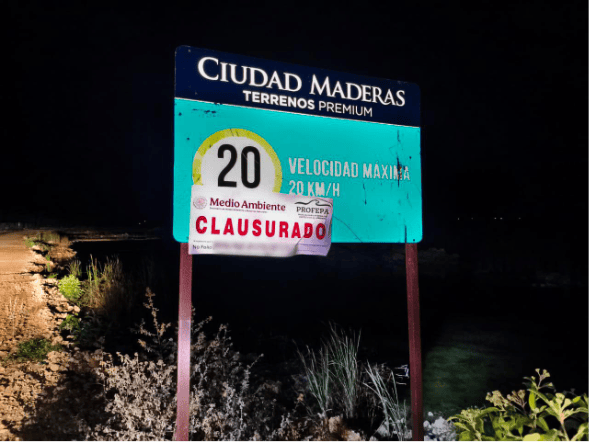
Just one day earlier, however, Profepa had announced in a press release that it was imposing a partial temporary closure on the Ciudad Maderas Península II project after detecting “noncompliance with various environmental conditions” established by Semarnat as part of the Environmental Impact Assessment approval process. Among the violations cited was the removal of 151,766 square meters of natural vegetation.
For this investigation, Mongabay Latam also sought an interview with Mariana Boy, head of Profepa. The agency’s press office responded in writing.
According to environmental authorities, following the December 2025 closure, personnel from the Environmental Protection and Territorial Management Office in Yucatán carried out a new inspection focused on environmental impacts. As a precautionary measure, officials imposed a second partial temporary closure on Ciudad Maderas Península Phase II.
For Oceransky, the Ciudad Maderas case exemplifies a broader trend that has been unfolding across Yucatán in recent years: the transformation of vast expanses of forest into urban developments.
“If this project moves forward, it will create an incentive for all the others,” he says. “There are many projects clearing forests without permits. We simply don’t have the capacity to report them all.”
Satellite imagery analyzed by the Global Forest Watch platform shows that Yucatán lost approximately 100,000 hectares of tree cover between 2020 and 2025.
By April 30, 2026, Morás had published at least six videos about Oceransky. Morás finances his YouTube channel through contributions made via Mercado Pago and Bitcoin. He also operates an online store where followers can purchase signed cards or exclusive video calls. For $250, customers can commission a report on any topic they choose—“naturally approached from our perspective,” according to the site. For $1,000, they can order a “90-minute documentary.”
Among the questions this reporting partnership sent to Morás—without receiving a reply—was whether he had been paid to produce the videos targeting Oceransky.
The reporting team also contacted YouTube’s press office and a company representative, asking whether the videos described in this investigation violated the platform’s policies. No response had been received by the time of publication.
Likewise, questions were sent by email to representatives of Centro Inmobiliario del Bajío. As of publication, they had not replied.
Linked Networks of Websites
The court-ordered suspension of construction at Ciudad Maderas coincided with a sharp escalation in the digital attacks against the director of Fundación Yansa. Between October 30 and December 31, 2025, roughly 50 posts targeting the activist were published.
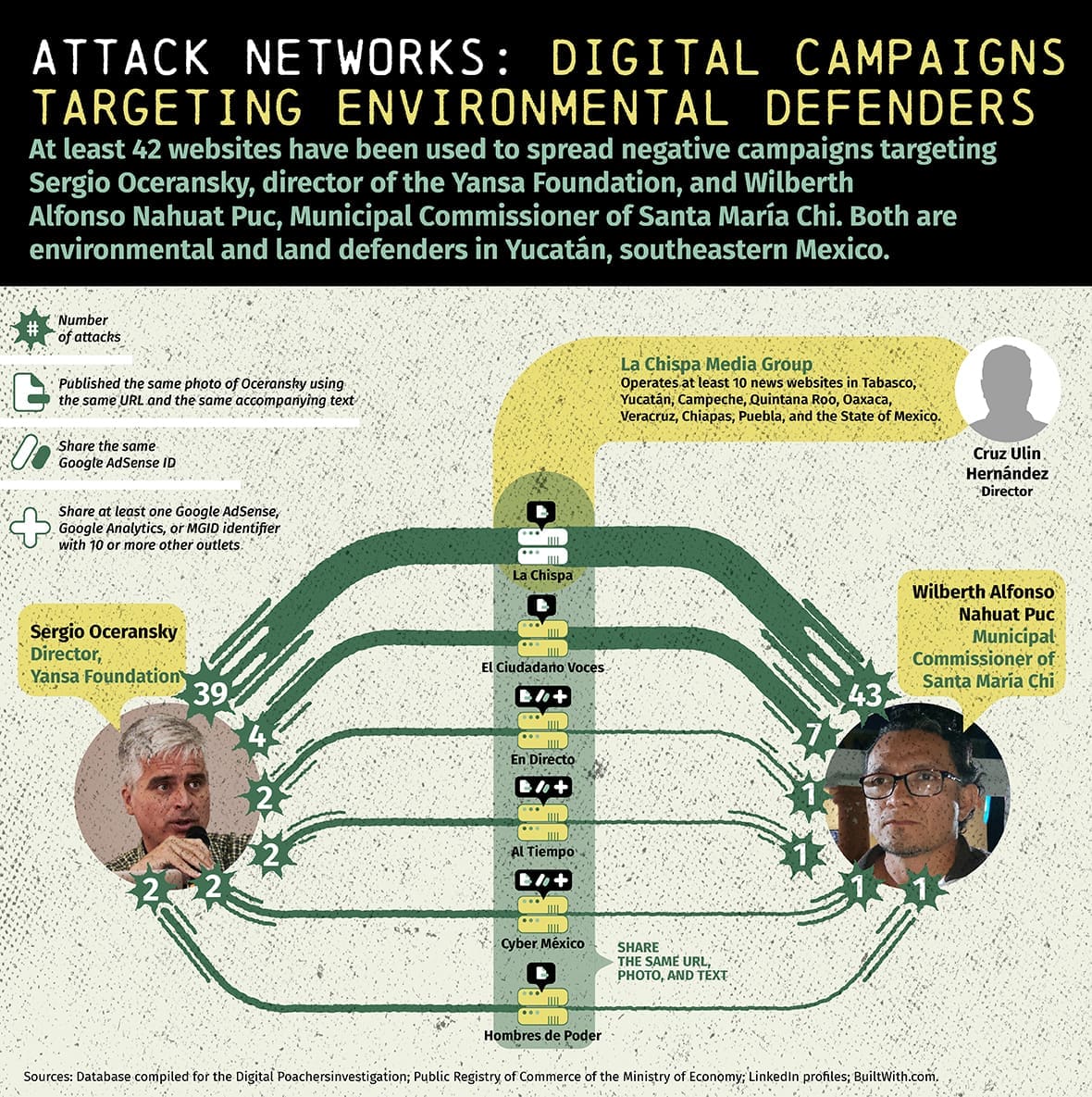
At least 19 of those articles appeared on websites belonging to Grupo Transmedia La Chispa, which is operated by Centro de Estudios e Investigación y Gobernabilidad S.A. de C.V., a company incorporated in the state of Tabasco in August 2009.
According to documents filed with Mexico’s Public Registry of Commerce, the company’s stated activities include “consulting, advisory, research, political studies and analysis,” “developing strategies related to media growth,” “representing news agencies,” “campaign development,” and “the design of public communications strategies.”
The company’s majority shareholder, sole administrator, and chief executive officer is Cruz Ulin Hernández. According to his LinkedIn profile, the executive director of Grupo Transmedia La Chispa is José Cruz Ulin Romo.
Between November 20 and November 27, 2025, at least 15 websites and Facebook pages published articles targeting Oceransky. Several of the outlets appear to be interconnected.
For example, the Facebook page of El Ciudadano Voces lists the same address as La Chispa de Yucatán. Its masthead also states that “transmedia and design” services are handled by Mi Publi, an advertising agency founded and headed by José Ulin.
This reporting alliance sent emails and called telephone numbers associated with Grupo Transmedia La Chispa but received no response.

Other websites that published critical content about Oceransky include En Directo, Al Tiempo, Cyber México, Noticia Metropolitana, and Fifi News. All five sites published near-identical articles about the activist. They also share the same Google AdSense code, which websites use to display advertisements. This strongly suggests that the five outlets may be managed by the same administrator. Two of them—En Directo and Al Tiempo—share an additional connection: they list the same contact email address on their websites. At least seven other sites that published one or more articles targeting the Fundación Yansa director also share the same Google Analytics code. In May 2026, both Cyber México and En Directo carried advertising for a Ciudad Maderas development in the state of Aguascalientes.
In January 2026, Grupo Transmedia La Chispa outlets and El Ciudadano Voces published an identical article about an alleged protest by ejidatarios from Chuburná against Oceransky. None of the reports specified where the demonstration supposedly took place. Diario Cambio 22 also ran the story.
An examination of the metadata attached to photographs published across the various sites revealed that the files shared both naming conventions and hosting servers. Among the filenames were: Inmobiliarios-yucatan-Business-1, Inmobiliarios-yucatan-4 , Inmobiliarios-yucatan-1.
Diario Cambio 22—which has published at least seven articles criticizing the activist—ran a story on December 6, 2025, stating that “various figures from the business sector claim that Oceransky has built a narrative based on unfounded accusations, harming both investors and the hundreds of families whose livelihoods depend on the projects he seeks to halt.”
The article further argued that Oceransky’s statements had particularly affected the real estate sector, “especially established developers such as Ciudad Maderas,” and asserted that the company’s projects possess “valid licenses, studies, and permits.”
The Same Websites, Another Environmental Defender
Several of the websites that spent the final months of 2025 publishing articles against Oceransky had carried out a similar campaign a year earlier against another environmental defender in Yucatán: Wilberth Nahuat Puc, the municipal commissioner of Santa María Chi and the most visible leader of the movement that succeeded in shutting down a pig farm found to be contaminating the community’s water supply and air quality.
The evidence that led a judge and environmental authorities to order the facility’s closure included technical reports documenting the damage.
Santa María Chi lies about 19 kilometers from the city of Mérida. In the 1990s, an industrial pig farm was established on the grounds of a former hacienda within the community. Over time it expanded to 73 pens, each housing between 600 and 700 pigs.
Residents say they lived like prisoners in their own homes, keeping windows and doors shut in a futile effort to block out the stench that settled over the community at certain times of day. They never became accustomed to the swarms of flies. Respiratory illnesses were common. Many stopped drinking water from the local well because it smelled and tasted foul, turning instead to bottled water.
“That’s what the people running the farm took from us—our peace of mind,” says Francisco Cauich, 66.
That situation persisted until April 2023, when the smell worsened dramatically and a cloud of smoke began enveloping the community.
“It took us a few days to figure out where it was coming from,” recalls Fernando Cruz, 63. “Then we realized it was the farm. All the manure had caught fire and was burning. The smell was unbearable.”
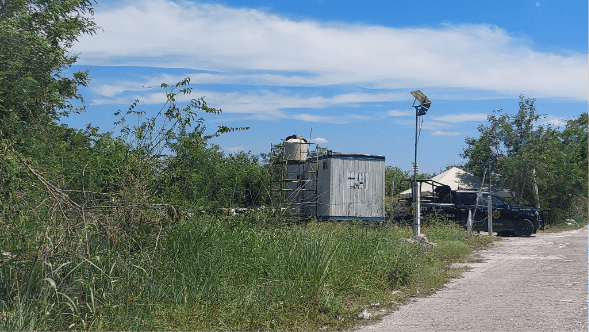
The incident—known locally simply as the burning—became the catalyst for community mobilization. In May 2023, residents set up a protest encampment at the entrance to the farm. There, they drafted a series of citizen complaints, adding them to the many reports they had already submitted to every government agency they could think of. They also filed around twenty amparo lawsuits challenging what they viewed as official inaction in the face of the pollution caused by the facility. Wilberth Nahuat began systematically compiling evidence of the environmental damage: photographs, technical studies, and witness testimonies.
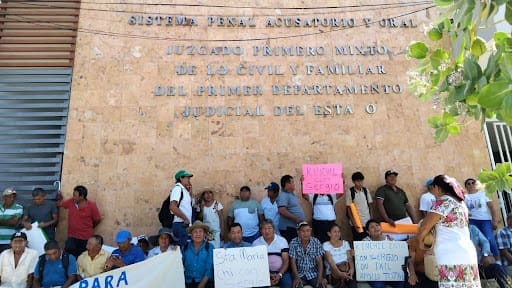
In May 2023, employees of Grupo Porcícola San Gerardo filed criminal complaints against Nahuat, accusing him of kidnapping and unlawful occupation of property. They alleged that the blockade had prevented workers from leaving the farm. The Federal Public Defender’s Institute (IFDP), which provides legal support to the community of Santa María Chi, described the complaint in stark terms: “This complaint constitutes an act of criminalization against those defending their right to a healthy environment—a right guaranteed by the Constitution and by international treaties to which Mexico is a party.”
The criminal complaint did not bring the movement to a halt. Residents continued pursuing legal action against the farm, and on April 25, 2024, the community achieved one of its most significant victories: a federal judge ordered the provisional suspension of the Environmental Impact Assessment that state authorities were preparing to approve for Grupo Porcícola San Gerardo.
The very next day, at least 17 websites published the same article attacking Wilberth Nahuat. Eleven of those outlets belonged to Grupo Transmedia La Chispa. The story was also carried by Visión Informática, Periódico Palacio, Al Tiempo, Hombres del Poder, Cyber México, El Ciudadano Voces, and El Chismógrafo en la Red.
The articles claimed that local residents had pointed out “inconsistencies” in Nahuat’s activism, arguing that he criticized the pig farm while remaining silent about the deforestation being carried out by real-estate developers around the community. Some stories went even further, suggesting that the municipal commissioner had accepted money from those companies to build his home.
Speaking with Mongabay Latam, Nahuat rejected those accusations and explained that the community deliberately focused its efforts on shutting down the pig farm rather than simultaneously fighting real-estate-driven deforestation.
“We simply couldn’t handle that many legal battles at once,” he says. “We couldn’t open another case before resolving the ones we already had.”
Two years later, Nahuat still vividly remembers the sense of helplessness he felt when he first read the articles. “It was a horrible feeling of powerlessness,” he says.
As he expected, the allegations quickly spread to his family, throughout Santa María Chi, and to people he knew in neighboring communities.
In addition to his duties as municipal commissioner, Nahuat performs jarana, the traditional dance and musical genre of the Yucatán Peninsula, and frequently appears at local celebrations. After the articles were published, people at some of those events would jokingly ask him: “So, were you selling land?” The jokes may have been casual, but the impact lingered. “I still get angry just thinking about it,” he says.
Rafael Rivas, another resident of Santa María Chi, says the campaign ultimately failed to weaken the movement because community members knew the accusations against Nahuat were false.
“We stood by him,” Rivas says. “They were only trying to divide us.”

Shutting Down the Farm
For the people of Santa María Chi, one of the most difficult moments in their struggle came when criminal charges were filed against Wilberth Nahuat.
“They accused him based on nothing but lies,” recalls 56-year-old Rita De Casia. “The judicial police came to take him away, but that day everyone came out. We rang the church bells and stood with him.”
The complaint also exposed Nahuat to a constant stream of warnings and intimidation. “You’ll never get that company shut down.” “They’re going to kill you.” “Aren’t you afraid?” His response was almost always the same: “If the community stands behind this struggle, we can keep moving forward.”
On May 15 and 16, 2024, the digital attacks against Nahuat flared up again, with articles recycling the same text and photographs. Six months later, another wave followed.
Between November 22 and December 16, 2024, at least 37 articles targeting him appeared on websites belonging to Grupo Transmedia La Chispa, El Ciudadano Voces, and Visión Informativa.
The headlines portrayed the Santa María Chi representative as someone who “is not an environmental defender,” claimed that “half the village ignores him,” or declared that “the UN is defending an alleged criminal.”
The timing was notable. The articles coincided both with Nahuat’s reelection as municipal commissioner of Santa María Chi and with a court hearing related to the criminal complaint against him.
In September 2025, Profepa ordered the farm’s permanent and total closure, citing “repeated noncompliance with seven corrective measures,” including the discharge of wastewater without the required permits.
A month later, a judge in Yucatán ruled that there was insufficient evidence to proceed with criminal charges against Nahuat and ordered that no prosecution be brought. The complainants appealed the decision, however, meaning that on June 17, 2026, Nahuat would once again have to appear in court for another hearing.
On April 30, 2025, the residents of Santa María Chi finally achieved what they had been fighting for: the pig farm ceased operations. Today, the community has set its sights on new goals. It wants to ensure that the company complies with environmental remediation measures and to prevent further expansion of real estate developments into the surrounding area. “Land grabbing is happening everywhere here,” says Francisco Cauich. “Go to any village and you’ll hear the same complaints. There’s hardly any forest left. They’re wiping out what remains of the high-canopy rainforest.”
Nahuat’s second term as municipal commissioner will end in November 2027. He is no longer eligible for reelection, but says he will continue monitoring environmental remediation efforts through the Santa María Chi Community Council.
The community is one of six that, by May 2026 and with support from Fundación Yansa, had established community councils aimed at strengthening local efforts to defend both the environment and their territories.

From Yucatán to Jalisco
On November 25, 2025, the TikTok account of Icer Real Estate—which promotes Ciudad Maderas developments across several Mexican states—shared a video originally posted by Actualidad MX, a page whose first-ever post was that very video.
Presented in the style of a television news broadcast, the video declared: “Criminal authorities in Yucatán are searching for the Spaniard Sergio Oceransky for the commission of various crimes.” It never specified what those alleged crimes were. The video also claimed that the Yucatán Attorney General’s Office had opened investigative files against the activist and that authorities had been unable to locate him. Mongabay Latam asked the state prosecutor’s office whether any additional complaints had been filed against the director of Fundación Yansa. No response had been received by the time this article was published.
Ironically, during those same days in November 2025, Oceransky’s whereabouts were hardly a mystery. He had appeared publicly at a press conference in Mérida alongside residents of Ixil and Kinchil.
It was not until the first months of 2026 that Oceransky learned he was in fact facing legal proceedings—but not in Yucatán. The case had been filed in Jalisco, a state nearly a full day’s drive away.
On April 6, 2026, he was summoned to appear before the Eleventh Control Court in Tonalá, Jalisco, in connection with a criminal complaint alleging extortion. The complaint had been filed on November 25, 2025.
At the hearing, Oceransky learned that the accusers were employees of Inmobiliaria Plaza Querétaro, S.A. de C.V., the second company linked to the Jury family. They alleged that Oceransky had called them demanding money.
According to records from Mexico’s Public Registry of Commerce, Inmobiliaria Plaza Querétaro was founded in January 1990 by Jaime Salvador Jury Estefan. Its legal representatives include Gastón Jury Arce and Daniela Jury Lazo—the same individuals who appear as shareholders or legal representatives of Centro Inmobiliario del Bajío.
When Oceransky left the hearing, he was taken into custody on the grounds that he had failed to appear at previous court proceedings.
He spent several hours at the Puente Grande Penitentiary Complex in Jalisco before a judge ordered his release under conditional liberty measures later that same day. Six days afterward, Judge Christopher Daniel Márquez González declined to formally charge him, finding insufficient evidence to support the extortion allegation.
News of Oceransky’s detention was quickly amplified by many of the same websites and Facebook pages that had previously published attacks against him.
At least eleven articles appeared under the identical headline: “Sergio Oceransky Reportedly Detained in Jalisco.” Two outlets went further, adding: “Sergio Oceransky Plays the Victim Before Landing Behind Bars.”
For Oceransky, the campaign against him has been deeply draining. “The attacks have been exhausting,” he says, “because they disrupt the organizing process and force us to devote enormous amounts of time and mental energy to defending ourselves against these accusations.”
For a time, he tried to ignore the online attacks. That became impossible once they intensified.
Even so, he says the digital harassment is not what has affected him most. What has shaken him most deeply is the criminalization itself: the legal complaints filed by Yucatán businesspeople accusing him and two Ixil residents of unlawfully occupying the disputed 324 hectares, along with the complaint brought by employees of the company developing Ciudad Maderas.
“When criminalization stops working for them,” he asks, “what will they try next?”
Criminalization and Digital Attacks That Show No Sign of Stopping
On the first day of 2026, a Facebook page called Contra la Corrupción MX (Against Corruption MX) was created.
Its cover image featured the logo of Mexicans Against Corruption and Impunity (MCCI), a legitimate nonprofit organization known for its investigations into corruption. However, MCCI had no connection whatsoever to the people behind the page. In its description, the account presented itself as a “non-profit foundation seeking to combat corruption in Mexico.” Representatives of MCCI confirmed to Mongabay Latam that the Facebook page was fake.
Of the fewer than ten posts published by the account, at least six were devoted to reproducing articles attacking Oceransky. In March 2026, the page even paid for Facebook advertising to expand the reach of its content. Facebook removed the account in mid-April 2026.
It was not the only Facebook page created for the apparent purpose of targeting the director of Fundación Yansa. Another page, Ejido de Ixil (Foundation Against Corruption), has been active since early December 2025. The first content it shared was an article from Diario Cambio 22 titled: “Private Sector Questions Sergio Oceransky’s Activism and Fundación Yansa’s Practices in Yucatán.” Seven of the nine posts published by the page focused on Oceransky.
The people behind the account describe themselves as “a peaceful group against corruption, seeking to eradicate bad practices.” The website they listed was contralacorrupcion.com. Yet as of May 20, the domain had been suspended because the owner’s email address had not been verified, as required by the Internet Corporation for Assigned Names and Numbers (ICANN), the organization responsible for coordinating the internet’s unique identifiers.
In mid-May 2026, following a 12-hour hearing, Judge Suemy Lizama formally ordered criminal proceedings against the director of Fundación Yansa, as well as against two Ixil residents, Guillermo Yam Ek and Cecilio Cisneros, who had been accused by Yucatán businesspeople of unlawfully occupying the disputed 324 hectares. The three defendants appealed the ruling. As of early June 2026, the case was under review by another judge, leaving its future uncertain: it remained unclear whether the proceedings would move forward or be dismissed.
Update
On June 17, 2026, the judge of Mérida’s Second Control Court in Yucatán ruled that no criminal action should be pursued against Wilberth Nahuat Puc, municipal commissioner of Santa María Chi, and formally dismissed the case he had faced since 2023.
The charges stemmed from a protest encampment established by community residents in May 2023 outside the facilities of Grupo Porcícola San Gerardo. At the time, company employees accused Nahuat of kidnapping and unlawful occupation of property.
After reviewing the case, the judge concluded that the residents had been engaged in a peaceful protest against environmental damage and health impacts caused by the pig farm and that no criminal offense had been committed.

Digital Poachers (Taladores Digitales) is an investigative project aimed at uncovering the interests behind online smear campaigns targeting environmental activists in six Latin American countries. The project is coordinated by the Latin American Center for Investigative Journalism (CLIP) in partnership with AFP (Brazil), Colombiacheck (Colombia), Agencia Ocote (Guatemala), Contracorriente (Honduras), Animal Político and Mongabay Latam (Mexico), and Concolón (Panama). It was carried out with support from the Global Initiative for Information Integrity on Climate Change and received legal review from El Veinte.


