


After nearly a decade defending the Guapinol River, the environmental leaders of the Tocoa Committee in Honduras faced imprisonment, exile, and the murder of three of their fellow activists. At the same time, a coordinated operation on social media and digital news outlets funded by companies belonging to the EMCO Group promoted the narrative of the “fake environmentalists” before each of the attacks. An investigation by Contracorriente, in partnership with CLIP and six other media organizations, documents the pattern of digital defamation and the network of accounts linked to companies in Lenir Pérez’s EMCO Group.
By: Jennifer Ávila and Fernando Silva (Contracorriente)
In his new backyard, in a distant and cold country, Reynaldo uses what little free time he has left to cultivate the land. “Wherever we go, we will produce,” he says. It is the second time we have seen him and his family far from their community. They fled a mining conflict that first targeted them on social media and later escalated with the murder of three defenders of the Guapinol River, in northern Honduras, as well as one of his brothers. Thousands of miles away from that place, there is now a vegetable garden, a chicken coop, a bean field, and 43 members of a single family who should not be here, but rather in the place they were forced to leave behind—where Reynaldo was born and where he hopes to be buried.
“These countries tend to encourage people to become isolated, but I believe that if we stay united, everything will work out,” he adds as he shows us the area where he has already harvested tomatoes and chili peppers. At 61 years old, adapting to a new country is a challenge. Reynaldo lives with diabetes and takes whatever work he can find. His wife, daughters, and sons also piece together hours as babysitters, house cleaners, or installing roofs and fences for facilities owned by large companies. They left as refugees with support from an international agency and relatives who had migrated from Honduras decades earlier.
When Reynaldo’s brothers were killed—Aly Domínguez in January 2023 and then Óscar Oquelí Domínguez in June of the same year—the verdict had already been written: Reynaldo would be next. After eight years defending the Guapinol River in the municipality of Tocoa, in the department of Colón in northern Honduras, he already sensed that violence would eventually reach them. Social media said so, and the impunity with which the mining company operated confirmed it. But when his two brothers were murdered—Oquelí in front of his family—Reynaldo gathered his wife, children, and grandchildren and moved to another city in Honduras, to a house where they could barely fit, longing for the river, the pastures, and the crops they had left behind.
Ana Mabel, his wife, says she feels as though all of this is a repetition of history. As a young woman, she watched her father, Isaías de la O, fight alongside Carlos Escaleras, one of the region’s first environmental activists and considered the first martyr of the Aguán Valley for defending the “Montaña de Botaderos” National Park. Escaleras was murdered in 1997 during a conflict sparked by the installation of a palm oil extraction plant owned by businessman Miguel Facussé (who died in 2015) near the Guapinol River. Today, that park bears Carlos Escaleras’s name.
“Carlitos told my father, ‘You should leave, because they’ll find you first since you’re in the community; I can hide more easily.’ My father left, and while he was passing through Guatemala, they killed Carlos,” Mabel recalls, her voice breaking as she remembers her father’s suffering.
Decades later, the Los Pinares megamining project, owned by Ana Facussé (Miguel Facussé’s daughter) and her husband Lenir Pérez, was established in the very area that Escaleras and Isaías had defended. The suffering returned. “My father encouraged young people; he went to the protests and to the encampment. They even tear-gassed him, and an ambulance had to come. After that, his lungs were never the same,” Mabel says. The last time she saw him, her father—whose memory had already become fragile—asked her over and over again to tell him about Reynaldo’s struggle and that of the Guapinol defenders.
In April 2025, after Mabel and her family had already spent several months outside the country, Isaías passed away. “I couldn’t see him. I only saw him through the phone. Once he got sick, he couldn’t get out of bed. Our absence made him very sad.”
Reynaldo says that Juan López, an environmental activist murdered in September 2024 and his closest companion, told him almost the same words that Carlos Escaleras had once said to his father-in-law: “You need to leave, because they’re coming for you.” Reynaldo left, but Juan stayed and was murdered.
“On social media they say we’re bad people, that our companions were killed because they were drunkards or because they were bad people. I used to respond, but then someone told me, ‘Stop answering them.’ I know that isn’t the truth,” Reynaldo says.
Mabel seems to hold back tears constantly. She says she does not cry in front of Reynaldo and avoids talking about what she misses because it hurts too much: she misses everything, and she knows that even if they return, things will never be the same.

The Pattern: Defamation, Exile, Assassination
The Los Pinares mining megaproject affected the core zone of Carlos Escaleras National Park and the Guapinol, San Pedro, and La Ceibita rivers, which serve as water sources for the community of Guapinol, 13 communities in the San Pedro area, and 14 communities in the La Abisinia area, in the densely forested mountains near the Honduran Caribbean coast.
The park’s most recent management plan, prepared in 2013 by the Forest Conservation Institute (ICF), describes the importance of this area within the Mesoamerican Biological Corridor of the Honduran Caribbean. Covering 96,755 hectares (approximately 239,000 acres) across the departments of Colón, Olancho, and Yoro, the mountain range is the source of eight sub-watersheds and contains 34 micro-watersheds that supply drinking water to six municipalities in the region. In terms of biodiversity, the document notes that the area is home to a wide variety of mammals, including ocelots, deer, squirrels, monkeys, birds, and snakes, as well as numerous timber and non-timber forest species. Among the species of greatest conservation concern are the Honduran emerald hummingbird (Amazilia luciae)—which is endemic to the country—and the great curassow (Crax rubra), a species classified as threatened.
In response to the installation of Los Pinares mining megaproject, environmental committees from the affected communities joined together under the Municipal Committee for the Defense of Common and Public Goods of Tocoa (CMBCPT). The committee was led by Juan López and Reynaldo Domínguez, but neither remains there now, and those who continue estimate that 400 people have been forcibly displaced as a result of the socio-environmental conflict. The community hardest hit is Guapinol, about 20 minutes from the city of Tocoa.
According to committee members, the displacement shattered the area’s already fragile social fabric and forced environmental defenders to rethink their struggle.
Gabriela Sorto, a committee member and daughter of Porfirio Sorto—one of the environmental activists imprisoned in 2019 on charges of aggravated arson and unlawful detention following a September 2018 incident in which security personnel from the mining company shot a protester and demonstrators detained a contractor before turning him over to the police—says the rupture became undeniable when Reynaldo and his family left, something previously unimaginable given his role within the community organization.
“Just imagine: Rey, a compañero who used to say in the encampment, ‘Comrades, we’re staying here until death; we’re not abandoning this struggle.’ And he had no choice—he left. They started targeting his family, his brothers, his mother. The pattern of these companies is to go after the family, and that’s what happened to him. They created terror in the community. People were saying, ‘We need to leave or they’re going to kill us.’ Many people began leaving for the United States, others for Spain, and others moved elsewhere within the country.”
For the committee, smear campaigns on social media and websites serve specific purposes and follow recognizable patterns. The first purpose, Gabriela explains, is to act as a prelude to assassination. These patterns were also documented by Contracorriente during the collaborative investigation Digital Poachers, which sought to uncover the interests behind digital smear campaigns targeting environmental activists in six Latin American countries. The project was carried out in partnership with seven media organizations and coordinated by the Latin American Center for Investigative Journalism (CLIP).
“It’s a pattern that eventually leads to death. They started saying that Reynaldo and his family were murderers, that they had all sorts of problems. And when something finally happens—when a fellow activist is murdered—people don’t believe it was because of the environmental struggle, because the smear campaign had been going on long before. That gets into people’s minds.”
Even when defamation does not end in murder, Gabriela says, it still damages the social fabric: it fosters hostility toward environmental defenders and leaves them more vulnerable. In everyday life, on the street, people say things like, “There goes the one who won’t let development come in.”
The Network Behind Oquelí’s Murder
On June 15, 2023—the same day that Oquelí Domínguez was murdered inside his home in Guapinol—a coordinated social media campaign showing signs of inauthentic behavior was activated within hours.
From a network of 26 accounts dedicated to promoting Palmerola International Airport and the company Alutech, 16 profiles on X (then Twitter) published one or two tweets about Domínguez’s murder between 4:20 p.m. and 6:00 p.m. (Honduras time). The posts, written in response to tweets from national media outlets, sought to discredit him: they denied his status as an environmental defender and portrayed him as a criminal.
The texts were similar but not identical, suggesting that they were written by a person rather than generated by an automated system.
 For example, the account @JustinM26746499 replied to TV Azteca Honduras: “We want to see the investigation into this case because they are distorting the information. For one thing, he wasn’t even an environmental defender.” Every original post published by that account between April 10, 2023, and February 5, 2024, promoted Palmerola Airport.
According to an analysis shared by independent researchers specializing in digital-risk investigations and the protection of human rights defenders—who requested anonymity—as well as Contracorriente’s own verification, the 16 accounts formed part of a coordinated network. Several characteristics point in that direction: most of the accounts were created in January 2023, while two were created in March of the same year. Three used profile photos taken from Instagram accounts in other countries, and two shared the same image. They showed little organic activity: the account with the largest following had only 31 followers, and many of the accounts followed one another.
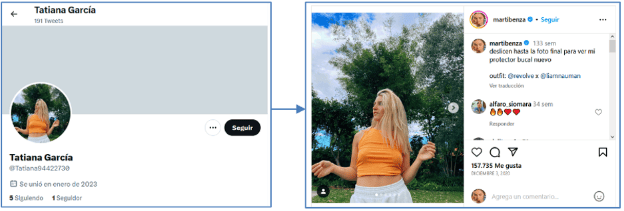
 This network of accounts, whose first posts consisted of favorable comments about Palmerola Airport or Alutech—both companies belonging to EMCO Holding Inc., a Delaware-registered corporation owned by businessman Lenir Pérez—published a total of 1,140 tweets supporting EMCO Group companies through June 21, 2023. The 16 accounts produced 2,540 posts in total, averaging between 100 and 200 posts per profile. Forty-five percent mentioned Palmerola Airport, and most were replies to other users’ posts, a practice that made coordination more difficult to detect.
The accounts also defended Lenir Pérez during sensitive moments. When reports emerged in late April 2023 that the FBI had questioned him in the United States, nine of the accounts responded to related posts by claiming the information was false.
Another pattern links these accounts to the news site Hondunews. Several of them share the user @hondunewshn as a follower. For example, the sole follower of @JustinM26746499 was @hondunewshn.
Between January 9, 2023, following the murders of defenders Jairo Bonilla and Aly Domínguez, and June 29, 2023, after the murder of Oquelí Domínguez, Hondunews published at least eight articles advancing the “fake environmentalists” narrative against opponents of the Los Pinares mining project.
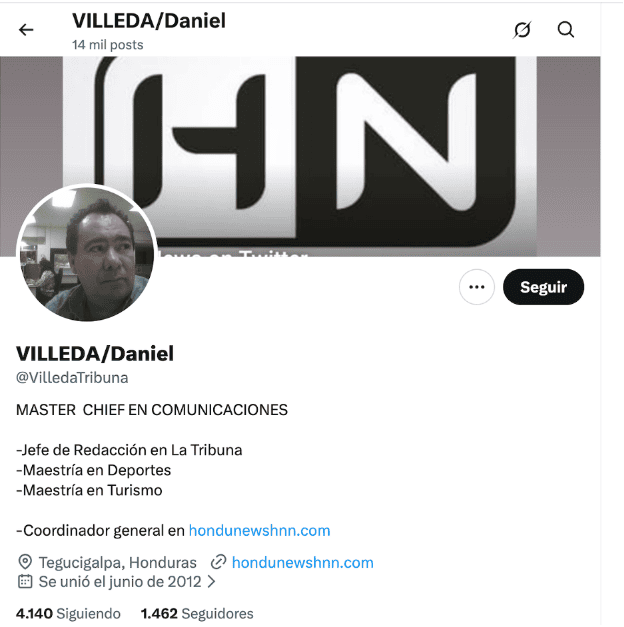
A review of the source code of Hondunews showed that one of the primary users and authors of its articles was dvilleda, and the contact information listed on the site’s social media pages corresponded to Daniel Villeda, who identifies himself on social media and LinkedIn as the site’s general coordinator. According to his LinkedIn profile, Villeda also serves as editor-in-chief of La Tribuna, one of Honduras’s oldest and most widely circulated newspapers.
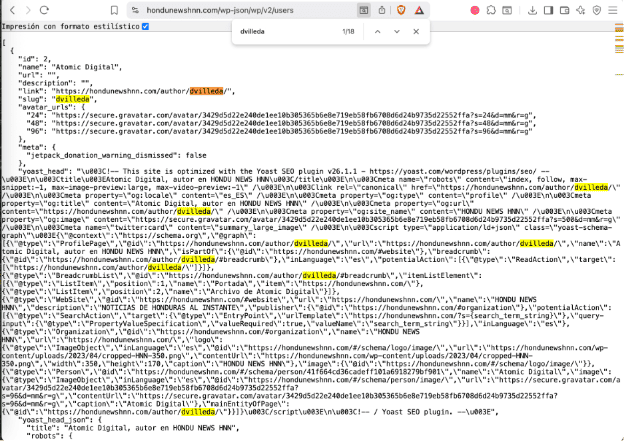
The portal has also published content favorable to Sergio Rodríguez, who was convicted in 2019 for the murder of environmental leader Berta Cáceres, and articles highlighting the consequences of the closure of the Los Pinares mine after the Honduran government announced in June 2023 that it had not granted the project an environmental license.
In an interview for this investigation, Daniel Villeda confirmed that he owns Hondunews and that the dvilleda username in the site’s source code belongs to him. He also stated that his work at Hondunews is entirely separate from his position as editor-in-chief of La Tribuna:
“There is no relationship between the digital newspaper I direct and La Tribuna. La Tribuna has its own established editorial policy. They are two different things.”
Villeda acknowledged that he personally wrote the articles describing members of the committee as “fake environmentalists.” He explained that at the time he was working from Tegucigalpa and admitted that he had limited information about the conflict, relying on what he heard from radio stations, television news programs, and statements by local journalists.
Villeda also revealed that Hondunews maintained advertising contracts with EMCO Group companies—specifically Palmerola International Airport and Alutech—from approximately 2019 to 2023. He confirmed that the commercial relationship extended beyond paid advertisements and included the publication of press releases supplied by the companies.
He admitted that some of those press releases referred to environmental defenders as “fake environmentalists” and that they were published while the contracts were in force. He explained:
“They would send press releases, and given the economic realities of any media outlet in Honduras, they essentially had to be published.”
Villeda’s statements point to the existence of a system in which EMCO Group companies paid for advertising in media outlets and digital platforms, and within the framework of those contracts, content was published that reinforced the “fake environmentalists” narrative and disparaged environmental defenders in Tocoa.
Regarding the connection between Hondunews on X (formerly Twitter) and the accounts identified in this investigation as a coordinated network targeting environmental defenders while promoting EMCO Group companies, Villeda said that Hondunews followed those accounts as part of journalistic research. However, he was unable to provide any published investigation resulting from that monitoring.
As for the publication of content favorable to Sergio Rodríguez, who was convicted for the murder of Berta Cáceres, Villeda confirmed that he wrote the article and justified it as an infiltration strategy:
“This person was defended. Why? Because that way, as a journalist, you gain access to information you wouldn’t have if you immediately took an antagonistic position.”
In this case as well, he provided no evidence that the alleged infiltration effort produced any published investigative reporting.
The Operation Expands: Friendly Media Outlets and Key Moments
The accounts linked to Palmerola Airport and Hondunews were only one part of the broader effort. Contracorriente found that between January 9, 2023, and October 3, 2025, at least nine media outlets—including some with a large audience, such as La Tribuna—published articles containing content similar to that of Hondunews and to one another. These publications spread misinformation and reputational attacks portraying members of the Committee as “fake environmentalists” and “murderers.”
Most of these articles reproduced statements from individuals identifying themselves as residents of communities within the area affected by the mining project in Carlos Escaleras National Park and who support the megaproject. Several of these individuals were later identified among those showing support for Lenir Pérez during the hearing he attended on March 27, 2026, in the case brought by the Honduran Public Prosecutor’s Office concerning alleged environmental damage caused by the Los Pinares mine to the protected mountain area.
The digital campaigns have tended to intensify at critical moments. During that hearing, four Facebook accounts posted nearly identical messages accusing environmental activists:
“Residents of the mountain sector of Tocoa arrive in Tegucigalpa to demand justice for the deaths of 13 people, most of them employees of mining companies, allegedly caused by fake environmentalists who, since 2018, have acted as impostors making decisions on behalf of the true communities in the area of influence.”
Although these posts blamed environmental activists for the deaths of “13 people” associated with the mining project, the company itself has publicly referred to only nine such victims in press conferences where it called for investigations: four project employees, two soldiers, and three community members. While the Public Prosecutor’s Office charged thirteen Committee members and a court held eight defenders in pretrial detention for more than two years, none of them were ever charged with homicide. Furthermore, all charges related to damage to company property were ultimately dismissed.
Leonel George, a member of the Municipal Committee for the Defense of Common and Public Goods of Tocoa and one of the individuals most frequently targeted in these campaigns, described the pattern:
“Whenever hearings were scheduled for the imprisoned compañeros, the campaigns would start up again, saying: ‘They’re criminals, they’re murderers, they’re freeloaders, they’re receiving dollars.’ The purpose of that image is to make people reject us. Whenever there was a hearing, a press conference, or a complaint against the company, the campaigns would be activated.”
Among the accounts highlighted by the Committee is the Facebook page Noticias de Colón, operated by journalist Héctor Madrid. The page regularly publishes content favorable to Inversiones Los Pinares and former mayor Adán Fúnez, a prominent leader within the Liberty and Refoundation Party (Libre). Fúnez is currently under formal indictment by the Public Prosecutor’s Office for allegedly masterminding the murder of environmental activist Juan López. He also appeared in a video published by InSight Crime that allegedly shows him negotiating bribes with drug traffickers on behalf of his political party. According to the Committee, Noticias de Colón has repeatedly served as a vehicle for misinformation campaigns during periods of heightened tension.
In the context of the hearing involving Lenir Pérez, Noticias de Colón accused Committee members of being “fake environmentalists” and of responsibility for the deaths of 13 people connected to the mining project.
Between June 6 and July 5, 2024—around the time of the town assembly in which Tocoa voted against an EMCO Group thermoelectric plant—Noticias de Colón published at least twelve articles describing environmental activists as “generators of hatred,” “organized criminal groups,” and “terrorists,” while blaming them for deaths involving individuals aligned with the company. These posts were subsequently shared across numerous Facebook groups.
On July 5, 2024, the day several offices in the Tocoa municipal government building were damaged by a fire—which, according to the fire department, originated in the treasury and taxation offices—Madrid’s page published a series of photographs attributing the damage to the Committee:
“How much longer will the hate campaign of Tocoa’s Committee of Common Goods continue, a political group disguised as environmentalists? Attention, UN Environment Programme: will you stop causing so much harm to the peace of Tocoa? ENOUGH OF THIS DESTRUCTION. Tocoa does not deserve these vandal groups causing so much damage.”
 Because of his role as a city council member, Juan López was specifically named. On June 14, 2024, Noticias de Colón referred to López and Leonel George—also a council member—as “shameless,” “irresponsible,” and “liars.” Three months later, Juan López, who was also a leader of the Committee and a lay minister in the Catholic Church, was murdered.
In November 2025, Contracorriente published an investigation revealing that Héctor Madrid, a correspondent for the Honduran television network Televicentro, had received a land donation in Tocoa from then-mayor Adán Fúnez in 2016. The investigation documented that Madrid’s social media platforms had carried out campaigns against peasant organizations in the Bajo Aguán region, defended individuals under investigation by the Public Prosecutor’s Office for alleged ties to organized crime, and promoted Fúnez’s administration even after the publication of the InSight Crime video allegedly showing him negotiating with drug traffickers.
In an interview with Contracorriente, Madrid defended his publications, stating that his accusations were based on “real life, lived experience, and what I have personally witnessed here.” He repeated his allegations that Committee members were the intellectual authors of various crimes, while acknowledging that he did not know who the material perpetrators were and lacked evidence to support his claims. For example, regarding his accusations about the fire at Tocoa City Hall, he stated: “I don’t have the evidence. I don’t have any of that. So I can’t say for certain that they were responsible.”
When repeatedly reminded that the Public Prosecutor’s Office had never charged the environmental defenders with homicide and had dismissed property-damage charges against them, Madrid nevertheless maintained his position: “I still believe it, and I will believe it until the last day of my life.” Madrid also rejected the suggestion that his publications had contributed to a climate of hostility toward environmental defenders, describing them instead as “politicians disguised as environmentalists.”
When asked whether he had maintained any commercial or professional relationship with companies belonging to the EMCO Group, Madrid acknowledged that he had a business relationship with the conglomerate through his company, Producciones Madrid. He explained that he sold advertising to Lenir Pérez’s business group until Los Pinares suspended operations in August 2023. He downplayed the significance of the relationship, arguing that he also sells advertising to other companies.
As a result, Madrid had not only received a land donation from former mayor Adán Fúnez but had also earned advertising revenue from the same corporate group whose mining project he regularly defended through his Noticias de Colón platform.
The journalists behind this investigation sent an email through the EMCO Group’s official website and to representantelegal@alutech.hn, providing the company with an opportunity to respond to allegations concerning its involvement in these smear campaigns against environmental defenders. As of publication, no response had been received.
This reporting alliance also contacted a representative of Meta to ask whether the Facebook accounts mentioned in the investigation might violate the company’s policies. No response was received before publication.
The Decree That Protected the Park, and the Social Media Attacks That Followed
The murders of Aly and Oquelí took place between January and June 2023, just one year after the left-wing Liberty and Refoundation Party (Libre), led by President Xiomara Castro, took office following two terms and eight years of rule by the conservative National Party under Juan Orlando Hernández. Hernández was later convicted on drug trafficking charges in the United States and subsequently pardoned by Donald Trump in December 2025. For Reynaldo, this political context matters, especially because he openly acknowledges that he worked to help Libre come to power. He believed in what President Xiomara Castro’s project promised: a “socialist” Honduras.
Aly had been criminalized alongside Reynaldo and Juan López in 2019. At that time, Aly was himself an activist within the National Party, which governed under former president and convicted criminal Juan Orlando Hernández. “I used to tell him, ‘Your president is the one keeping you in prison.’ He was the coordinator of the Vida Mejor program in the community,” Reynaldo recalls telling his brother while they were both facing criminal prosecution. Vida Mejor (“Better Life”) was the flagship social assistance program of Hernández’s administration. It promised to reduce poverty through welfare initiatives, but organizations such as the Center for the Study of Democracy (CESPAD) criticized it for opacity, clientelism, and irregular management of public funds. That government presided over a prolonged political crisis that eventually gave way to Xiomara Castro’s administration. One year later, Aly was murdered alongside fellow environmental defender Jairo Bonilla.
“These things leave us lost. They make us question our path in these struggles. Why didn’t this happen under Juan Orlando’s government? What happened? Who is responsible? How did this happen under Xiomara’s government, the one we placed all our hopes in? We worked ourselves to exhaustion believing things would really change.”
Even so, Reynaldo acknowledges that under Castro’s administration they succeeded in obtaining the restoration of the original boundaries of Montaña de Botaderos National Park, effectively prohibiting mining concessions throughout the area that Los Pinares had sought to exploit.
“Now,” he says, “the only thing missing is implementation.”
In May 2024, Decree 18-2024 came into force after being approved by the National Congress. The measure restored and protected the core zone of Montaña de Botaderos “Carlos Escaleras Mejía” National Park, where part of the mining megaproject had been established.
The decree triggered what the Committee considers one of the most effective and dangerous digital disinformation campaigns it had faced—once again orchestrated through Noticias de Colón.
The publications accused the Tocoa Committee for the Defense of Common Goods and the San Alonso Rodríguez Foundation of promoting the decree, which they described as the cause of the “imminent forced displacement of at least 50,000 people.” Other posts singled out two Committee members—who were then serving as city council members—claiming they were responsible for families in the mountain region losing their land. The posts further accused them of “using the environmental cause for partisan political purposes” and of concealing the fact that people killed in related conflicts had been employees of a company operating in the area.
Leonel George recalls how the campaign worked: “They used what was happening in protected areas of Olancho, where families actually had been removed from conservation zones, and they said, ‘The same thing is going to happen here.’ Some people who had been part of the struggle said, ‘If they’re going to throw us out, then we’re not fighting anymore.’”
The misinformation reached some of the most remote communities inside and along the edge of the national park. In the San Pedro sector, rumors that the decree would strip residents of their land led directly to threats.
José Olayo, a resident of Meangul—located within Carlos Escaleras National Park—and one of the Committee’s earliest members, remembers the most tense moments: “They came and told people that the government was going to take their land away. Some got angry and said, ‘If they come to take our land, the first people who are going to leave are the Committee members.’ They even organized groups to protest. It was a false campaign.”
Some residents threatened Committee members, but years of trust-building helped defuse the situation. Activists went house by house explaining what the decree actually did.
“The Committee has always been straightforward, and when it says something, it has evidence in hand. That’s why some campaigns have failed. If we were frauds, we wouldn’t operate openly. There’s documentation for everything: the complaints that have been filed, against whom, and why.”
Despite those efforts, the murders, forced displacement, and ongoing threats weakened the movement. “After Juan’s death, there was a great silence. Families kept saying, ‘They killed this man—even though he had protective measures, they didn’t help.’ Your family is what makes you feel fear and think, ‘This is no longer worth it.’ But we’ve survived all those moments.”
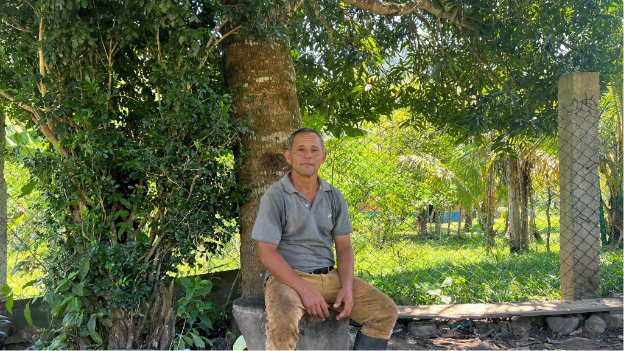
Orbin Hernández, another Committee member who was prosecuted in 2019 and who lives in Vado Ancho, says the smear campaigns do not affect him personally.
“Cases aren’t won on social media; they’re won in court.” Yet he says they have deeply affected his mother, who now suffers from facial paralysis brought on by stress.
“The struggle is non-negotiable. We cannot abandon it. The responsibility of any decent citizen is to defend at least the place where they live. If we stay silent about what we know and fail to explain it to the people, they end up believing the other side.”
Farther down the mountain, in Mala Falda, teacher and Committee member Javier Maradiaga warns that the effects of these campaigns reach even isolated communities. “When you have a media outlet like Noticias de Colón—a social media page that many people follow—people become confused. They are presenting a different version of events and, for their own interests, they delegitimize social struggles.”
Speaking about the displacement of leaders such as Reynaldo and the murder of Juan López, Javier adds: “When members of the group are targeted, it affects everyone emotionally and increases the risks for those of us who remain on the front lines. Not everyone is willing to die for a cause, and that reduces people’s willingness to confront projects like these.”
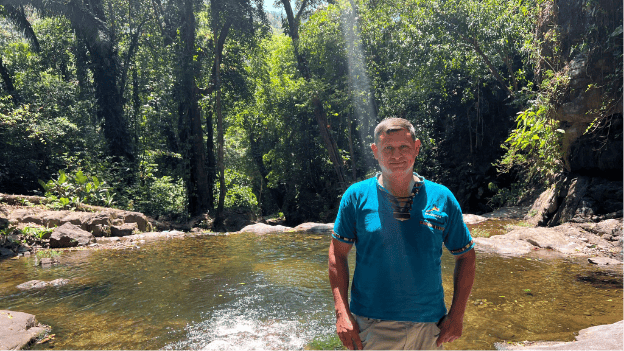
Javier lives amid the extraordinary natural beauty of the national park. Just ten minutes from his home lies the crystal-clear El Sereno waterfall, where he often goes with his family to escape the intense heat of Honduras’s Caribbean coast. Sitting beneath a large shade tree outside his home, he says he has no plans to leave, although his family is afraid, and the defamation campaigns have even limited their social lives.
He also criticizes what he sees as bias within the country’s investigative and judicial institutions:
“When they filed false complaints against us, the Public Prosecutor’s Office acted on its own initiative. When we have filed complaints against the people who are actually defaming us, there seems to be no willingness to investigate them.”
Reynaldo and Juan López were the leading figures of the environmental committee. Both traveled extensively, participated in national and international advocacy tours, met with officials, and organized local communities. During one international advocacy trip, Reynaldo learned that Aly and Jairo had been killed. When his other brother, Oquelí, was murdered, Reynaldo was in the United States on another advocacy mission.
In the United States is also located one of the companies with which Los Pinares maintained active commercial transactions until 2023: the steel giant Nucor Corporation.
Reflecting on the online attacks, Reynaldo says: “People on social media said that Guapinol was full of bad people. If we were bad people, why is it only between 2017 and 2024 that all these deaths occurred? They also said that families were fighting each other. That’s a lie. We know each other well. We are hardworking, prosperous people, each focused on our own work. Guapinol has a great strength: people who migrated to the United States invested their savings back into the community and built small businesses. These campaigns create a fog of confusion. They work to deny every truthful action, and judges and prosecutors end up grabbing onto that and believing what they see on social media.”
As he speaks, Mabel and their daughters prepare a seafood soup, using ingredients that come as close as possible to the flavors of Honduras. Nearby, far from the Guapinol River and the mountains they once called home, they continue trying to rebuild their lives.
State Silence and an Uncertain Municipal Transition
In January 2023, the Committee filed a formal complaint with the Public Prosecutor’s Office for defamation and slander against Héctor Madrid, whom they identified as one of the sources of the smear campaigns. According to the Committee, the case was closed in early 2025 due to a lack of investigation. However, they successfully appealed the decision, and the matter is now being reviewed by an inter-prosecutorial task force that is expected to continue the investigation.
In October 2023, the Inter-American Commission on Human Rights (IACHR) granted precautionary measures to 13 individuals connected to the Committee’s struggle who had reportedly been subjected to persecution and threats from criminal groups and state security forces. Among the beneficiaries were Reynaldo and Juan López, of whom the IACHR wrote in its resolution that he “had allegedly been the victim of numerous defamation campaigns.” The Commission also referred to a “prolonged smear campaign through publications” in its decision granting the protective measures.
In November 2025, the Latin American legal organization Center for Justice and International Law (CEJIL) stated that, as of that date, the Honduran government had failed to ensure the “effective, comprehensive, and collective implementation” of those measures. Committee members continue to denounce what they describe as a lack of political will on the part of the state to protect them.
Contracorriente asked the Public Prosecutor’s Office about investigations into online smear campaigns targeting environmental defenders and about the status of the Committee’s 2023 complaint. On May 8, 2026, one of the institution’s spokespersons said that they would need to consult internally before responding. No reply had been received by the time this article went to press.
Another figure identified by the Committee as a promoter of the campaigns is former Tocoa mayor Adán Fúnez. After serving three consecutive terms—and facing scrutiny following the publication of an InSight Crime video allegedly showing him negotiating with drug traffickers alongside former National Congress secretary Carlos Zelaya Rosales—Fúnez left office and was succeeded by Roger Banegas of the Liberal Party.
Fúnez now faces two criminal cases brought by the Public Prosecutor’s Office: one for alleged criminal association in connection with the murder of environmental defender Juan López, and another for alleged abuse of authority during his administration.
On the surface, the municipal government has changed. However, Committee members argue that part of the bureaucratic structure that supported Fúnez remains in place under the new administration. They specifically point to the continued presence of municipal secretary Norma Agripina García, who faces charges from the Public Prosecutor’s Office for allegedly falsifying public documents in the minutes of a 2016 town assembly that paved the way for operating permits and environmental licenses benefiting the mining project.
In June 2025, the Criminal Court of First Instance in San Pedro Sula ordered formal criminal proceedings against García. Contracorriente also verified through official information published on the Tocoa municipal government’s transparency portal that she remains employed by the municipality.
One of the new administration’s promises, however, is to refrain from continuing the smear campaigns.
Vice Mayor Boris Reyes states:
“We have already held two meetings with members of the Committee, and we have guaranteed them that the new municipal administration will not carry out any campaign promoting the installation of mines, nor any campaign to discredit environmental defenders.”
“I know all of them. They are exemplary citizens,” Reyes says, adding that as a new administration “without commitments to private companies,” they will not spend “a single cent” on smear campaigns or pay anyone to attack environmental defenders. Reyes himself served as a city council member during the Fúnez administrations.
The electoral victory of Nasry Asfura in November 2025—with the backing of Donald Trump—has generated both expectations and fears among environmental defenders. Many worry that mining activities that have been largely halted in recent years could resume.
Reyes responds: “We are not in a position to approve open-pit mining, and we want to make that clear in order to rebuild public trust.” He notes that Tocoa declared itself a mining-free municipality through an open town assembly. At the same time, he acknowledges that if the central government ultimately grants the necessary permits, the municipality would lack the authority to stop the project.
Despite everything, Reynaldo says he still holds onto hope: “I have faith that we will return with our heads held high, as people who fought for a cause that belongs to everyone. We hope things will improve with the new authorities, sons and daughters of Tocoa who want what is best for Tocoa. Mining is not the solution; there are other ways to develop the municipality. If the authorities fail us, it will be yet another tragedy.”
A mining project that, by this point, has already left behind a great deal of bloodshed and suffering in the Aguán Valley.
Mabel and Reynaldo rarely leave their house now, except when one of them finds temporary work. On this particular day, however, we go with them to a department store. One of their sons drives, while their teenage daughter accompanies us with the mixture of shyness and indifference typical of her age.
Less than ten minutes after arriving, a woman approaches them, almost in tears with emotion. Years ago, she had been their neighbor in Guapinol.
Mabel tells me that the woman migrated four years earlier and that many others from the community followed the same path. Today they are scattered across different places. Those Sundays when neighbors would carry their chairs into the yard and spend the afternoon talking together now feel like a distant dream.
In this country, reunions happen by chance—in the aisle of a store.
The Burden Carried by Families
Gabriela lives in Guapinol, the community that has been so deeply affected and where she and her fellow environmental defenders often move through daily life in a state of hypervigilance, constantly aware of danger. This time, however, we speak in the offices of the Aguán Popular Organizations Coordinating Committee (COPA), a bunker-like building with high, thick walls on an unpaved street near the center of Tocoa. The compound was fortified after several land defenders were attacked there.
Sitting in an office that also serves as a radio studio, Gabriela speaks calmly and with determination, though her concern about the future of the mining project and the ongoing smear campaigns is unmistakable. She recalls that before Juan López was murdered, he received messages on social media threatening to kill him and break his fingers one by one. To Gabriela, the campaigns are planned long in advance, escalating step by step until they culminate in violence, after which the perpetrators can claim that the murder had nothing to do with environmental activism.
Even when the campaigns do not end in murder, they still inflict damage on families.
“My father was one of those who was imprisoned, and people would say, ‘No, they’re not environmentalists; they’re fake environmentalists.’ Psychologically, that harmed two of my younger brothers. One of them only recently stopped suffering from anxiety because he would read social media and think, ‘They’re going to kill my father; he’s never getting out of prison.’ For those of us involved in this struggle, the thing that hurts us most is what it does to our families.”
Thousands of miles away, Reynaldo’s family has been scattered, yet 26 relatives have managed to remain close to one another, living in two houses in neighboring communities. Tonight they have gathered together.
It is Sunday. It is ten o’clock at night in this distant country, but eight o’clock in Guapinol. Reynaldo and his surviving siblings still keep the village’s time in their hearts.
Around ten children, between the ages of two and fifteen, run, shout, and weave between the adults gathered in a large living room, drinking coffee and eating bread. Reynaldo tells story after story. He talks about Juan. He talks about his brothers. Tomorrow he will return to the daily struggle of finding work in a place that still feels foreign.
“Juan used to say, ‘If life must be defended with life itself, then so be it.’ Juan already proved that. The victims who came before him died with the same longing—to see the river running clear again.”
Within the family, Reynaldo was the anchor. In Guapinol he served as president of the local water board. His brother Aly led the parents’ association at the school. Oquelí was a member of the community council. Together they formed the backbone of a large family that lived from its crops and livestock.
Today that family is dispersed and depends on whatever work can be found from one day to the next.
“We can’t go back, because we would return to the same struggle, and they would be waiting for us. We are not enemies of development, but we are enemies of the way they want to exploit everything here. Communities must always come first. I am afraid—we all are. But living without water one day would be even worse.”
Mabel misses everything. She misses her fellow church members, the early mornings when she milked the cow and walked down to the river, the freedom of moving about her community, her Honduras. “Here we don’t feel free.”
She also remembers why they fought in the first place: the river water arriving dirty, the children’s school uniforms that could no longer be washed properly, and then the relief of seeing the water run clear again. “Despite the fear, you find the courage to keep fighting.” Yet distrust remains. “We hope that one day they will protect environmental defenders, those of us who defend forests, water, and families. Because you live in fear there, and we have no confidence that the authorities will protect us.”
Although she avoids social media, others told her what was being said about her family: that they were bad people, that they were violent. It hurt her deeply. “Two men devoted to the word of God… I refuse to listen to that.”
Their hope survives in a series of framed collages hanging on the wall. The photographs of Juan López, Carlos Escaleras, and the Domínguez brothers merge into an image of the Guapinol River. Through those images they invoke justice for Juan, a man who, Mabel says, “was so innocent, yet despite all the fear, he was always at the front.” And they hold on to another hope as well: returning home. “I want to be buried in my homeland,” Reynaldo says. “I do not want to be buried here.”
What remains of Honduras for them—the recipes, the memories of dawns by the river, the recollections of an entire life in Guapinol—continues to sustain them. “It has only been possible because of God and so many angels on earth who supported us every step of the way,” Mabel says.
Then she smiles through her tears. She rises from her chair and returns carrying a piece of tortilla and a slice of fresh white cheese, offering them to us as though we were sitting in her home in Guapinol. “I make this cheese here,” she says, laughing, “but it’s made with powdered milk.”

Digital Poachers (Taladores Digitales) is an investigative project aimed at uncovering the interests behind online smear campaigns targeting environmental activists in six Latin American countries. The project is coordinated by the Latin American Center for Investigative Journalism (CLIP) in partnership with AFP (Brazil), Colombiacheck (Colombia), Agencia Ocote (Guatemala), Contracorriente (Honduras), Animal Político and Mongabay Latam (Mexico), and Concolón (Panama). It was carried out with support from the Global Initiative for Information Integrity on Climate Change and received legal review from El Veinte.


