
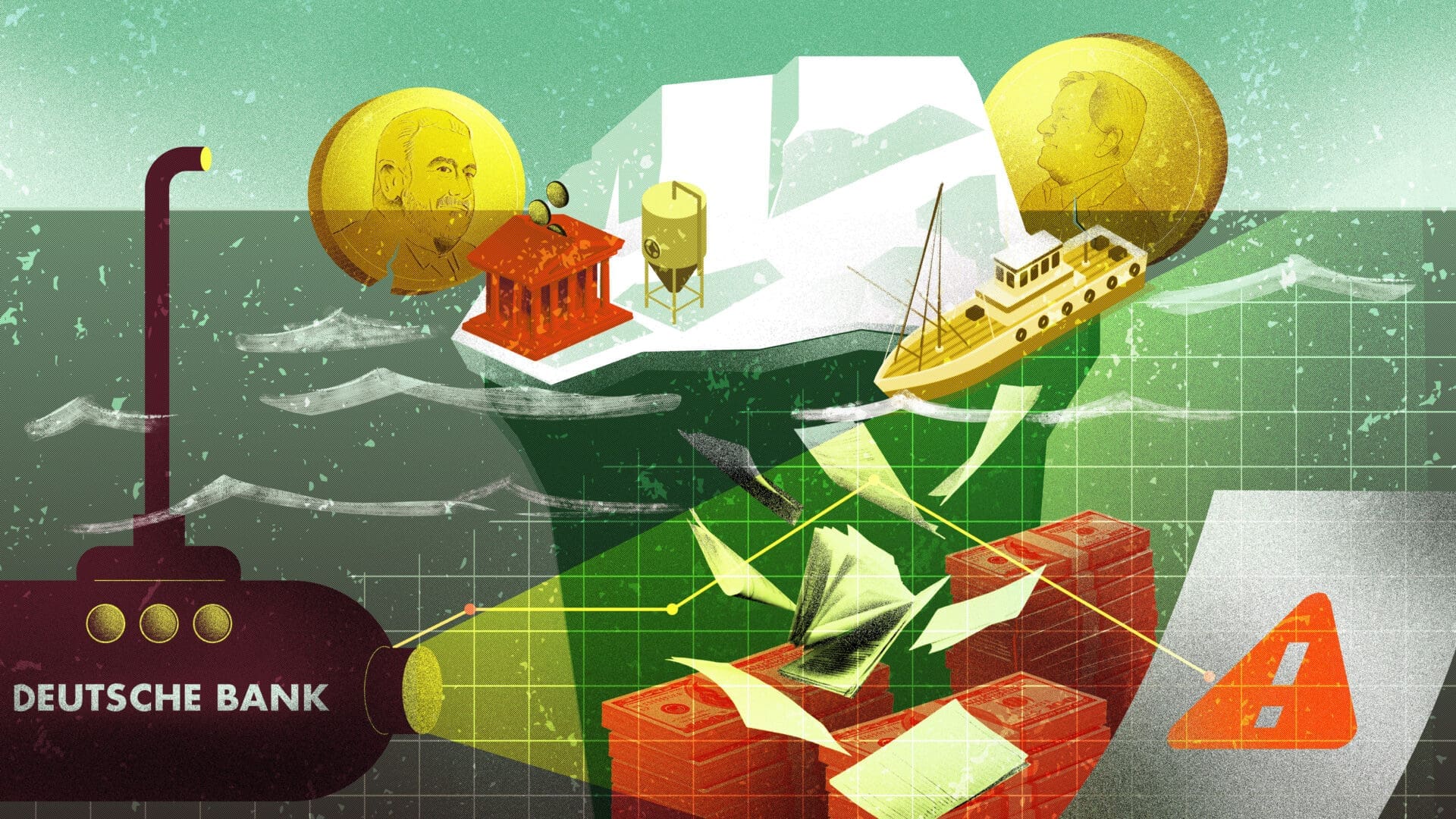
The Luksic and Angelini families control two of Chile’s largest business groups and command considerable respect in the country’s business circles, despite a history of judicial investigations and corruption allegations. Fortunately for them, Deutsche Bank was willing to take them on as clients. But the German bank has not forgotten their checkered past and has issued internal warnings about the risks involved.
By Francisca Skoknic
In Chile, the names Luksic and Angelini are synonymous with success and wealth. The Luksic family controls one of the country’s largest banks, its biggest privately owned mining company and its leading brewer. The Angelinis, meanwhile, dominate the forestry, oil and gas, and fishing industries. Although both business groups have been implicated in some of the murkier episodes of Chile’s economic history, their names rarely carry negative connotations in public discourse. Deutsche Bank, however, has a longer memory: its analysts consider having them as clients a “reputational risk” for the bank.
The Chilean businessmen feature in the files of Inside Deutsche Bank, a cross-border investigation based on a leak of more than 15 million documents from the German bank, led by Barracuda Media and coordinated in Latin America in partnership with the Latin American Center for Investigative Journalism (CLIP). Deutsche Bank’s internal records offer a rare window into how a global financial giant views some of Latin America’s most powerful business figures, including the Luksic and Angelini families. The bank’s assessment is decidedly critical, at times outright negative.
There are few objective measures of the standing of Chile’s business elite. One of them is the Corporate Reputation Business Monitor (Merco), which draws on the views of executives at major companies, financial analysts, communications specialists, business journalists and academics, as well as corporate performance data. Both families consistently rank near the top. Andrónico Luksic typically vies for first or second place in the business reputation rankings, while Roberto Angelini generally places between third and fifth.
Their positions in the reputation rankings broadly mirror their places on the wealth ladder. According to the latest Forbes ranking, the Luksic family, represented on the list by the late patriarch’s widow, Iris Fontbona, is Chile’s wealthiest, with a fortune of $52 billion. Roberto Angelini, who heads his family’s business empire, ranks fifth with $2 billion. His sister, Patricia Angelini, holds sixth place with another $1.5 billion.
Luksic: “Political Connections to Secure Business Advantages”
An internal Deutsche Bank presentation dated December 2016 contains some harsh assessments of the Chilean businessmen. It was prepared by the bank’s Business Intelligence Unit (BIU) to provide the Reputational Risk Committee and senior executives responsible for the Americas with information on the riskiest and most “sensitive” clients handled by its Wealth Management (WM) division, which serves high-net-worth individuals.
 The review followed an analysis of Russian oligarchs conducted the previous year, after which BIU’s Anti-Money Laundering team was asked to assess the risks associated with strategically important clients in several regions, including Latin America. The final sample comprised 11 wealthy individuals and families from the region, including the Angelinis and the Luksics, who were assigned one of three risk ratings. Both Chilean business groups fell into the middle category: medium risk.
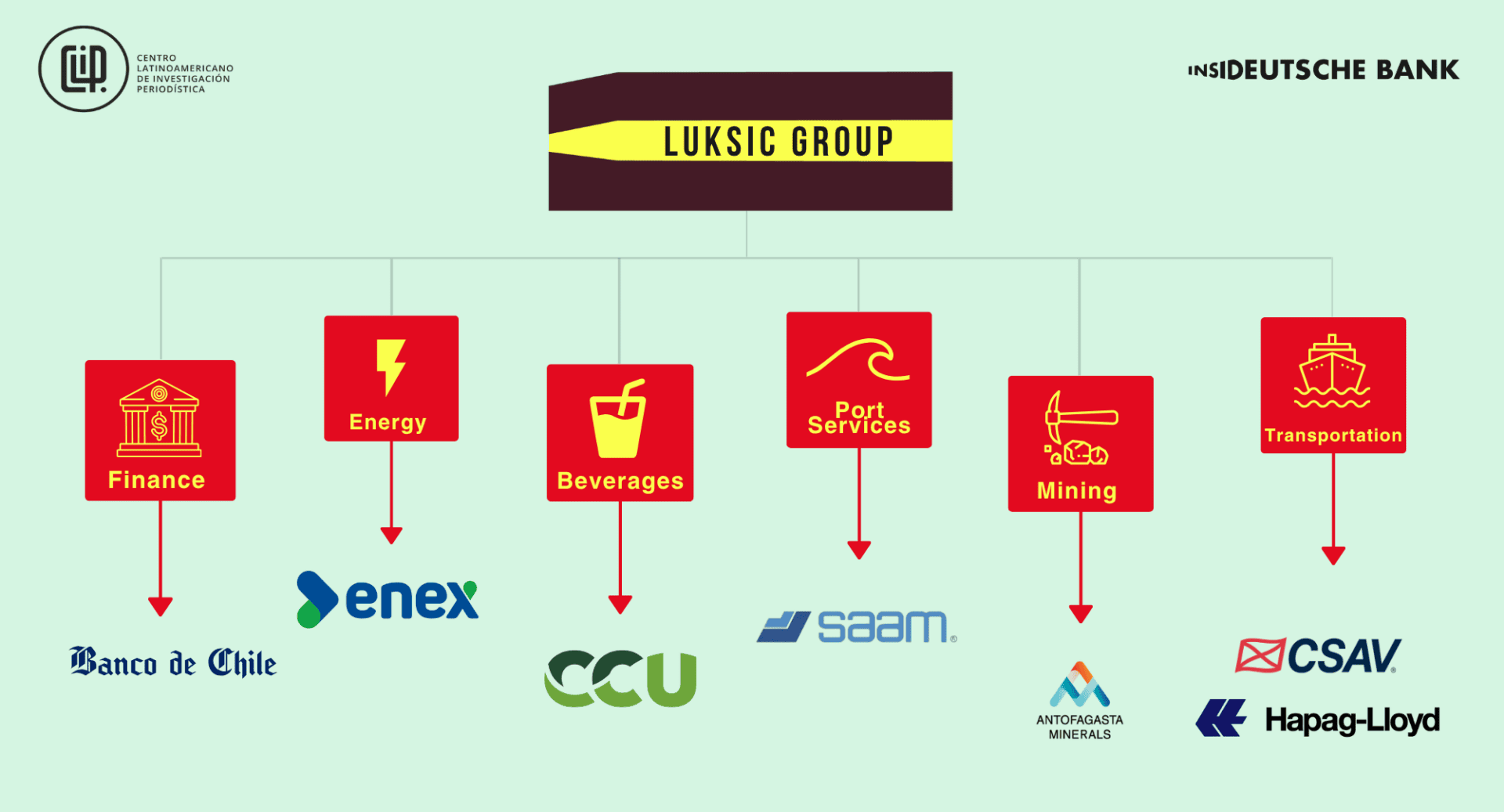
The report describes the Luksic family as “one of the most prominent business dynasties and also the wealthiest in the country, with an estimated net worth of $12.5 billion.” It identifies Andrónico Luksic Craig as the head of Quiñenco, a holding company with interests in banking, food and beverages, manufacturing, energy, transportation and infrastructure.
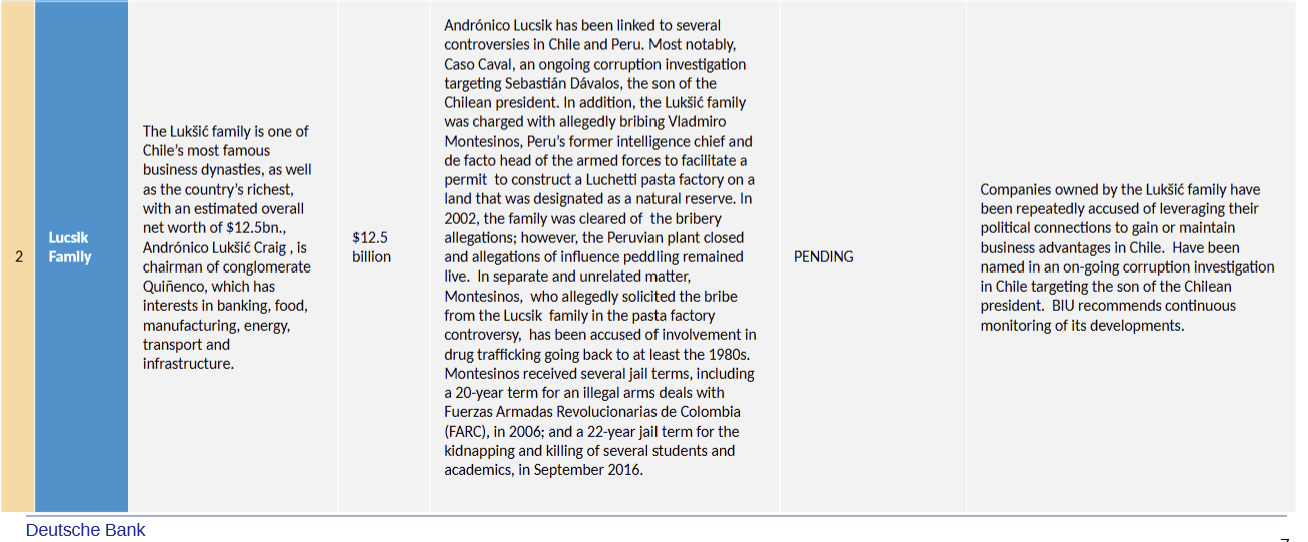 In summarizing the risks, the report focuses on Andrónico Luksic himself. First, it cites the Caval scandal, which had erupted the previous year, in 2015, following an investigation published by Qué Pasa magazine. It describes the affair as “an ongoing corruption investigation involving Sebastián Dávalos, the son of Chilean President Michelle Bachelet.” The investigation began after Dávalos and his then-wife, Natalia Compagnon, met with Luksic, vice chairman and controlling shareholder of Banco de Chile, and secured a multimillion-dollar loan for a real estate investment that their business experience and financial track record could hardly justify. The affair spawned several strands of judicial investigation, one of which resulted in Compagnon’s conviction. Luksic, who was never charged, acknowledged that agreeing to meet with the couple “was a mistake.”
The next episode recalled by Deutsche Bank is more serious: the Vladivideos scandal. “Charges were brought against the Luksic family for allegedly bribing Vladimiro Montesinos, Peru’s former intelligence chief and de facto head of the armed forces, to facilitate approval for the construction of a Luchetti pasta factory on land designated as a nature reserve.” The report goes on to explain that the charges were dropped in 2002, but the plant was shut down and “allegations of influence peddling persisted.” Although it notes that the matter is separate from and unrelated to Andrónico Luksic, the document explains that Montesinos, who allegedly solicited the bribe, had faced drug trafficking charges and received several prison sentences, including 20 years for trafficking weapons to the FARC guerrilla group and another 22 years for the kidnapping and murder of students and academics.
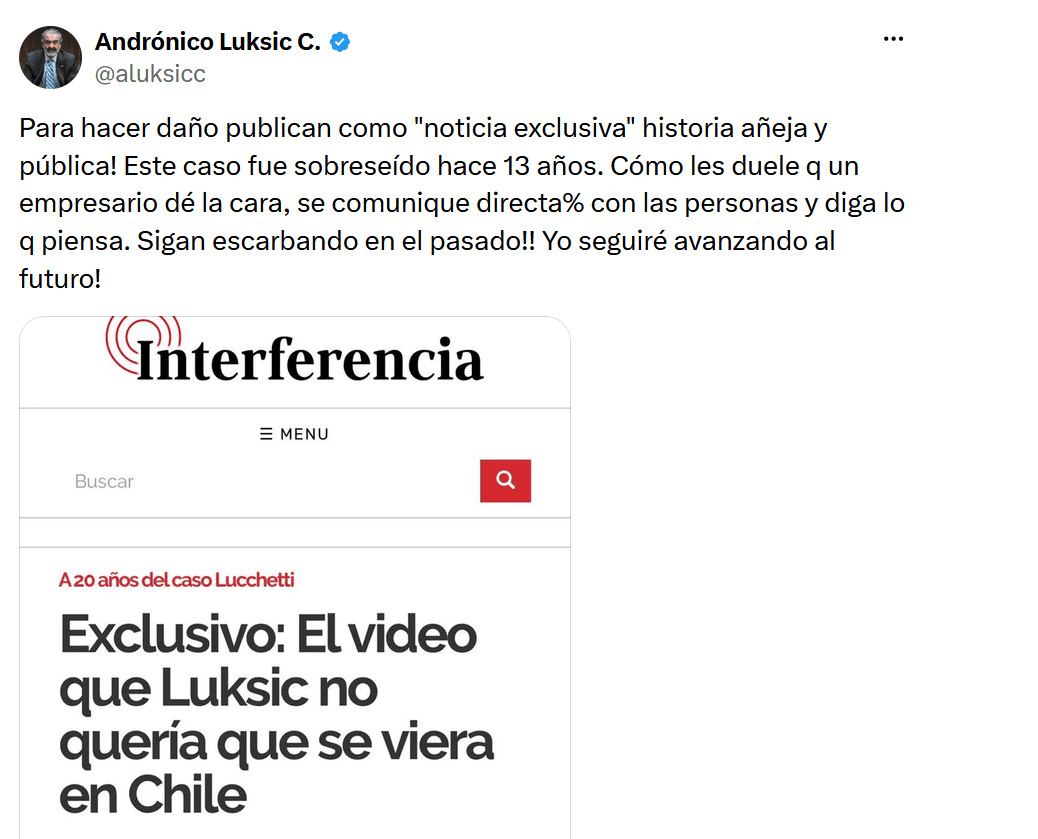
In 2019, the Chilean news outlet Interferencia published the complete video of a 1998 meeting between Andrónico Luksic and Vladimiro Montesinos. Responding on social media, the businessman accused the publication of trying to damage his reputation by dredging up an “old story,” pointing out that the case against him had been dismissed 13 years earlier. Judging by Deutsche Bank’s report, however, the financial world had not forgotten.
 To justify its risk rating, the Deutsche Bank report states that “the Luksic family has repeatedly been accused of exploiting its political connections to obtain or maintain business advantages.”
A year later, another internal document focused specifically on Andrónico Luksic as a client, again assigning him a medium risk rating, although the group’s business activities were classified as “high risk.” The analysis incorporates the findings of the earlier report before explaining its assessment: “Andrónico’s political connections in Chile and his involvement in the Caval case pose a reputational risk to the bank and are likely to continue generating negative media coverage. It is also worth noting that Antofagasta Minerals has faced allegations from Chile’s environmental regulator concerning its conduct at Los Pelambres, one of Chile’s largest copper mines. Although none of these issues is likely to result in substantial fines or penalties against the family, BIU recommends close monitoring.”
Three years later, in 2020, the bank received a presentation from DWS, an asset management company that had operated as part of Deutsche Bank until 2018 and in which the bank still held a majority stake. The presentation reviewed high-risk client cases across the Americas, including the Luksic Group’s mining operations.
The first section examines four companies controlled by Antofagasta PLC, the Luksic family’s mining holding company: Centinela, AMSA (Antofagasta Minerals), Inversiones Pelambres and Antucoya. It identifies three reasons for classifying them as high risk: first, mining is inherently a high-risk industry; second, the companies have links to a high-risk jurisdiction (Metalinvest Establishment, which owns Antofagasta PLC, is domiciled in the tax haven of Liechtenstein, as is the E. Abaroa Foundation, which controls Metalinvest); and third, adverse media coverage.
Among the reports informing this assessment were ongoing legal disputes involving the subsidiaries Twin Metals Minnesota and Minera Los Pelambres over mining rights and land, as well as “claims by environmental groups that the company is involved in the privatization of water in desert areas, depriving poor and Indigenous families of their water sources.”
Andrónico Luksic is cited as another source of adverse media coverage, following a 2017 report in The Wall Street Journal revealing that a company owned by Luksic had purchased a $5.5 million mansion in Washington, D.C., which it subsequently rented to Jared Kushner and Ivanka Trump, the son-in-law and daughter of Donald Trump, who had begun his first term as U.S. president in January of that year. At the time, a Luksic-owned mining company, Twin Metals Minnesota, was suing the U.S. government in an attempt to overturn a decision by the Barack Obama administration barring it from operating. The mining company eventually secured authorization in 2019, raising suspicions about the family’s ties to the Trumps. The Luksic Group denied “any correlation” between the rental arrangement and the green light for its mining project, but questions lingered. The activist group American Oversight even filed a lawsuit seeking records and communications from the Trump administration concerning Twin Metals’ permits in an effort to trace potential lobbying activity.
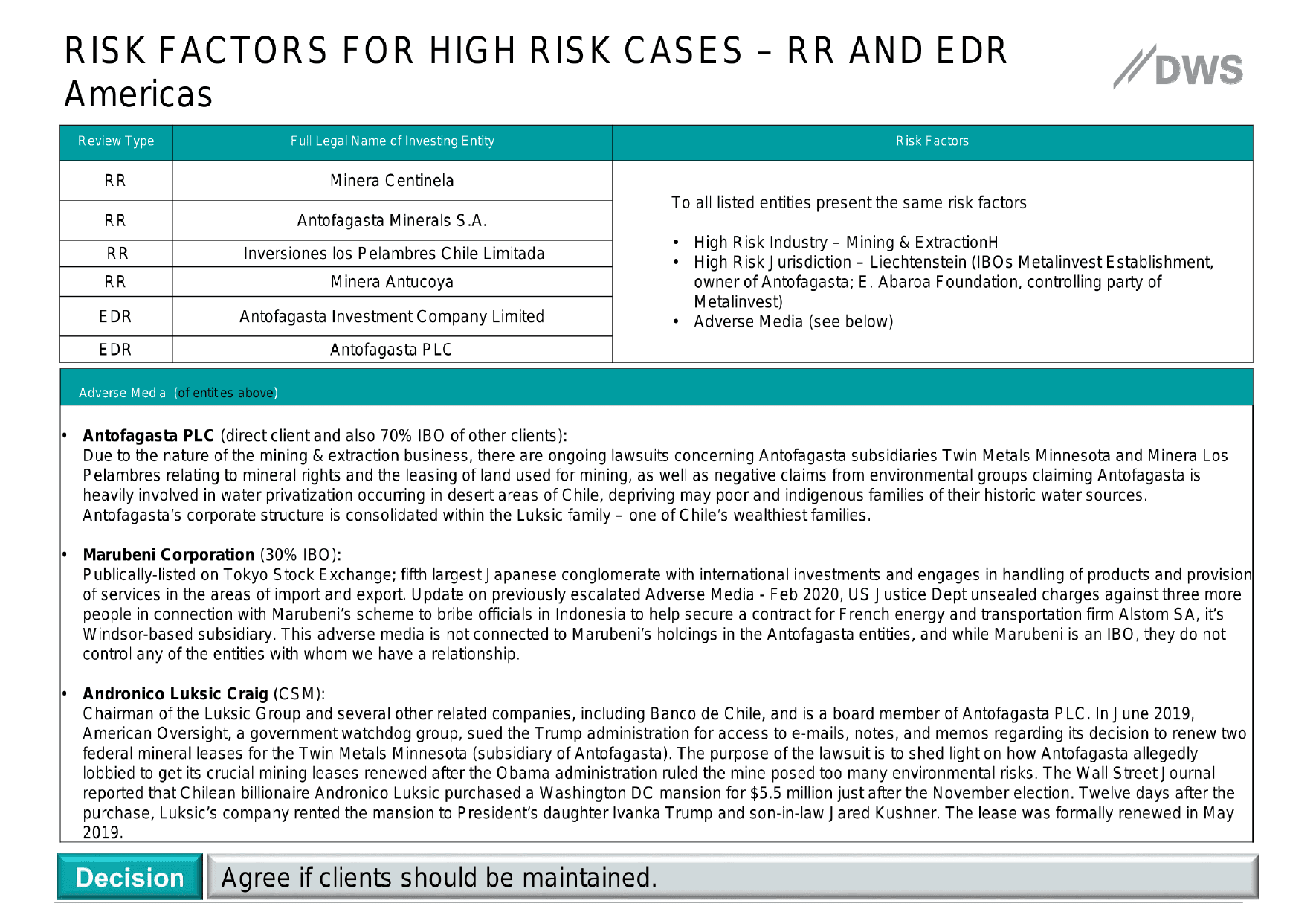 The location of its subsidiaries is also considered a negative factor in the assessment of Antofagasta Investment Company Limited, another subsidiary of Antofagasta PLC, whose risk rating was raised from medium to high in the report, partly because it is incorporated in Jersey, a British Crown Dependency that, like Liechtenstein, is considered a tax haven.
Antofagasta PLC, the mining holding company itself, also saw its risk rating raised from medium to high in the same review.
Questions Surrounding the Angelini Group
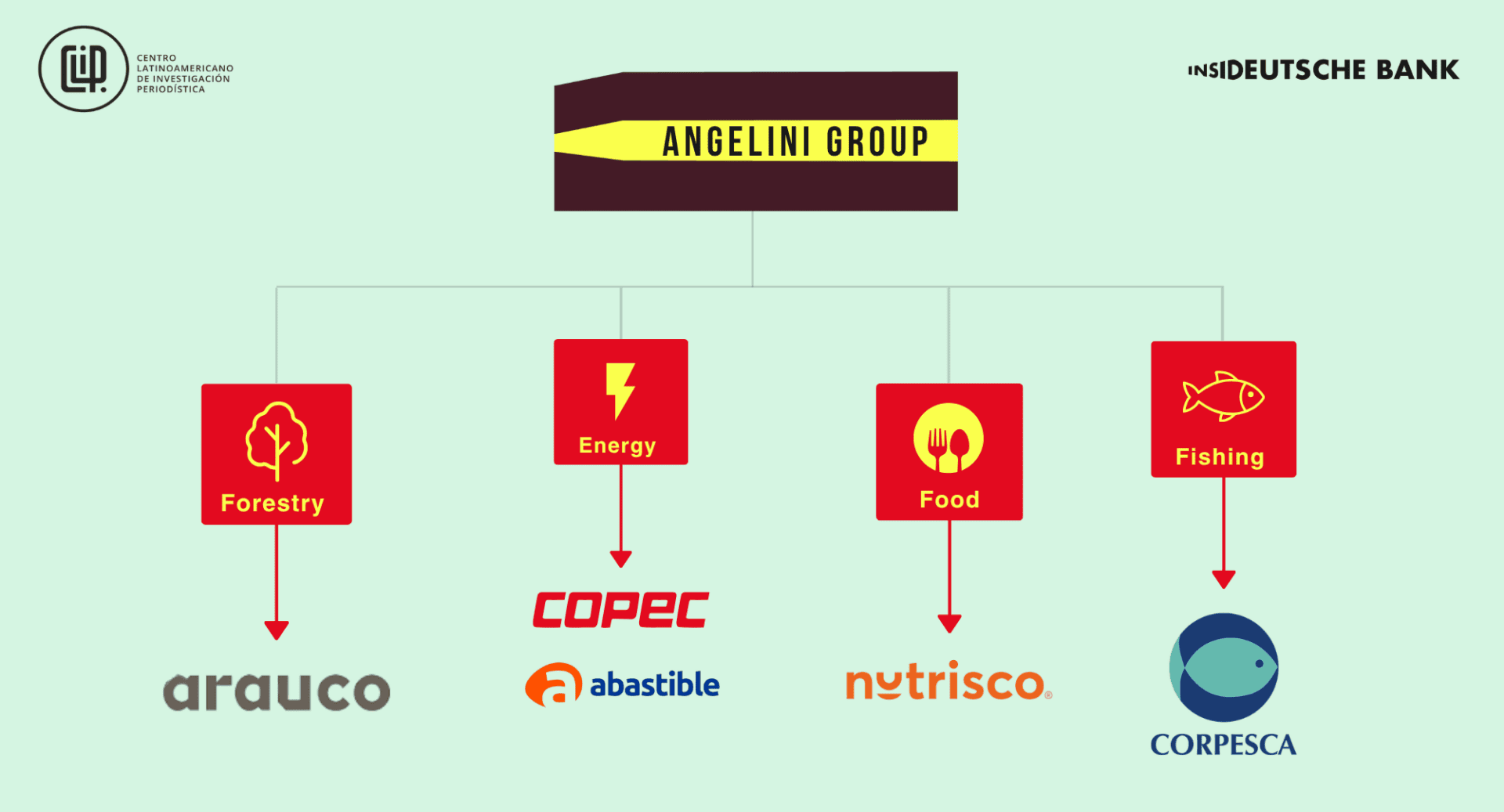
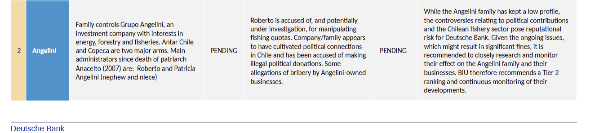
In the same 2016 report by Deutsche Bank’s Business Intelligence Unit (BIU), the Angelini Group was also assigned a medium risk rating. It is described as an investment company with interests in the energy, forestry and fishing industries (including ownership of Copec, Celulosa Arauco and Corpesca, among others), managed by Patricia and Roberto Angelini Rossi, the niece and nephew of the group’s late founder, Anacleto Angelini.
“Roberto has been accused of, and is potentially under investigation for, manipulating fishing quotas. The company/family appears to have cultivated political contacts and has been accused of making political donations,” the internal document states, adding that companies belonging to the Angelini Group have also faced bribery allegations.
 At the time of the assessment, the Angelini Group’s businesses were under scrutiny in a landmark Chilean corruption case. An investigation was underway into bribes paid by Corpesca to Senator Jaime Orpis and Congresswoman Marta Isasi (both associated with the right-wing UDI party) to secure votes favorable to the company’s interests during the passage of the Fisheries Law. Both former lawmakers were subsequently convicted of bribery, and Orpis, who was also charged with defrauding the state, served a prison sentence. Corpesca, meanwhile, became the first company in Chile to be criminally convicted of bribery and was ordered to pay a multimillion-dollar fine.
In a separate investigation stemming from the Penta-SQM scandal, companies belonging to the Angelini Group were also investigated for illegally financing political campaigns through fraudulent invoices, disguising payments intended to support politicians as fees for services. Ultimately, a controversial political settlement allowed the Angelini Group and other companies to resolve the matter by paying a tax penalty, avoiding criminal prosecution.
This history of business controversies weighed against the group in the German bank’s internal assessment: “Although the Angelini family has maintained a low profile, the controversies surrounding political contributions and Chile’s fishing industry pose a reputational risk to Deutsche Bank. Given the ongoing issues, which could result in significant fines, close investigation and monitoring of their impact on the Angelini family and its businesses is recommended.”
In October 2020, Roberto and Patricia Angelini became the subjects of a special BIU report after they were identified as the ultimate beneficial owners of several Deutsche Bank accounts opened between 2010 and 2012, holding a combined $19.5 million. The accounts were managed by the bank’s Private Wealth Management division in New York. The draft report examines in greater depth the two major corruption investigations reviewed several years earlier and dissects the ownership structure through which the Angelinis—Patricia, Roberto and their respective children—control their business interests, which Forbes valued at approximately $2 billion at the time. Three group companies held investment accounts with Deutsche Bank: Inversiones Angelini y Compañía Limitada, Inversiones Senda Blanca Limitada and Inversiones Golfo Blanco Limitada.
That year, the Angelinis were classified as “moderate-risk” clients, although the bank identified significant concerns arising from the bribery and illegal political financing investigations associated with the Penta-SQM scandal. The nine-page document provides a detailed account of the corruption allegations and ongoing investigations, but emphasizes that, as of that date, there was no evidence implicating either Roberto or Patricia Angelini in any criminal wrongdoing. Neither was ever charged.
 Drawing on reports from several Chilean news outlets, the document also highlights a new investigation into possible corruption, this time involving the fishing company Orizon, which was accused of registering fictitious fishing grounds to obtain larger fishing quotas.
The report also mentions disputes between Celulosa Arauco and Mapuche communities in southern Chile, although it stresses that these are primarily a conflict between the Chilean state and the Indigenous peoples of the Araucanía region, rather than a matter of corporate responsibility. Finally, it notes that the bank reviewed offshore companies linked to the Angelini family and identified only one: a Panamanian company called Ferrara Capital Inc., of which Roberto Angelini is listed as a director. Ferrara is the Italian city where he was born.
The journalists involved in this investigation contacted the Luksic and Angelini groups to invite them to comment on Deutsche Bank’s assessments, but received no response.
The Inside Deutsche Bank leak was obtained by Indian author and journalist, Josy Joseph, and South African investigative journalist, Khadija Sharife. It was coordinated globally by Barracuda Media in South Africa, and the Centro Latinoamericano de Investigación Periodística (CLIP) in Latin America, with technical support from the Data and Research Center (DARC) in Germany.
“Inside Deutsche Bank” is a transnational investigation that originated from the leak of more than 15 million documents from the German bank. It was led by Barracuda Media and coordinated in Latin America by the Centro Latinoamericano de Investigación Periodística (CLIP), with the participation of 56 media outlets in 53 countries. In Latin America, the collaborating partners were Armando.info (Venezuela), Concolón (Panama), IDL-Reporteros (Peru), El Universal (Mexico), No Ficción (Guatemala), Cuestión Pública and El Armadillo (Colombia), Agencia Pública (Brazil) and La Nación (Argentina). Legal review: El Veinte.


