

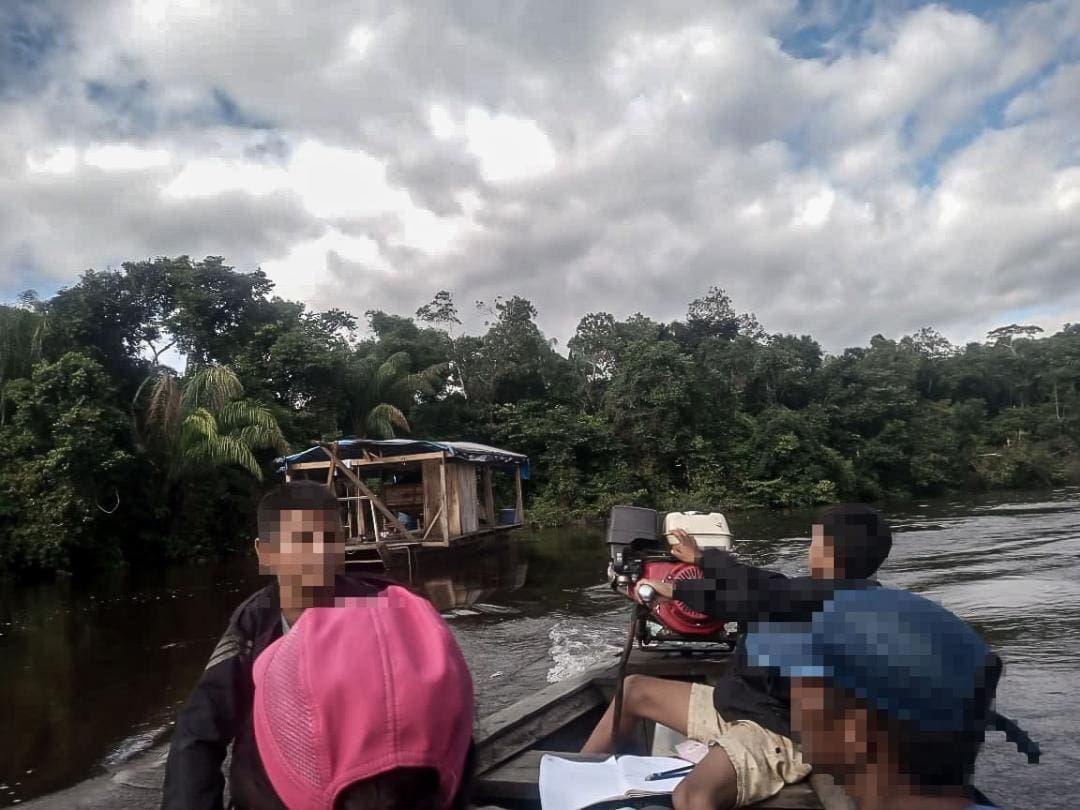
Under the centuries-old trees of the Alto Nanay-Pintuyacu Chambira Regional Conservation Area, dozens of dredges dig the riverbeds in search of gold, destroying the balance of several ecosystems of great biodiversity and a vital source of drinking water for more than half a million people in Iquitos. No one has been condemned for this illegal mining, and community members themselves have taken on the defense of their territory, without weapons or official support.
Por: Leandro Amaya Camacho (Nube Roja Magazine)
The night had been left behind in the jungle of Loreto and the world was noisy, colorful, and wild behind the bends of the Nanay River. Darkness was diluted in the form of a forest. A multitude of aguajes, capironas and shapajales advanced towards the water. At that hour, sunlight sipped warmly through the treetops and fell on the dark and gentle back of the river. The branches and the new sky reflected on its surface. And the birds’ songs awoke the tapir, the peccary and the paca rodent from their lethargy. The branches rustled. It was dawn.
This remote and ancient place in the northern Peruvian Amazon is just one side of the Alto Nanay-Pintuyacu Chambira Conservation Area that extends, like a green and boundless sea, along more than 950,000 hectares of white sand forests, high altitude forests and flooded forests.
It was established in 2011 by the Ministry of Environment to protect the Pintuyacu, Chambira and Nanay rivers, the main source of drinking water for Iquitos, Peru’s largest Amazonian city.
Other objectives of the area, according to the Ministry of Environment, are to take care of rare species with restricted distribution in the Peruvian Amazon, such as the restless river otter, the manatee, and the black-crested batará, as well as to guarantee the “maintenance of ecological processes” involving fish spawning and migration.
This area sustains the lives of 19 communities -native and peasant- that live scattered in and around it, at the foot of its two basins: the Pintuyacu and the Nanay. It is home to some 494 species of fauna, seven of them endangered according to the IUCN Red List of Threatened Species, and there is a variety of 670 plants.
Although its flooded forests help with carbon storage, since its creation it has lost more than 2.4 million tons of CO?, an amount equivalent to the emissions of almost 50 thousand people in eleven years, according to data raised by Pedro Paulo Souza-Lopes, who is part of the Quantitative Ecology Training Program of the Serrapilheira Institute. This report is the result of a collaboration between Latin American journalists and scientists, promoted by this Brazilian institute and the Latin American Center for Investigative Journalism (CLIP), to explore how damage to the Amazon’s biodiversity disturbs the various environmental services it provides to the continent.
This loss sounds a serious alarm of environmental degradation. Although the causes are not fully determined, they could be associated with the pressure of illegal activities, such as gold mining in the riverbeds, which threatens this clear and fresh ecosystem, full of life and movement.
The dredges and the river
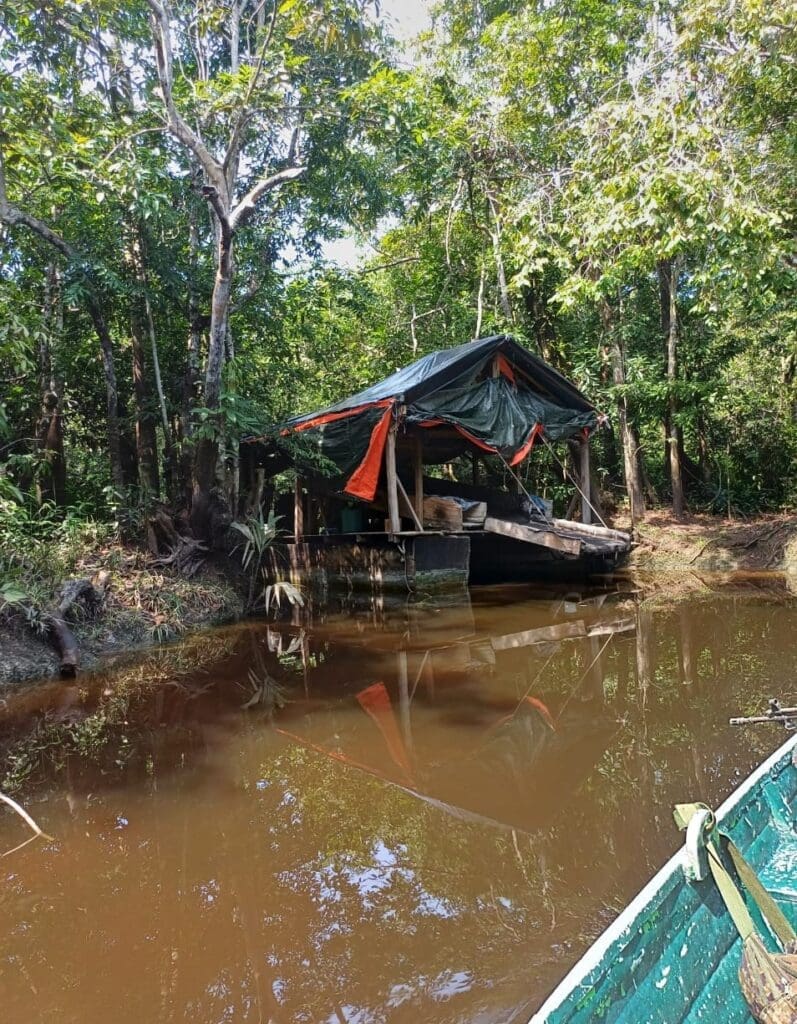
The tumultuous sound of Amazonian nature is interrupted by the hoarse roar of an engine. Near the intricate forest rests a barge of damp wood that seems to huff and puff. Inside it, five men, or maybe six, are busily moving about. It looks like a houseboat: three bows support a plastic roof, some hammocks, pots and jars hang from the pitchforks. The raft is stocked with blue gallons full of fuel to keep the engine running for several days. It is a dredge: a wooden monster animated by oil, which will soon snout the riverbed in search of gold.
The hose, attached to one of the sides, stretches out into the water, a diver holds it and starts sucking. The noise caused by the engine is tremendous and disturbs birds, fish and beasts. A crewman watches a ramp, running from bow to stern, to see if gold is coming in. If gold particles come up the ramp, he will give the warning: “Here it is!” Then they won’t move from that spot.
The ramp expels the extracted waste, leaving behind a white trail of sediment on the dark riverbed, an impact that is difficult to mitigate.
In the case of the Nanay, a black water river, the alteration of its turbidity affects all related ecological processes: photosynthesis decreases, aquatic species adapted to these conditions such as the yaraqui, the tucunaré, the zungaro or the palometa die. One of the greatest potentially sustainable uses of the Nanay is ornamental fish. If we look at the tracks left by the dredge, the murkiness of the water is impressive. “Alarming,” says Martín Arana, forestry engineer and leader of Amazonian territorial management at the Foundation for Conservation and Sustainable Development (FCDS).

The insatiable dredge continues to stir the Nanay, digging and damaging its entrails. Like this one, there are dozens anchored in the middle and upper basin of the river: only in 2024 the Monitoring of the Andean Amazon Project (MAAP), of the consortium of environmental organizations called Amazon Conservation, counted 221 findings of dredges in operation. In 2025, between January and April, 99 mining infrastructures were detected.
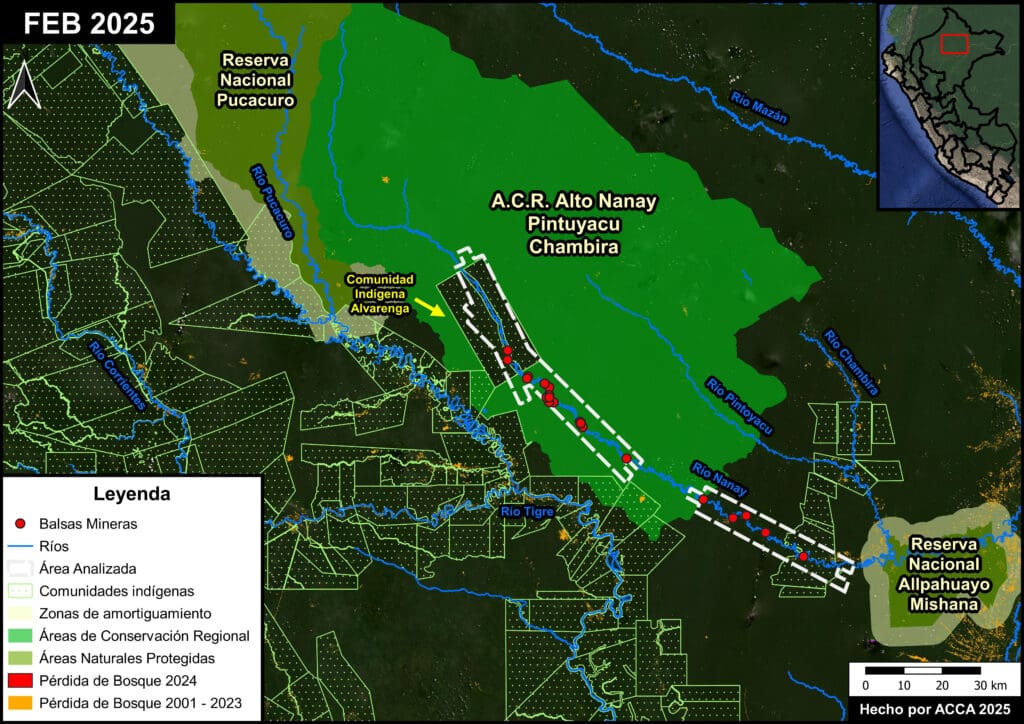
Some of them have approached the river beaches or have eaten its banks, cutting down the trees of the floodable forests, starting an alarming course of deforestation. In March 2024, for example, the MAAP reported that 2,000 square meters of forest cover had already been lost in the conservation area due to mining activities.
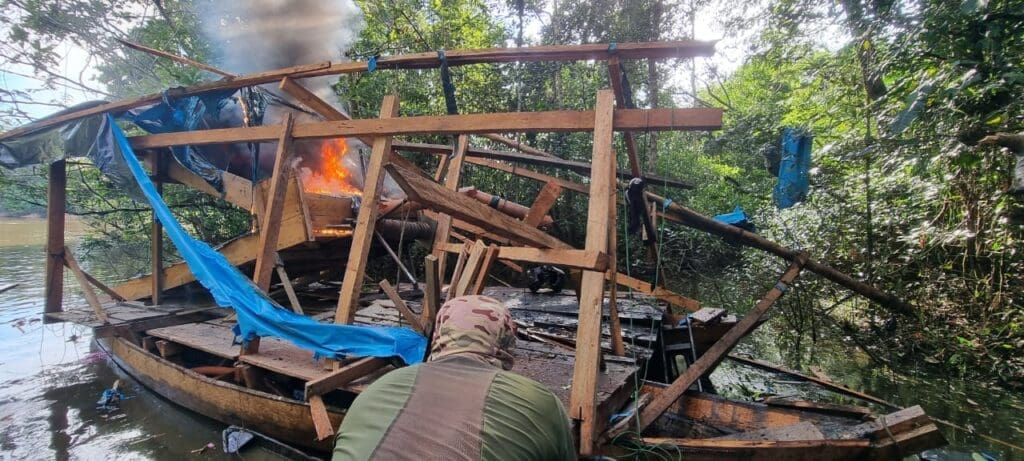
The Peruvian Navy claims to have destroyed 169 dredges in the Nanay River -between 2020 and 2024- and nine in the Pintuyacu. But so far in 2025 no mixed operation against illegal mining in the Nanay has been carried out.
“We have zero budget to carry out joint operations against illegal mining”, says a source from the Specialized Environmental Prosecutor’s Office of Loreto who asked to remain unnamed because he is not authorized to talk to the press.
When the miners finish their day they will collect the extracted material in plastic gallon cans and apply mercury to separate the gold from the impurities. Then they will shake them until the amalgam of both metals settles to the bottom, ready to be collected and heated in the open air so that the mercury evaporates – and spreads like a poison over the jungle, causing atmospheric and aquatic contamination – and only the gold remains, shiny.
The Environmental Evaluation and Oversight Agency (OEFA) – after being consulted for this report through the Access to Public Information Law – reported that, in 2024, it detected environmental impacts in the Nanay River basin due to illegal mining, but did not specify the magnitude. When asked about the environmental monitoring carried out in the area, it responded that it had no information on the matter.
The National Water Authority (ANA), in response to a request for public information, indicated that it has not conducted specific studies to detect mercury in riverbed sediments.
“There is no systematic evaluation [by the State] in the Loreto region, only isolated studies that, because of the way they were done, do not provide sufficient information,” explains scientist Claudia Vega, coordinator of the mercury program of the environmental NGO Centro de Innovación Científica Amazónica (CINCIA).
The gold rush
In Peru, mining in bodies of water has been a prohibited activity since 2012 according to Legislative Decree 1100. Miners with their dredges should not be in the Nanay, not even near the Alto Nanay Pintuyacu-Chambira Conservation Area. But they are. They arrived ten years ago. At first they were few, observing the behavior of the communities. Some had been illegal loggers, it was said that they came from the capital of the region. Others came from Colombia where they had also been involved in mining, some were even part of the Colombian army, according to investigations carried out by the Environmental Prosecutor’s Office of Loreto.
Sometimes they would go into the forest for long periods of time and then return to convince the younger ones to follow them. They offered money and work, two things that are scarce in those parts.
“They arrived, mixed with the communities entering our conservation area and took over everything. For example, in Alvarenga and Puca Urco they impose the law”, says a community member who lives near the junction of the Pintuyacu River with the Nanay, in one of the six annexes called Los Seis Hermanos del Pintuyacu (The Six Brothers of the Pintuyacu). The places she is referring to are two native communities strategically located at the beginning and inside the protected area.
“We can’t go in there, there are many of them,” adds another community member.
Both have received death threats and ask that their names not be revealed.
In the last five years, illegal miners have multiplied. Their leaders – according to community members’ accounts and documents from the Peruvian judicial system – adopted outlandish aliases: Moico, Tío Goldberg, Pastuso, Marino, Mago and Papillon. To consolidate their dominance, they resorted to intimidation of those who opposed them. In the farming community of Diamante Azul, located on the banks of the Nanay and known for its resistance to illegal mining, they came armed in search of an environmental defender whom they threatened with assassination. Little by little, they succeeded in sowing fear among the community.
To date, there is no record of a single arrest of illegal miners in Nanay by military or police forces. Likewise, the Public Prosecutor’s Office confirmed that no one has been convicted for the crime of illegal mining in the Nanay and Pintuyacu rivers.

When reviewing the number of filed cases related to this crime in the Loreto region during the last decade, it was found that, out of 102 registered processes, 24 were archived, 52 are still open and only one concluded with an unappealable sentence. The rest are in the qualification stage or with scheduled hearings. These figures reflect the slowness and limited effectiveness of the judicial system in dealing with this type of crime.
Without identifying and sanctioning those responsible, the dredge destruction operations become symbolic: the vessels disappear, but the operators, the financiers and the system that sustains them, remain intact.
“There is no attention to small communities with [sustainable] productive projects that would help them improve their living conditions. This is a surmountable tragedy”, says environmental activist José Manuyama, president of the Committee for the Defense of Water in Iquitos, for whom economic reactivation in the watersheds would help defeat illegal mining.
The Six Brothers of the Pintuyacu
The only resistance to illegal mining in both watersheds, albeit weak and unarmed, is the vigilance committee Los Seis Hermanos del Pintuyacu, founded in 2009 to protect the Regional Conservation Area.

The watchmen are skilled with the machete, good navigators and agile fishermen, they claim to be descended from the Ikitu, ancestors who knew how to endear themselves to these hostile lands. They know well the convoluted paths of their jungle. They walk from one side to the other, even at night, without fear of getting lost. They know which tree is useful to cure this or that pain, in which place of the forest there is good hunting and how to fish doncella more easily in the Pintuyacu and the Nanay. They have learned to feel the warm breath of the forest on starry nights and to recognize the paths marked in the sky.
“I am Ikitu blood, my mother is Ikitu race,” says one of the women who leads the vigilance committee The Six Brothers of the Pintuyacu. She is Marcelina. She was born in one of the small communities along the Pintuyacu River. “The forest is the lungs of the world. In Peru we take care of our part, thousands of hectares, but we have no support. We deserve to tell the story of what we go through.”
Something inside her – that even she does not understand – pushes her to devote her life to the fight for the forests and rivers. Perhaps it is because her grandfather, decades ago, had stood up to the white man who cut down the trees in the watershed. Or perhaps he has a serene courage in his chest, a bravery inherited from the Ikitu warriors.
What is certain is that, since she was 19 years old, she had learned to track the passage of the logger, then the hunter and, later, to find in which bend of the river the miner is hiding.
Sometimes she would climb into the committee’s only boat, leading the other watchmen; other times, she would travel to Iquitos or Lima to tell what the miners were doing on the Pintuyacu and Nanay. Sometimes she was successful: she appeared on the front pages of the independent newspapers, but almost always silence and indifference followed. Then she would return to her community by the same river that had taken her to the big cities in search of justice.
On some occasions she could not even leave her village. The miners forbade her to walk freely and threatened to kill her. Even during the development of this report, her home was photographed by someone with the clear intent of intimidation.
“They were looking for her everywhere, she was almost dead”, says the current president of the group. This man has bright, shining eyes, and the affable manners typical of the inhabitants of the Peruvian east. His speech is very expressive. Hard life in the jungle has not damaged his character: he still laughs easily and has a natural disposition to tell stories.
Most of the watchmen are like this: they are willing to do their job and are willing to take risks to defend the trees, birds, animals and rivers of the conservation area. There are about seventy of them, and they call themselves Los Seis Hermanos because there are six villages that guard the junction between the Pintuyacu and the Nanay. Despite the hot jungle climate, they wear green vests, hunting hats and balaclavas. Only some wear boots, the rest wear sandals.
“We identify as guardians of the forest. We safeguard the rivers, our waters, which are born there from a stream at the end of the basin. We take care of them for us and for those who come after,” Marcelina tells the young people in her community.

The committee’s initial task was to patrol the boundaries of the Regional Conservation Area (ACR) to deter illegal logging, identify poachers, prevent blast fishing, and report any unauthorized entry into the forest. They were also there to verify that no new farms were opened within the protected area, to participate in conservation training, and to maintain constant communication with the Regional Government of Loreto.
“We have confronted illegal loggers and fishermen. We have been threatened, we have been shot at,” says the vigilance committee president. Since then, everything has been an effort, a sacrifice. “We work with rain, sun or hunger.”
This way, their work stopped being only preventive or based on skirmishes and became a frontline defense. Now their self-imposed mission is to prevent the miners settled in the middle and upper part of the basin from receiving supplies. Sometimes they act directly, intercepting boats carrying fuel upstream. Other times, however, they are more cautious and apply intelligence tactics: they pose as hunters to detect, record and report the exact location of illegal camps and dredges.
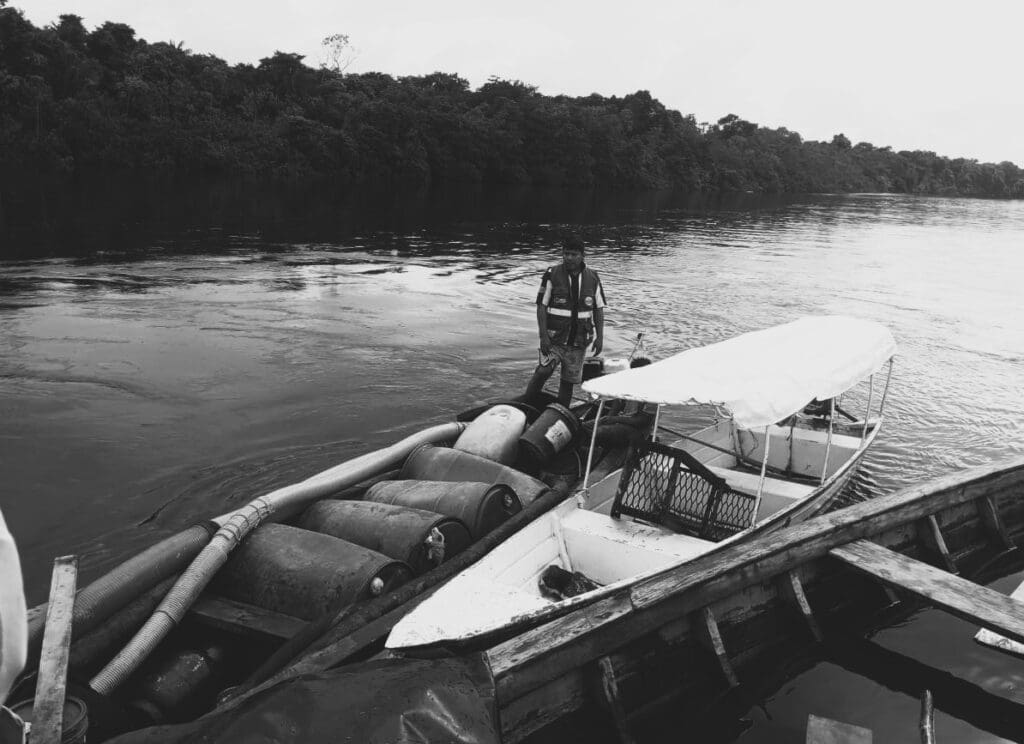
“We patrol towards the ACR in groups of 12 to 15 people, including men and women. The miners pass in front of us towards our ACR, they think we are only community members, and they trust us”, says Marcelina.
“If the river is contaminated we are screwed. We don’t have access to drinking water, we take it directly and store it in buckets. As watchmen, we make sure that the forest and the river don’t run out,” she says.
But there is nothing romantic about their work: the watchmen receive death threats, they are unarmed, their economy is subsistence, they live in precarious conditions and, as in the case of one of them, sometimes they cannot even bury their relatives for lack of money. The State has turned its back on them, while armed only with a strong will and wooden spears, they face criminal organizations with the economic capacity to acquire assault rifles, shotguns, revolvers, and a complex network of informants throughout the basins.

The Bishop of Iquitos, Miguel Angel Cadenas, who has traveled through a good part of the native and farming communities of Loreto emphasizes the sacrificed work of these men and women. For him it is important to keep in mind that what the rest see as heroism, for the watchmen is a task full of suffering and dangers. A life of toil, a pendulum between poverty and survival, the oblivion of the state and the voracious craving of a productive system that does not take nature into account.
“The state is sacrificing, handing over, this population to criminal organizations. It is an omission of functions that is absolutely insane. If democracy does not serve to defend the most defenseless inhabitants… Then what are we talking about,” asks Bishop Cadenas.
The Church, in the Nanay and Pintuyacu basins, is a fundamental ally of the defenders. It supports them by providing emotional and educational support – in each community they seek to guarantee access to secondary education, a right that the State does not provide – but it also denounces: the vicariate psychologist has detected that the children live in fear, and the teens suffer anxiety because of the risk their parents face when they go out to defend the conservation area.
“The community surveillance mechanisms were never intended as a response to criminal organizations. They served for self-regulation in the use of resources. The communities should not play the role of the armed forces; it is putting the lives of the inhabitants at risk,” says lawyer Ricardo Rivera, coordinator in Loreto of the environmental NGO Naturaleza y Cultura.
The Ministry of Justice and Human Rights reported that in Alto Nanay 13 situations of risk have been registered involving 21 environmental defenders. Marcelina says that she has protection measures, but stresses that this is only on paper, in reality no one from the State protects her, only her fellow watchmen take care of her.
“During the activation of the environmental defenders’ protection roundtable, a person from the Vicariate said that papers are not useful to defend people. After that, they never gave us the floor again”, says the religious man whose account coincides with Marcelina’s. The abandonment is overwhelming. For the Bishop, the problem is not only in the Nanay or in the dredgers that remove sediments and contaminate with mercury, but in the large international buyers that launder the illegal gold.
To further complicate their task, the watchmen have very few logistic measures. In 2025, they claim to have received only ten gallons of gasoline from the State and about thirty bags of food. Most of the resources are donated by non-governmental organizations and the Catholic Church, but it is not enough.
The defenders interrupt their watch seasonally because they must attend to the needs of their homes. “This tires you, sometimes there is no way to cope with the economy of the household, our children study,” says the president of the group.

In each community there are between 50 and 80 families. Each village sets traps for daily subsistence. Fishing is one of their daily tasks. But now they practice it with distrust. They fear the possible contamination by mercury in the fish and the water, since this substance is easily absorbed through the digestive tract and accumulates in the aquatic food chain. Predatory fish usually contain higher levels of mercury. By consuming them, people are also exposed to contamination.
To date, the State has not conducted any analysis of mercury in blood, urine or hair of the inhabitants of the communities. The Ministry of Health confirmed for this report that there is no data on this matter.
The only state assessment of heavy metals in fish was conducted by the National Fisheries Health Agency (SANIPES) in 2020, which analyzed three species (yulilla, yaraquí and cunchi) caught in the Nanay and Pintuyacu basins.
The results showed lead and cadmium levels above the permitted limits, implying a potential risk for human consumption, although mercury levels were low. However, community members and specialists question the results, pointing out that these species are not commonly consumed and that the methodology was deficient.
“There is no justification for having chosen them. We criticize these results and this report, which suspiciously was quickly disseminated in Alto Nanay to justify that “nothing was happening,”” says Ricardo Rivera of Naturaleza y Cultura.
In the last four years, no other studies have been carried out.
This silence from the state encourages mistrust among the watchmen. When talking about the subject, his discourse runs through different emotions: anger, discouragement and weariness.
-How many colleagues from the Nanay are already contaminated by the metal. What a pity, I don’t know how to rescue my Nanay. I suffer, I love this river very much,” says the president of Los Seis Hermanos del Pintuyacu. His voice does not denote anger; it seems more like a desperate call for help.
“The authorities don’t tell us anything. Mining advances and advances…in the Nanay we are losing,” Marcelina gives a deep sigh.
Silence engulfs her.
She likes to watch the Pintuyacu River at sunrise and sunset. The dawn, in that part of the world, impregnates things with reed green; the twilights are lilac. But there is a moment, before night comes, when the firmament lights up as if a fire were burning inside. Perhaps that changing sky recalls how the people of this region have, since time immemorial, resisted the dozens of outposts against them. Using the intricate jungle as a protector; weak and scattered in many cases, but managing to remain standing, surviving.

This story is the result of a collaboration between Latin American journalists and scientists, fostered by Instituto Serrapilheira of Brazil and the Latin American Center for Investigative Journalism (CLIP), exploring together how damage to the Amazon’s biodiversity disrupts the various environmental services it provides to the continent.


