


The pirarucu suffers the effects of the climate crisis in the Amazon, making the species adapt to rivers without water. An alliance with riverside communities helps keep the species alive.
By: Maickson Serrão (SUMAÚMA)
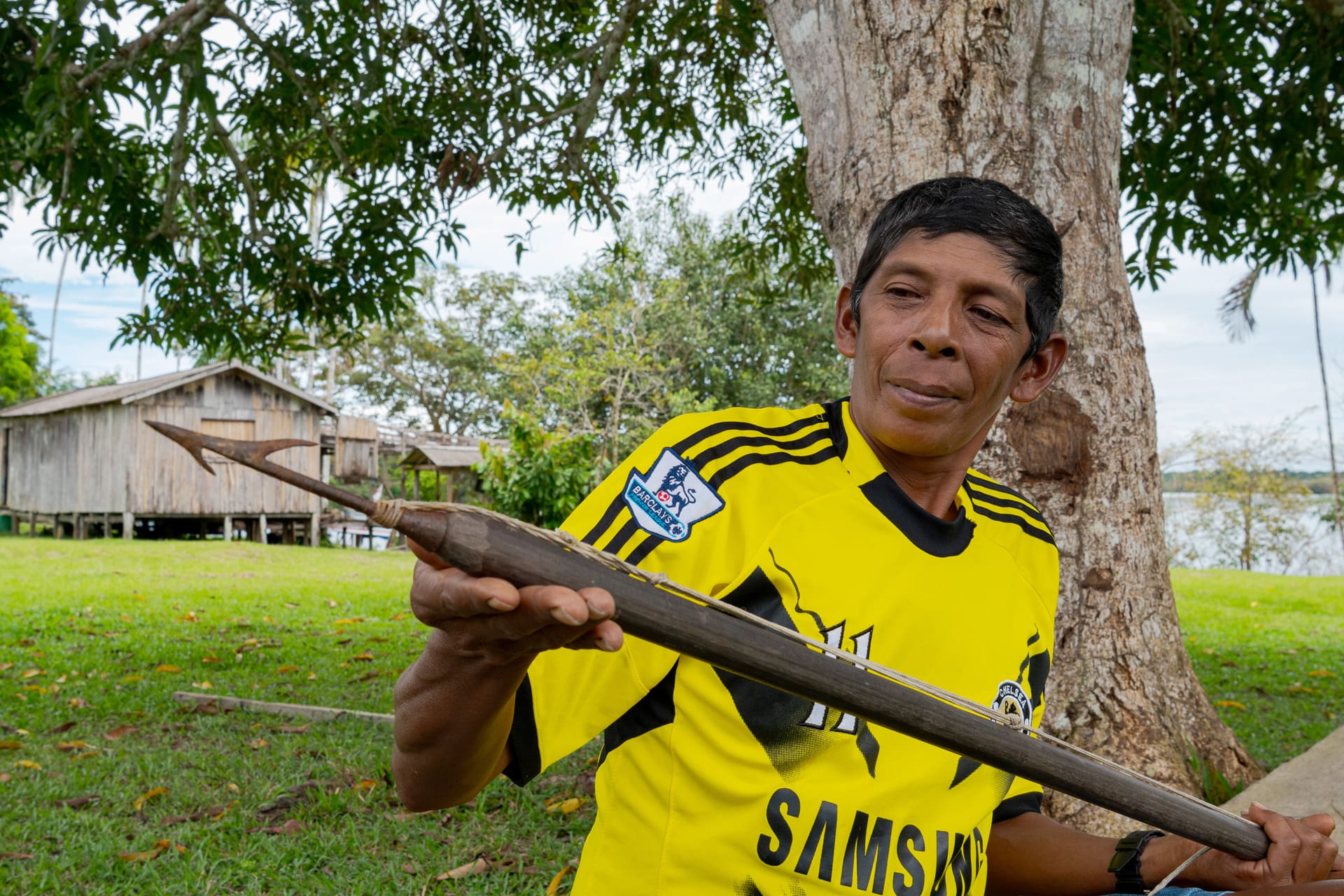
Elsivan Ferreira Feitosa has known the pirarucu since childhood. Today, at 44, he is a fisherman, a forest guard, and one of the few “counters” in Boa Vista do Calafate – a riverside community within the Amanã Sustainable Development Reserve, in the mid-Solimões region of the Amazon. His role requires more than skill; it demands listening, focus, and generational wisdom.
The pirarucu that Elsivan carefully observes is an ancestral giant of the Amazon waters. It can grow up to three meters long and weigh up to 200 kilograms. Its dark green scales, flecked with reddish spots, shimmer intensely in the sunlight. A long dorsal fin runs from head to tail, which is wide, robust, and red. When it surfaces to breathe, it fills its lungs with air, then dives again, its tail churning the water – a movement the counters learn to recognize from afar. The name “pirarucu” comes from the Tupi language and means “red fish.”
“I learned from my father, my grandfather, from my uncles. One counter passes it on to another.”

Counting pirarucus determines the annual fishing quota and requires no sophisticated equipment – just the body, trained eyes, and perfect timing. Elsivan can tell small fish from large ones by how long they take to surface: the small rise every ten minutes, while the large only appears every twenty. The bubbles from the bigger fish are thick and strong; from the smaller, fine and faint.
“The big fish comes slower. When it comes up, it washes with its tail. It stays on the surface longer. And we time it.”
Beyond counting, Elsivan reads environmental signals. He says the pirarucu listens to the forest and orients itself by following the jaçanã—a wading bird living in the reeds. “If the canoe touches something and makes noise, the jaçanã jumps. It warns the fish. It surfaces angered or moves away.” The fish also pays attention to beetles that strike the canoe’s hull, signaling human presence. “It knows something’s wrong. And it doesn’t come back.”
These behaviors show that the pirarucu is sensitive, strategic, and alert. If disturbed, it migrates to another area – even if that puts it at risk. “I’ve seen fish leave a protected area because of noise and end up where there are intruders. There it’s killed. That’s why silence is part of vigilance.”
This finely tuned listening between fish and fisherman reveals more than a way of life – it also reveals a survival strategy in the face of climate collapse. Ancient methods of counting pirarucus intertwine with scientific knowledge, both pointing to the same direction – the fish and the communities that depend on it are adapting, or they won’t endure.
To understand this adaptation – of both fish and people – in late April 2025, SUMAÚMA traveled to the Amanã Sustainable Development Reserve in the mid-Solimões, following the course of the Tefé River, a tributary of the Solimões that connects diverse ecosystems. For over a week, the team visited communities, spoke with fishermen, resource-managers, leaders, and scientists, explored protected areas, and heard firsthand accounts of how climate shifts have reshaped riverside life. This reporting was technically supported by the Instituto Mamirauá, linked to the Ministry of Science, Technology, and Innovation, and involved collaboration with specialists from Instituto Serrapilheira and the Latin American Center for Investigative Journalism (CLIP), all analyzing the socio-environmental impacts of extreme droughts in the Amazon.
A Record Braking Drought in the Amazon
In 2023 and 2024, the Amazon Basin experienced the most severe droughts in four decades. The level of the Tefé River remained below historical averages for nearly half the period from January 2022 to November 2024, according to data from the National Water and Basic Sanitation Agency, analyzed at SUMAÚMA’s request by hydrologist Caio Mattos (Federal University of Santa Catarina), as part of a collaboration between Instituto Serrapilheira and CLIP.
This low water level is part of a series of extreme events tied to global warming and the intensification of phenomena like El Niño – an abnormal warming of Pacific waters that disrupts rainfall patterns and brings severe drought to the Amazon.
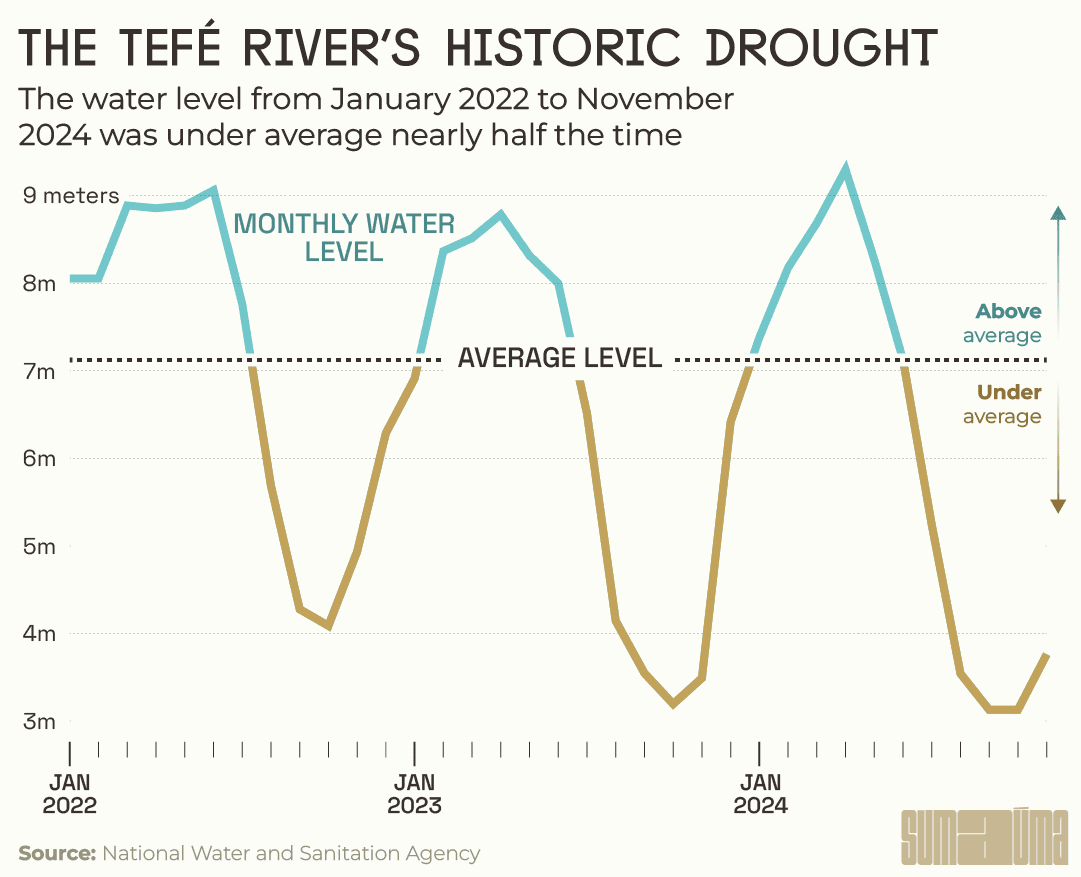
The Tefé River, a branch of the Solimões, is vital for transport, fishing, and the daily life of dozens of communities within the Amanã Reserve. It feeds Lake Tefé and links varied ecosystems, serving as a thermometer for climate change in the region.
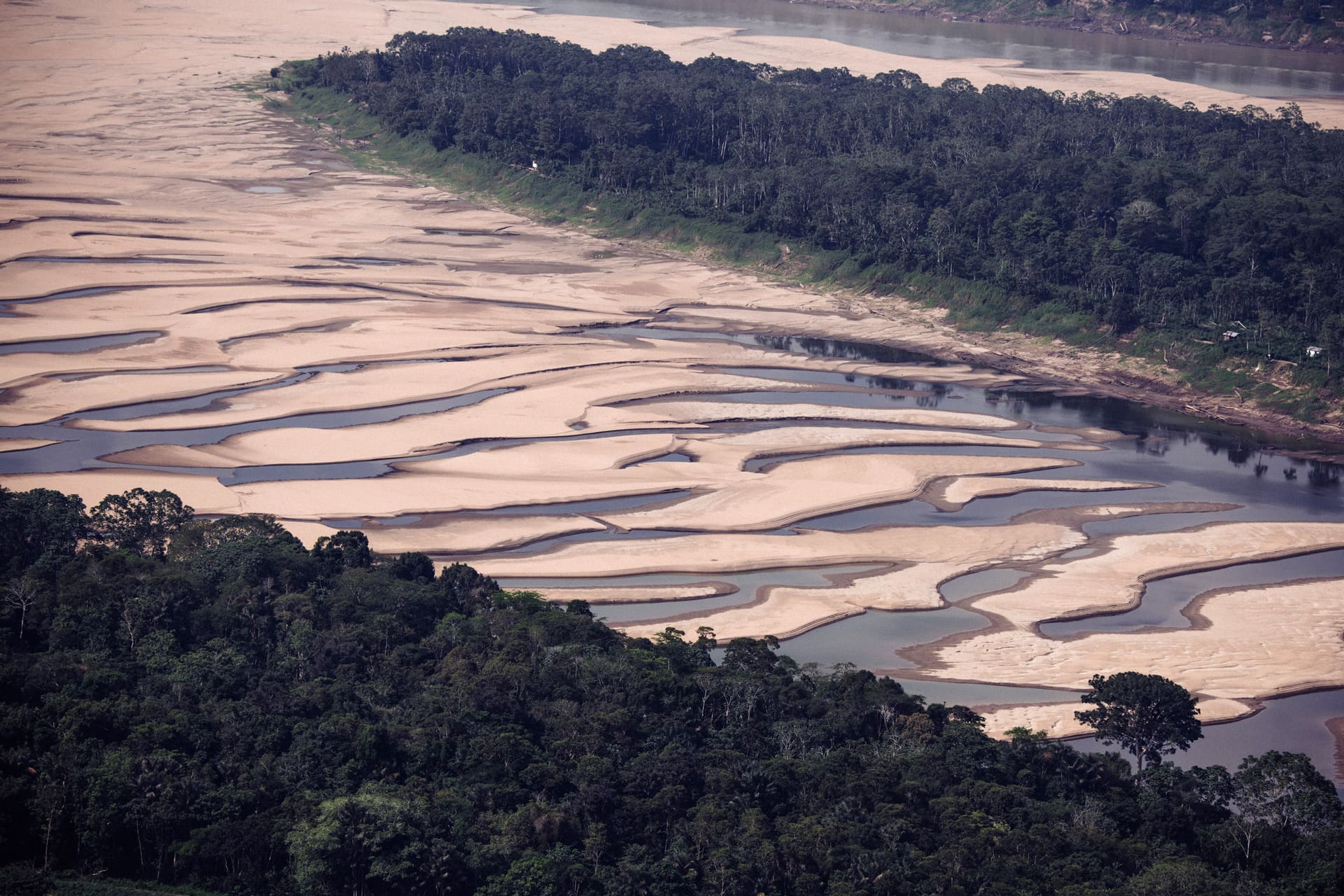
The consequences of recent droughts have been devastating. River dolphins perished by the hundreds, lakes dried up completely, and fishing was nearly halted. Many families were stranded or lost access to drinking water. Extreme heat increased illnesses, and fish less tolerant to heat died from lack of oxygen in shallow, warm waters.
But the pirarucu anticipated the crisis: it migrated to deeper parts of the river. According to researchers, this anticipatory behavior is rooted in its biology and evolutionary history. Biologist João Campos?Silva, president of Instituto Juruá – a conservation and community organization based in Manaus – explains: “The pirarucu evolved in shallow, low-oxygen environments – the ancient Lake Pebas – millions of years ago. That’s why it has an impressive physiological adaptation. It breathes air, migrates strategically, and seeks deeper waters during droughts.”
According to Campos-Silva, Lake Pebas – a vast ancient lake system covering Western Amazonia – was the pirarucu’s evolutionary cradle. Its waters were often murky, acidic, and oxygen-poor, allowing only the most adapted species to thrive. The pirarucu survived thanks to its ability to breathe atmospheric air – a key trait it still retains. It also developed sophisticated migratory behavior and brood protection, ensuring its survival even under adverse conditions.
Its swim bladder – an internal organ that assists buoyancy – became hypertrophied, functioning almost like a lung, allowing it to surface for oxygen. This adaptation not only secures survival in low-oxygen waters but also shapes its behavior and interactions with both environment and fishermen.
The pirarucu stands as more than a survivor; it is a living example of how evolution shaped resilience strategies in one of the planet’s most challenging environments.
Community-Led Management and Protection
Riverside communities in the Amanã Reserve rely on fishing, farming, and extraction. They have formed community associations that establish collective agreements for managing pirarucu – a strategy in place since 2009. Today, it involves over 30 communities and around a thousand fishermen in activities ranging from fishing and counting to selling the fish. This model has become one of the most successful examples of participatory conservation in the Amazon.
The process is thorough: first, the fishes are counted by specialized counters like Elsivan, who assess the sizes and numbers of pirarucus in management zones. Those figures set the annual fishing quota. Fishing takes place through organized community efforts, with tasks assigned to each person – from locating fish to transporting and icing them.
Selling the fish follows the same collective system, with pre-arranged contracts with buyers who agree to fair prices and sustainable practices. These include selling only fish within the allowed quotas and sizes, and avoiding fishing outside designated periods. Profits are shared among participants, reinforcing social and economic unity. Part of the proceeds also fund communal improvements – such as boat repairs and community spaces.
In 2023 alone, the collective earnings from management exceeded 4 million reais (about 820,000 USD at the time), demonstrating a system that combines income generation, environmental conservation, and local autonomy. These figures come from reports prepared by the communities with oversight from Instituto Mamirauá’s management group.

Based in Tefé, Mamirauá provides technical support- developing counting and monitoring methods, training counters and personnel, and advising on implementing fishing agreements. This collaboration between riverside people and scientists is a central pillar of the success in managing the pirarucu.
Decisions are made in local assemblies, where members discuss everything from creating new protected zones to temporarily suspending fishing – as occurred in 2023 in four communities, including Calafate, due to extreme drought.
Territorial protection is constant, with regular patrols organized by the communities themselves, supported by institutions like Mamirauá. This work is essential not only to preserve the pirarucu but also to defend the entire ecosystem from illegal fishers, loggers, land-grabbers, and wildlife traffickers who act in protected areas.
Jovane Cavalcante Marinho, 40, son and grandson of fishermen, now works as a management technician at Mamirauá after years of direct involvement in fishing. He learned about the pirarucu as a child and now works so that this technical knowledge remains within the community: “We make sure that what we’ve achieved here doesn’t get lost over time. When I leave, there’s already someone to continue with the same purpose. The idea is to train people from the community to write technical reports themselves and take over management autonomously.”

A Legacy Across Generations
Theibson da Silva was just 10 years old when he first laid eyes on a pirarucu. He was with his grandfather, deep in a river backwater, when he spotted an entire family of the giant fish – father, mother and their offspring.
“At first, I thought it was some strange creature,” he recalled. “I was scared. But then I stopped and watched. The father stayed beneath the babies, the mother behind them, protecting.”
The image stayed with him. And the learning didn’t stop there. Now 25, Theibson is a father of two and a pirarucu manager – part of a new generation of riverside residents helping to renew both the fishing practices and the social fabric that binds the Amanã Reserve communities together.
During fishing expeditions, Theibson oversees the monitoring and handling of the fish. He manages the reception, the ice, the logbooks. The lessons came from his grandparents, but when he speaks of the future, it’s his own children he thinks about. “If my grandfather taught me, I want to teach too,” he said. “I want my children to see what I saw.”
Theibson now serves as vice president of his community’s fishing agreement and sits on the financial oversight council. He doesn’t call himself a leader, but those around him do. His generation has learned to manage the pirarucu – and more recently, to grapple with new challenges brought on by extreme drought, pandemic isolation, and a shifting climate that demands constant adaptation.
In 2023 and 2024, Theibson noticed something unprecedented: the pirarucu changed its spawning season. Traditionally, the eggs would hatch between October and November. But during those years of relentless drought, the fish waited. “They could tell the water was going to dry up too much,” he said. “If they’d spawned earlier, the babies would’ve died. So they waited for the water to rise. They didn’t spawn until January.”
For Theibson, this wasn’t coincidence – it was adaptation. “They’re smarter than people think. They know where to hide, when to run, when to wait.”

And like the fish, the people are learning to adapt too. “I’ve never seen a pirarucu die from the lack of water,” he said. “Even in the worst drought I’ve ever seen. They find a way. They find the deeper pools. They concentrate. It’s us – sometimes we’re the ones who can’t adapt.”
Theibson grows bananas and manioc, tending his small farm, but he’s also an active member of the community association, helping to shape management decisions. His generation carries the knowledge of their elders and is now learning how to turn it into strategy in a world growing more unstable by the year.
If Theibson represents the present and the future, Edivan Ferreira embodies the leadership that has anchored pirarucu management over the past decades. As president of the Boa Vista do Calafate Community Association, Edivan knows the ins and outs of the fishing agreement, as well as the hard realities of territorial protection.
“Here there’s no competition, only agreement,” he said, distilling the ethos of their management model. The agreement is a collective pact, designed to ensure that fishing happens sustainably – respecting the fish’s life cycle and guarding the lakes against intruders.
Edivan understands the need for organization. Without surveillance, internal regulations and collective decision-making, he said, the pirarucu could disappear – not only from overfishing, but from invaders who operate outside the rules, often backed by armed groups and wildlife traffickers. “We take care of this, but we’re threatened,” he said. “Still, if we stop, that’s when we really lose everything.”
For Edivan, the strength of community management lies in the blend of traditional knowledge – handed down generation after generation – and the social structure that sustains the practice. He witnessed the start of the management system, watched as it generated economic gains, and has also seen the mounting threats.
In riverside communities, local assemblies are pivotal moments. It’s there that people decide everything from establishing new protected zones to suspending fishing during critical years – as they did in 2023, when, faced with historic drought, the communities chose not to fish. It was a difficult decision, but one they saw as necessary to secure the long-term survival of both the species and the livelihood.
Edivan knows that such a choice was only possible because a strong system of local governance had taken root. And he believes the younger generation is ready to take the reins. “Young people are participating, taking on roles, learning to care,” he said. “That’s important – because they’re the ones who’ll carry this forward when we no longer can.”
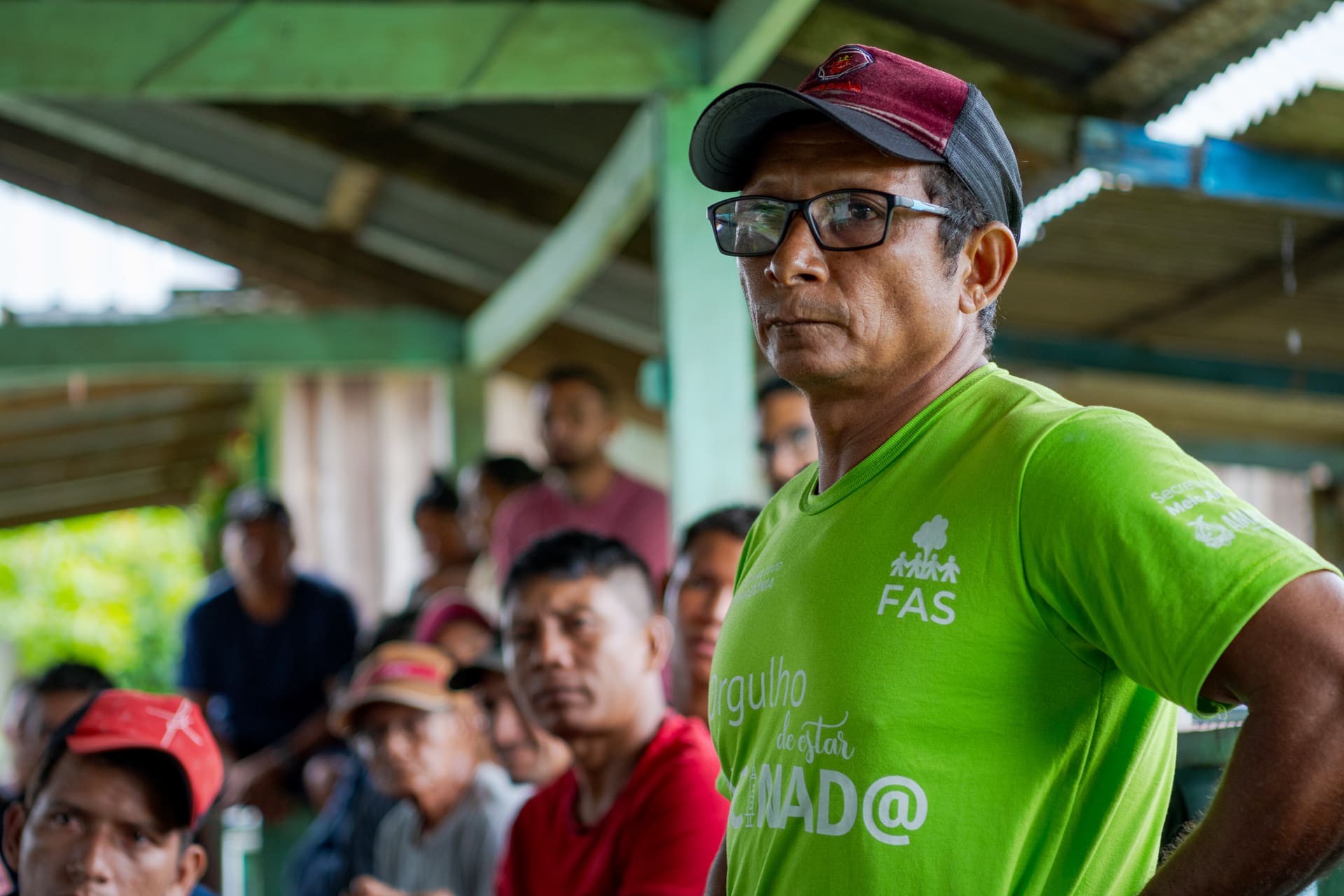
Between Theibson and Edivan there is a gap of years, life stories, and perspectives. But there’s also a deep, common thread: a connection to the pirarucu that both guides and binds them. One, at 25, is learning how to teach. The other, an experienced leader at 49, is passing on what he’s lived. And the pirarucu endures – breathing, migrating, adapting – just like the people who manage it, observe it, and, generation after generation, learn from it how to live within the time and silence of the forest.
The Juruti, the Pirarucu, and a Possible Future
For the Deni people of the Juruá River, the pirarucu is not just a fish – it is a transformed being.
Long ago, according to Deni oral tradition, a young man and his sister lived in harmony with their community. The sister married a man from another village, but an illness swept through that settlement, leaving her as its sole survivor. Consumed by grief and solitude, she transformed into a Juruti – a bird that now inhabits the riverbanks. Her brother, inconsolable, dove into the water and became a fish. He became the pirarucu. Before their separation, the siblings made a vow: they would never be far from each other. And so, the Deni say, to this day the Juruti sings near the places where pirarucus live.
“That’s how his story began for us,” said Umada Kuniva Deni, a leader among her people. “He was one of us. That’s why we respect him. That’s why we listen to him.”
For Indigenous groups like the Deni, the pirarucu is more than sustenance or a source of income. It is their kin. It is an ancestral spirit. It is a symbol of continuity. This connection transforms how the fish is managed. “They don’t manage a resource,” explained biologist João Campos?Silva. “They manage a fellow being.”
The fish’s white flesh, sheathed in green, red, and gold scales, is seen as a symbol of abundance. Its bony tongue, armed with sharp teeth, is used by Indigenous people as a tool for grating manioc – a reminder that no part of the pirarucu goes to waste: from its meat to its hide, from its bones to its mythology. At community festivals, the fish is roasted in large pieces, cooked in stews or smoked over wood fires – gracing meals that mark the water cycle and the social rhythms of the forest.
For Umada Deni, the relationship with the pirarucu shapes the past, the present, and the future. “The pirarucu helps keep our culture alive,” she said. “When we fish together, when we take care of it, we’re also taking care of our way of life, of our history.” The pirarucu is culture. It is food. It is history, tool, and myth – a being that crosses dimensions and reaffirms the intricate relationship between forest peoples and the creatures that share their world.
“The pirarucu is much more than a fish,” said Campos?Silva. “It’s a symbol that inspires us to imagine an Amazon led by local peoples – an Amazon that generates wealth, but also protects biodiversity, the enchanted beings, and Indigenous worldviews. The pirarucu is a model of development that stands in stark contrast to the predatory, destructive development we’ve witnessed for far too long in the Amazon.”
From Juruá, Campos?Silva’s words encapsulate the meaning the pirarucu and its community-led management now carry in the region. The fish that predicts droughts, migrates to survive, and inspires ways of living has also become a point of reference in the broader debate over the Amazon’s future: how to reconcile conservation, income generation, and local leadership.
In the Mid-Solimões region, this alternative isn’t just a theory – it’s a daily practice. The pirarucu continues to swim in the deep waters of the Amanã Reserve, safeguarded by the counters’ silence and the watchfulness of generations who have learned that listening to the forest’s movements is also a form of resistance.


This story is the result of a collaboration between Latin American journalists and scientists, fostered by Instituto Serrapilheira of Brazil and the Latin American Center for Investigative Journalism (CLIP), exploring together how damage to the Amazon’s biodiversity disrupts the various environmental services it provides to the continent.


