


Although many Ecuadorians and Colombians don’t realize it, several of their main hydroelectric plants, such as Coca Codo Sinclair and Guavio, depend in part on water that reaches them from the Amazon rainforest. That means deforestation in the Amazon could end up hurting electricity users in Andean cities. Even so, neither country has drawn up plans accounting for this dependence between hydroelectric infrastructure and Amazonian ecosystems, nor have they prepared for rising electricity demand during severe El Niño-driven droughts.
Esteban Tavera (Climate Tracker América Latina)
*Coca Codo Sinclair is Ecuador’s largest hydroelectric plant by generating capacity and depends heavily on moisture that travels from the Amazon. Photo: Ecuadorian Electricity Corporation
On October 26, 2023, Ecuador’s government stunned its citizens with an announcement no one was prepared for. Starting the next day, an energy rationing plan would take effect, with scheduled blackouts of three to four hours a day. Officials said the plan could run through December of that year. Instead, the rationing dragged on much longer: a year later, in September 2024, authorities announced that the cuts would not only continue but increase to eight hours. A red alert was declared in several regions of the country.
Weeks later, the scheduled blackouts reached 14 hours, which for people across much of the country meant going more than half a day without internet, without refrigeration, without electricity, and often without being able to work.
President Daniel Noboa’s government blamed the measures on the severe drought gripping Ecuador’s Amazonian region because of El Niño, which had driven the flow of the rivers that feed the country’s two flagship hydroelectric plants to record lows: Coca Codo Sinclair, in the north, between the provinces of Napo and Sucumbíos, and Paute, in the south, in Azuay province.
Coca Codo Sinclair is operated by the Ecuadorian Electricity Corporation (CELEC) and supplies roughly a third of the country’s total demand. As of August 11, 2026, the plant had generated a third of all the electricity produced in Ecuador, while the second-largest plant, Paute, accounted for 19%.
The plant has been at the center of several scandals. After it was built, cracks appeared that, according to Ecuador’s comptroller general’s office, cost the state tens of millions of dollars in damages. Former president Lenín Moreno was convicted of bribery for taking part in a kickback scheme between 2009 and 2018 and, according to Ecuadorian courts, for receiving money from Sinohydro, the Chinese company that built Coca Codo Sinclair.
A trial is currently underway against former president Lenín Moreno, who is accused of allegedly taking part in a bribery scheme.
Unlike other hydroelectric plants that store huge volumes of water to generate electricity, this plant makes use of water that flows through the Coca River: the water passes through its turbines and is returned to the river downstream. This type of plant is known as a run-of-river hydroelectric plant. From there, the Coca River empties further downstream into the Salado and Quijos rivers, which in turn flow into the Napo, a tributary that ultimately joins the Amazon.
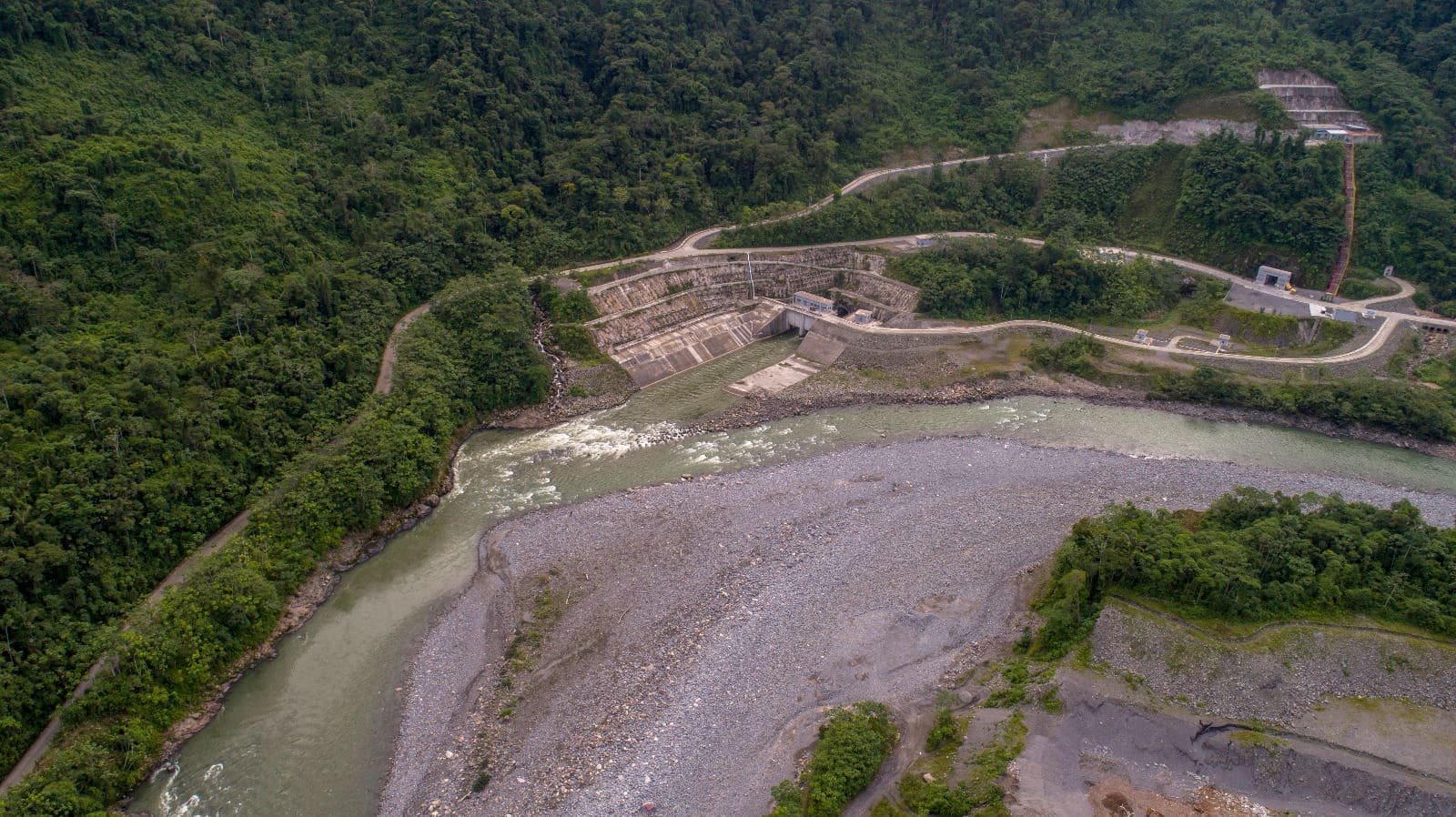
But that run-of-river design also makes Coca Codo Sinclair highly vulnerable to running out of water to operate. If the river’s flow drops sharply because of a drought, the plant has no reservoir of stored water to keep feeding the national grid. “In low water, the impact is immediate and severe; the plant can lose capacity overnight,” explains Nora Estela Fernández, an economist and energy specialist at the Pontifical Catholic University of Ecuador.
That explains why the plant was so hard hit during the long drought of 2023 and 2024. If it can suffer a serious blow from one day to the next, when rain stops falling for months the impact is even worse. And it’s all Ecuadorians who feel it.
Colombia felt the drought too. The country is the main exporter of electricity to Ecuador, and at the start of the crisis it doubled its power supply to its neighbor. But once rainfall began to dwindle at its main reservoirs because of the same El Niño phenomenon, Colombia had to redirect its electricity output to domestic consumption and cut back exports to Ecuador. Colombia did not ration electricity at the time, but its capital, Bogotá, was forced to impose drinking-water cuts for an entire year.
At the time, public awareness in Ecuador linked the energy crisis to El Niño and the Amazon, where the country’s primary hydroelectric plants are located east of the Andes.
In Colombia, that didn’t happen. When water was rationed in Bogotá, some news outlets did discuss the relationship between the reservoirs that supply the city with drinking water and the rain that arrives from the Amazon rainforest. But the connection to hydroelectric plants is almost never mentioned.
“This knowledge gap must be addressed by drawing on scientific research to answer these critical questions, which remain unresolved yet are essential to ensuring our energy security and sovereignty,” says Carolina Useche, director of climate, economy and finance at the World Resources Institute (WRI) in Colombia, an environmental group that has designed a methodology for measuring how vulnerable small hydroelectric plants are to the impacts of the climate crisis.
This knowledge gap about how Colombia’s main power plants relate to what happens in the Amazon may stem from the fact that they sit high in the Andes, far from the Amazon region.

The Guavio hydroelectric plant, operated by the Italian multinational Enel, has a capacity of 1,250 megawatts and is Colombia’s largest by net generating capacity. Located in the western part of the department of Cundinamarca, it generates electricity using water stored in a large reservoir that stretches across the municipalities of Ubalá, Gachalá, Gachetá, Gama and Junín, in the mountains of Colombia’s Eastern range. It sits 200 kilometers from Sierra de La Macarena National Park, the nearest protected area in the Amazon.
Hidroituango, Colombia’s second-largest hydroelectric plant by capacity — expected to become the country’s biggest source of power once its second phase comes online — is located in Antioquia, more than 500 kilometers from the Amazon rainforest. Something similar is true of the San Carlos, Peñol and Hidrosogamoso plants, more than 500 kilometers away, and Chivor, roughly 300 kilometers away.
That’s why, when droughts hit Colombia’s most important reservoirs, many people don’t think of the Amazon River basin or the forests of Guyana, Suriname and Venezuela as an important source of moisture. But science has found that electricity generation in both countries depends significantly on the Amazon rainforest.
How much do they depend on it?
One way to understand the relationship between Andean hydroelectric plants and the Amazon rainforest is to look at the atmospheric moisture that falls as rain in the areas where they’re located, and where that precipitation comes from.
At Coca Codo Sinclair, nearly two-thirds of precipitation comes from the Amazon. Another 25% of the rain comes from the Pacific (13%) and Atlantic (12%) oceans.
Of that total, 52% comes via “direct contribution”—rain originating in the Amazon through tree evapotranspiration that travels across the biome to Napo province. Another 6% arrives through “indirect or cascading contribution,” where Amazonian rainfall falls in adjacent regions and recycles as atmospheric moisture before continuing toward the Andes. These estimates were calculated by Sandro Pauli, a physicist at the Federal University of Santa Catarina who specializes in atmospheric moisture tracking and climate modeling.
At Guavio, the Amazon contributes more than a third of the rain it receives: 31% of its precipitation would be “direct contribution” from the Amazon and another 10% indirect — more than what the plant receives from the Atlantic Ocean (24%), the Pacific (2%) or other sources (33%).


The data come from a computational analysis by Pauli, who is part of the quantitative ecology training program at Brazil’s Serrapilheira Institute, a partner in the Águas Partidas (Divided Waters) investigation coordinated by the Latin American Center for Investigative Journalism (CLIP) together with eight news outlets from the region. Pauli used a computer model that tracks the trajectory of air masses step by step, using hourly records of wind speed and direction across 25 different layers of the atmosphere.
“In practice, the model works like this: for every millimeter of water that evaporates from the surface, the system releases 100 virtual ‘moisture packets’ into the atmosphere. The trajectory of these packets is tracked in three-dimensional space for up to 30 days of travel, or until 99% of their water has fallen as rain,” Pauli explains.
Coca-Codo Sinclair and Guavio aren’t the only hydroelectric plants that benefit from this ecosystem service and draw significantly on rain formed from moisture that travels across the entire basin.
Paute, Ecuador’s second-most important hydroelectric plant, located in the Amazon region in the country’s southeast, also depends mostly on that biome. According to Pauli’s calculations, 56% of its precipitation arrives through direct contribution and another 7% through indirect contribution.
Hidroituango likewise depends in part on rain coming from the rainforest despite being so far from the Amazon. By Pauli’s calculations, the direct contribution would be 17% and the indirect one 12% — meaning nearly a third of the precipitation the plant relies on to operate comes from the connection between the Amazon and the Andes.
At Peñol-Guatapé, another hydroelectric plant in Antioquia that is also key to the country’s energy security, the contributions are similar: 19% of the rain is direct contribution from the Amazon and 14% indirect.
The science behind the relationship between the Andes, the Amazon and the Atlantic
“There’s already enough evidence to show that our water cycle depends on the Amazon, and that deforestation across the Amazon affects the hydrological cycle of all of South America,” says Paola Andrea Arias, a Colombian engineer and climatologist who leads the water reports for the United Nations Intergovernmental Panel on Climate Change (IPCC), the world’s top scientific authority on climate issues.
Arias, together with colleagues from Colombian universities and neighboring countries, has studied the ways water circulates through the atmosphere between the Atlantic Ocean, the Amazon and the Andes mountain range. That research has shown that rainfall patterns in the Andean countries of northern South America are linked to the Amazon rainforest.
“The first thing to think about is how water moves around the planet,” says Arias, who teaches at the University of Antioquia. “Water evaporates from sources that are largely oceans and rivers, but vegetation also transpires, and that’s one of the ways we get water vapor into the atmosphere.”
That water vapor does not necessarily remain where it originates; wind currents transport it to fall as precipitation in distant regions, either as rain or snow. As Arias explains, water is in constant motion, forming geographically defined basins as it travels across land.
“However, atmospheric basins are far larger, spanning vast cross-border regions. That is why we can trace water reaching Colombia from as far away as the North Atlantic, near Africa, or central Chile via the Pacific — and, of course, from the Amazon,” the Colombian scientist explains.
The Atlantic-Amazon-Andes hydroclimatic system, or AAA, is described by Peruvian scientist Jhan Carlo Espinosa — who has also been an IPCC author and is part of the Science Panel for the Amazon — as an “interconnected and interdependent” system.
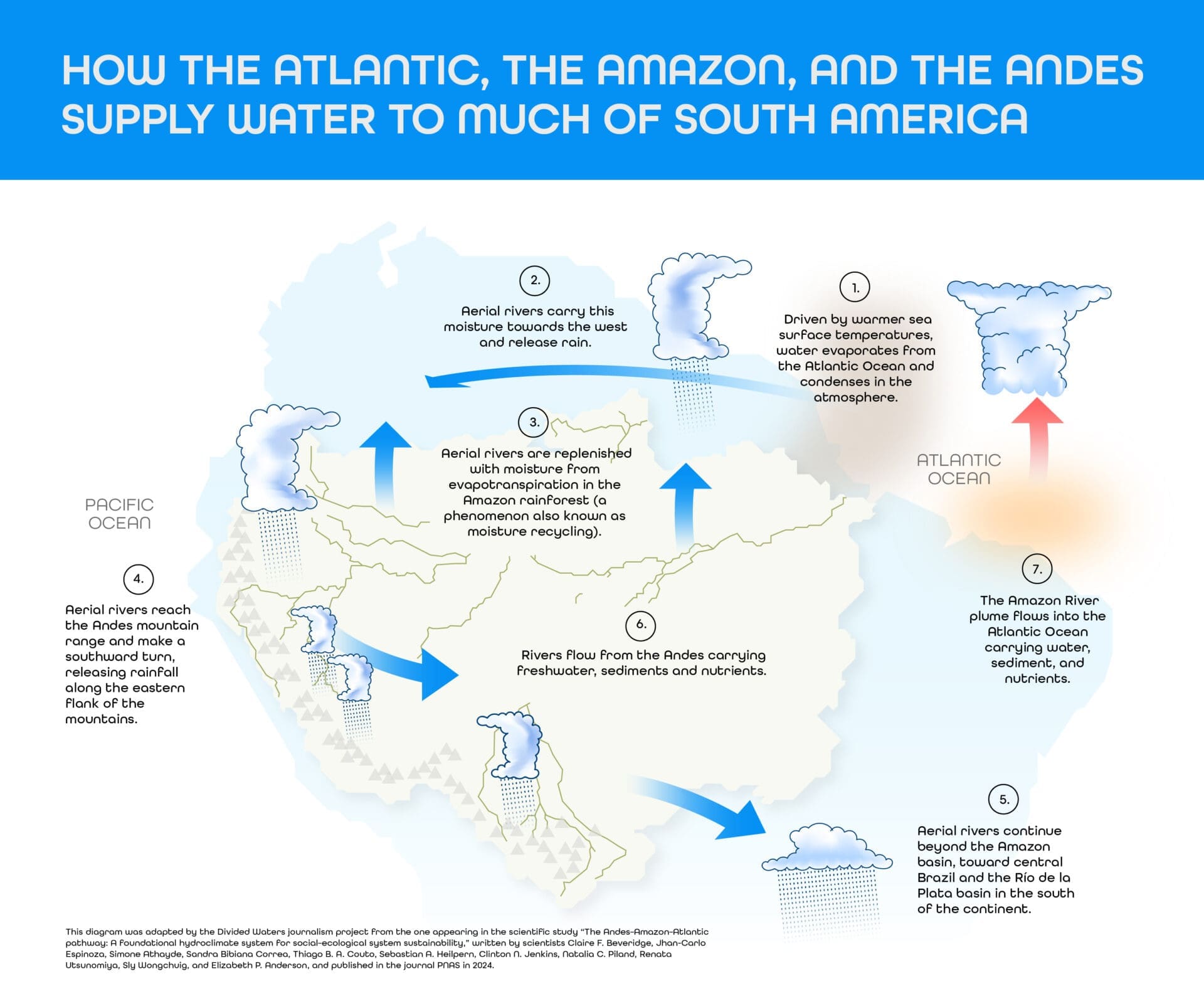
“The main source of rainfall in both the Andes and the Amazon is evaporation from the tropical Atlantic Ocean. That moisture enters the continent through atmospheric circulation, and part of it generates precipitation over glaciers and at the headwaters of rivers that flow into the Amazon and out to sea. The Amazon rainforest absorbs part of that moisture from the soil or from rainfall and returns it to the atmosphere through evapotranspiration,” explains Espinosa, who teaches at the Pontifical Catholic University of Peru.
These so-called “atmospheric basins,” which carry huge volumes of water vapor to places as far away as the main Andean cities of Colombia and Ecuador and the basins that supply their most powerful hydroelectric plants, are known in the scientific community as “flying rivers.” The term, which caught on, was coined by Peruvian meteorologist José Antonio Marengo.
A study published in April 2026 by Colombian and Brazilian scientists showed that rainfall patterns in the northern Andes are closely tied to the Amazon forests, especially during the month of April. Researchers reached that conclusion through monthly monitoring over seven years, collecting isotope samples — a chemical marker that works as a kind of “water fingerprint” and reveals where the moisture that generates rainfall in a specific region comes from.
The study, led by hydrologists Luis Eduardo Toro-Espitia and Juan Camilo Villegas of the University of Antioquia, meteorologist Alejandro Martínez of Eafit University, and chemist Valeska Peres de Araujo of Brazil’s Nuclear Engineering Institute (IEN), also found that during La Niña periods there is greater moisture recycling, while during El Niño periods there is less.
Separately, a study published by a group of Brazilian scientists in 2024 found that fires and climate change could turn the Amazon rainforest into a degraded forest with less biodiversity and fewer trees, pushing it toward a tipping point that would represent a collapse on a global scale.

As Arias and Poveda explain, the data show that the hydrological cycle driving atmospheric moisture across the continent is intensifying. “This means rainfall extremes will worsen: some regions will face heavier downpours and severe flooding, while others will experience far more pronounced dry conditions. These effects can be seen at the Amazon basin,” Arias says.
The Colombian scientist notes that the same holds true for dry conditions: “for example, the dry season in the southern Amazon is lasting longer. That means less evapotranspiration and less moisture available to be carried to other regions.”
Bolívar Erazo, executive director of Ecuador’s National Institute of Meteorology and Hydrology (INAMHI) until March 2026, notes that the impact of this intensifying cycle is already clear: the climate baseline used to plan Ecuador’s main hydroelectric projects has shifted. Feasibility studies for Coca Codo Sinclair rely on data from the 1980s and 1990s, with updates ending in 2009. A similar mismatch affects Colombia’s Guavio plant, where construction began back in 1981.
“If hydroelectric projects in the Amazon basin used to be designed based on a climate track record, that record no longer holds because climate variability has changed. We’re in a new climate reality with more extremes — either too much water or none at all,” says Arias.
Although Ecuador and Colombia have no known scientific studies directly linking Amazon deforestation to electricity generation by Andean hydroelectric plants, in Brazil it is already a subject of research.

In the Brazilian state of Mato Grosso, the Teles Pires hydroelectric plant — which has an installed generating capacity of 1,820 MW — is estimated to have lost an average of $21 million a year because of reduced rainfall caused by deforestation in the Amazon. That is the conclusion of Rafael Carlquist Araujo, an economist with a doctorate from Brazil’s Getulio Vargas Foundation, who led a study calculating the potential losses deforestation causes to hydroelectric generation in Brazil.
Although the energy economist’s calculations did not account for the Andean countries, some of his conclusions serve as warnings for possible scenarios in Ecuador and Colombia. In his words: “we found that, with more deforestation, the amount of water available for energy production will decrease.”
“Deforestation will always drive up the price of energy, and reforestation will always bring it down, because the more water there is, the more energy is produced,” he added.
The study also led to a conclusion crucial for the continent: protecting the Amazon benefits hydroelectric companies, while deforestation hurts consumers.
How governments are preparing for a changing future
Sixty-seven percent of the electricity generated in Colombia comes from hydropower, according to the Biennial Transparency Report the Colombian government submitted to the United Nations in 2024. In Ecuador, that figure is 63.5%, according to the 2024 National Energy Balance — meaning roughly two-thirds of the total in both countries.
This dynamic traps both nations in a dangerous feedback loop. In both cases, when water runs short at hydroelectric plants, the countries often have to turn to backup sources such as thermal power plants, which burn fossil fuels like coal, natural gas or petroleum products to generate electricity — releasing greenhouse gases in the process.
In other words, the hydrological cycle — already so disrupted by climate change and already straining water supplies in both countries — could be further damaged by the very solution both governments are forced to rely on to solve that same water shortage: burning fossil fuels, which science has identified as the leading cause of climate change.
According to Fernando Salinas, president of the Ecuador Energy Forum, “in our Electricity Master Plan, the biggest expansion projects are hydroelectric. The largest, for example, is Santiago, with a capacity of around 6,000 megawatts, located in Morona Santiago province, in the country’s southeast. But the studies were done about 10 or 15 years ago.”
In Colombia’s case, according to a 2025 document from the Mining and Energy Planning Unit (UPME), future scenarios do not anticipate any new large hydropower projects coming online — essentially all planning is based on the second phase of the Ituango hydroelectric plant entering operation.
The Amazon Network of Georeferenced Socio-Environmental Information (RAISG), made up of eight NGOs from countries in the Amazon basin, maintains a database of hydroelectric plants under construction in the Amazon region. According to that data, Colombia has only one plant under construction, in the city of Mitú, while Ecuador has 53 registered across its entire Amazon region.
On top of that comes another challenge: demand for electricity keeps rising. That means that even with less water available, and even as countries need to move away from the most polluting sources of electricity, they will need even more power.
“There’s a global trend, one that isn’t a local whim and is backed by plenty of evidence, that electrifying end uses [replacing equipment or processes that run on fossil fuels with electric alternatives from renewable sources] is the path to finally achieving a transition away from fossil fuels,” says Jessica Arias Gaviria, an electrical engineer and researcher at Polen Transiciones Justas, a Colombian NGO specializing in public policy for the energy transition. “In other words, that demand for fossil fuels needs to be replaced with something else, but the energy and the need for it still have to be met.”
Asked how Colombia is preparing for a future scenario of less rainfall caused by disruptions to the hydrological cycle connecting the Andes, the Amazon and the Atlantic, as well as by climate change, Colombia’s Ministry of Mines and Energy said its plan centers on diversifying its generation sources.
“This approach is based on diversifying the energy mix by incorporating Non-Conventional Renewable Energy Sources (FNCER), as well as promoting self-generation, distributed generation and energy communities, which helps reduce dependence on hydropower generation,” the ministry said in May 2026, before the transition from Gustavo Petro’s government to that of Abelardo de la Espriella.
These options include decentralized self-generation (such as rooftop solar panels for homes or businesses), the installation of small power plants close to where electricity is used, and community or neighborhood projects in which several people join together to generate the energy they need for their businesses or homes.
To that end, Colombia has rolled out the 6GW+ Plan, which aims to add 6 gigawatts of solar, wind and small hydroelectric plant (PCH) capacity on minor rivers. According to UPME data, as of January 2026 the plan had already added 4,416.14 MW.
Ecuador, in its most recent Nationally Determined Contribution (NDC) — the five-year roadmap for implementing the Paris climate agreement — has pledged to cut its greenhouse gas emissions by 7% (roughly 8,800 kt of CO2-eq) by 2035. One pillar of that reduction is boosting renewable energy, which of course includes hydropower.
For Ecuadorian freshwater ecologist Andrea Encalada, who has spent years studying the hydrological cycle between the Andes and the Amazon, her country’s authorities have not thoroughly analyzed the data already available to prepare Ecuador for the scenarios ahead. “We have a lot of satellites orbiting up there. The information is already out there, but we need to organize it, draw conclusions and actually work out how we adapt to these changes,” Encalada says.
Instead, Encalada warns, officials are weighing alternatives such as nuclear energy, an area in which the country has no experience whatsoever.
Jessica Arias Gaviria, from Polen, highlights a similar concern regarding Colombia. She explains that existing national energy strategy still lacks a clear framework for fully decommissioning thermal plants, which continue to serve as the default emergency backup. “To make things worse, over the last four or five El Niño events, I’ve seen that we’re in the middle of talking about speeding up the rollout of renewables, transforming the system and becoming less dependent on fossil fuels — and then an El Niño hits and we forget all of it,” Arias says. “The panic is so great that we can’t plan for this El Niño while also keeping a 10-year planning horizon.”
On top of all this is an underlying problem already mentioned by Carolina Useche, of WRI: governments still haven’t fully internalized the need to understand how these countries’ hydroelectric plants depend on the Amazon.
El Niño, the phenomenon that makes everything worse
The El Niño phenomenon, which severely disrupted operations at major hydroelectric plants such as Coca Codo Sinclair and Guavio during 2023 and 2024, has returned. According to the Climate Prediction Center of the U.S. National Oceanic and Atmospheric Administration (NOAA), conditions for this natural climate pattern intensified between June and July 2026 and are projected to persist through the first quarter of 2027. NOAA also confirmed that these represent the strongest El Niño conditions recorded since 1950.
In the Amazon regions of both Ecuador and Colombia, the impacts of this phenomenon tend to be mainly reduced rainfall. “The fact that there’s a strong El Niño event right now isn’t the same as having that same event 30 years ago. The planet is now much warmer, and an event like this can trigger bigger effects,” notes Arias Gómez.

Given this scenario, the quickest solution to address water shortages at hydroelectric plants remains firing up thermoelectric plants — which, in the end, help worsen the problems the planet is already facing.
Perhaps severe energy rationing will finally make Ecuadorians and Colombians understand the direct connection between the loss of the Amazon rainforest and the electricity powering their homes.
Scientific references
Rafael Araujo. “The Value of Tropical Forests to Hydropower”. Energy Economics, 2024.
Claire Beveridge et al. “The Andes–Amazon–Atlantic pathway: A foundational hydroclimate system for social–ecological system sustainability”. Proceedings of the National Academy of Sciences (PNAS), 2024.
Rubén Molina et al. “Forest-Induced Exponential Growth of Precipitation Along Climatological Wind Streamlines Over the Amazon”. Journal of Geophysical Research: Atmospheres, 2019.
Bernardo M. Flores et al. “Critical transitions in the Amazon forest system”. Nature, 2024.
Luis Eduardo Toro-Espitia et al. “Beyond the Rainfall Amount Effect: Moisture-Source Controls on Precipitation Isotope Seasonality in the Northern Tropical Andes”. Hydrological Processes, 2026.

This project is the result of a collaboration between Latin American journalists and scientists, spearheaded by Brazil’s Serrapilheira Institute and the Latin American Center for Investigative Journalism (CLIP), to explore the Atlantic-Amazon-Andes water pathway and the disruptions to the ecosystem services it provides to the continent.


