


Two years ago, 42 Guatemalan citizens who were travelling North from their country looking for a better life, died in a trailer accident in Chiapas, Mexico. Guatemalan and Mexican authorities pledged to investigate the events, but so far no progress has been reported in the case, while the conditions of poverty for the survivors and their families remain unchanged.
“He was crazy that driver, driving with madness. He never thought about us,” recalls Baldomero Sis, 36, a Guatemalan farmer who survived the accident of a trailer with a container full of people who were migrating from their country to the United States, that overturned on a highway in Chiapas, Mexico on December 9, 2021.
The driver lost control and his vehicle turned upside down in the middle of the road. On impact, the roof of the trailer’s tail came off like if it were a can of sardines. This caused some travelers to be projected out on the road. Those who survived the crash were able to get out faster. Among all the bodies piled up was Baldomero, originally from San José Poaquil, Chimaltenango, Guatemala, a community of dirt roads and dust where he left his wife and four children in a house made of sticks and tin.
With one arm dangling, Baldomero managed to get out of the metal skeleton and discovered the panorama of the tragedy: dozens of bodies were scattered on the road and the air was filled with the cries of survivors. They were the people like him, who minutes ago were trying to reach the United States,. That day he felt a sadness that still pains him to remember. Baldomero reached for his backpack, grabbed it tightly and collapsed. This was the story he told reporters of this investigation in a conversation over the phone.

The Centro Latinoamericano de Investigación Periodística (CLIP) and Noticias Telemundo created a database – factchecked by ICIJ – of more than 150 cases of trailers and trucks that were inspected, detained, abandoned or involved in accidents in Mexican territory between 2018 and 2023. The data reveals that in that time period around 18,900 migrants, including 3,216 children were transported in these types of vehicles. At least 110 migrants died due to high heat exposure or lack of oxygen inside the trailers, or as a result of traffic accidents.
This data base is part of a cross-border investigation in which Plaza Pública participated, along with the aforementioned media, together with Contracorriente (Honduras), Pie de Página and its allied network, Chiapas Paralelo, En un 2×3 and journalists in Veracruz en México.
Of these cases, the most lethal was the accident in Chiapas in 2021, where the trailer carrying around 200 people, capsized on a curve and killed 56 people, among them 42 Guatemalan migrants (See: Crime, impunity and death behind migration in Chiapas).
Like Baldomero, 142 other Guatemalans survived the December accident with serious injuries, according to a count made by the Ministry of Foreign Affairs. One of the survivors was only three years old, while the rest ranged in age from 15 to 50. All were from Quiché, Chimaltenango, Quetzaltenango, Izabal, Baja Verapaz, San Marcos and Escuintla.
No chance of staying
Although he almost lost his arm, Baldomero feels fortunate to tell his story: his life moved forward, he managed to recover physically and on a fourth attempt he made it to the United States. What did not change were the conditions of poverty in which he and his family live. Nor were the promises made by the then Guatemalan government fulfilled. They publicly said that together with Mexican authorities, they would thoroughly investigate who was behind the crime. An Inter-Institutional Action Group (GAI) was indeed created by the Mexican, Guatemalan and other governments to investigate those responsible, but according to the Guatemalan Ministry of Foreign Relations (Minex), there are no records that members of this committee met more than once.
We also asked Minex for information on the results of that action group and the Directorate of Social Communication responded that they do not know what happened since, with the change of government, the officials who were part of it are no longer in the institution and there are no documents available.
Also, the then Guatemalan minister of Foreign Relations had said to survivors in a press conference he held after the accident that “you are not alone, we are with you and we will be giving you all the support you need”. This contrasts with what was said by survivors and their families interviewed for this investigation who said the government never even contacted them.
The investigation coordinated by CLIP, which interviewed dozens of survivors and experts, also identified the group “Los Chiapanecos” as the people who came to Guatemalan communities to offer their transportation services to the United States via tractor-trailers. This group is linked to the Chamula Cartel, made up mainly of Tzotzil people from San Juan Chamula in the highlands of Chiapas, Mexico, which controls the border with Guatemala. According to the testimony of a former federal official, is suspected be backed by the Sinaloa Cartel.
In December 2021, Mexico’s Secretariat of Security and Citizen Protection (SSPC) said it was investigating a network of human traffickers who use cargo trucks to smuggle Central American migrants through a route that starts in Chiapas, passes through Veracruz and Puebla and reaches Tamaulipas, before entering the United States.
In Guatemala, following the accident, the Public Prosecutor’s Office announced that it had opened an investigation to find the coyotes who transported the migrants. The case was opened by Stuardo Campo, then head of the Prosecutor’s Office on Illicit Traffick of Migrants. He travelled to Chiapas to gather evidence and interview survivors and families of the deceased. However, to date, April 2024, no progress has been reported.
Campo was detained on two occasions, the last one in December 2023, due to a complaint by the extreme right-wing organization Fundación contra el Terrorismo, which accuses him of alleged anomalies in the cases he investigated. Campo has told the media that he considers it a revenge for disrupting the business of corrupt actors. This office investigating this case is now headed by Cindy Gloria Euler, with whom Plaza Pública requested an interview to know the fate of the investigation, but her office responded that the file is under reserve and hence, they cannot inform details.
Although the Prosecutor’s Office, headed by Attorney General Consuelo Porras (sanctioned by the United States as corrupt and anti-democratic), assures that the investigation is still ongoing, neither Baldomero, who survived, nor his family, nor the loved ones of Marcos Gabriel Quiná, another mortal victim 19 years old, were contacted by the prosecution.

One last call
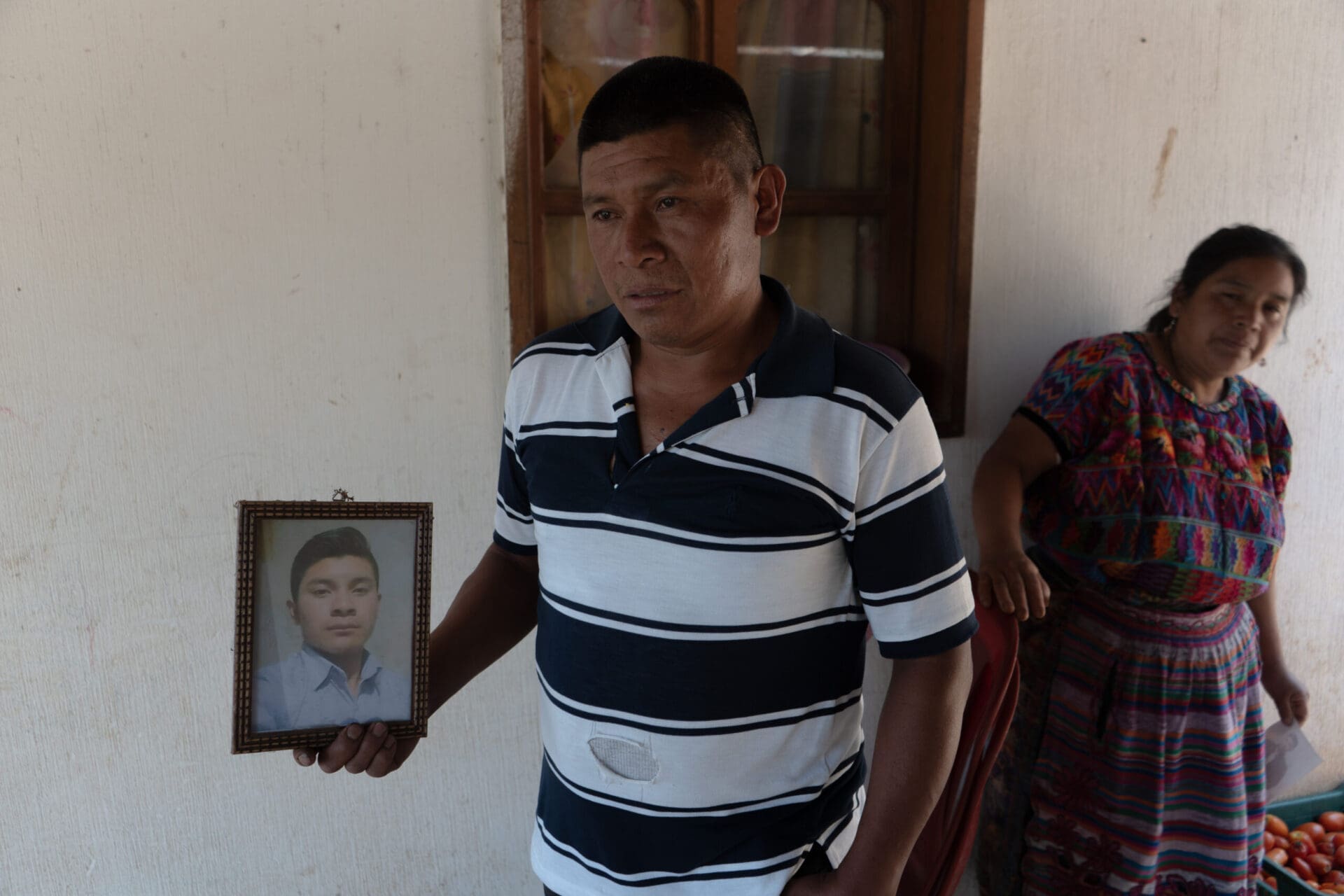
Paulino Quiná, 46, lives in the village of Xenimaquin, in Comalapa, a municipality in the department of Chimaltenango. He had twelve children and the fourth of them was Marcos.
Paulino found out about the trailer accident on Facebook and although he suspected that his son was among the victims, he was hopeful that he would find him alive. Amidst the lack of official information and no answers from the coyote, he found photographs of the possible victims. One of those portraits was similar to Marcos. That led him to travel to Chiapas.
“The last time I talked with him was the day before the accident, he told me he was in San Cristóbal de las Casas and the next day they would leave town. I told him ‘get your act together, don’t be sorry, they (the coyotes) know what the trip is like, they are the ones who drive’. That was the last thing I talked to him about,” he said in an interview with Plaza Publica at his home.
Upon arriving in Mexico, Paulino looked for his son in hospitals and at the Red Cross. There he was given a list of deceased migrants, but his son was nowhere to be found. His ordeal in public institutions ended when he took a DNA test and minutes later it was confirmed that it matched one of the deceased. With this information, he returned to Guatemala without Marcos, awaiting the procedures for his repatriation.
“Here we don’t achieve anything”, Paulino told reporters in tears, while leaning against the wall of the house he built thanks to his work as a farmer. “We have seen that those who go to the other side have always achieved something. That is why he (Marcos) decided to leave. But unfortunately he did not realize his dream. He wanted to build a house and buy small plots of land to plant”.
Between fear and economic needs
The Quiná family works the fields for a living, planting corn and beans, but they depend on the rainy season. That is why the path that Marcos began was a hope for economic improvement for his entire family.
“We have learned that in the trucks they are very close together and run out of oxygen, that they are tightly packed and do not move and that is the problem,” says Paulino.
Baldomero confirms this. All the way, until before the accident, he was standing in the tractor-trailer, with no room to move or hold on and held upright by the physical pressure of the rest of the cramped migrants. That was his third attempt to reach the United States, but it was not his last.
“Today yes, hopefully I can resist… that’s all I thought,” says Baldomero, who upon waking up from the impact of the accident, found himself in a hospital in Mexico where he was told that to save his arm he had to have platinum rods placed in it. After the surgery he paid for a cab to the Guatemalan border, where his family was waiting for him. Baldomero recovered at home, with his wife Isabela Esquit and his four children, 13, 12, 7 and 2 years old, who are totally dependent on him.
“Practically, when he came here (Guatemala) he received no help at all from the government, there were individuals and community members who helped,” says Isabela.
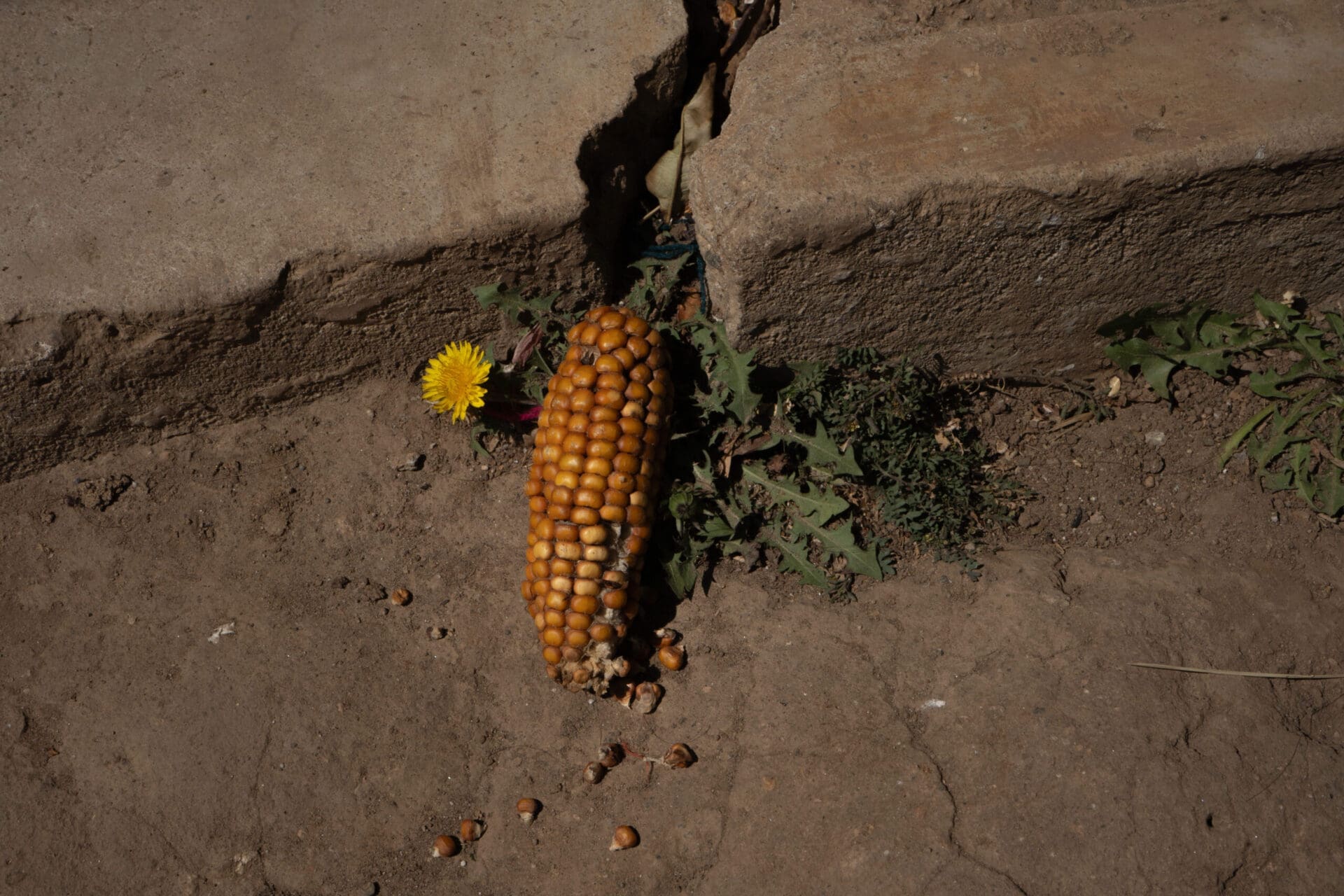
Cornered by economic needs, Baldomero tried to return to work on the land, but although he managed with difficulty, the money was still insufficient and he carried on his shoulders a debt with the coyote for more than 80,000 quetzales. Faced with need and fear, he decided to try once again to reach the United States.
“I was afraid, but this time luck was with me,” he recalls.
On that fourth attempt he arrived in New York. He rested for three days and soon found a job washing dishes in a restaurant in Queens. He has been in that country for two years and now cooks quick recipes in a Chinese restaurant in that big city.
Baldomero’s four attempts to get to the United States caused his debt to grow. For this reason, he uses most of his income to pay it off. This does not allow, for the moment, to pull his family out of poverty. However, he is proud to send them money for food and shoes, but especially for their education.

“I have told my ducklings to study so that what happened to us doesn’t happen to them, that we didn’t have the opportunity. As long as I’m here, even if it’s just a little, I’m going to support them,” he said in a call from New York.
Neither Baldomero nor Marcos’ family hold out hope that the Public Prosecutor’s Office will finish the investigation and that there will be justice for the tragedy that killed 42 Guatemalan migrants. Paulino has one request:
“If it were possible I would tell the coyotes who take people there to look for another way, something safer, so that the people who want to leave can get what they want,” he says.
Baldomero anticipates spending a long time in New York, while he pays off the debt and accumulates the money to build his house and buy land.
“What has already happened has already happened, you never know what will happen down the road”, he said. “To my friends who have not made that decision, I ask them to try hard and ask God, because we don’t want them to go through what I went through.

A journalistic investigation coordinated by Noticias Telemundo and the Latin American Center for Investigative Journalism (CLIP) with the participation of the International Consortium of Investigative Journalists (ICIJ), Bellingcat, Contracorriente (Honduras), Plaza Pública (Guatemala), EnUn2x3-Tamaulipas, Chiapas Paralelo and Pie de Página (Mexico). Legal review: El Veinte