

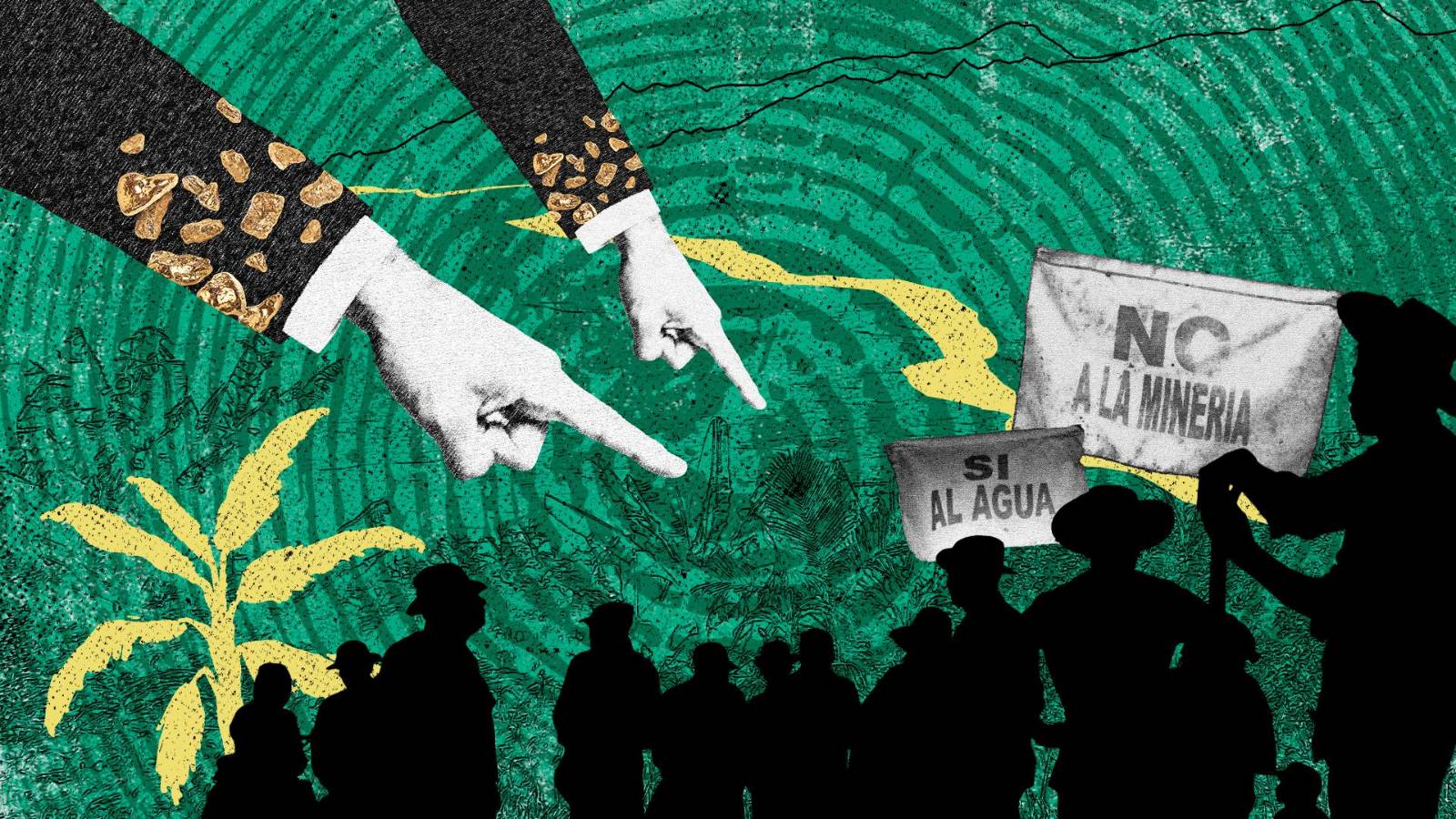
Users both inside and outside the municipality of Jericó, in Antioquia, who promote AngloGold Ashanti’s mining project on social media, backed the judicial harassment of opposing farmers through campaigns
of discredit and stigmatization.
By Alexander Campos and María José Echeverry (Colombiacheck)
In the turmoil of a protest, two brothers draw their machetes. They threaten one another. Only their father’s intervention prevents the confrontation from ending in tragedy.
The reason is a deep rift: one supports the neighbors who allow Quebradona Copper Mine to carry out exploration work in the village, while the other is part of the community resistance demanding that all work in the region be halted until the project obtains an environmental license.
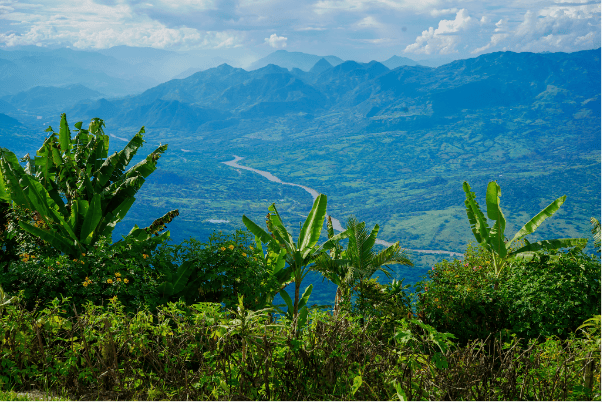
Porfirio Garcés recalls the scene at the entrance to his home in the district of Palocabildo. It reflects the division within the community of Jericó, Antioquia, a Colombian municipality of fewer than 15,000 inhabitants. As the birthplace of the mother of Laura Montoya—the only Colombian canonized by the Catholic Church—it has become a pilgrimage destination for thousands of believers.
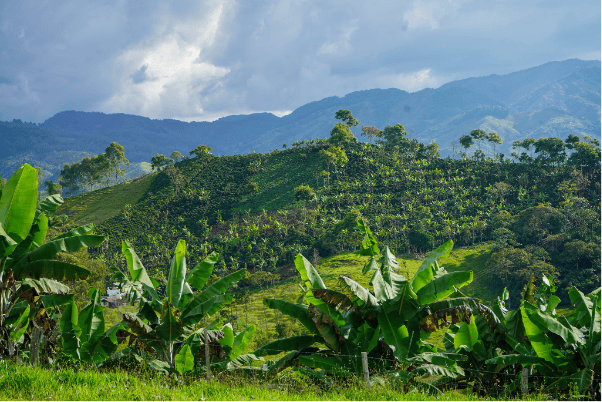
The source of the conflict is invisible, hidden beneath the mountains of southwestern Antioquia, where farmers cultivate coffee in the villages of Quebradona, Palocabildo, Vallecitos, La Soledad, La Hermosa, and Cauca. Even so, the buried treasure has long been a dream, an ambition, and a promise presented by the multinational AngloGold Ashanti in its 2020 reports to shareholders: 2.9 billion pounds of copper, 1.4 million ounces of gold, and 21.6 million ounces of silver.
The environmental cost of extracting those riches would be the excavation of underground tunnels using drills, explosives, and heavy machinery, replacing the mountain summit with a crater so deep it could nearly bury a 50-story building twice over, and so wide it could encompass Colombia’s major stadiums—the Atanasio Girardot, Pascual Guerrero, Metropolitano de Barranquilla, and El Campín—placed side by side, with room still to spare.
According to the National University’s Observatory of Environmental Conflicts, the project’s area of influence is home to 329 animal species and 676 plant species. It also contains an aquifer whose disturbance would affect the flow of at least three streams: La Mica, La Virgen, and Yarumala.
Those who support the project despite its environmental costs see the mine as a path toward a greater good: economic development and employment. In March of this year, even before mining operations had begun, Quebradona already provided direct employment to about 105 local residents.
These two narratives—environmental conservation and economic development—are in constant dialogue throughout Jericó. They appear in demonstrations, on banners hanging from windows, in casual conversations among passersby, in the platforms of candidates seeking public office, and, of course, in the local newspapers displayed in public establishments: Aldea de Piedras, the mining company’s publication, and Despierta Jericó, published by the Environmental Roundtable that leads opposition to the project.
However, this battle of competing narratives is not confined to the municipality itself. As Colombiacheck found, as part of a collaborative investigation led by the Latin American Center for Investigative Journalism (CLIP), together with six other media outlets in the region and supported by the Global Initiative for Information Integrity on Climate Change, journalists have been examining who is behind the attacks against defenders of land and the environment in Guatemala, Mexico, Honduras, Colombia, Brazil, and Panama.
In February 2024, an investigation by El Armadillo identified a news website and at least 30 X accounts, created between October 2022 and December 2023, that were devoted almost exclusively to amplifying Quebradona’s institutional messaging across Colombia. They used hashtags that AngloGold Ashanti was promoting through its official account (@AGAColombia): #ThereIsRoomForEveryone (#TodosCabemos) and #MiningWithPurpose (#MineríaConPropósito).
Within that institutional narrative, protests by opponents of the Quebradona project are consistently described as “acts of vandalism,” “illegal detentions,” or even portrayed as criminal offenses.
This position extended beyond the media sphere. As the Environmental Roundtable had already reported in 2020, AngloGold Ashanti had by then filed criminal complaints against farmers who were monitoring the company’s exploration activities. In 2024, the multinational itself reported that it had filed another criminal complaint.
In mid-2025, the mining company announced its involvement in the criminal case against 11 farmers accused of simple kidnapping, personal injury, and aggravated theft. According to its statement, the company fulfilled its “civic duty to report to the authorities any acts of which it becomes aware and that may or may not constitute a crime.”
Porfirio Garcés is one of the farmers charged in the proceedings, with his indictment hearing scheduled for next August. With a touch of humor, he refers to himself as “the grandfather of the eleven”:
“At 87 years old, I’m being prosecuted for the first time for defending this region. But why do I defend it? Because I love it, because I care about it, because I was born here. Because this was my cradle, and because it’s a region that deserves to be loved. It’s a very healthy place, with humble but kind-hearted people.”
The Colombian Ombudsman’s Office rejected the prosecution of these demonstrators in May 2025, arguing that it contravenes Article 9 of the Escazú Agreement, signed by Colombia in 2019, which requires the state to guarantee environmental defenders “a safe and enabling environment” in which they can “act free from threats, restrictions, and insecurity.”
In its response to this journalistic alliance, Quebradona Copper Mine reiterated that the complaints were filed because of evidence of “illegal actions and unlawful conduct.” According to the company, the protests resulted in “violent acts against individuals, work equipment, and vehicles.” Finally, the company once again emphasized that it is its “constitutional and legal duty to inform the authorities of acts that could constitute violations of the law,” adding that it will be up to the Attorney General’s Office to determine whether any criminal conduct occurred.
Legal Proceedings and the Network
Between May 2022 and December 2023, farmers from the villages of Jericó held numerous demonstrations that prevented personnel from Quebradona Copper Mine from continuing exploration studies in the area. The Environmental Roundtable and its members have maintained that these were peaceful protests throughout, while supporters of the project condemn what they describe as direct action tactics, arguing that they harmed both the company and the local community.
Lina María Velásquez, a communications officer affiliated with the organization, reported in July 2024 that two legal complaints filed by the company were underway. The first targeted 46 people who took part in a sit-in between late 2022 and early 2023. The second was filed against 57 people who entered a property in the village of La Soledad to dismantle equipment the company was using to measure groundwater levels in the area.
Based on those latter events, on May 13, 2025, the Attorney General’s Office summoned 11 of the protesting farmers to an arraignment hearing. Since June 16, 2025, they have been subject to non-custodial pretrial restrictions. Several of them share their testimony below.
All proceedings remain ongoing following six hearings arising from the company’s complaints, with the criminal prosecution hearing scheduled for August 3–6.
In addition, on May 28, another group of demonstrators received summonses from the Jericó Police Inspector’s Office. Acting on an anonymous complaint, the office scheduled individual hearings beginning June 1 to determine whether those named had committed “urban planning violations within the municipality.”
In light of the findings previously documented by El Armadillo, Colombiacheck decided to revisit the activity of the X accounts that, until early 2024, had been dedicated to promoting a narrative of prosperity and development in support of the Quebradona mining project. We reviewed 15 months of interactions, from January 2025 through April 2026, coinciding with the legal proceedings against the group known as the “Jericó Eleven.”
We found that many of the accounts previously identified remain active. In fact, the network has expanded to a total of 37 users, 34 of whom are followed by AngloGold Ashanti Colombia’s official X account. Posts from these profiles frequently repost the company’s graphics and use hashtags such as #ResponsibleMining (#MineríaResponsable), #ThereIsRoomForEveryone (#TodosCabemos), and #CopperForLife (#CobreParaLaVida), among others.
We found no evidence that bots were being used. Instead, we investigated the identities behind the accounts and identified two recurring patterns:
- Most belong to women and young people who genuinely live in villages such as Vallecitos and La Hermosa and have benefited from social investment projects funded by the mining company.
- Several have worked for Quebradona, have relatives employed by the project, or believe their livelihoods could eventually benefit from the mine’s operation.
None of these interests is disclosed anywhere on their profiles. Many of these users repeatedly appear across Quebradona’s various communication channels, praising the benefits they say they have received from the company’s social investment initiatives.
AngloGold Ashanti categorically denied to this journalistic alliance that it had funded or coordinated digital campaigns. In a written statement, the company asserted that it “does not, under any circumstances, influence or pressure external actors to publish content about the project.” It also stated that it respects “the complete autonomy of any citizen to express their own opinions on social media, for which the company bears no responsibility.”
However, the support several of these individuals express for the mining project extends beyond social media. Eight of them submitted written comments to the Ministry of Environment during the public consultation period for a separate proposal to establish a Temporary Environmental Reserve Zone in southwestern Antioquia. If enacted, the measure would prevent the granting of new mining concessions in the area. The submissions argued that the proposal had not been adequately socialized beforehand, questioned the clarity of its legal framework, and warned that the restriction could have negative economic consequences for tourism, investment, and youth employment in Jericó.
The mining company’s opposition to the measure was also conveyed through a letter signed by four of the employees mentioned above. The letter explicitly requested that the Ministry “refrain from issuing a resolution such as the one proposed and instead carry out the necessary technical studies before declaring any area protected or, alternatively, establish transitional regulations that respect the continuation of pre-existing mining activities in the area that hold all permits and authorizations applicable to their current stage of development.”
The same four employees also signed a letter dated January 14, 2023, addressed to President Gustavo Petro, requesting recognition as a community and the opportunity to engage in dialogue regarding the future of the Quebradona project.
Among the signatories to both letters is José María Dávila Román, the mining company’s communications specialist and one of the most active members of this digital network promoting Quebradona. His view is that, on social media, an employee can speak “both as an employee and as a resident of Jericó.” Neither his X biography nor the blog linked from his profile identifies his position at the company. Nor did Al Día Suroeste—a news outlet aligned with AngloGold’s project—where he was listed simply as “Director of Print Media.”
 When interviewed for this investigation, Dávila confirmed his direct employment with the company: “I work in Quebradona’s communications department… Part of my role on the project is to share what we do with the community through the media… I believe in this project. I believe it can be a good opportunity—not only for Jericó, but for the country.”
Posts from Dávila’s account were shared by 15 of the 37 accounts identified in the investigation, which also actively amplify content from AngloGold Ashanti Colombia’s official profile. Beyond these two primary sources of the mining narrative, this first group also circulated messages from a second cluster: a core group of X users, influencers, and public and anonymous social media personalities who amplified the multinational’s messaging to their thousands of followers.
Unlike the first group of accounts, which generally seeks to project a diplomatic and conciliatory tone, this second cluster becomes especially active during sensitive moments and employs a markedly hostile and polarizing discourse against those seeking to stop the mining project. The visualization below illustrates the interactions among these accounts and the reach achieved by these external actors.
As shown, Pablo Pinto Brun, Quebradona’s head of communications and also a signatory to the two letters sent to government authorities, shares content from both high-profile influencers with thousands of followers and smaller accounts belonging to Jericó residents. During the criminal proceedings against the 11 farmers, he appeared in a photograph alongside individuals associated with both groups.
#AparecieronLasLlaves
En #Jericó, @PintoBrun comunicador de Minera de Cobre #Quebradona acompañado de @Danielbricen que amaneció hablando de los “falsos ambientalistas” de #Jericó y de @dona_pily2 @ANIABELLO_R @julipalacioc que han estigmatizado al campesinado defensor del AGUA pic.twitter.com/2JxPWlrsyB— Lina María Velásquez (@Linavelasqueze) June 3, 2025
Taken together, employees, beneficiaries, and others with an interest in the mining project account for a total of 50 X profiles. This figure includes the influencers already mentioned as well as three accounts representing organized groups supportive of Quebradona: Jericó es Desarrollo (“Jericó Is Development”), Jericoanos con Visión (“Jericó Residents with Vision”), and Veeduría Recursos Naturales en Jericó (“Natural Resources Oversight Committee in Jericó”).
Pinto Brun and José María Dávila also appeared as opposing parties in a constitutional protection action (tutela) seeking to protect the rights to environmental participation and prior consultation. Asked about his involvement, Dávila said he joined the case as a supporting party at the request of a university professor, relying on the Ministry of the Interior’s certification that there were no Indigenous communities in the area concerned. “Where Indigenous communities do exist, there absolutely must be a process of prior consultation,” he stated.
Pablo Pinto Brun received a questionnaire concerning these matters and responded as follows: “It is important to clarify that my role is not that of a company spokesperson, nor am I authorized to make individual statements on its behalf. For that reason, and in order to avoid partial interpretations or fragmented responses on matters that are strictly corporate in nature, a single consolidated response has been provided, reflecting the organization’s official position on the issues raised.”
As these findings show, both men play significant roles within what the investigation describes as this propaganda apparatus—hereafter referred to as the network—whose definition and analytical framework are explained in the methodological note at the end of the article.


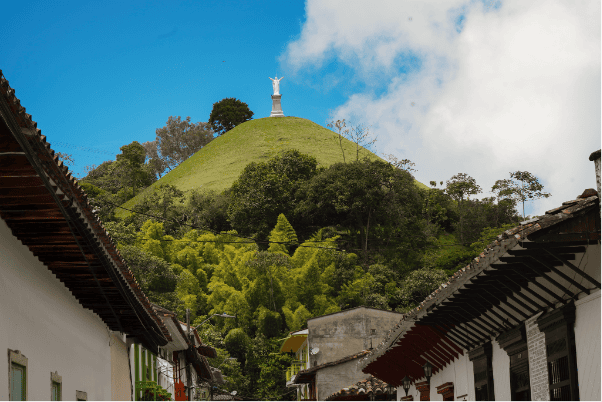
Streets of Jericó. Photos: Leidy Stephany Arenas Díaz.
A Digital Echo Chamber Against the Eleven
Using the media monitoring platform Meltwater, we obtained a dataset of 16,959 X posts published by the accounts identified above between January 2025 and April 2026. The graph below shows the periods of highest interaction among these accounts during the timeframe analyzed—that is, when they published original posts or reposted, quoted, or replied to other content.
Several of the highest peaks correspond to critical moments for either the municipality or the company. For example, on December 3, 2025—the day after the National Mining Agency denied the renewal of the Quebradona project’s mining title. Meanwhile, the highest level of activity in 2026 coincided with presidential candidate Paloma Valencia’s visit to Jericó. Posts from that day combined support for her campaign with messages urging backing for the Quebradona project, using the institutional hashtag #ThereIsRoomForEveryone (#TodosCabemos).
We also identified spikes devoted almost entirely to promoting stigmatizing narratives against the demonstrators, portraying them as people who do not respect the authorities, who serve hidden interests, or who are criminals—or even guerrillas.
On March 27, 2025, farmers organized another sit-in that prevented Quebradona employees from continuing exploration work. This date marks the highest level of account activity during the period analyzed, after AngloGold Ashanti posted on X alleging that its employees had been “detained.”
The company’s message was amplified by media outlets such as Blu Radio and Caracol Radio. In the comments on those posts, several women from the identified network repeatedly used the expression “vías de hecho” (“extralegal direct action”). Their comments argued that the mining company promoted “honest development” and claimed that the protest was the work of a minority that did not represent Jericó’s farming community.
During this period, several of the female X users identified as belonging to the second group also became active. One was lawyer and former Senate candidate for the Democratic Center party, Ana María “Ani” Abello (@ANIABELLO_R), who now promotes the Tigresas movement supporting presidential candidate Abelardo De la Espriella. In her post, she suggested that the demonstrators’ sit-in was unlawful.
Meanwhile, the user Pilar Rodríguez, known as “Doña Pily” (@dona_pily2), directly described the demonstrators as “violent paid activists” and “kidnappers.” It is worth recalling that both she and “Ani” Abello were previously identified as participants in the so-called “Uribista troll farm“, which disseminated disinformation favorable to the government of Iván Duque.
When interviewed for this report, Rodríguez said she travels frequently to Jericó and defended her statements by referring to what she said she learned during one of her visits about the “occupation” of a farm and the removal of equipment:
“That man couldn’t leave his house for who knows how long. They had them trapped inside their own home—that’s true… The word sounds awful, but then what do you call someone who can’t leave their own house?”
However, Rodríguez softened her characterization of the demonstrators, adding: “I don’t think they’re bad people. I think they can be manipulated.” She also said that some residents who support the project tell her: “They used to be good people, and then somehow they went over to the dark side.”
The portrayal of the demonstrators as criminals continued throughout the period highlighted in the graph, with repeated assertions labeling the farmers as criminals before any conviction had been handed down, in apparent tension with the presumption of innocence that applies to the 11 farmers standing trial.
The period in question spans the time between the arraignment hearing and the judge’s decision on pretrial measures. The judge rejected the Prosecutor’s Office’s request to place the defendants in pretrial detention while the criminal proceedings were pending.
Among the 1,715 posts analyzed during that period, three main narratives predominated.
The first portrayed the demonstrators as “fake environmentalists” who were controlled by leaders, paid to protest, driven by hidden interests, or manipulated by the alleged “masterminds” behind the crimes with which they had been charged. According to Claudia Serna, attorney for the eleven defendants, prosecutors themselves used the same expression during one of the hearings.
The second narrative, promoted by AngloGold Ashanti and rejected by the Colombian Ombudsman’s Office, argued that the lawsuit had nothing to do with defending the territory or environmental activism, but instead concerned criminal conduct unrelated to social protest.
The third emphasized that 50 people had filed the complaint against the 11 demonstrators, repeatedly stressing that the protests represented only a minority of the local population (1, 2, 3).
Promoting these narratives became the principal activity of the group of Jericó residents, particularly through efforts to undermine the #IStandWithThe11OfJericó (#EstoyConLos11DeJericó) campaign launched by the Environmental Roundtable. Posts from these accounts adopted the phrase “I do not #StandWithThe11OfJericó” in order to insert allegations about the farmers’ supposed crimes and misconduct into conversations using the campaign’s hashtag.
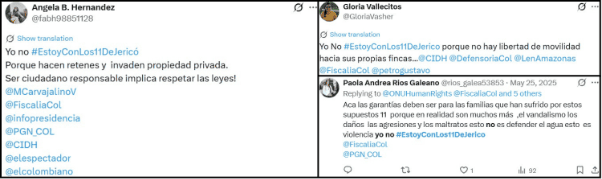 According to Luisa Fernanda Pedraza, a researcher at Censat Agua Viva, the operation “has a gender component, expressed in portraying the women in the group as reasonable people who are open to dialogue, while depicting the eleven men as aggressive and opposed to development.”
Meanwhile, X users from outside the region intensified accusations against the farmers facing prosecution, referring to alleged crimes while the judicial process was only just beginning.
The leading voices behind these accusations were, in fact, the users Ani Abello, Doña Pily, and Juliana Palacio (@julipalacioc), who spearheaded the group of accounts describing the eleven as “guerrillas,” “thugs,” “criminals,” and “delinquents.”
The three traveled together to Jericó on May 19–20, accompanied by Daniel Briceño—then a Bogotá city councilor for the Democratic Center party and now a member-elect of Colombia’s House of Representatives. During the visit, Briceño expanded on the claim that the protesters were “fake environmentalists.” His video shows that the group was received at the offices of Quebradona Mining and later met with women who are part of the network.
Interviewed for this report, Briceño confirmed that he visited the project at AngloGold Ashanti’s invitation. Like Pilar Rodríguez, he said he had known Pablo Pinto for some time—in his case, “through the running community.” Regarding his posts, Briceño defended his use of the term fake environmentalism, saying he had not coined it himself but had heard it “at some conference.” He described it as a political critique and stressed that he had never referred to the prosecuted farmers as guerrillas or criminals.
“Until the courts rule on matters like these, I try not to make those kinds of statements,” he clarified.
It remains unclear why social media figures with no direct ties to either the region or the project have taken such an active interest in commenting during key moments. According to José María Dávila, Quebradona’s communications specialist, who spoke to El Armadillo, the company has “briefed them on the project so they can learn firsthand about our activities.” Along similar lines, Daniel Briceño told us:
“I’m very interested in this project. I think it’s an extremely important project, and one that Colombia should move forward with.”
The day with the highest level of interaction during the period analyzed was May 23, 2025, one day after the teenage environmental activist Francisco Vera posted a video expressing support for the #IStandWithThe11OfJericó campaign. In response, Juliana Palacio and other like-minded accounts directed stigmatizing messages at him. Several women from the network joined the discussion, defending Palacio and dismissing the young activist.
When interviewed for this investigation, Francisco Vera’s mother said that Palacio’s attacks on her son have been ongoing: “This woman has been targeting Francisco for a long time, even linking him to armed groups, which is one of the reasons Francisco is now living in exile.” A monitoring document provided by the family shows that these messages, which began in 2020, have consistently targeted the young activist and have been amplified by other X users.
Finally, on the day the judge ruled that the defendants would remain free while awaiting trial, the network launched a new hashtag: #50VictimsOfJericó (#50VíctimasDeJericó). The purpose of the label was to reverse the narrative of victimhood. The focus shifted away from the 11 farmers facing criminal charges and toward the people allegedly harmed by their protests, portraying them as the true victims deserving public attention.
After that period, the network shifted its attention to opposing government decisions that have hindered the mining project by promoting alternative land uses, such as the declaration of the Temporary Environmental Reserve Zone in mid-June. The group also coordinated its opposition to the designation of an Agricultural Protection Area in November, which restricts land use to food production or ecotourism.
The most recent references to the “Jericó Eleven” date from last February and are tied to election-season campaigning, including congressional efforts by the Historic Pact coalition led by candidate León Freddy Muñoz. Given the patterns described above, the report suggests that attacks against the demonstrators may intensify again as the indictment hearing approaches.
Before publishing this report, the journalistic alliance sent a questionnaire to Ana María Abello seeking her response to the issues described. No reply had been received by the time this edition went to press. The reporters also attempted to contact Juliana Palacio but were unable to reach her.
Methodological Note
The selection and analysis of the X (formerly Twitter) accounts discussed in this report was based on the findings of an earlier investigation by El Armadillo, which in February 2024 identified an initial group of approximately 30 profiles dedicated to amplifying the institutional messaging of the Quebradona mining project.
We tracked the evolution of that network by analyzing 15 months of interactions, covering the period from January 2025 through April 2026, during which the judicial proceedings against the “Jericó Eleven” took place. Over the course of this analysis, we found that the network had expanded to 37 active profiles. This selection was not arbitrary. It was based on two criteria documented through network analysis: The active amplification of content published by the mining company’s official account and its spokespersons. Coordinated participation during key moments of public debate concerning the territory.
After ruling out the use of automated accounts (bots) and verifying the identities of the users, we used the media intelligence platform Meltwater to compile a dataset of 16,959 posts published by these 37 accounts during the period under review. This dataset enabled us to chart peaks in their interaction and document the narratives used to stigmatize the farmers facing criminal prosecution.

Digital Poachers (Taladores Digitales) is an investigative project aimed at uncovering the interests behind online smear campaigns targeting environmental activists in six Latin American countries. The project is coordinated by the Latin American Center for Investigative Journalism (CLIP) in partnership with AFP (Brazil), Colombiacheck (Colombia), Agencia Ocote (Guatemala), Contracorriente (Honduras), Animal Político and Mongabay Latam (Mexico), and Concolón (Panama). It was carried out with support from the Global Initiative for Information Integrity on Climate Change and received legal review from El Veinte.


