


A copper mine in the middle of the Colombian Amazon, a protected forest that could be reduced to make way for it, a mining company that operates in a secrecy jurisdiction, a veteran U.S. politician who is a stakeholder in it, and a mining executive who does not believe in climate change, even though he seeks to work in one of the most fragile ecosystems on the planet.
These are some of the peculiar features of Canadian mining company Libero Copper’s copper project in Putumayo, where the Andes meet the Amazon rainforest.
Conservation of the Amazon rainforest is Colombia’s greatest contribution to solving the global climate crisis.
In recent years, the Colombian jungle that forms part of the Amazon, the world’s largest continuous rainforest, has climbed many rungs in official political discourse. Gustavo Petro, the current president, called it one of the four “pillars of the planet’s climate” and proposed that countries be allowed to swap their foreign debt for environmental services that would keep it standing. His predecessor, Iván Duque, said that “protecting the Amazon is not an option, but a moral duty” and the previous president, Juan Manuel Santos, created the world’s largest rainforest national park.
These pledges will be put to the test by plans to open a copper mine in the highlands of Putumayo, where the Andean peaks meet the Amazon rainforest. If brought to fruition, the mine promoted by Canadian company Libero Copper in Mocoa would be the first major legal mining project in the Colombian Amazon. Incidentally, it could bring with it the felling of a forest that is protected today and that the country proposed to expand just a decade ago to safeguard it.
The Libero copper project is located in the forests 10 kilometers from Mocoa, in the vicinity of a nationally protected forest reserve and two indigenous reservations. Video: Pedro Samper.
There are substantial arguments in favor of the mine. It would be Colombia’s largest endeavor in copper, a mineral the current government has labeled “strategic” because of its high global demand for electric cars, solar panels and wind turbines, at a time when Petro vowed to transition to cleaner energy sources. Libero, which has been conducting exploration drilling since February 2022, describes the deposit as “the largest copper resource in Colombia and one of the world’s largest undeveloped molybdenum deposits.” Its preliminary estimates are that it could hold 636 million tons of both minerals, which would bring Colombia sizable royalties.
But it could also have a significant impact on an environmentally sensitive area, rich in biodiversity and water sources. The prospect of the mine has already triggered a protest in Mocoa, the Colombian Amazon’s third largest city, located 10 kilometers from the namesake deposit. Many of its 40,000 inhabitants fear a repeat of a tragedy like that of March 2017, when a torrential flood of mud and water left 330 dead in a disaster that scientists say was likely aggravated by deforestation.
So far, Putumayo residents – and Colombians – know little about the project’s developers and its possible consequences on an ecosystem that the country has pledged to protect. An investigation by the Latin American Center for Investigative Journalism (CLIP), NBC News of the United States and Mongabay, with support from the Pulitzer Center’s Rainforest Investigations Network, found that the looming project would benefit two members of a U.S. political dynasty and that carrying it out could entail shrinking a protected natural area.
With its unusual combination of a U.S. political dynasty investing in a Canadian mining company in the world’s largest rainforest, the Mocoa project sits at the unique intersection of shifting economic, environmental and political concerns surrounding mining around the world. This is the story of the Amazonian copper mine, the forest reserve that could be cut down to make way for it, the veteran Republican politician that invested in it and the mining executive who doesn’t believe in climate change.

The arrival of Anglo Asian and the Sununus in Putumayo
Colombia has been a mining country for several decades but, unlike other South American countries such as Peru or Chile, it has been slow to tap its potential to mine copper. So much so that it is only the 44th largest producer in the world, according to the national mining association.
This changed in 2021, when the government began promoting a shift towards copper, which it described as ‘the mineral of the energy transition’ due to its growing global demand and for being the best known conductor of electricity. “We want to become the third largest copper producer in Latin America,” President Iván Duque announced. His successor and opponent, Gustavo Petro, highly critical of coal and oil, is also pinning his hopes on those minerals. “Just as in prehistoric times we needed stone, iron and bronze, now we need some minerals (…) Colombia doesn’t seem to have them, except nickel and some copper,” he told mining entrepreneurs, encouraging them to prospect for them.
There is already a first project operating in Chocó and at least seven others in various planning stages, but the deposit in the Amazonian department of Putumayo appears to be the one with the greatest potential. First identified in 1973, interest in mining it only took off in the last decade and became more tangible when Canada’s Libero Copper & Gold Corporation bought it from another mining company, B2 Gold Corp, in 2018 in exchange for a stake in its shares.
Libero Copper is one of a thousand small exploration companies -known as ‘juniors’- based in Canada. These mining start-ups often spend years developing deposits around the world and then sell them to larger companies with a view to mining them. Its CEO Ian Harris told this journalistic alliance that Libero differs from most juniors in that it plans to produce copper from its deposit in Mocoa. He explained that they do not plan to engage in large-scale mining, but to build a small mine and create an “ethically sourced” supply chain that supplies “a green economy.”
The company’s pursuit of copper is part of an industry trend, though. As demand has increased for “green energy” metals, many junior mining companies pivoted away from metals like iron to exploring those deposits.
“There’s urgency as people are recognizing the intrinsic link between those metals required to reach that [carbon zero] goal,” said Alex Christopher, former president of the Prospectors and Developers Association of Canada, the country with the highest concentration of these mining companies. As a result, he says, “the base of investors in the junior mining space is broadening.” It’s still a speculative industry: the vast majority of junior mining projects fail, but those that succeed can be a lottery for their investors.
“We’re in a rush for energy and battery minerals. The global economy is scrambling to scale up the supply of minerals needed for the green energy transition,” said Simon Jowitt, an economic geologist and professor at the University of Nevada Las Vegas in an interview with this journalistic alliance, making tensions between demand, profit and ecological concerns surrounding mining more common.
In October 2021, Libero – headquartered in Vancouver and listed on the Toronto Stock Exchange – reported the start of exploration activities in Putumayo. Two months later, it announced an $8.3 million capital injection from a new investor: UK-based Anglo Asian Mining plc, which became Libero’s largest individual shareholder with just under 20% of shares, according to company documents.
Anglo Asian is a mining company that has worked in Azerbaijan. Its chairman and largest shareholder is Mohammad Reza Vaziri, a lawyer of Iranian origin who holds 28.7% of its shares and is listed as exercising significant control over the company. Having held several senior positions in Iran’s government prior to the 1979 Islamist revolution, Vaziri emerged as a prominent businessman in Azerbaijan, running Anglo Asian’s gold, silver and copper mining operations, most notably the Gedabek mine.
His main partner – and Anglo Asian’s second largest shareholder – is John Henry Sununu, patriarch of a powerful Republican political dynasty of Salvadoran-Lebanese origin in the state of New Hampshire. This former governor of his state and former chief of staff to George Bush Sr. in the White House owns 9.3% of Anglo Asian and sits on its board of directors, according to company documents.

Apart from Anglo Asian, the elder Sununu and Vaziri have overlapped at the U.S.-Azerbaijan Chamber of Commerce, a business lobbying organization where the former has sat on the advisory council and the latter on the board of directors. It is a high-profile political guild whose board of trustees is headed by Ilham Aliyev, the autocratic president who has ruled Azerbaijan for two decades, and includes two former US secretaries of state and a national security advisor.
Anglo Asian’s capital injection enabled it to appoint a member on Libero’s board. It chose Michael Charles Sununu, John Henry’s son and an American executive with experience in the oil and energy sector, who has also been on the board of Anglo Asian.
Their surname has been a respected brand in Republican politics for 40 years. In addition to John H., his other son John Edward Sununu served in the U.S. Congress for over a decade, as a senator and representative. Yet another son, Chris Sununu, has been governor of New Hampshire for six years and is one of the few Republicans who has successfully navigated the line between marking distance from Donald Trump – going so far as to criticize him for the storming of the Capitol a year ago – and staying safe from his political vendettas. He was widely expected to run as a candidate in the Republican Party primaries for the 2024 presidential election, but announced last week that he wouldn’t. The governor hasn’t disclosed any direct involvement with either company and, according to an email response from his office, has no involvement in their operations.
Regarding the Mocoa mine’s potential environmental impact, Libero president Harris explained that the company’s vision has changed and it now imagines an underground operation, devoid of open pits or tailings facilities. This would allow them, he explained, to minimize the impact on water sources. “We truly believe that we can develop a project that has a very small impact and footprint, and dramatically reduces any of the normal environmental concerns”, he says. The total area, he noted, could be less than 100 or 200 hectares. He envisions moving to the licensing phase only four to ten years from now.
Harris sees the Mocoa mine as the pillar for Colombia to develop a “circular and green” industry from processed copper, instead of being a supplier of the commodity. In his view, the country is positioned to benefit from the global demand for the metal, due to the existence of multiple deposits in the ‘Andean belt’, as well as the geopolitical decision of countries like the US to rely less on China. “In order to do the energy transition, in the next 27 years you have to produce twice more [copper] than has been produced in the history of mankind. Colombia has a massive opportunity,” he said.
In Harris’ view, Colombia could follow the model of Saudi Arabia, which -in his words- “didn’t just export oil but built industries” around plastics, gasoline or petrochemicals. On a more local level, Harris argues that copper could help Putumayo become less dependent on extractive or illicit economies. In his opinion, the national government’s announcement last month that deforestation decreased by 25% in the Colombian Amazon during 2022, but jumped 26% in Putumayo, underscores the need for projects like his.
In fact, Harris is openly complimentary of Colombia’s current left-wing president and underscores that the company he leads fits within his vision for mining. “I do really enjoy the way that President Petro says he wants to build an industry of life, not one that is a culprit of the world’s global warming, but the opposite”, he said.
Anglo Asian, Libero’s president explained, is a key part of the company’s plan for the Mocoa mine to produce copper metal and not just the concentrate that is shipped to China for smelting. He recounted having met them when he led a mining company in Saudi Arabia and being marveled by their “innovative approach” to recovering copper from a gold solution.
“I personally visited their operations in Azerbaijan and was blown away by the professionalism and knowledge of the team,” said the mining engineer who also worked in the US, Venezuela, Ecuador and Mali.
Harris preferred not to identify its other partners, but stressed that it is a “largely diversified group,” that none other holds more than 10% of shares, and that he aims to attract more investors. “We look for shareholders that are aligned with the vision of building green industries,” he said.
Anglo Asian Mining’s spokesperson explained in an email that its investment in Libero follows its strategy to expand its global presence and commodity portfolio. The company, its spokesperson said, “has a strong track record of operating its mines and production facilities with a commitment to best practices” and “works with its stakeholders at the local and national levels to maintain its high level of environmental and social stewardship – and will continue to do so as it expands its operations”. Michael Sununu, its board member and representative on Libero’s board, responded by email that he wouldn’t provide any comments outside of Anglo Asian’s response. His father, John H. Sununu, replied in an email that “Anglo Asian’s statement should suffice”.

The forest reserve Libero contemplates shrinking
Although the situation in the Colombian Amazon is less dramatic than in neighboring Brazil and 86 percent of its area is still in a good state of conservation, deforestation has increased rapidly since the signing of the peace agreement with the Revolutionary Armed Forces of Colombia (FARC) in late 2016. However, according to Environment Ministry figures, Colombia has lost 1.85 million hectares of the Amazon biome since 2001 – almost the area of Slovenia.
Right off the bat, there is one place where Libero’s mining aspirations clash with Colombia’s pledge to safekeep the Amazon: part of the copper lies within a protected natural area, something the mining company acknowledges in its 2022 technical report on the project and its 2023 audit report. “A Regional Forest Reserve is located over the western part of the deposit,” both documents say.
This is the Mocoa River Upper Basin Protected Forest Reserve, an area of 308 square kilometers that safeguards the source of the river that bears the same name as the mine and the neighboring departmental capital – and which doesn’t have a regional protection status, as Libero’s report suggests, but a national one. It is one of Colombia’s 59 national protected forest reserves, a category designed to preserve forests that are in a good state of conservation and that only admits sustainable economic activities.
Despite its relatively small size, the forest reserve west of Mocoa encompasses a wide variety of ecosystems, from tropical rainforests at 800 meters to high-altitude paramos (alpine tundras) above 3,200 meters. Due to its unusually steep terrain, it harbors great biodiversity and is a privileged wildlife corridor between the Amazon and the Andes. A wildlife survey conducted by biologists from the environmental NGO Wildlife Conservation Society in 2016 spotted 163 species of birds, more than there are in entire countries.
This overlap of the mine with the protected forest means that, in addition to obtaining a national environmental license and concession contract from the Colombian government to eventually move into a mining phase, Libero contemplates that it would need a third permit.
Since mining is not permitted in the forest reserve, the mining company’s documents show that – in order to access part of that copper – it is contemplating requesting the national government to reduce the size of the protected area.
“Libero believes they will gain access to the Forest Reserve for mining purposes as part of the environmental permitting phase of the project. These types of concessions for mining projects are not uncommon and, as a result, the base case estimate of mineral resources assumes access for mining purposes that extends into the current Forest Reserve area,” say both its 2022 technical report and 2023 audit.
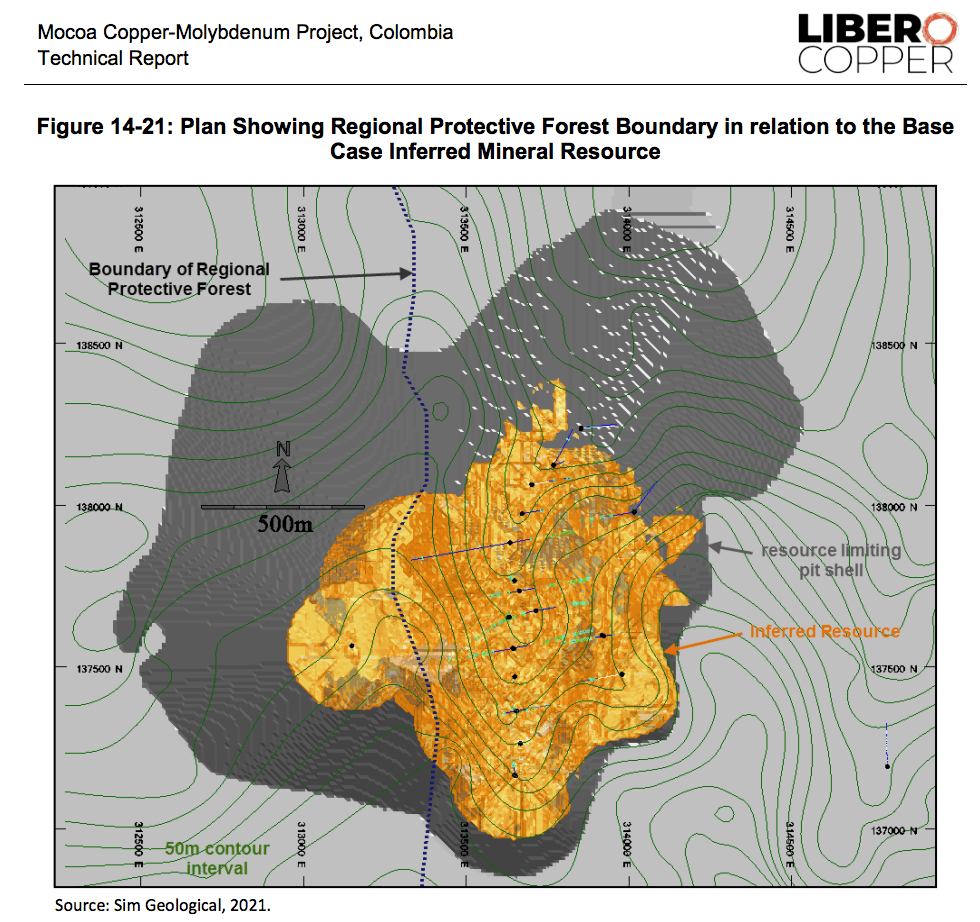
In another passage of the technical report, Libero notes that although it “does not currently have permission to drill in the Forest Reserve,” it is confident that it will be able to apply for the administrative subtraction procedure that – if granted – would remove any restrictions on the use of the land where the ore is located.
“Libero has researched Colombian law for information regarding access to a forest reserve. The Company believes the process is similar to obtaining other permits required to develop a mine and expects it can obtain the necessary access to the forest reserve as the project develops,” it concluded.
In fact, although most of the deposit lies outside this protected area, Libero’s documents suggest that the viability of the mine depends in part on this subtraction. “Should the Colombian Government decide not to grant access into this area, this would reduce the size of the estimated mineral resources by about one half,” say both the 2022 technical report and the 2023 audit report. “Other than the location of the Forest Reserve and the portion of the resource that is partially oxidized, there are no other known factors related to environmental, permitting, legal, title, taxation, socio-economic, marketing, or political issues which could materially affect the mineral resource,” both documents note.
Asked which legislation Libero believes would allow them to propose shrinking the protected area, Libero president Harris responded that the Environment Ministry’s Resolution 110 from 2022. This was a controversial norm with which the Duque administration relaxed the subtraction procedure for activities deemed of public utility and social interest – including mining – and which the Petro government is in the process of repealing. And that, in addition, clashes with a 2011 law that expressly forbids mining within this type of protected area. Consulted about the viability of a request in a protected forest reserve, the Environment Ministry emphatically replied that “Law 1450 of 2011 prohibits mining and subtractions for that purpose in protected forest reserve areas”.
In an interview with this journalistic alliance, the mining company downplayed the importance of what its reports say about the subtraction. “The current idea is not to do it, because we’re working with a much smaller project,” said Ian Harris, adding that they have not made the request and that the current project design excludes mining within the forest reserve. “There is legal ambiguity but it’s not a current objective of the company. At today’s date, it’s not necessary,” he added.
A request to the Environment Ministry for the names of all the companies and persons that have requested subtractions from forest reserves since August 2018 confirmed that neither the mining company nor its directors appear on the list. There were also no requests for the forest reserve that protects the source of the Mocoa River.
A forgotten proposal to expand the protected forest
A decade ago, the Colombian government considered expanding the protected area that Libero’s reports speak of, and if those plans had been carried out, the forest reserve could have ended up covering part of the area currently being explored by the Canadian mining company.
The reason is that the road between Mocoa and the town of San Francisco, to replace another one commonly dubbed “the trampoline of death” that is still in use and takes three hours to travel 78 kilometers, crossed another fragment of the same forest reserve. The construction of this bypass has been a demand of Putumayo’s inhabitants, historically poorly connected to the rest of the country. Because this new 44-kilometer-long road is located in an environmentally rich area and required removing a corner of the Mocoa River forest reserve, the project outlined by the Alvaro Uribe administration and partially financed by the Inter-American Development Bank (IDB) included an ambitious mitigation plan. So ambitious that the lending bank considered it its “pilot for the development of infrastructure projects in areas of high biodiversity”.
At the center of the environmental compensation measures was the expansion of the forest reserve. The objective was to “guarantee the permanence of the large block of habitat that extends along the eastern slope of the eastern mountain range and that in the Colombian massif stands out for its cover of little intervened forest that still stands towards the south and the border with Ecuador,” according to the project’s environmental and social management plan. Among other virtues, the government considered that it would help preserve connectivity with other nearby protected areas, such as the Doña Juana Cascabel and Churumbelos Range national parks.
Two expansion proposals emerged: one to the south of the existing reserve and the other to the north. However, work on the Mocoa-San Francisco bypass – whose construction was conditional on mitigating its environmental impact – was interrupted in 2015. Its viaducts were left half-built in the middle of the jungle, as captured in the documentary ‘Suspension’.
Seven years later, at the beginning of 2022 and already under the government of Iván Duque, work was resumed without IDB funding by a consortium that included Costa Rican construction company Meco, which – as another CLIP investigation reported – had been accused of corruption in its country. The expansion of the forest reserve disappeared completely from the government’s language. Ironically, the president who resuscitated the road – without a word on the promise to mitigate its environmental impact – had worked for 12 years in the development bank that conditioned its construction to strict environmental commitments. With the change of national government last August, there is no news of its extension either.
One of the two areas proposed for the forest reserve’s expansion appears to overlap with where Libero is exploring today, according to a map provided to this journalistic alliance by Corpoamazonia, the regional environmental authority of the western Amazon, in late December 2022. A month later, in early February 2023 and following this journalistic alliance’s insistence, the same government entity sent the shape files for those proposed areas – only they were different and would no longer overlap with the area where the Libero field is located.
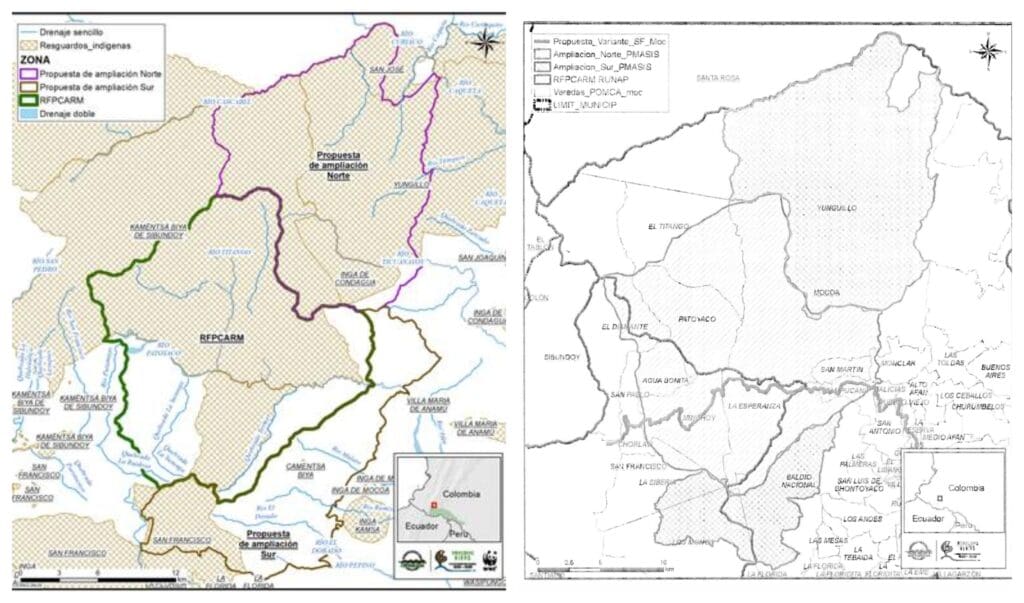
Invías told this journalistic alliance that, as holder of the environmental license of the variant, it submitted its expansion proposal in December 2008 and that “there is no specific timeframe for the process” given that it has been waiting for a response from the Environment Ministry since June 2018. Although it announced that it would send the resolution with the proposal and the corresponding maps, it hadn’t done so by publication date.
Corpoamazonia responded that it doesn’t know if Invías “is advancing in the process of expanding the [forest reserve] or has a new proposal” and explained that the discrepancies in the maps are a result of having considered different alternatives, but that “the proposals consolidating the definitive process” are those that do not overlap with the area where the Libero reservoir is located.
Libero said it is “aware that one of the proposed expansion areas for the protected forest potentially overlapped with our deposit area”, but noted that it was discarded because of opposition from communities and landowners. The company added that it considers “the Mocoa project as a potential source of funding for the protected forest”.
In any case, the expansion of the Mocoa River forest reserve is still bogged down fifteen years after it was deemed necessary to build the road and one year after construction of said road was resumed.
Indigenous people against the mine
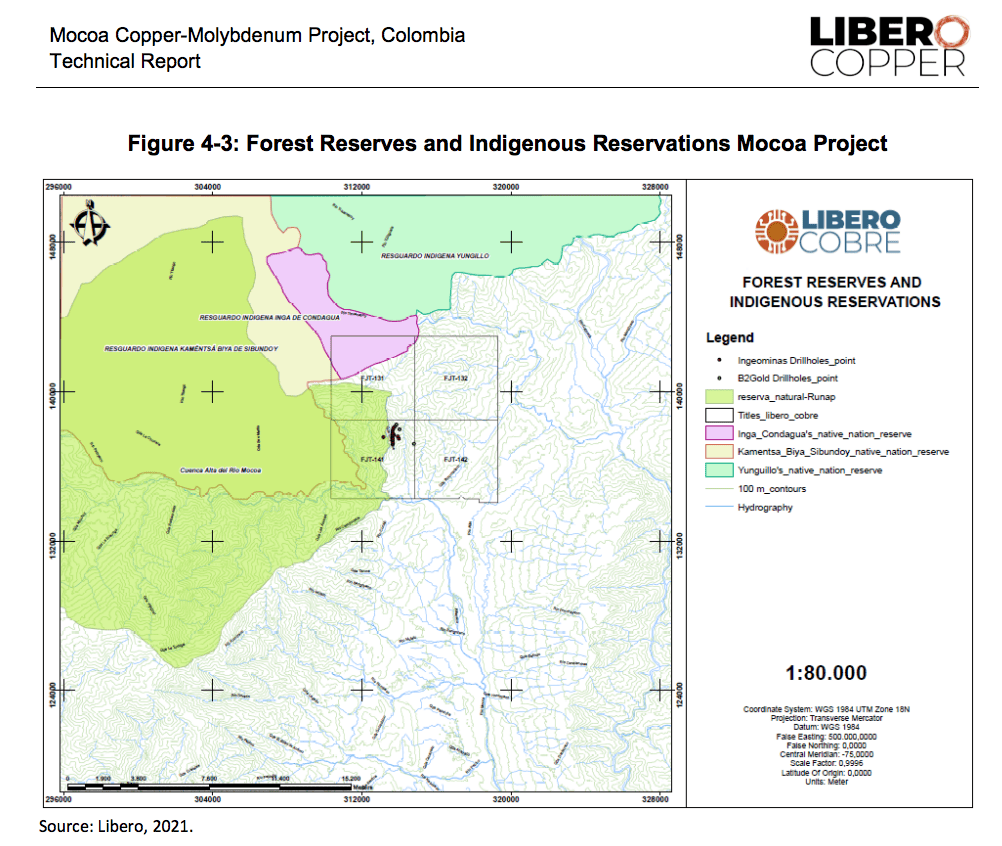
The prospect of this mine is a cause of concern for the Indigenous communities in its area of influence. Especially in those living in two reservations, whose collectively-owned territories overlap with Libero’s mining titles: the Inga reservation of Condagua to the north and Kamentsá Biya of Sibundoy to the west.
“This is the jungle’s heart: where springs are born, which then flow downstream and form rivers. If these headwaters are affected, water will surely decrease”, said Inga leader Ramiro Silvino Chindoy, who was governor of Condagua until last December. He speaks with us while sitting in his traditional doctor’s hut.
Although Libero set up its exploration drills outside the reservations, it seems likely that the company will have to conduct free, prior and informed consultations with the three Indigenous communities whenever it wants to move to the mining phase. A 2017 Interior Ministry resolution determined that the three reservations lie within the area of influence of those mining titles. More recently, in April 2022, the Inga reservation of Condagua filed a protection action arguing that not consulting them during the exploration phase violated their fundamental right to free, prior and informed consent. Per a judge’s order, the Ministry assessed their claim and agreed with them. That decision was appealed by members of the Montclar village where Libero is currently exploring, who said it infringed on their rights as private landowners and demanded they be included in all consultations.
This overlap underscores a widespread contradiction in Colombia: different national government agencies end up granting mining titles to companies in the same places where that same state has granted collective land deeds to ethnic minorities that enjoy special constitutional protection, without one decision invalidating the other. Although Colombian norms oblige companies to consult with communities living there and a mining title does not yet mean an acquired right, traditional authorities of the two reservations visited by this journalistic alliance -Condagua and Kamentsá Biya de Sibundoy- feel that in practice companies assume that they’ll be able to mine and only consult neighboring communities when the projects are already at an advanced stage, and that landholders don’t really have the possibility to refuse. This is usually the seed of several socio-environmental conflicts that then escalate rapidly.
As of May 2023, Libero had requested the Colombian State to grant it 31 additional titles, whichwould expand the area where it can explore by 11.5 times – what Libero describes in its corporate presentation as a “regional opportunity”. That expanded area overlaps with at least nine other reservations, thus opening up a vulnerable terrain for conflict. As of June 8th, however, the National Mining Agency listed 20 of them as rejected and 11 as still pending.
Asked about these requests, Harris insisted that Libero only seeks to develop the Mocoa project. “We have no plans at all of doing any exploration activities in any of the areas that we put in applications for. It’s not on our radar,” he said. “I’m going to be very frank: it was to stop anybody else from coming in.”
“Although there is a legal system that protects us, it is often violated to suit state policies, in this case for mining, which are quite aggressive,” says Angel Pasuy, an architect and Kamentsá leader who has worked in the constitution and expansion processes of several reservations in the Sibundoy valley for a decade. “It seems that Indigenous peoples are an obstacle for such projects because we live in the territories where, unfortunately for us, these riches are found”.
In addition to the overlap with their lands, the Inga and Kamentsá Indigenous people are upset that the Colombian government grants mining titles without taking into account the existence of the forest reserve since 1984. “What good is it for us that there is a conservation figure, in this case environmental, if the Environment Ministry doesn’t provide that information to the National Mining Agency or, vice versa, the latter does not consult the Ministry whether it can grant a mining title there?” asks Pasuy. “They should have the complete map with the shapes of protected areas and collective territories and, according to that, grant or not mining titles.”
The skepticism of many Indigenous communities towards mining is due, according to Inga leader Hernando Chindoy, to the fact that the successive economic booms in the Amazon – from cinchona bark and rubber in the 19th century, to coca, oil and gold more recently – have not brought them greater well-being. In the words of the Inga national political leader, “if they extract copper, gold and other resources but people don’t see any real progress and, on top of that, their skills are not enhanced, in the end what they’ll be left with is simply a destroyed territory”.
In relation to consultations with Indigenous communities, Harris stated that “we will do whatever the law states”. Libero’s president stressed that they are currently only conducting studies on private land in the Montclar area – with whose peasant community the company has a fluid relationship – and that they haven’t done so in Indigenous territories. Vice-president of corporate affairs Thyana Álvarez added that the company has had dialogues “with all the Indigenous communities in Mocoa from the very beginning” and that they have a local Indigenous person as ethnic coordinator.

The Sununus and climate change denial
Although Ian Harris says that Libero and its investors are aligned around the vision of ‘green mining’, evidence suggests that one shareholder and one board member have advocated positions contradictory to that idea.
“Among the many drivers of unsound public policy in this day and age, perhaps the most odious is the alarmism over changes in climate that are supposedly driven by human activity” – those are the words that kick off a text published by Libero board member Michael Sununu in January 2017 on the climate crisis.
In that essay, Sununu called “a litany of recommendations that would expand government and strangle development” a report submitted by an official commission from New Hampshire, in the United States, to assess the risks of climate change on communities living along its 29 kilometers of Atlantic coastline.
The bulk of his text disputes the idea that sea level rise is linked to human causes, but additionally Sununu took the opportunity to expand many of his ideas about the climate crisis. “Time and again, we have seen costly, unjustified, and economically destructive public policy implemented in the name of climate protection, proclaiming that humanity can and should micromanage the earth’s climate, the largest and most complex system mankind will ever encounter,” he wrote in the text published by a New Hampshire think tank that promotes free markets, whose board of directors his brother James chairs and on which his father John H. is a member emeritus.
“The justification for these costly actions is based on flimsy evidence, exaggerated claims, and a profound ignorance of the natural evolution and cycles of our climate systems,” he wrote, contradicting global scientific consensus. “National, state, and local governments have all acted to impose damaging regulatory regimes, costly mandates, and harsh anti-development initiatives in the name of climate change”.
He isn’t the only Sununu to deny climate change. When he was Bush father’s chief of staff, John Henry Sununu –shareholder of Anglo Asian, one of Libero Copper’s owners– believed that climate models were inaccurate and would have economic costs that would outweigh their benefits (although, paradoxically, he’d taken action against acid rain as governor). In November 1989, the first global negotiation of environment ministers on climate change failed in part because of the US’s refusal to adopt specific targets for reducing carbon dioxide emissions. Journalist Nathaniel Rich attributes that derailment, in his long-form New York Times investigation and book ‘Losing the Earth’ on the dawn of climate policy, to Sununu’s instructions from the White House. Rich also singled him out for censoring the congressional testimony of James Hansen, a NASA climatologist who helped raise public awareness of the problem.
More than three decades later, having become mining entrepreneurs, Sununu Sr. and Sununu Jr. will have decision-making power over a “green energy” mine located in one of the most fragile and valuable biomes on the planet for the ecosystem services it provides.

Neither Michael nor John H. Sununu responded to the question, sent by this journalistic alliance as part of a broader questionnaire, about whether their views on the climate crisis have changed in recent years.
Libero’s Ian Harris preferred not to comment on the Sununus’ climate positions, explaining that he doesn’t know John personally and has never heard Michael express such views. “I can’t comment on specific beliefs or desires. But I know what’s being done right and I haven’t seen that commented in any board meetings,” he said, stressing that Michael is just one of seven members. “I’ve talked with the largest shareholders of Anglo Asian and they’re aligned [with Libero’s vision]. I don’t think [that view] has a significant influence on the strategy of the company”, he said. Harris added that neither Sununu has yet visited the project site.
“A deposit area covered by densely vegetated rain forests”
While the economic and strategic value of copper is clear for Colombia, even more so given that the Petro administration promised to accelerate the energy transition, the area where the mining project is located is today in a good state of conservation.
In its 2022 technical report and its 2023 audit report, Libero Copper explicitly recognizes that “the deposit area is covered by densely vegetated rain forests”. The mining company’s photos of the points where it installed the first drill holes confirm this.
If Libero were to end up requesting a subtraction of land from the current forest reserve to take full advantage of the mine, two scenarios envisioned in its reports, and the Colombian government were to grant it, what impact would the mine have on these ecosystems? Are there political implications of a mining project of this scale in the Amazon being led by two businessmen known for their climate change denialism?
These questions hold special significance in Mocoa, where an environmental tragedy took place on March 31, 2017. That early morning, following a 600-millimeter deluge, the Mocoa River and two tributaries overflowed and caused a torrential flood. The resulting avalanche of mud and sediment wiped out entire neighborhoods of the city, leaving more than 330 dead and thousands affected. Among the human causes for the disaster most cited by scientists are deforestation in the upper river basin and urbanization in high-risk areas, which increase erosion and sedimentation.
“What one sees statistically is that areas with high slopes, elevated rainfall and the presence of both rocky material and geological faults are very susceptible to landslides,” says Germán Vargas Cuervo, a National University professor who has studied the geomorphology of Colombia’s rivers for two decades. In Mocoa’s case, he explains, the impact of the 2017 torrential flood was aggravated by the fact that the city is located within an alluvial fan, revealing that landslides have occurred there for hundreds of thousands of years and that those morphological processes are still active. This means that the risk of new landslides continues to exist.
Vargas Cuervo and his team of researchers are currently trying to understand how much human alterations to forest cover contribute to this vulnerability, as vegetation tends to absorb and buffer large amounts of water. “We know that changes in vegetation cover affect, but we want to quantify how much it weighs to take the skin off the land,” he says.

The fear of many Mocoanos today is that any logging by the mining company could contribute to a repeat tragedy – and another trauma. “How can Mocoanos expect to be happy with the reconstruction of the city if there is a large-scale mining project in the highlands? With such an alteration of the environment, how can catastrophes be avoided?” asks Kamentsá Ángel Pasuy. “The avalanche generated a state of latent emotionality in our collective mental health,” admits professor and environmental activist Constanza Carvajal.
Libero contends that its project would not have this risk given that it would be underground and is located in a different basin than the rivers that overflowed six years ago.
This journalistic alliance asked the ministers of Environment and Mines about how they could harmonize their two policies, which clash here: on the one hand, promoting mining of key metals for the energy transition, and on the other hand, prioritizing conservation of the Amazon. Neither Minister of Mines Irene Velez nor Environment Minister Susana Muhamad responded at the time of publication.
Perhaps, as Simon Jowitt, the economic geologist, says, “there’s always going to be conflict between mineral exploration and environmental impact. And there is [copper] exploration happening in environmentally sensitive areas here in the U.S. and all sorts of places globally.”
Knowing mine owners
Colombia has pledged that information on the ultimate beneficial owners of mining projects would be public, but has not yet complied.
In 2014, Colombia joined the Extractive Industries Transparency Initiative (EITI), an international standard seeking to promote transparency in the mining and energy sectors by forcing companies and governments to be more open about their numbers and make them available to civil society. One of the commitments under EITI is for citizens to be able to consult who are the companies and individuals that bid for, operate or invest in mineral extraction in their countries, including the identity of the beneficial owners, their degree of participation and whether any of them is a ‘politically exposed person’ (or PEP, in financial sector jargon). However, although EITI rates Colombia’s overall compliance as “satisfactory”, as of 2023 there is no such public registry of beneficial owners of mining projects in the country.
In parallel, Colombia made another bold commitment to improve corporate transparency. In May 2016, after returning from the Global Anti-Corruption Summit in London, then-President Juan Manuel Santos promised to create a national registry with the identities of the beneficial owners of companies operating in the country and to share that information globally. “This way we can prevent companies or certain legal and financial instruments from being used for corruption purposes, so that people cannot hide, but have to be in the light of the whole world,” he said.
Five years later, the government finally started to make good on that promise. In 2021, the tax reform of his successor Iván Duque included the creation of a beneficial owner registry. That tool, which was unveiled in October 2022, makes it mandatory to declare beneficial owners with more than 5% stake in any company and introduces clear sanctions for those who fail to do so.
However, the registry has one notable weakness: it is not publicly accessible. The reason is that Colombia decided to house it with its tax authority, the DIAN, which zealously guards taxpayers’ private data. “It is surprising and disappointing that the regulatory framework does not establish adequate pathways to share this information beyond a few select government agencies,” says a 2022 report by the NGO Global Financial Integrity.
For those who monitor the mining sector, this decision implies that Colombia has not fulfilled those commitments to greater transparency. “Natural resources are a strategic resource for countries. When decisions are made about the relevance of a project, an informed debate is required so that it doesn’t revolve around the interests of the persons promoting it, but of the country and region where it’s located,” said Ana Carolina González, program officer at the Natural Resources Governance Institute (NRGI) and researcher at the Universidad Externado who has studied the relationship between actors in the mining sector for a decade. “Having information on the real beneficiaries is a guarantee for a serious and rigorous discussion.”
Beneficial owners that, in the case of the Mocoa copper mine owned by two companies registered in a secrecy jurisdiction, as this investigation has discovered, include an influential and climate change skeptical retired foreign politician, John H. Sununu, whose economic interests seek to mine the Amazon rainforest around which Colombia is staking an important part of its environmental policy and its international reputation.
This investigation is a collaboration between the Latin American Center for Investigative Journalism (CLIP), NBC News, Mongabay and El Espectador, with support from the Pulitzer Center’s Rainforest Investigations Network.


