

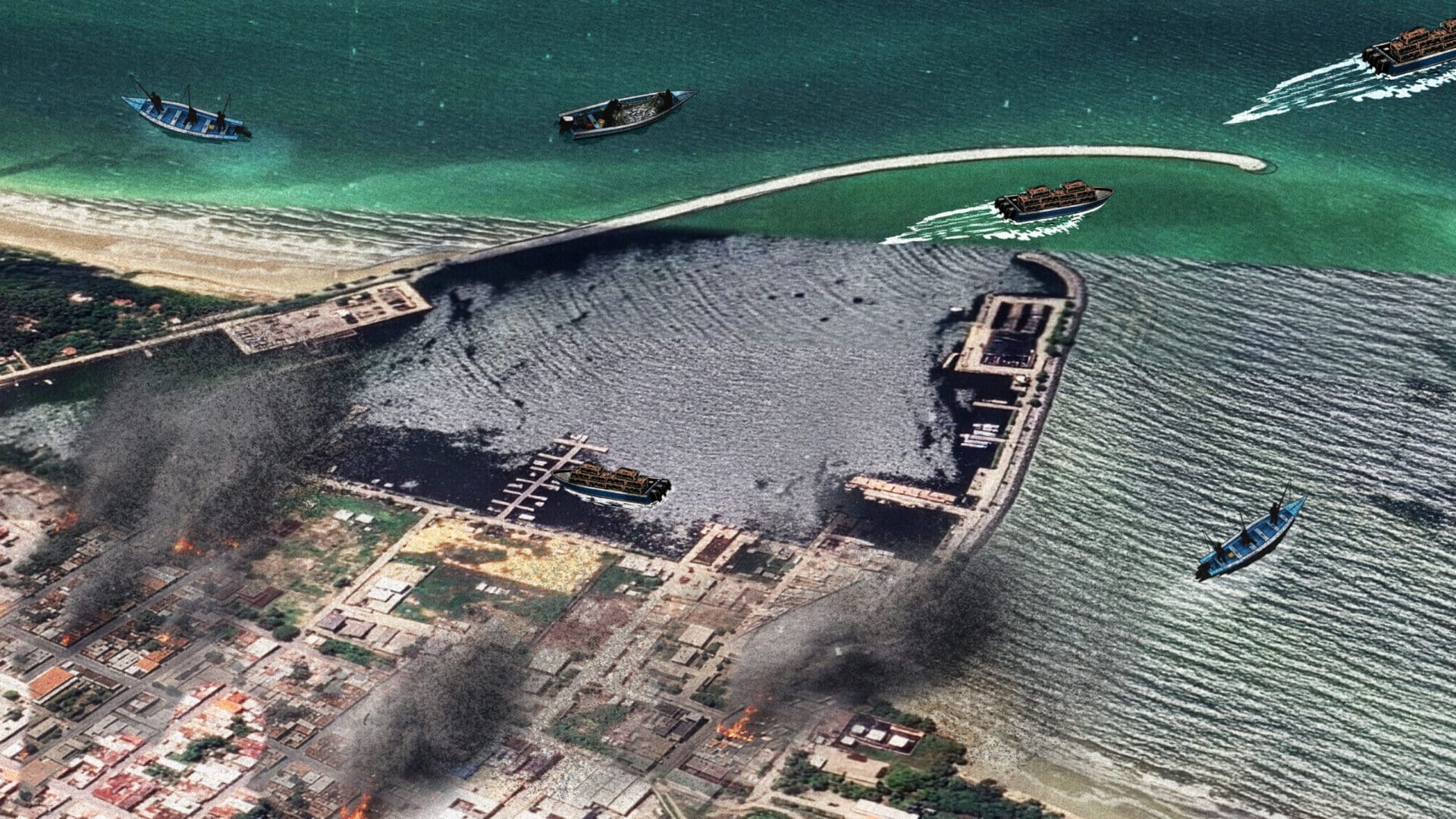
A boat captain, a schoolteacher, and a construction worker paint a starkly human portrait of Güiria, the town in eastern Venezuela where most of the victims identified so far among those killed aboard boats bombed by the United States in the Caribbean came from. Juan, Olivia, and Pedro* describe how the collapse of Venezuela’s economy and living conditions pushed many locals away from fishing and state-company jobs and into drug trafficking, fuel smuggling, migrant trafficking, and other illicit trades.
By Alianza Rebelde Investiga
If there is one thing that defines Güiria, it is that something is always burning. Every day, smoke hangs over the town. The streets carry the constant smell of something scorched. On the horizon, at every hour, gray, white, or black plumes drift upward from the ground. It makes no difference whether the neighborhood is lined with homes roofed in rusted sheets of zinc and tin or with terracotta tiles and LED lights. The smell of burning never leaves.
Güiria lies on the southeastern edge of the Paria Peninsula, in Sucre state, part of eastern Venezuela. In many ways, it is the most important city—and the most historically charged—on this side of the country. A narrow channel of green water opens from its shores toward Trinidad and Tobago, Grenada, Saint Vincent and the Grenadines, Barbados, Saint Lucia, Martinique, and Dominica. Beyond them lies Central America.
The town sits nearly eleven hours by car from Caracas and has gained notoriety in recent years. Geography matters here, because Güiria has long been known for fishing, cacao, Carnival celebrations, and a cuisine shaped by its closeness to Trinidad and Tobago. But it is also known for crime: its open Caribbean coastline offers a strategic launching point for narcotics trafficking, an activity that—like the smoke—is visible everywhere in town.

Since 2017, other stories from Güiria have spread across Venezuela and beyond: drug trafficking, migrant smuggling, human trafficking, shipwrecks, and now men killed aboard boats blown apart by U.S. forces.
As part of the investigation The Bombed: Denied the Right to Defend Themselves, coordinated by the Latin American Center for Investigative Journalism (CLIP), the Rebel Alliance Investigates (ARI)—formed by Runrun.es, El Pitazo, and TalCual—traveled deep into this remote territory to understand the place from which at least a dozen of the men killed by Donald Trump’s government at sea in the name of the war on drugs had come.
In this Venezuelan town, people do not call the illicit transport of drugs and other goods from the beaches of La Salina, Caurantica, Las Malvinas, or Río Salado to neighboring Caribbean islands or Colombia’s Guajira Peninsula “drug trafficking” or “smuggling.” They call them vueltas—literally “runs” or “jobs”—borrowing the slang Colombian traffickers use for narcotics shipments, contract killings, or debt collections.
For many people in Güiria, those vueltas are the only path to a decent life. “You even start feeling bad about yourself because we don’t have money, we’re not involved in the vueltas, we’re not running scams, and we’re falling behind,” one young woman says. “You have to be involved in the vueltas if you want to get ahead here,” says a retired schoolteacher from Güiria.

Reports by the NGO Transparencia Venezuela identify Valdez municipality—of which Güiria is the capital—as the country’s main hub for human trafficking recruitment and transit. The organization says the lack of controls at docks and on the clandestine routes linking Güiria to Trinidad allows roughly 30 percent of trafficking victims who migrate through the area to end up in sexual exploitation networks. Another organization, Mulier Venezuela, estimated that the number of trafficking victims in the country rose by 35 percent between 2021 and 2024.
But the streets themselves do not always reveal those dynamics. To understand how people see these journeys—which have become as much a part of daily life here as smoke, fishing, and farming—you have to sit down and talk to them.
“What we do here is transport passengers. We go by Macuro, cross past Patos Island, head toward the Trinidadian coast, and come in through Maracas or Las Cuevas. We get in quietly,” says Juan, a young boat captain who, since 2022, has made a living ferrying passengers—many of them migrants—and other goods between Güiria and Trinidad.
People in this part of Venezuela speak openly and casually about migrant smuggling. They swap stories about the “mafiosos” of yesterday and today—the ones who were killed and the ones who found religion. People say that back then, “when the mafiosos were serious men,” nobody ever knew what they were doing. There are no newspapers or local media outlets in town, yet everyone interviewed for this story agreed on one thing: everybody knows when someone leaves on a vuelta and when they come back—with drugs, copper, steel, plaster, or people.

From the outside, these “businesses” can seem not only viable but almost impossible to stop. The authorities appear to do little to prevent them. But what dominates life here is necessity: the need to feed a family in a state where food insecurity affects nearly 90 percent of the population. In 2023, Sucre ranked as Venezuela’s third deadliest state, with a homicide rate of 12.6 per 100,000 inhabitants, according to figures released by the Venezuelan Violence Observatory.
“It was better to sell a little gasoline and make sure there’d be money and food than send the boat out fishing and maybe come back with nothing. Through that business, I got to know people in La Salina, and that’s when I started thinking about transporting people,” Juan says.
“You’re practically inside the machine”
Along with the smoke and the vueltas, Güiria has its own codes and ways of speaking. One of them is ending sentences with “you understand?” Juan says it constantly, emphasizing that this work allowed him to leave behind the shack where he used to live.
“I wish I could do these trips legally. I wish people could board with passports, the coast guard could inspect everything, and I could just do my job legally. I’ve always wanted that. But here they don’t give you permits, so people end up doing it illegally,” he says.
If that ever happened, Juan could work openly—departing from authorized docks and ports, entering legally through Chaguaramas, without having to evade the coast guard or pay bribes just to travel without delays. But that is not how things work here, and legalizing the trade feels almost impossible.

“You’re practically inside the machine, so you know all the movements. Even when they started blowing up boats, people still kept going back and forth because they figured they hadn’t done anything wrong—they were just carrying people, you understand?” he says.
Before he began transporting migrants to and from Trinidad and Tobago, Juan had been a migrant himself. He spent two years working on the islands. Together with his brother, he bought a fishing boat and put it into service while he managed the business from abroad. Gasoline was scarce, but in 2021 fishermen still received preferential access to fuel. Even so, the money from selling fish barely covered food for his wife and children back in Güiria. So he returned home and began reselling gasoline to other boat captains.
Transporting migrants and parcels to Trinidad is, in this town, as ordinary a job as teaching school—only far better paid. People here use their knowledge of the sea to move goods from one shore to another. Doing it is almost a point of pride, especially because it means crossing the Boca del Dragón, the dangerous, turbulent strait connecting the Gulf of Paria to the Caribbean Sea.
The men who make these vueltas walk through town smiling, chests out, dressed in brand-name clothes and shoes, carrying new phones and gleaming watches. In the liquor stores, they order the most expensive bottles. Old Parr whisky is a favorite. They see themselves not as criminals but as providers, men doing what they must to support their families.
Juan only transports migrants and a few boxes of anise liquor, which he can sell for about $200, so there is little luxury in the way he lives or dresses. His home is no longer a shack, but it remains modest: small, sparsely decorated, practical.
“When I came back here, I saw how everything worked and kept selling gasoline just to make enough for food,” he explains.
Later, he realized he could make more than $200 a trip transporting people to Trinidad—even when he was still renting engines and paying a more experienced captain to guide the route. Now both the boat and the engines belong to him, and the profits are significantly higher.

“For this work you need powerful engines, and you have to maintain them because there’s always the risk they’ll die in the Boca. Out there the motors have to respond, they have to be strong. Because in the end, the engines are what save you.”
Juan never travels without someone more experienced alongside him. He never sails alone. He never leaves during daylight. And he never departs without first notifying the criminal groups that control the route, both on the Venezuelan coast and in Trinidadian coves like Maracas and Las Cuevas, on the island’s northern shore, roughly fifteen kilometers from the coast of Sucre state.
“And once everybody gives the OK, someone at the dock lets us know whether a coast guard boat has gone out. If they’re inside the harbor, we can leave safely. If they’re already outside, we don’t make the trip because they might spot us. We leave from Las Malvinas or La Salina. If necessary, we can even leave from Río Salado. The important thing is getting out without the government seeing us.”
His tone shifts as he speaks, searching for complicity.
 “The people moving drugs usually head toward La Guajira. Once they pass through the Boca, they keep north, toward Carúpano, then past Margarita Island. Obviously, they can also enter through Trinidad, so at that point we share part of the route.”
Back in 2019, only three or four captains dared make the crossing to Trinidad and Tobago. At the time, a passage cost around $300. Now the price is closer to $200, and in Güiria alone more than ten boats regularly run the migrant route. The number of vessels using the same maritime corridor for other kinds of trafficking is harder to estimate, but they are always out there.
To leave, you have to pay vacuna—protection money—to the people who control those waters. Payment goes to the gang that gives the orders, not just along the coast but inland as well. They are the ones who enforce the rules. And one rule is absolute: if you want to sail to Trinidad, you pay.
Once you arrive, the gang controlling that stretch of coast on the island also demands payment for watching the shoreline and allowing boats to land there. If you do not pay, they can retaliate. They might seize your cargo—or do something worse.
The Boss
According to Transparencia Venezuela, the Tren de Aragua still maintains a strong presence in Sucre state, especially in Güiria, because of the town’s strategic importance as a hub for drug trafficking. On the ground, the Tren remains the law.
Nothing enters or leaves the town without the approval of its local leader. He is not a government official. He does not wear a uniform. He is simply a man from Güiria who took control of the Tren de Aragua’s operations in the area after Colombian authorities arrested Carlos Antonio López Centeno—known as “Pilo”—the former head of the organization’s local faction.

Nothing happens in the mountains, on the beaches, offshore, or in the center of town without his knowledge. From his base in the hills, he oversees operations and collects vacunas—protection payments—from formal and informal businesses alike in exchange for letting them operate. Everyone knows who he is. There is not a single person in Güiria who does not know his name.
He is the head of all criminal activity in town, the man responsible for maintaining order and dispensing justice.
They call him “Ismaelito.”
He has messengers stationed throughout every neighborhood: men tasked with making sure the rules are obeyed, no one interferes with the organization’s work, and everyone fulfills their assigned role.
Anyone who breaks the rules is taken up to “the base,” a mountainous area overlooking the town, to be punished.
On land, the rules are simple: no stealing, no scams, no pointless violence, no disrupting events. In the mountains, the rule is equally clear: do not interfere with them, and provide supplies if they ask for them. The murders and robberies that once plagued Güiria have, in recent years, almost completely disappeared.
“The Only Thing Left Was the Vueltas”
Olivia first met the man who would later become the local leader of Tren de Aragua because she was his teacher. For years, she worked at the rural school near the area where he now runs his base.
To her, the smoke hanging over Güiria feels symbolic too—a sign of the way the futures of children and teenagers are burning away, forcing them to choose between only two paths: becoming baseball prospects—several players from Güiria have reached Major League Baseball—or getting involved in vueltas.

The first option is, naturally, the one parents dream about. Families pressure boys to secure el cierre—the coveted signing with a Major League organization before turning sixteen. School becomes secondary to training and tryouts. And if baseball does not work out, many turn to the second path.
Olivia believes school dropout rates are key to understanding when young people in Güiria began seeing crime as the only route to advancement.
“I became a teacher because, back then, that was the only thing there was here,” she says. “Now there are more degree programs, but none that can give you a decent quality of life the way teaching once could. Not anymore.”
When she graduated, the only opening available was at Juana Ramírez La Avanzadora School, the same rural school later attended by the future local leader of Tren de Aragua.
Back then, she says, almost everyone lived off farming. Houses were modest, and there were no wealthy families. But around 2012, things began to change.
“It was all crime and kidnappings. Criminals would walk into the school carrying rifles and grenades right in front of the classrooms. By ten or eleven in the morning there would already be shootouts. I had to run with the children to keep them safe,” Olivia recalls.

She also remembers the moment the country’s economic collapse accelerated the violence.
“When the crisis really began in Venezuela, between 2015 and 2017, companies shut down and all those facilities were abandoned. That’s when the copper theft started. Different gangs fought each other over it. It was chaos. That’s when communities started splitting apart under different gangs.”
By “the companies,” she means the Juan Manuel Valdez Thermoelectric Plant and the related industrial projects built around it. The plant was inaugurated in Güiria in 2018 to generate electricity from natural gas. But during Venezuela’s humanitarian collapse, it was systematically looted—with the complicity of authorities. Even Juan spent time stripping copper from the facilities to sell to foreign buyers.
“That copper theft lasted more than three years, until they carried off the last pieces. Then the groups started turning against each other. In those clashes, people were murdered and butchered like pigs,” Olivia says matter-of-factly.
She insists Güiria had not always been like this. “There was drug trafficking before, yes, but there were only two groups: León’s people and Los Gordos’ people. Both came from Río Salado. They were family—first cousins. Each handled its own trafficking operations. Then their sons started getting involved. Little groups began forming here and there, all trying to take control of the territory,” Olivia explains. It is a story many other residents tell as well. Looking back on her years teaching in that school, Olivia says she now understands how Güiria became one of the most dangerous places in Venezuela.

She speaks sadly about how the school is still used as a transit point and how, because it is now nearly empty, people hold barbecues on the grounds. Olivia also worked at the school in Río Salado—the historic center of drug trafficking in town—but prefers not to dwell on those years.
“Back in 2017, 2018, 2019, there were no jobs here. The only thing left was vueltas: stealing from the companies, drug runs, copper runs. Then came the vueltas transporting girls to Trinidad—that is, human trafficking. Everybody got involved. Almost everyone lived off those vueltas because there was nothing else. No other source of income. By then teachers were nobody. We meant nothing.”

As people migrated away and state companies like PDVSA were left without workers, criminal groups expanded into the farming regions as well—stealing crops, livestock, and merchandise. Most of Olivia’s former students were eventually swallowed by the gangs. Many of them were killed.
“The Economy Here Runs Mostly on Drug Trafficking”
In 1972, Güiria was home to the most important fishing port in eastern Venezuela and the only one with direct access to the Atlantic. Its infrastructure was extensive, and the port became a crucial engine of the local economy.
But the boom did not last long.
The port gradually deteriorated, and by the 1990s jobs had become scarce. Pedro, a lifelong resident of Güiria who has worked for Venezuela’s state electric company, Corpoelec, for the past twenty-eight years, lived through that decline firsthand.
“At that time Corpoelec was the best company around,” Pedro recalls. “The services worked well because all the electrical networks were properly maintained. But it’s been many years now since any kind of maintenance has been done.”
The good salaries of those years—when Pedro was in his early thirties—have long since vanished, erased by inflation and Venezuela’s repeated currency devaluations. Before joining Corpoelec, he worked maintaining boats at the fishing port.
“After that came PDVSA, and they hired more people. Then all the projects connected to PDVSA started arriving here. Those were basically the only jobs available, some of the few public-sector jobs left in town,” Pedro says.

He walks through Güiria in a faded, worn-out uniform that employees are still required to wear even though their salaries are nowhere near enough to replace it.
Electricity in Güiria is as unreliable as it is across much of Venezuela. According to a 2023 study by the Venezuelan Observatory of Public Services, 54 percent of Venezuelans experience power outages every day.
Pedro says utility workers now operate with almost nothing. “The workers are basically improvising everything because they don’t have materials to replace anything. If a power line breaks, they splice it back together with the same damaged cable because there’s nothing else. There aren’t even vehicles to get around, so the younger guys use their own motorcycles for work. We haven’t had company vehicles in years.”
The area also hosts the repeater stations for the town’s cell phone antennas, which means the signal becomes unstable—and disappears entirely when the electricity fails.
While the town sits in darkness and isolation, illegal economies continue to thrive. “Here, the economy has mostly revolved around drug trafficking,” Pedro says. “A lot of people lost their jobs when Chávez banned industrial trawling and drag-net fishing”—a reference to the 2009 Fishing and Aquaculture Law, which aimed to protect marine ecosystems and support artisanal fishermen. “A lot of fathers were left unemployed. They had no choice but to start doing vueltas.”
Los bombardeados: sin derecho a la defensa es una investigación sobre las víctimas civiles de los ataques de Estados Unidos en Latinoamérica, coordinada por el Centro Latinoamericano de Investigación Periodística (CLIP) en alianza con Casa Macondo, Verdad Abierta y 360 grados (Colombia); la Alianza Rebelde Investiga (Venezuela); The Guardian (Trinidad y Tobago) y con el apoyo técnico de Airwars (Reino Unido) y El Veinte.


