


“We always saw leaders being threatened in other parts of the Amazon and never imagined that something like that could happen in our own territory,” says Luene Karipuna, an Indigenous activist from the municipality of Oiapoque, in the Brazilian state of Amapá. She watched her town and the life of her community begin to change as the prospect of offshore oil exploration off the state’s coast gained momentum. According to Karipuna, the changes began in 2023, when she started speaking out against the project. Soon afterward, her name began appearing on local Instagram pages, where she was accused of trying to obstruct the state’s development.
By Luiza Queiroz and Michelly Neris (AFP)
Amanda (a pseudonym), an employee of the Arayara Institute, an environmental advocacy organization, experienced similar intimidation. During a meeting with local communities about the impacts of the oil exploration project led by Petrobras, her presentation was interrupted by an unidentified man who entered the event and threatened to return with more people. AFP Checamos gathered additional testimony from attendees, and in three separate accounts—including Amanda’s—witnesses said that one of the men present claimed to be armed.
As oil exploration along Brazil’s so-called Equatorial Margin moves closer to becoming a reality, the state of Amapá—the Brazilian state nearest to one of the offshore wells already drilled by Petrobras in the region—has become fertile ground for politicians who support the project and benefit from social media profiles that intimidate activists and spread false information aimed at securing public support for oil operations.
The workshops Amanda attended in November 2024 were organized by the Arayara Institute and other environmental organizations to inform local communities about exploration plans for Block FZA-M-059 (commonly referred to as Block 59), an offshore concession located in the Amazon River Mouth Basin, approximately 175 kilometers (109 miles) off the coast of Amapá. The block forms part of Brazil’s Equatorial Margin, a vast offshore region stretching from Amapá to the state of Rio Grande do Norte that has already earned the nickname “the new pre-salt.”
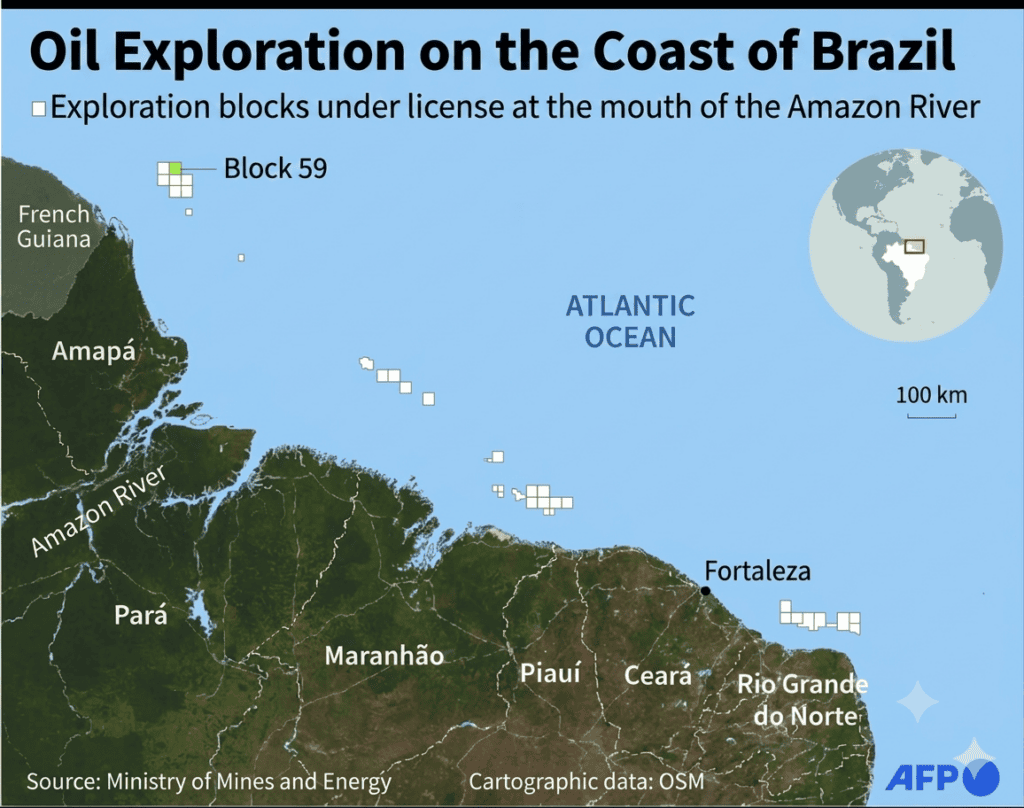 Oil exploration in this region would be expected to benefit Oiapoque in particular. As the municipality closest to the drilling area, it would become the principal logistical and administrative hub for offshore operations. Its geographic proximity would also entitle it to receive oil royalties—financial compensation paid by petroleum companies to Brazil’s federal, state, and municipal governments for the extraction of non-renewable natural resources.
The promise of those royalties has triggered a new wave of migration to Oiapoque and neighboring municipalities. At the same time, it has made the work of organizations and individuals opposing offshore oil exploration increasingly dangerous.
These are the findings of Digital Poachers, a collaborative investigation led by the Latin American Center for Investigative Journalism (CLIP), with the participation of AFP Checamos and six other media organizations from across Latin America.
Attempts at Dialogue Shut Down
The series of meetings with local communities took place along the coast of Amapá in late November 2024 and was organized by a coalition of non-governmental organizations: the Arayara Institute, Greenpeace, WWF-Brazil, ClimaInfo, and the Iepé Institute. Several of these organizations sent representatives to participate in the workshops in person.
The Arayara Institute’s objective was to present the findings of a study on the potential impacts of offshore oil exploration on local fisheries in a region that is home to highly sensitive ecosystems. The plan was to hold closed-door meetings with the communities that would be directly affected by the project.
However, during the very first workshop in Oiapoque, Amanda and her colleagues realized they were being recorded after learning that photographs and audio recordings from the meetings were already circulating in large local WhatsApp groups.
“We realized there was a specific pro-oil WhatsApp group. At first it was difficult to understand what was happening, but later we realized that someone attending the workshop was forwarding photos, audio recordings, and videos to that group.”
According to Amanda, the group included not only local residents but also state legislators and public officials.
Following the incident, the delegation quickly left Oiapoque, concluding that the atmosphere had become one of “pressure and danger.” They continued with their planned itinerary, which included more remote locations such as Calçoene and the Bailique Archipelago.
By then, the NGOs’ travel schedule was already being tracked and shared in the WhatsApp group Amanda had described. When the coalition arrived in the town of Amapá on November 16, 2024, they were met by then-Mayor Carlos Sampaio (DEM), state representatives Dayse Marques and Deputado Inácio (PDT), along with approximately 45 people who attended the event.
Tensions peaked when a man wearing a hat and dark sunglasses interrupted the meeting, shouting that he would return with reinforcements to “put an end to this circus.” A source present at the event, interviewed by AFP Checamos, said that one attendee claimed to be carrying a firearm in his backpack.
Mayor Sampaio said he would call the police to deal with the man who had made the threats. Amanda and others present, however, questioned whether the individual was really a stranger.
“It seemed very strange to us that he [Sampaio] didn’t know who that man was, because it’s a small town,” Amanda said.
This reporting alliance attempted to contact Sampaio by email on May 5 and May 27. Journalists also sought to obtain his telephone number through several channels but received no response before publication.
The incident was later briefly mentioned by Vinicius Nora, a researcher at the Arayara Institute, during a hearing in Brazil’s Chamber of Deputies on oil exploration in the region. At the conclusion of his remarks, Nora condemned “an incident we documented during workshops where one member of our organization was threatened and followed, along with people from other organizations.”
Witnesses interviewed by AFP Checamos described Deputado Inácio as one of the most active politicians present during the workshops held in Amapá. At least three people interviewed for this report said the legislator frequently interrupted presentations and discussions during the meetings.
Inácio Maciel, known publicly as Deputado Inácio, was elected to the Legislative Assembly of Amapá (ALAP) in 2022 after receiving the highest number of votes of any state legislative candidate. Before entering politics, he served for 15 years as a Civil Police investigator and later headed the Amapá State Department of Traffic (Detran-AP) during the administration of Governor Waldez Góes, also a member of the PDT.
On April 12, 2026, Maciel was elected mayor of Oiapoque in a special election ordered by Brazil’s Electoral Court following the removal of the previous municipal administration. Of the approximately 14,000 voters who participated, he received nearly half of the vote (49.46%) and assumed office on May 6.
In addition to his electoral support, Inácio Maciel received backing on social media from a network of Instagram accounts (1, 2) promoting oil exploration in the region. According to AFP’s investigation, those same accounts have also disseminated demonstrably false environmental information and targeted groups opposing the oil project in Amapá.
When contacted by this reporting collaboration, Inácio did not respond before publication. AFP attempted to reach him by email on May 5 and May 11 and also spoke with a member of his staff. No response was received before this investigation was published.
Oil Takes Over Social Media in Amapá
On social media, AFP identified two leading pro-oil movements: O Petróleo é do Povo (Oil Belongs to the People), led by real estate broker Ariana Moraes, and Exploração de Petróleo no Amapá Já (Oil Exploration in Amapá Now), headed by activist Rozely Martins. Both emerged in late 2024. Although they operate separately, the two groups share several connections, including repeated expressions of support for Deputado Inácio.
The Instagram account for O Petróleo é do Povo includes posts documenting meetings between the group and politicians such as Deputado Inácio, Senator Lucas Barreto (PSD), and former federal congresswoman Silvia Nobre Waiãpi.
Through a source who requested anonymity, AFP obtained access to messages exchanged in the O Petróleo é do Povo WhatsApp group, created on October 18, 2024. Discussions in the group focused extensively on the NGO workshops, accusing the organizations of delaying Amapá’s development, calling their staff “lazy,” and advocating for the NGOs to be “expelled” from the state. After the workshop in the municipality of Amapá concluded, participants posted messages thanking Deputado Inácio and another individual whom the investigation identified as a possible municipal government employee.
Meanwhile, the Exploração de Petróleo no Amapá movement, led by Rozely Martins, regularly publishes content supporting Inácio (1, 2, 3, 4). After he won the mayoral election in Oiapoque in April 2026, the account publicly congratulated him on his victory. Other politicians featured in its posts include the state’s vice governor, Teles Jr., Senator Lucas Barreto (1, 2, 3), and Silvia Waiãpi. The page also features posts alongside municipal officials and representatives of institutions such as the Amapá Bar Association (OAB-AP) and the Amazonian Institute for Petroleum and Renewable Energy (IAMPER).
IAMPER is chaired by Thoni Furtado, who also serves as president of the Environmental Commission of OAB-AP. The institute’s vice president is Rozely Martins.
The movement also includes other members, such as journalist Adriana Garcia and legal scholar Gesiel Oliveira. Together they maintain an active WhatsApp group created on October 17, 2024. The group includes advisers to the politicians mentioned above, as well as members of OAB-AP and IAMPER. A blog post describing the group listed several of the topics it promoted, including “the dark side of NGOs” and the alleged “scientific fake news spread by Greenpeace” concerning the existence of coral reefs near the mouth of the Amazon River—even though scientific research has documented the presence of corals and other reef-forming organisms in the region.
Graphic by AFP Checamos. Data compiled from mentions, shared posts, event attendance, and participation in livestreams. Thicker lines indicate stronger identified connections between actors.
During the period in which the workshops took place, both pro-oil movements circulated similar messages through the Exploração de Petróleo no Amapá Instagram account and the O Petróleo é do Povo WhatsApp group. The posts called on supporters and lawmakers to attend the meetings, claiming that the NGOs’ objective was to “block Amapá’s development through fake news.” Rozely Martins’ page also shared an image accusing the organizations of disseminating “fabricated scientific data and manipulated materials.”
When interviewed for this report, Martins said that she “supports oil exploration but has never attacked any environmental activist.” She was also asked about her relationship with Oiapoque’s mayor-elect, Deputado Inácio, and whether she had attended the NGO workshop held on November 16, 2024. She declined to answer those questions.
For her part, Ariana Moraes, founder of O Petróleo é do Povo, confirmed that she created the WhatsApp group and insisted that it has no political affiliation. She said its sole purpose is to contribute to Amapá’s development. She also denied attending any of the NGO workshops held in 2024.
Thoni Furtado, president of IAMPER, did not respond directly to the specific questions raised in this investigation. However, he stated that the institute supports a technical debate but “will never accept the indirect criminalization of sectors, institutions, or citizens who defend energy sovereignty, economic development, and national autonomy.”
The Amapá Bar Association (OAB-AP) did not respond to requests for comment before publication.
Attacks on Indigenous Peoples
The activity of pro-oil social media accounts also extends to attacks on environmental organizations and Indigenous communities that oppose oil exploration. In April 2025, during an event with Brazilian President Luiz Inácio Lula da Silva, Indigenous Chief Raoni Metuktire argued that Petrobras should not drill near the mouth of the Amazon River. According to him, “leaving things as they are ensures that we have a healthier environment, land with less pollution, and less global warming.” Raoni also said that he had “been in contact with the spirits, who understand the risks of continuing down this path.”
On social media, Vice Governor Teles Jr. mocked Raoni’s remarks, writing that the “technologies used [by Petrobras] have now been replaced by advice from a spirit.”
Later that year, during the Third United Nations Ocean Conference, Raoni appealed to French President Emmanuel Macron, urging him to oppose oil exploration in the region. His intervention sparked backlash among supporters of the project. In response, Adriana Garcia published an article titled “French NGOs Co-opted Indigenous Peoples in Brazil, Took Our Land, and Now Want Our Seas.” In the article, she also claimed that Brazil’s National Foundation for Indigenous Peoples (Funai) was “working against the country and in favor of foreign interests.”
When contacted for this investigation, Garcia said that the article was based on information from “a French website” and on Raoni’s conduct during his visit to France.
“[Raoni] behaved as though he owned the Brazilian Amazon and had plans for our future. As Brazilians, we would like to have the autonomy to decide our own destiny.”
The journalist added that, in her view, Indigenous communities in Amapá lack “even the minimum level of dignity precisely because decisions have been influenced for years by other countries working alongside Brazilian governments.”
Following that year’s UN conference, the concerns expressed by Chief Raoni and other forest-dependent communities intensified when Petrobras’ operations at Block 59 were suspended in January 2026 after approximately 18,000 liters of a substance known as drilling fluid spilled during operations. About a month later, Brazil’s National Agency of Petroleum, Natural Gas and Biofuels (ANP) authorized the state-owned company to resume drilling under certain conditions, and Petrobras restarted operations in March. Brazil’s environmental agency, Ibama, told AFP that although it did not expect the incident to produce lasting environmental consequences, “it cannot be completely ruled out that some degree of environmental damage occurred, even if only localized and temporary.”

The Facebook page Oiapoque Verdades AP—which also supported Inácio’s mayoral campaign (1, 2)—published a video on April 26, 2025, illustrating the political climate in Amapá. In the video, residents identifying themselves as inhabitants of Oiapoque voice their support for Petrobras’ oil exploration plans. The accompanying text states:
“On one side are the people of Oiapoque, the vast majority of whom support oil exploration because they believe it will bring development to the city (…). On the other side are the Indigenous peoples, the majority of whom oppose oil exploration. We’d like to know whether their real concern is nature—or whether there are economic interests behind their position.”
Speaking with AFP, Indigenous activist Luene Karipuna said that, as the debate over oil exploration intensified, she became the target of attempts to hack her social media accounts and began receiving messages accusing her of “sitting on wealth” and preventing the state’s development. As a result, she stopped sharing details of her personal life online and removed photographs of her family from her social media profiles.
Karipuna believes that the rhetoric of “development” gradually became a tool for attacking Indigenous communities opposed to Petrobras’ project.
“It’s completely legitimate for people to want a better life and better opportunities for their families. But that sentiment started being used to attack Indigenous peoples—not just me. That message became constant, every day, on the radio, on television news, and across social media.”
According to Karipuna, the hostility toward Indigenous peoples has not remained confined to the digital sphere. Since they began opposing the project, she says, Indigenous leaders have also experienced profound changes in their daily lives and community relationships.
“We [Indigenous people] have always had strong commercial relationships, selling cassava flour and fruit. But once the chiefs started speaking out, people would point at them in the street and say, ‘Look—that’s the chief who’s against the oil project. That’s the chief who doesn’t want development.'”
The situation prompted the Council of Chiefs of the Indigenous Peoples of Oiapoque to publish an open letter in May 2025, accusing political representatives in Amapá of spreading disinformation about the oil project and violating Indigenous rights. The statement also referred to the “persecution and threats against the lives” of Indigenous leaders opposing oil exploration in the region.
Pipelines of Disinformation
The debate over oil exploration also spilled over into other environmental and public-interest initiatives in Amapá. In 2025, activists and politicians mobilized on social media against the creation of marine extractive reserves (Resex) along the state’s coastline—a proposal that fishing communities in Oiapoque had been advocating since 2006.
The proposal, put forward by the Chico Mendes Institute for Biodiversity Conservation (ICMBio), sought to establish four protected extractive reserves along the coast, located between 130 and 447 kilometers (81–278 miles) from Block FZA-M-59. Politicians and activists soon began criticizing the initiative, arguing that it would obstruct Petrobras’ oil exploration plans and related infrastructure projects.
In April 2025, when ICMBio organized public hearings to discuss the proposal, Vice Governor Teles Jr. accused the agency of misleading the public. Other politicians, including Senator Lucas Barreto and Deputado Inácio (1, 2), encouraged residents to oppose the initiative.
During the same period, the proposed extractive reserves were described as “an attack” on the state’s development in a joint statement issued by IAMPER, the Amapá Bar Association (OAB-AP), and former federal congresswoman Silvia Nobre Waiãpi. The statement accused ICMBio of “manipulating the public” and making the oil project “unviable.” Meanwhile, the Instagram account Exploração de Petróleo no Amapá promoted a petition opposing the reserves, which, according to the post, was also circulated during an event organized by OAB-AP.
Faced with mounting political pressure, the public consultations were postponed and have yet to be rescheduled. ICMBio said the decision was prompted by an “intense campaign of disinformation and falsehoods.”
Asked about the controversy, ICMBio told AFP that the proposed extractive reserves “do not affect the blocks designated for oil exploration or the areas planned for offshore infrastructure because of the distance separating the projects.” The agency also noted that Brazil already has marine and coastal protected areas that coexist with oil and gas operations, including Albardão National Park in the southern state of Rio Grande do Sul.
When contacted for this investigation, Petrobras declined to comment on the issue.

Another debate that gained momentum on social media concerned the existence of coral reefs near the mouth of the Amazon River. A study published in the journal Science in 2016 by researchers from Brazilian and international universities identified an extensive reef system at depths ranging from 30 to 120 meters (98 to 394 feet).
Known as the Great Amazon Reef System (GARS), the formation was first described in 1977. Researchers documented corals, sponges, sea urchins, reef fish, and other organisms adapted to conditions of low light and high sediment concentrations. The reef provides habitat for numerous species, many of which are important to local fisheries.
Despite this body of scientific evidence, Petrobras Director Sylvia Anjos stated in October 2024 that the presence of corals in the region was a “scientific fake news” and claimed that the state-owned company had found only “carbonate rocks similar to corals.” Her remarks were challenged by scientists and environmental advocates.
According to research by Marina Kuzuyabu, who analyzed transcripts of Petrobras’ meetings with local communities to study the spread of disinformation, company representatives neither confirmed nor denied the existence of corals during those meetings. When asked whether conservation initiatives existed for these ecosystems, one Petrobras representative said inspections of the seafloor had found only “muddy sediments” around the drilling site.
When contacted by AFP, Petrobras said it had conducted extensive studies to “minimize potential impacts” and maintained that “in the drilling area, at depths exceeding 2,000 meters [6,560 feet], there is no evidence of corals or other organisms associated with biogenic formations on the seabed.”
Meanwhile, posts published by Exploração de Petróleo no Amapá portrayed the discovery of GARS as if it were solely the work of Greenpeace, despite the fact that the reef studies involved multiple universities and scientific institutions. The posts argued that, by denying Petrobras an environmental license, Ibama was “giving credibility” to Greenpeace while “disregarding scientific studies conducted rigorously aboard oceanographic research vessels.”
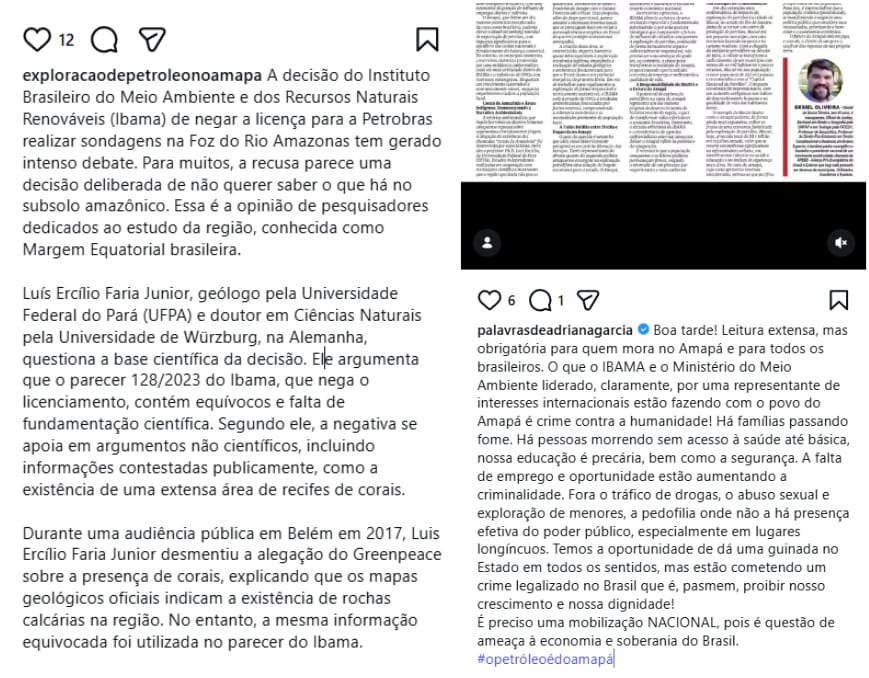
These posts cite geologist Luis Ercilio Faria as the expert who supposedly “debunks” Greenpeace’s claims. In an interview with the website Petronotícias in October 2024, Faria described the 2016 reef study as “an attempt to impose a manipulated narrative.”
That same year, Faria went viral on social media after claiming during an event for rural producers that the Amazon rainforest does not influence the global climate. The video was widely shared by pro-oil movements (1, 2). At the time, AFP Checamos demonstrated that the claim was false and that the Amazon plays a fundamental role in regulating the Earth’s climate.
For researcher Marina Kuzuyabu, the harassment campaigns and the spread of disinformation are rooted in a simplistic, binary narrative. “Petrobras says that [oil exploration in Amapá] is necessary to bring development to the region. And local politicians repeat that message constantly, as if there were no other possible path.”
Promises of enormous financial gains from natural resource extraction are nothing new in Amapá. Between the 1950s and the 1990s, manganese mining in Serra do Navio served as the state’s principal economic engine, ultimately leaving behind abandoned infrastructure and environmental degradation once the deposits were exhausted. Years later, the construction of major hydroelectric dams likewise failed to resolve the state’s deep structural challenges, where only 12% of households are connected to a sewage system.
Beyond skepticism toward promises of sweeping economic progress driven by oil, many local residents embrace a different understanding of what development means.
“Communities there are deeply connected to their territory. They have a very strong relationship with nature. (…) Petrobras talks about development and job creation. But people ask: ‘What kind of development ignores the environment? What will that mean for my children? And what will my grandchildren inherit?'”
About Digital Poachers
Digital Poachers (Taladores Digitales) is an investigative project aimed at uncovering the interests behind online smear campaigns targeting environmental activists in six Latin American countries. The project is coordinated by the Latin American Center for Investigative Journalism (CLIP) in partnership with AFP (Brazil), Colombiacheck (Colombia), Agencia Ocote (Guatemala), Contracorriente (Honduras), Animal Político and Mongabay Latam (Mexico), and Concolón (Panama). It was carried out with support from the Global Initiative for Information Integrity on Climate Change and received legal review from El Veinte.

Digital Poachers (Taladores Digitales) is an investigative project aimed at uncovering the interests behind online smear campaigns targeting environmental activists in six Latin American countries. The project is coordinated by the Latin American Center for Investigative Journalism (CLIP) in partnership with AFP (Brazil), Colombiacheck (Colombia), Agencia Ocote (Guatemala), Contracorriente (Honduras), Animal Político and Mongabay Latam (Mexico), and Concolón (Panama). It was carried out with support from the Global Initiative for Information Integrity on Climate Change and received legal review from El Veinte.


