


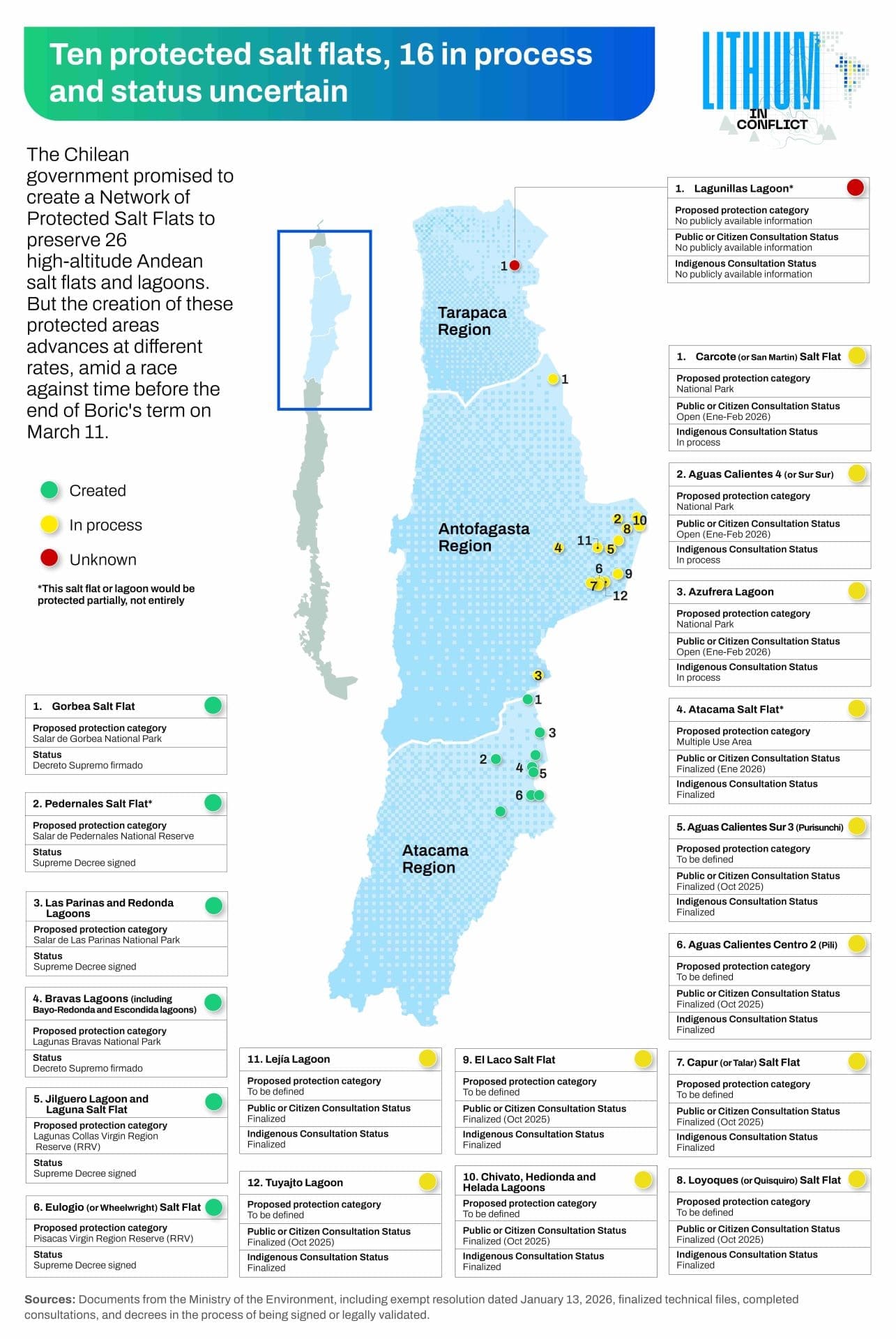
Chile’s Ministry of the Environment launched a process unique in Latin America to protect 510,000 hectares of salt flats and high-Andean lagoons as part of its National Lithium Strategy. The government of Gabriel Boric announced last Thursday the creation of six protected areas in Atacama, safeguarding 10 high-altitude wetlands. But it remains uncertain whether the remaining 16 sites in Antofagasta and Tarapacá will be protected before José Antonio Kast takes office as president in March, after having hinted that he would prioritize mining investment. Nor is it clear whether that protection will be a real shield or merely an administrative mirage.
Barinia Montoya (Mongabay Latam)
On January 29, the Chilean government announced the creation of six new protected areas in the Atacama region, in the country’s north. All share a common mission: they will protect 10 high-altitude wetlands, including salt flats and lagoons. “What we are doing today with the Network of Protected Salt Flats is defending our very existence,” President Gabriel Boric said in the municipality of Diego de Almagro, 37 days before handing over office to his successor, José Antonio Kast.
The announcement is a milestone because it covers nearly half of the 26 high-Andean ecosystems that the government pledged to “shield” as part of its National Lithium Strategy launched in 2023, in order, in Boric’s words, “to build a new salary for Chile,” but in an environmentally sustainable way.

In this way, the Chilean government seeks to resolve—or at least defuse—a political and economic tension in which lithium is a central topic of debate.
Chile holds one of the world’s largest lithium reserves. In fact, this mineral has already displaced copper as the country’s most strategically significant resource. Lithium is the backbone of the batteries that power electric vehicles, which are essential for moving away from the fossil fuels that still drive much of global transportation. It is also central to electricity storage systems that make it possible to harness, on a large scale, energy produced by renewable sources such as sun or wind. Transportation and electricity generation are the two sectors that produce the most greenhouse gas emissions worldwide.
With just over a month left before Boric’s government ends and Kast takes office on March 11, the Salt Flats Network risks remaining unfinished.
The remaining 16 ecosystems—salt flats and lagoons—almost all located in the Antofagasta region, with the exception of one, Laguna Lagunillas, in Tarapacá, are still in preliminary stages of the designation process, including public citizen consultation and consultation with Indigenous communities. This is revealed by an investigation carried out by Mongabay Latam and the Latin American Center for Investigative Journalism (CLIP) as part of the Lithium in Conflict project, led by CLIP in partnership with ten media outlets across the region to understand some of the conflicts surrounding the lithium industry in Latin America. In some of the salt flats awaiting protection, mining interests are already present.
That risk exists because president-elect Kast is an ultra-conservative leader who based his government program on economic freedom and the reduction of bureaucracy, which he believes “holds back investment.” In his public statements, he has argued that the country must grow under regulations that are not “burdensome or convoluted,” and has already proposed a sweeping reform of the Environmental Impact Assessment System (SEIA) to fast-track mining projects.
For the Ministry of the Environment, Kast selected Francisca Toledo, an industrial civil engineer with a master’s degree in regulatory law, who previously worked as a natural resources specialist at Libertad y Desarrollo (LyD), a technically oriented, liberal think tank that has shaped the economic vision of Chile’s center-right. Since 2022, her work as a researcher at LyD has focused on environmental permitting issues.
This outlook has led many scientists and environmental experts to fear that if the government fails to establish the remaining protected areas within the next five weeks, they may face new obstacles to ever becoming a reality.

The National Network of Salt Flats Is Born
The National Lithium Strategy, presented by the Boric administration in 2023, was designed around a premise of public–private collaboration aimed at forging a new balance in the industry. Under this framework, the country aims to contribute the resource along with a sovereign strategic vision, while private companies provide capital, technology, and access to the global market. To counterbalance this productive push, the Strategy established environmental protection and sustainability as one of its core pillars. This pillar consists of creating a Network of Protected Salt Flats to act as a counterweight to industrial activity.
Until the government’s announcement this week, only 8.5% of Chile’s salt flats were protected, and these were concentrated in emblematic but isolated areas, mainly within National Parks and Natural Monuments. Examples include the Salar de Surire (partially protected as a natural monument); the Salar de Huasco, in the Andean zone of the Tarapacá region (a national park); parts of the Salar de Maricunga; the Negro Francisco lagoon (preserved within Nevado Tres Cruces National Park); and portions of the Salar de Atacama, which are currently under the protection of Los Flamencos National Reserve. The new network seeks to break with this fragmentation and create an interconnected system that conserves a greater number of high-Andean wetlands and covers the Atacama and Antofagasta basins, where mining pressure is most intense.
These salt flats and lagoons, once protected, will be incorporated into the newly created National System of Protected Areas (SBAP). They are organized into two major geographic clusters in the far north of Chile.
In the Atacama region, the Network includes the six newly created protected areas, which safeguard 10 high-Andean salt flats and lagoons. These consist of three national parks, one national reserve, and two Virgin Region Reserves (RRV), a new category in Chilean land-use planning. All of them completed every stage of the administrative process—including technical and citizen consultations, the signing of the Supreme Decree, and validation by the Office of the Comptroller General of the Republic, the autonomous body that certifies the legality of state acts—to formally become law.

Farther north, in Antofagasta, the plan is just as ambitious but far more uncertain: the conservation of 15 ecosystems is envisioned.
One final body of water slated for protection, Laguna Lagunilla, is located in the Tarapacá region, but there is no public information on the status of its designation process.
While the protected areas in Atacama have just come into being, those in the Antofagasta region remain in limbo. The first stage—Indigenous and citizen consultation—has only recently been completed for some ecosystems, while for others it is still ongoing. This dialogue process between the State and Indigenous peoples, such as the Atacameño or Lickanantay communities living in nearby areas, aims to reach agreement with them or obtain their consent regarding legislative or administrative measures that may directly affect them, including the declaration of protected areas, which often entails restrictions on land use.
A Real Shield or an Administrative Mirage?
Since the launch of the National Lithium Strategy (ENL), the Ministry of the Environment (MMA) has deployed an unprecedented technical and political effort, signing agreements with universities and opening Indigenous consultations, with the ultimate goal of protecting these 26 saline ecosystems. Geographer Valentina Pineda, a professional in the MMA’s Protected Areas Department, explained in a webinar in September 2025 that the objective is “to add 510,000 new hectares for conservation.” These designations, she said, would help Chile move closer to meeting the global goal of protecting 30% of terrestrial and marine areas by 2030, as part of the negotiations under the Kunming–Montreal Global Biodiversity Framework.
For Minister Maisa Rojas, this Network is the tool to ensure the survival of fragile and unique ecosystems in the face of the biodiversity loss crisis. “Salt flats have a potential for wealth based on research and technological development, derived from knowledge of their flora, fauna, and microorganisms,” Rojas explained.
At the same time, scientists and environmental experts consulted for this article agreed that the Network is an ambitious bet aimed at reversing decades of state neglect in a north that has historically served as “Chile’s wallet, but at the cost of ecological sacrifice,” in the words of one of them.
Although many scientists share the view that creating protected areas is essential, some have raised alarms about the race against the clock, as Mongabay Latam reported two years ago. Chemical engineer Ingrid Garcés, who holds a PhD in science and is an academic at the University of Antofagasta, argues that the Network was launched with a profound lack of understanding of what it was meant to protect. According to Garcés, a salt flat is not a deposit but an interconnected hydrological body. From her perspective, protecting only “polygons” or surface fragments while allowing extraction in the rest of the basin is “not understanding the ecosystem at all.” Her fear is that what is being created are, in her words, “paper parks” that look good on international maps but could end up dying of thirst in real life.
The effort led by the Boric government seeks to leave this legacy in place before his term ends on March 11. It is a “genuine effort” to institutionalize the protection of extremophile microorganisms and vulnerable fauna—something never seen on the continent with this level of force. But the political urgency has left open flanks that environmental lawyers are already mapping. Uncertainty over whether these decrees will withstand the transfer of power to the administration of José Antonio Kast hangs over every technical meeting.
While Chile’s environmental institutions celebrate the greatest conservation advance of the 21st century in the Atacama region, the very foundation of that protection—legal and scientific certainty—hangs by a thread in the neighboring region of Antofagasta. Is this network a real shield, or an administrative mirage that will fade with the change of government? To understand this, it is necessary to descend into the details of a policy caught between the ambition of the 30% target and the harsh reality of pre-existing mining rights in these salt flats and lagoons.
Atacama, the conservation laboratory of 10 saline ecosystems
The regional ministerial secretary (Seremi) of the Ministry of the Environment in Atacama, biologist Natalia Penroz, says she feels “great pride” at having achieved protection for systems that historically had no level of conservation at all.
The Atacama bet is ambitious. Three of the new protected areas will be designated as national parks: Lagunas Bravas National Park (encompassing the Bravas, Redonda, Bayo, and Escondida lagoons), Salar de Gorbea National Park, and Salar de Las Parinas National Park. These will be joined by the Salar de Pedernales National Reserve and the creation of the country’s first two Virgin Region Reserves (RRV), called Lagunas Collas and Lagunas de Las Pisacas. This represents a milestone, as it is the strictest protection category in Chilean legislation, intended for areas that remain in a pristine natural state and where any human activity is prohibited, allowing only scientific research and environmental monitoring under rigorous standards.
According to Penroz, “this deployment seeks not only to save water, but also the genetic heritage of extremophile microorganisms that inhabit these basins,” and which today, for the first time, are explicitly named in the protection decrees.
However, protection in Atacama is a double-edged sword.
The case of the Salar de Pedernales, which involves partial protection, is emblematic of the conflict between conservation and mining. While the State has just created a National Reserve, the state-owned giant Codelco retains water rights that have impacted the aquifer for decades. This water pressure escalated to the courts when the Council for the Defense of the State (CDE)—the technical-legal body responsible for defending the Nation’s patrimonial and environmental interests—sued the mining company for causing “irreversible damage” after 36 years of extraction. Although the litigation closed in 2020 with a remediation agreement, experts such as Ricardo Espinoza, an industrial civil engineer and water specialist at the Pontifical Catholic University of Valparaíso, warn that “it is a technical contradiction to protect the surface if the aquifer continues to be drained.” For the expert, any protection designation will be “insufficient” if the source of water stress is not addressed and the mining industry is not compelled to definitively transition to the use of desalinated water.
The Salar de Maricunga emerges as the most complex board in this forced coexistence. Although it appeared on the original protection list in 2023 as ecosystem number 27 to be safeguarded, its status has been a constant question mark due to its strategic value: Codelco considers it the second-best salt flat in the world in terms of lithium concentration, second only to Atacama. This economic potential was sealed in May 2025, when the Chilean state company signed an agreement with the British group Rio Tinto—the second-largest mining conglomerate on the planet—to begin lithium extraction, with construction slated to start in 2030.
In the face of this industrial push, the MMA’s strategy has been a reduced expansion limited to the Gran Laguna and the Pantanillo–Ciénaga Redonda biological corridor, including La Gallina wet meadow. Penroz acknowledges that in a salt flat that is simultaneously a conservation area and a production zone, the last line of defense lies with the Environmental Impact Assessment System. “Each project has to define how it will mitigate or compensate its impacts. We will all be watching when they enter the system,” she assures.
The urgency is also political. With the entry into force of the Biodiversity and Protected Areas System (SBAP), Maricunga—protected as a wetland of international importance under the Ramsar Convention—must be harmonized as a protected area of the Chilean State. Before this law, Ramsar sites were recognized but were not formally part of the system of parks and reserves administered by the State. The new legislation requires these international wetlands to be integrated into the National System of Protected Areas (SNAP), granting them, for the first time, a national legal category (such as park or reserve) and a binding management plan. However, the law does not define which category must be automatically assigned. This is where current authorities’ concern lies: while the MMA “proposes the category of national park,” Penroz says, she warns that a new administration, under pressure from the lithium industry, “could opt for a figure with a lower level of protection.”
Seremi Natalia Penroz herself acknowledges that some salt flats were “lost” to environmental protection as a result of negotiations with the Ministry of Mining. This is the case of Laguna Verde, an iconic tourist site that was left out of the Network.
This “negotiated protection,” as Penroz described it, left a bittersweet aftertaste for some scientists familiar with the inner workings of the process. For María Isabel Manzur, a biologist and researcher specializing in biodiversity and genetic resources at the environmental NGO Chile Sustentable, “the fragmentation of maps in Atacama does not respond to ecological criteria, but to what the mining industry allowed to be conserved.”
Her voice carries historical weight: Manzur is one of Chile’s foremost conservation specialists and spent 13 years working as a consultant to Congress to bring Law 21,600 to life—the legislation that created the Biodiversity and Protected Areas Service (Servicio de Biodiversidad y Áreas Protegidas, SBAP), popularly known as the “Nature Law.” Passed in 2023, this legislation is the country’s most significant environmental milestone in decades, as it unified the management of parks and reserves under a single technical environmental authority, removing ecosystem protection from the purview of state agencies focused on productive or forestry activities.
Despite this criticism, Penroz argues that “going from almost nothing to 33% regional protection of salt flats and lagoons is a gain that cannot be dismissed.” In the Seremi’s offices, the argument is that there is a vital urgency: species such as the Chilean flamingo, they explain, show declining population curves that demanded immediate action, even if those actions may be seen as partial or insufficient.
In the end, for the government whose term ends in March, a fragmented shield today is preferable to a completely unprotected ecosystem tomorrow—just as lithium fever driven by global demand for the mineral is taking hold.

Antofagasta: a 30-year debt and the race to protect 15 ecosystems
If Atacama is the laboratory, Antofagasta is the battlefield where time seems to have stood still.
Pineda, the geographer from the MMA’s Protected Areas Department, points to an alarming figure: the quintessential mining region has barely 3% of its surface under protection and has not seen the creation of a national park in the past 15 years.
To break this inertia, the Network of Protected Salt Flats proposes safeguarding 15 ecosystems that function as biodiversity oases. Although the process initially advanced amid high technical uncertainty, the definition of legal categories began to materialize in the final stretch of the administration. As of January 28, 2026, the government has already formalized protection proposals for key nuclei: the salt flats of Carcote, Aguas Calientes IV, and the Azufrera Lagoon are in public consultation to become national parks, while for the Salar de Atacama—one of the epicenters of lithium mining in the country—a category of Multiple-Use Conservation Area has been proposed, which would raise environmental standards without restricting all economic activities.
However, conservation ambitions collide head-on with an already consolidated map of mining ownership.
Almost the entire surface of the salt flats and lagoons in the municipality of San Pedro de Atacama—located at the heart of the Antofagasta region and proposed by Chile as a World Heritage Site for its rich natural legacy and colonial architecture—already has granted mining concessions, according to a journalistic investigation by Climate Tracker published in November 2023 and based on data from the national mining authority, Servicio Nacional de Geología y Minería (Sernageomin).
The potential collision of rights is direct in lacustrine systems such as Capur (also known as Talar), Aguas Calientes Centro 2 (Pili), and Loyoques (also known as Quisquiro), where the Chilean company SQM concentrates mining claims. Likewise, the Canadian firm Lithium Chile has interests in the Capur or Talar salt flat; the Canadian company Wealth Minerals Ltd. in Loyoques or Quisquiro; and the Chilean company Lithium Chile SpA in the Tuyajto Lagoon, according to a data compilation of projects and companies conducted by CLIP with support from Columbia Journalism Investigations (CJI), to be published in February.
In these cases, although the public consultation concluded in October 2025, the definition of the final legal category remains subject to coexistence with these pre-existing rights. In all four cases, these are salt flats or lagoons that the Ministry of the Environment has proposed to protect in their entirety, not partially.
Faced with this scenario of clashing rights, the new Law 21,600 that created the SBAP could become the main control tool. Eduardo König, a lawyer from the Universidad de Chile and researcher at Fundación Terram, explains that the prior existence of a concession does not amount to a blank check. According to König, any activity intended to be carried out within the boundaries of a protected area is governed by Article 63 of the law and must “respect the category and protection objectives of the area and be compatible with its management plan.”
This “environmental customs checkpoint,” in his words, would apply not only to those seeking new concessions, but also to holders who already have mining claims in areas that later become protected—as is the case with SQM in Capur or Loyoques. In his view, they will need to obtain the permits prescribed by law and comply with the conservation objectives defined by the State.
Unlike neighboring Atacama, in Antofagasta the Indigenous consultations with the Atacameño people have been marked by territorial tensions. A critical point was the relationship with the community of Socaire regarding the protection of Aguas Calientes 3. Although the community suspended its participation in November 2025 after describing the process as “centralist” and “undertaken without consultation,” the dialogue ultimately concluded. The president of the Socaire community, Rodrigo Varas, confirmed that the Indigenous consultation has ended, despite multiple disagreements with the Ministry of the Environment and the Ministry of National Assets over the regularization of their ancestral land titles.
For Varas, “the government is imposing protection categories on ancestral lands that are still in the midst of a title regularization process,” according to a report by the sector-focused outlet Reporte Minero published in November 2025.
The most recent administrative advance occurred on January 13, 2026. Through an Exempt Resolution, the MMA initiated the public consultation process for the creation of Carcote National Park (which would cover 30,880 hectares) and the expansion of Llullaillaco National Park (up to 31,856 hectares). As an “exempt” resolution, the document does not require prior review by the Comptroller General’s Office to take effect, allowing the citizen participation process to be expedited. However, as lawyer König cautions, this does not mean the act is free from oversight, since “the Comptroller retains its authority to conduct ex post (subsequent) legality control through rulings.”
The resolution sets a deadline of 23 business days to receive public comments—a period that ends just days before the transfer of power.
Despite these milestones, and during a recent informational meeting in January 2026—open to the public via Zoom—the MMA’s lawyer Daniela Cisternas stated that, legally, “no new protected area yet exists in the region until the decrees are published in the Official Gazette.” For now, 70% of regional protection still depends on a single park created in 1995—Parque Nacional Llullaillaco—while the rest of the Network remains stuck in the final stages of a process racing against the political calendar of the transition.
Mongabay Latam requested an interview with the regional ministerial secretariat of the Ministry of the Environment in the Antofagasta region starting January 12, 2026, through three emails and a visit to the Seremi’s regional office. By the close of this investigation, there had been no response.

The legal uncertainty of an unfinished process
One month before the transfer of power in Chile, the race against time to protect these 26 high-mountain ecosystems raises a fundamental question: what could happen if some of the proposed designations are not finalized by the time Boric leaves La Moneda Palace?
A legal specialist who requested anonymity due to being a public official argues that there is a “conclusive principle” obligating the State to complete processes it has begun. From this perspective, the mandate of the Council of Ministers for Sustainability and Climate Change (CMSCC)—the interinstitutional body that led this public policy—is binding, and the new government must, by law, conclude the creation of the Network.
Other lawyers, such as Antonio Pulgar of the environmental NGO FIMA, warn that the risk is more subtle: a change in the category of protection. The incoming government could keep an area “protected” in name while downgrading it to a category with looser use restrictions that allow productive activities.
Although environmental specialists agree that no category under the Biodiversity and Protected Areas Service law permits mining, uncertainty remains high regarding how a pro-investment administration might interpret the law. “They could change the protection objectives to make them compatible with exploitation,” Pulgar warns.
Indigenous consultation adds another layer of tension. While the MMA maintains that agreements are binding, experts such as anthropologist Mauricio Lorca suggest the process has been exclusionary and that the “social peace” achieved in some territories is instrumental and monetized.
“If the Network does not have a solid social base to defend it in the streets and in the courts, its survival will depend exclusively on the will of whoever occupies La Moneda,” he warns.
Pedernales under mining and partial protection
Under the relentless sun of the high Andes, the smoke from a cigarette slowly disperses in the thin air at 3,300 meters above sea level. José Reinoso, founder of the Indigenous Colla community Geoxcultuxial, gazes at the horizon with narrowed eyes that seem to hold the memory of the mountains. His skin, weathered by the extreme climate of the Puna, and his long hair dancing in the wind, frame his gesture as he points toward the vast white-and-turquoise expanse of the Salar de Pedernales. José never went to school; he taught himself to read, taking refuge in his mother’s books amid Andean solitude, and today he moves across this surreal landscape with the confidence of someone who has walked it like a backyard since childhood.
The landscape at Pedernales—part of which was converted just last week into the Salar de Pedernales National Reserve —looks like something out of another world. Salt crusts crunch underfoot, turquoise lagoons mirror dormant volcanoes, and the terrain shifts texture with every step. Suddenly, the silence breaks with the elegant passage of a small herd of guanacos and the cautious trot of a culpeo fox. Along the water’s edge, pink flamingos filter microorganisms, oblivious to the political tension in the country, while wild donkeys and birds such as Andean geese (Chloephaga melanoptera) and vicuñas (Vicugna vicugna) complete a scene of pristine majesty. It is an ecosystem that pulses with life and that now, with the protected-area designation, might finally leave behind years of strain.
In that salt flat, large-scale mining has also left its historical mark, prompting the legal dispute with the Council for the Defense of the State years ago. For him, the remediation agreement reached by the mining company is “barely the beginning” of a long recovery. The contrast is stark: the fragility of an ecosystem that has just acquired the title of National Reserve and is trying to heal, set against the promise of economic well-being offered by a global-scale industry that still keeps it under watch.
At the end of the day in the Salar de Pedernales, the cold afternoon wind seeps into the bones. José Reinoso puts out his last cigarette and crouches down to pick up a handful of white crust from the ground. With the salt gleaming in his weathered hand, he fixes his gaze on the lagoon where flamingos, like pink stains, filter life amid the Andean silence. José sighs, with the wisdom of someone who has watched governments and promises come and go from the solitude of the highlands.
“I wish 100% of the salt flats were protected, because they are the heart of our territory,” he says in a soft but firm voice.
José pauses and lets the wind carry the grains of salt from his hand, as if they were grains in an hourglass running out. While in government buildings in Santiago ministers were affixing their signatures to decrees, here time moves at a different pace—one marked by an urgency José feels on a global scale. When the designation is mentioned, his thoughts turn to the Doomsday Clock of Einstein and Oppenheimer: “They say we are 85 seconds from global extinction,” he reflects, linking the fragility of his salt flat to tensions among powers such as Iran, the United States, China, and Russia.
Reached by phone after the news of the official signing on January 29, 2026, José’s voice conveys not celebration but caution and strategy. “I’m not happy, but this can be reversed with a strong defense. I’ll study it in detail,” he says with determination, before hanging up with the courtesy that defines him.
His feeling is echoed from academia in Antofagasta by scientist Ingrid Garcés, who lashed out at the government’s celebratory tone during the signing of the decrees. “Where is the ecological country? The national lithium industry? The State institute that would generate world-class science? It seems completely incoherent to me. I don’t celebrate,” she declared.
For Pedernales, the paperwork has arrived—but for José Reinoso, the work of vigilance is only just beginning. The clock continues to run for the other 16 ecosystems in the Network in Antofagasta and Tarapacá, which await the same process amid uncertainty over what plans the new government will have for them.


Lithium in Conflict is a project led by the Latin American Center for Investigative Journalism (CLIP) in partnership with Consenso (Paraguay), La Región (Bolivia), Quinto Elemento Lab (Mexico), Repórter Brasil (Brazil), Ruido (Argentina), Climate Tracker Latam, Dialogue Earth, Mongabay Latam, and Columbia Journalism Investigations (CJI), on how the lithium industry is operating in Latin America. With the support of the legal team El Veinte.


