

Behind the lithium fever sweeping Paraguay’s Chaco region stands a company that claims to be based in Canada—but doesn’t appear in commercial registries there. It suggests it is in the process of listing on a stock exchange that, in fact, has no such pending application. Among its shareholders is an Ecuadorian businessman who is deceased. Additionally, Chaco Minerals hired a former senior Paraguayan official who, less than a year earlier, oversaw the very sector in which the company now operates.
By Maximiliano Manzoni (Consenso / Climate Tracker) and Andrés Bermúdez Liévano (CLIP)
Over the past two years, Paraguay has caught the lithium fever. Between the final stretch of President Mario Abdo’s administration and the early months of his successor Santiago Peña, the country’s mining interests have turned their gaze toward a new object of desire: the Chaco, South America’s second-largest forest—and one of the most heavily deforested ecosystems on the planet.
During helicopter prospecting flights, Deputy Minister of Mines and Energy Mauricio Bejarano stated that these efforts “not only open economic opportunities for the mining sector, but also provide vital information for the management of our natural resources.”
The vision is to expand the so-called Lithium Triangle—the region that holds the world’s largest resources of the mineral, with corners in Chile, Bolivia, and Argentina. The plan from Paraguay’s government seems to be to “pull” one of those corners outward so that the triangle includes their own slice of the Chaco, where lithium is also believed to lie hidden underground.
The dream’s chief architect is Chaco Minerals, a company that presents itself as a holding group of five mining firms conducting exploration in the region. “Our big challenge is to reshape that triangle—and that’s exactly what we’re aiming for,” said one of its executives, Wilmar Bartel, at an energy conference in Asunción in April 2024.
With boundless enthusiasm, Chaco Minerals is now courting new investors. “Imagine an opportunity so significant it could redefine wealth generation in the mining sector. We’re talking about a lithium salar twice the size of the biggest known deposit in the world, poised to deliver unprecedented returns,” declares its website launched in October this year to attract potential shareholders.
Although Deputy Minister Bejarano has announced that other companies are also interested in lithium exploration in the Chaco—and another firm, Rich Minerals, has recently submitted a prospecting request—most of the companies that have so far applied for permits and obtained environmental licenses belong to the same corporate conglomerate.
Despite the government’s support and the vast prospecting areas authorized by the Paraguayan state since 2023, very little is actually known about Chaco Minerals. The company lists a physical address in Canada, and several of its corporate presentations imply that it is publicly traded there—on the same stock exchange where most of the world’s so-called junior mining companies are listed. Yet, as this reporting team has confirmed, the company’s name appears nowhere in Sedar+, the Canadian stock exchange’s official database, nor in Canadian business registries, nor in the public directory of registered organizations in British Columbia. The company did not respond to requests for information about its registration and shareholders.
Chaco Minerals has also been one of the early beneficiaries of a major shake-up in Paraguay’s conflict-of-interest rules, driven by President Peña’s government and approved by Congress in 2024. One of those reforms eliminated the requirement for senior public officials to refrain from working in sectors they previously regulated or supervised for a certain period after leaving office.
Mónica Urbieta, now Chaco Minerals’ Director of Resources, served for five years as Paraguay’s Director of Mineral Resources—until less than a year before joining the mining company. That revolving door was made possible after Congress amended the conflict-of-interest prevention law in December 2023, scrapping the previous one-year “cooling-off” period.
These findings come from a joint investigation by Consenso, Climate Tracker, and the Latin American Center for Investigative Journalism (CLIP), as part of Lithium in Conflict, a cross-border project that brought together ten media outlets from across the region to explore the tensions and controversies surrounding Latin America’s booming lithium industry.
Chaco Minerals’ Chaco Dream
On its website—designed in the same shades of blue and green that color its logo—Chaco Minerals’ investor presentation boldly proclaims the imminent arrival of “South America’s next great lithium district.”
Inside, the company—claiming to operate out of Vancouver—highlights what it calls the many advantages of launching a lithium extraction project in Paraguay. “Geology doesn’t stop at borders,” it says, explaining that “based on preliminary exploration and prospecting, the Company believes that the Chaco basin contains numerous shallow and deep brine systems.”
In fact, the company claims that the area where it is prospecting for lithium is “potentially double the size of Bolivia’s famous Salar de Uyuni and significantly larger than Argentina’s top three lithium salars combined.”

That would mean the Chaco “has the potential to become the next great lithium-producing region”—a promise with global implications, given that lithium is the essential ingredient in the batteries powering electric vehicles and large-scale renewable energy storage systems. Those batteries make it possible to store solar and wind power so it’s available even when the sun isn’t shining or the wind isn’t blowing.
Transportation and electricity generation remain the two largest greenhouse gas emitting sectors worldwide.
That surge in demand is what has earned lithium its classification as a “critical mineral”—a label that reflects not only its central role in the global energy transition, but also the geopolitical and environmental disputes that have grown increasingly intense in recent years.
According to Chaco Minerals’ corporate presentation, dated spring 2024, the company’s exploration work is being carried out on “flagship lithium concessions consisting of 2 million hectares in the Chaco Basin,” which—by virtue of its provincial status—“could provide for significant government support.” The investor website adds that Paraguay is, in its own words, “an extremely stable mining jurisdiction with superlative economics: no currency controls, low taxes, and free trade zones.”
Based on that premise, Chaco Minerals says it plans to invest USD 30 million in lithium exploration, using geological maps from a previous, unsuccessful oil exploration effort in the Chaco. In exchange, the company pays the Paraguayan state a prospecting fee of fifty cents per hectare.
The expected economic returns, the company claims, could be extraordinary. “Even just five successful drill holes could lead to a valuation exceeding $1 billion in as little as 9-10 months,” it tells potential investors. For all these reasons, Chaco Minerals concludes, “Chaco Minerals’ opportunity is unique, not only in its scale, but in its risk profile.”
No News from Canada
Chaco Minerals, which describes itself as an “exploration company with a portfolio of assets located in the emerging lithium district of Paraguay,” provides no information anywhere on its website about where it is legally incorporated. Nor do its corporate presentations or social media accounts. The only detail it discloses is a physical address in the financial district of Vancouver, Canada.
References to its supposed Canadian ties, however, abound in Paraguay. Deputy Minister Bejarano described Chaco Minerals as “a Paraguayan–Canadian holding company [that] has already injected USD 30 million in this first stage.” Company geologist and technical manager Wilmar Bartel stated that “the investors are a group from Canada, based in Canada,” and that the “holding consists of five companies.” The newspaper La Nación refers to it as a “Paraguayan–Canadian consortium,” while ABC Color calls it a “holding made up of five companies,” linked as well to a sixth, Valdor Technologies, based in Canada.
Despite all these references, there are no clear indications that Chaco Minerals is registered in Canada. A search in the federal corporation registry turns up nothing—nor does a check of Canada’s Business Registries, the official platform that aggregates business information from all the country’s provinces and territories. It is likewise absent from OrgBook BC, the public directory of registered organizations in British Columbia, the province where Vancouver is located.
 Furthermore, two abbreviations appear on Chaco Minerals’ corporate presentation—CSE and LIPY—printed side by side in the top-right corner of the cover slide and repeated on the lower-left corner of about half the following slides.
The first acronym, CSE, refers to the Canadian Securities Exchange, a Toronto-based stock exchange with a satellite office in Vancouver. It has long been the trading home for much of the world’s mining sector—especially for the so-called junior companies that specialize in mineral exploration, often identifying technically and economically viable deposits before structuring the projects, securing permits, and selling them to larger, better-capitalized mining firms.
The second acronym, LIPY, follows the usual formula for stock ticker symbols—combining the chemical symbol for lithium (Li) with the international abbreviation for Paraguay (PY). On later slides, the company adds an asterisk next to LIPY, along with a note saying the symbol is “reserved.”


This information suggests that Chaco Minerals is either already present on the Toronto exchange or preparing to list there.
Other corporate documents reinforce that impression. Two presentations—dated March 3, 2024, and December 18, 2023—are not publicly available on Chaco Minerals’ website, but their filenames appear in the site’s HTML code. Both include references to the Canadian stock exchange. In those versions, the ticker LIPY appears without the “reserved” asterisk.
In those same presentations, the “Terms and Conditions” slide—where companies normally include disclaimers—ends with a final paragraph not found in the version currently available on Chaco Minerals’ website. It states that the “scientific and technical information contained in this presentation was reviewed and approved by geologist Gustavo Delendatti,” and that part of it was taken from a technical report he prepared in February 2023 titled “NI 43-101 Independent Technical Report for Chaco Lithium Project, Chaco – Paraguay.” The slide adds that this report “**is available in the company’s SEDAR+ profile at www.sedarplus.ca.**”
That report—known as a “National Instrument 43-101” or Disclosure Standard for Mining Projects—is a mandatory technical document for all mining companies listed on Canadian exchanges.

Despite these repeated references to Canada’s stock exchange and its public disclosure platform, no record of Chaco Minerals can be found there. A search for LIPY on the CSE’s website returns no results, and the Sedar+ platform contains no profile for the company either.


This was confirmed by Anna Serin, the CSE’s Director of Listings Development for Western Canada, when contacted by this reporting alliance regarding Chaco Minerals and the ticker LIPY. “As of this moment they are not a listed company with the CSE,” Serin replied by e-mail in June 2025. “I see they notated it is reserved, meaning they have paid us to reserve a ticker symbol but not listed.” After checking with her listings department, she added, “It seems there was an application years ago, it was never completed and never became a listed company.” When asked who had filed the application and in what year, Serin said she was not authorized to disclose that information.
A similar response came from the technical support service of the Canadian Securities Administrators (CSA), the umbrella organization that brings together all of Canada’s provincial securities regulators and operates the Sedar+ platform.
“I am also unable to find any SEDAR+ profile corresponding to Chaco Minerals,” they told this reporting alliance by e-mail in June 2025, adding: “Ultimately, they are responsible for their filings and how they demonstrate those facts to the public.”
In the end, as the compliance disclaimer at the bottom of Chaco Minerals’ investor website warns, “securities offered may not be suitable for all investors. This website and its contents have not been reviewed or approved by any regulatory authority. Potential investors should conduct their own due diligence and seek independent professional advice before making any investment decisions.”
Both the Canadian Securities Exchange and the Canadian Securities Administrators suggested that inquiries be directed to Chaco Minerals itself.
This reporting alliance has been trying to reach the company since June 10, 2025, when a first questionnaire with four questions was sent to the email address listed on its website, including one asking in which country the company is registered as a legal entity. On September 3, the request was reiterated, and on October 16, a new questionnaire with six additional questions was sent. The company has not responded. (The questionnaires can be read here.)
The Paraguayan Companies and Chaco Minerals’ Inner Circle
While investor presentations at energy fairs emphasize Chaco Minerals’ leadership and ambitions and the company has been seeking 5 million Canadian dollars (around 3.5 million U.S. dollars) to finance its first drilling operations in the Chaco, in Paraguay, the names most frequently heard are not of the Canadian investors—but of the five companies beneath Chaco Minerals’ umbrella.
Those five corporations—Minera Atenea, Chaco Lithium, Roca Lithium, Paraguay Lithium, and Guaraní Lithium—have filed 26 prospecting requests with the Vice Ministry of Mines and Energy covering 1,935,519 hectares in Paraguay’s Chaco region between 2023 and September 2025, according to an analysis conducted by Consenso of public data from the Mining Registry. That’s an area more than seven times the size of Asunción and its entire metropolitan area.
Behind these five companies stand the same four shareholders: Christian Alexander Hirtz Naundorff, Wilmar Bartel Hildebrandt, Fernando Javier Díaz Mallorquín, and Rodrigo Díaz Mallorquín—as listed in the sworn declarations each company submitted to Paraguay’s Ministry of Economy and Finance as of June 2025.
Three of them have also held executive positions at Chaco Minerals itself.
Rodrigo Díaz Mallorquín, a civil engineer who heads the construction firm RDM Ingeniería—a regular government contractor that has provided services ranging from rural internet installations to road paving—has served as general manager of the parent mining company. He is listed as the legal representative for all the environmental licenses granted to the group’s lithium prospecting ventures by the Ministry of Environment and Sustainable Development (MADES). He was also one of the hosts who accompanied Deputy Minister Bejarano on his visit to the Chaco, where the company demonstrated its lithium prospecting model using what it calls an aero-magneto-telluric method. Díaz Mallorquín appears as a shareholder in all five companies, holding between 15.5% and 16.5% of their shares.
Wilmar Bartel Hildebrandt, Chaco Minerals’ technical manager, is a geologist who served as an adviser to the Vice Ministry of Mines and Energy in 2013. According to his profile on professional social media platform LinkedIn, he has worked for mining companies such as Vane Minerals—which announced gold prospecting in 2007 that never bore fruit—and Morrison Mining Company, one of the firms that once searched for hydrocarbons in the same area now targeted for lithium. He also owns Geomeister, a company specializing in drilling underground water wells. Bartel, who once dabbled in politics as the Liberal Party’s 2018 candidate for governor of Paraguay’s Boquerón Department, holds one-third of the shares in the five Paraguayan mining companies.
As he recounted during the Gas and Energy Forum in Asunción, he even provides Chaco Minerals with an office in his own home in the Chaco. “We have an office in Filadelfia. I’m from the Chaco—I’m from Filadelfia—and that’s my house. I really work from home, to put it that way,” he said, showing a photo of it during his presentation.
The third one is Christian Alexander Hirtz Naundorff, an Ecuadorian geologist who has been involved with various mining ventures in Paraguay since at least 2007, when he was mentioned as the main shareholder of Transandes Paraguay, a company that sought to explore for uranium in the country. In Ecuador, Hirtz was known as the founder of Quito’s Botanical Garden and for his work researching native flora. He holds one-third of the shares in the five companies associated with Chaco Minerals.
Hirtz continues to appear as a majority shareholder in the companies’ sworn declarations in 2025, even though press reports in Ecuador state that he died in July 2024.
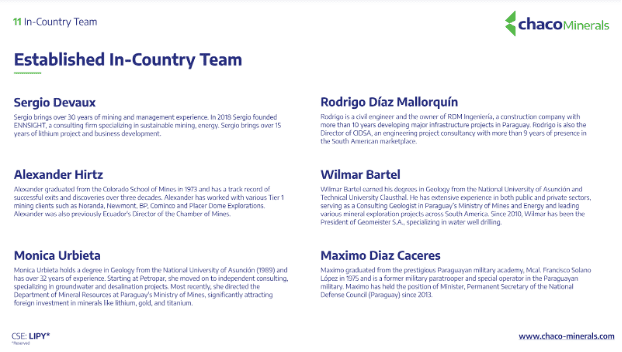
Also listed as a shareholder is Fernando Díaz Mallorquín, owner of the construction and consulting firm Noesis. A note in the newspaper Última Hora stated that this company secured a large number of direct contracts to build social housing during President Santiago Peña’s administration.

A Seventh Company
There is also a seventh mining company prospecting for lithium in Paraguay: Valquiria Exploration, which appears to be connected to several of the others. Although officially not part of the Chaco Minerals holding, it shares the same legal representative—Rodrigo Díaz Mallorquín— and the same four investors as the five affiliated companies, as well as the same environmental consultant, engineer Juan Carlos Weseluk, who submitted their environmental permit applications to the Ministry of Environment.
One of the 18 lithium prospecting requests submitted by Valquiria Exploration and approved by Paraguay’s Vice Ministry of Mines, an investigation by Consenso revealed in June 2024, overlaps with the ancestral lands of the Ayoreo Totobiegosode—the last Indigenous people in voluntary isolation in South America outside the Amazon.
The application for authorization to search for lithium lay within an Indigenous territory protected since 2016 by a precautionary measure from the Inter-American Commission on Human Rights (IACHR). Following the revelations of that investigation, the Ministry of Environment launched a review of the company’s licenses and found “new elements not foreseen in the previous environmental license declaration.” That review ultimately led to the revocation of the environmental permit for that mining prospect in early 2025.
One of the companies associated with Chaco Minerals has also been linked to a Canadian mining firm called Valdor Technology International Inc., based in Vancouver and listed on the Toronto Stock Exchange. According to a stock exchange filing, Valdor Technology signed a purchase agreement in July 2023 with another Canadian company, 1000175307 Ontario Ltd., which in turn held an option to acquire the Paraguayan firm Minera Atenea S.A.—and, through it, an “option to acquire from MAS an 80% interest in and to certain mining rights located in Paraguay.”
It is unclear whether that option remains in effect. Valdor does not appear in the sworn declarations submitted by Minera Atenea to Paraguay’s Ministry of Economy and Finance in June 2023, June 2024, or June 2025, which this reporting alliance obtained through public information requests.
According to ABC Color, Valdor is a company associated with the Chaco Minerals holding. This reporting alliance, however, found no evidence of any similar relationship between Valdor and the other corporations linked to Chaco Minerals.
This journalistic alliance contacted Chaco Minerals three times by email, on June 10, September 3, and October 16, 2025, asking who its largest shareholders or investors are, as well as asking it to clarify its relationship with the five mining firms registered in Paraguay—whether they are subsidiaries, joint ventures, or temporary partnerships. It also wrote to Rodrigo Díaz Mallorquín and Wilmar Bartel via LinkedIn. At the time of publication, neither had responded.
The Revolving Door Between Chaco Minerals and the Paraguayan Government
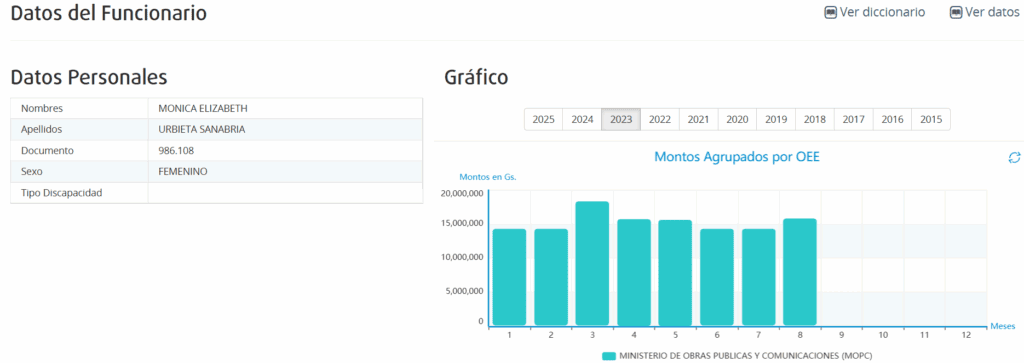
Among Chaco Minerals’ management team—alongside its three principal shareholders—is a former senior official of the Paraguayan state: geologist Mónica Urbieta Sanabria. As Consenso revealed in a separate investigation published in November 2024, Urbieta served as Director of Mineral Resources at the Vice Ministry of Mines and Energy between August 2018 and August 2023, throughout the presidency of Mario Abdo.
Urbieta now holds a post at Chaco Minerals with a similar title—Director of Resources—a position she has occupied since at least May 2024. A corporate presentation by Chaco Minerals dated fall 2023, already listed her as part of the company’s team.
According to Paraguay’s Public Service Secretariat’s open data portal, Urbieta remained a public official under the Ministry of Public Works and Communications, the parent institution of the Vice Ministry of Mines and Energy, until August 2023. Public records signed by her confirm she had been heading the Directorate of Mineral Resources since at least November 2018.
Urbieta’s move to Chaco Minerals was made possible by a change in Paraguay’s conflict-of-interest law, passed by Congress in December 2023 and promulgated by President Santiago Peña in January 2024.
The original Law on the Prevention and Sanction of Conflicts of Interest in Public Service—which was still in force when Urbieta left government in August 2023—explicitly prohibited public officials, for up to one year after leaving office, from providing “any services, in an employment or advisory capacity or otherwise, to any individuals or entities that were subject to the inspection, supervision, control, or regulation of the State body or municipality to which the official had been attached, whenever the official played a decisive role in matters relating to those entities.”
The same law also barred them from “representing, sponsoring, or conducting administrative dealings on behalf of third parties before the body in which they had served,” and from “being shareholders, partners, or participants in any company or corporation over which they had exercised regulatory authority.”
Together, these safeguards constituted what the public sector commonly calls “cooling-off periods”—a standard buffer designed to prevent conflicts of interest when officials move between government and private industry.
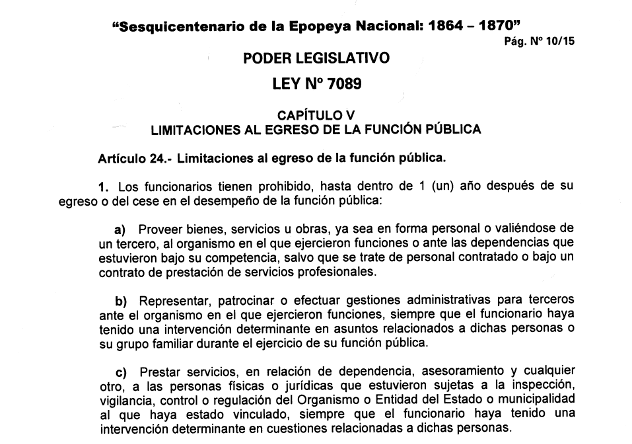
However, Paraguay’s Congress repealed Article 24 in its entirety—the very clause that established “restrictions upon leaving public service.”
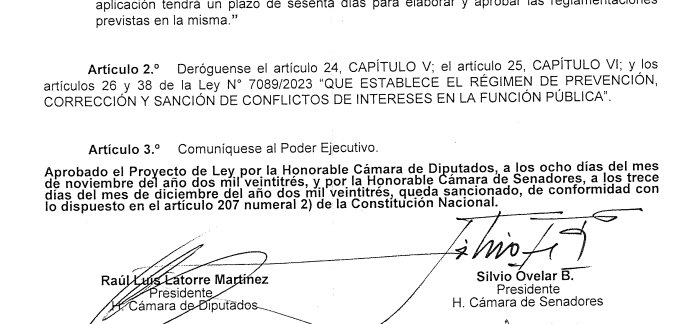
That removal of incompatibility barriers paved the way for Urbieta’s appointment in 2024 as Chaco Minerals’ Director of Resources at a company that presents itself as a holding of several mining firms she once oversaw. This happened less than nine months after she left government.
The Directorate of Mineral Resources, which Urbieta led for nearly five years under Deputy Ministers Celso Nazario Velázquez and Carlos Zaldívar Villalba, holds direct responsibility for the mining sector. It is the office that grants “authorization to carry out mineral prospecting, exploration, and exploitation activities,” according to Paraguay’s Unified Government Portal, which serves as the public’s one-stop access to state information, services, and procedures. Under Paraguay’s 2012 Mining Law, the National Mining Register “depends on the Directorate of Mineral Resources of the Vice Ministry of Mines and Energy.”
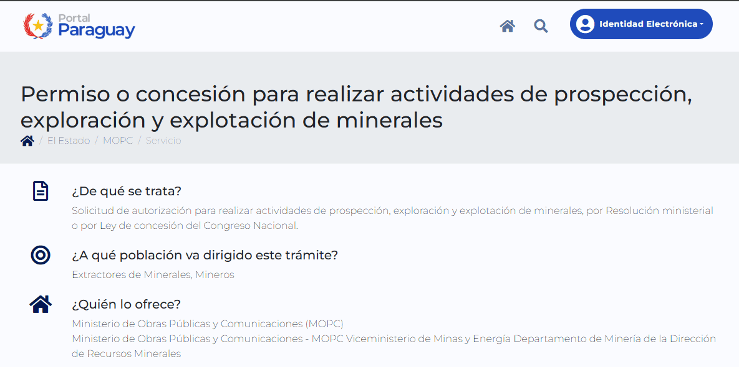
On the government’s online portal of administrative procedures, it is stated that permits for mineral prospecting, exploration, and exploitation fall under the jurisdiction of the Directorate of Mineral Resources—the very office headed by Urbieta when Chaco Minerals’ companies obtained their approvals.
In fact, the application form that companies must submit to obtain prospecting or exploration rights is filed directly with the Directorate of Mineral Resources.

While Mónica Urbieta served as Director of Mineral Resources, the evaluation committee of the Vice Ministry of Mines and Energy approved at least six prospecting requests from companies associated with Chaco Minerals.
For example, on July 10, 2023, the Vice Ministry approved an application submitted by Chaco Lithium, as confirmed by the public environmental license issued by the Ministry of Environment. According to their own environmental license filings, Minera Atenea received four similar approvals from the Vice Ministry on June 3, 2023, while Paraguay Lithium obtained its approval on August 4 of that same year.

Before the publication of this report, this investigative alliance attempted to contact Mónica Urbieta by phone on four occasions between October 6 and October 13, 2025, to ask about her move to Chaco Minerals and a possible conflict of interest. The former director of mineral resources for the Paraguayan government did not respond as of publication time.
Chaco Minerals likewise did not reply when asked whether Urbieta had participated in any way in the evaluation of prospecting applications submitted by the group’s companies to the Vice Ministry.
Lithium in the Chaco
This recent surge in prospecting requests across the Chaco forms part of what U.S. scholar Thea Riofrancos calls the “expansion of extractive frontiers,” a phrase she uses in her newly published book Extraction: The Frontiers of Green Capitalism, which explores the global lithium boom.
The Chaco that this prospection seeks to expand into is an ecologically and socially fragile biome—home to a remarkable array of species and cultures. It is the territory of Indigenous peoples such as the Nivaclé, Yshir, and Guaraní Ñandeva, as well as the Ayoreo, who live in voluntary isolation. It is also habitat for threatened or near-threatened species including the jaguar, the Chacoan peccary, the giant armadillo, and the tapir.
Scientists have warned that the Chaco’s ability to store carbon, retain water, and channel rainfall from the Amazon as atmospheric moisture—the so-called “flying rivers”—is already under serious threat from accelerating deforestation, the expansion of the agricultural frontier, and other land-use changes, such as those that mining could bring.
For that reason, as Professor Riofrancos writes, “global climate action may come into conflict with local environmental protection.”
Yet, in this very region, Chaco Minerals is promising investors potential returns of one billion dollars in just nine to ten months with five successful drillings—touting Paraguay as an “extremely stable mining jurisdiction” while acknowledging that “all investments involve substantial risk and potential for loss,” and that “the value of investments may go down as well as up, and investors may lose all or part of their invested capital.”
All this, even as it remains unclear in which country Chaco Minerals is actually registered.
Lithium in Conflict is a project led by the Latin American Center for Investigative Journalism (CLIP) in partnership with Consenso (Paraguay), La Región (Bolivia), Quinto Elemento Lab (Mexico), Repórter Brasil (Brazil), Ruido (Argentina), Climate Tracker Latam, Dialogue Earth, Mongabay Latam, and Columbia Journalism Investigations (CJI), on how the lithium industry is operating in Latin America. With the support of the legal team El Veinte.


