

In its eagerness to exploit its massive lithium deposits, Bolivia signed at least 14 agreements with foreign companies between 2023 and 2024, the scope and content of which remain undisclosed. Two contracts were eventually submitted to the Legislative Assembly, yet doubts persist about their conditions; one involved meetings with Russian officials internationally sanctioned for the invasion of Ukraine. This investigation uncovers unprecedented details about the opaque lithium agreements signed by the government of Luis Arce, amid concerns over their uncertain economic benefits, potential environmental impacts, and unacknowledged overlaps with Indigenous communities.
Rocío Lloret Céspedes – La Región / Dialogue Earth
On the morning of January 20, 2023, an enthusiastic President Luis Arce announced the dawn of Bolivia’s lithium industrialization era. Standing before an audience packed with guests at the Casa Grande del Pueblo — the seat of government — he predicted that by the first quarter of 2025 the country would be exporting lithium batteries manufactured with local raw material.
“Today is a historic day for all of us. How many years had to pass for the country to finally feel it is on the right path toward harnessing one of its most valuable natural resources, Bolivian lithium?” he told attendees.
By appearing at the event, Arce sought to underscore the historic nature of the first agreement between the state-owned company Yacimientos de Litio Bolivianos (YLB) and the Chinese consortium Hong Kong CBC, made up of three firms. After several failed attempts to break into the international lithium business — considered critical for the global energy transition — the president pointed out that Bolivia would at last be able to sell its natural resources with added value, rather than as a mere commodity. “There is no time to lose,” he repeated more than once.
The Ministry of Hydrocarbons explained at the time that the agreement committed both parties to set up two industrial complexes based on a technology known as “direct lithium extraction” (DLE). Then-minister Franklin Molina described it as “a viable, real, and quickly deployable solution.” According to government estimates, both facilities would produce up to 25,000 tons of lithium carbonate annually in the Uyuni salt flat (Potosí department) and the Coipasa salt flat (Oruro department).
Lithium carbonate is the most common commercial form of the resource. It is a chemical compound of lithium, carbon, and oxygen, essential for producing the batteries that power electric vehicles — critical to moving away from the fossil fuels that still drive most of the world’s transportation. It is also fundamental for electricity storage systems that enable large-scale use of energy from renewable sources such as solar and wind. Transportation and electricity generation are the sectors that produce the highest levels of greenhouse gas emissions globally.
In this strategic market, Bolivia holds 23 million tons of lithium resources, according to the U.S. Geological Survey (USGS), one of the world’s largest volumes. However, the country has yet to certify its reserves, the portion of resources that can be economically exploited.
Five months after Arce’s announcement, YLB had to clarify that what was presented in January 2023 was a study agreement, not a contract to build industrial plants. Opposition lawmaker María José Salazar, along with other congress members and civil society actors, demanded explanations from the government for not disclosing the document or submitting it to the Legislative Assembly. Article 158, section 12 of the Constitution stipulates that the legislature must “approve contracts of public interest related to natural resources and strategic areas, signed by the Executive Branch.”
In June 2023 — a year and a half after President Vladimir Putin invaded Ukraine — the Bolivian government signed a new agreement, this time for “the creation of a production plant with a capacity of 25,000 tons of lithium carbonate per year, based on the Pastos Grandes salt flat.” The deal was made with Uranium One Group, a subsidiary of the Russian state-owned giant Rosatom. Exactly one year later, Arce himself met in Russia with Rosatom president Alexey Likhachev to discuss lithium, despite the latter having been sanctioned by the United Kingdom, Canada, New Zealand, and Australia precisely for the Russian invasion of Ukraine.
Between 2023 and 2024, Bolivia signed 14 documents labeled “agreements,” according to an infographic published by the state-owned YLB last July and still available on its website. This designation allowed the government to make deals without sending them to the Legislative Assembly. “We are talking about a first stage of agreements that fall within the powers of Yacimientos de Litio Bolivianos. Once these agreements conclude, and in the case of success, the corresponding contracts will indeed be signed, which — according to the law — must be published and approved by the Assembly,” Karla Calderón, then-president of the state-owned company, told the local outlet Erbol in 2024.
From public announcements, it is known that the companies involved in these agreements come from six countries — China, Russia, Australia-Germany, France, and Argentina — for the purposes of study and development, though their content and execution remain undisclosed.
This opacity has raised concerns across wide sectors of Bolivian society. “I call them instruments, because their scope and the responsibilities of each party are unknown,” warns sociologist Marco Gandarillas, a researcher at the environmental organization Latinomerica Sustentable.
Three of the agreements—one with Uranium One Group and two on behalf of Hong Kong CBC Investment Limited— later gave way to two contracts, according to the general process outlined by the former president of YLB.
La Región and Dialogue Earth, partners in the Lithium in Conflict investigation coordinated by the Latin American Center for Investigative Journalism, obtained both contracts along with their annexes and full reports. An analysis of these documents, conducted together with Bolivian experts in natural resource governance and Indigenous rights, raises pressing questions about the economic benefits of lithium exploitation for Bolivia under this scheme, the environmental impacts it will bring, and what happens when there are overlaps with Indigenous communities.
These questions have gained traction in Bolivia’s presidential campaign, fueled by the country’s severe economic and energy crisis. The two candidates headed for the runoff this Sunday, October 19 — Senator Rodrigo Paz and former president Jorge “Tuto” Quiroga — both pledged to reject the two contracts, while agreeing that lithium is a resource the country must exploit.

A Handful of Opaque Agreements
How did Bolivia come to accumulate agreements whose contents remain secret, while being showcased as the great promise to turn the country into a key player in the global energy transition?
In 2021, just months after taking office, Luis Arce shifted Bolivia’s lithium policy. Gone was the traditional method of solar evaporation in open-air pools promoted by his predecessor, Evo Morales, into which the state had poured more than $585 million USD. In its place came the push for direct lithium extraction (DLE), promoted by his government as a modern technology “that allows for faster and more sustainable production of lithium carbonate,” according to official sources.
To that end, YLB launched the first call for tenders in April 2021, inviting companies with DLE technology to conduct pilot tests using brines from the Uyuni, Coipasa, and Pastos Grandes salt flats, according to the Ministry of Hydrocarbons. The second call was issued in January 2024, “for the use of evaporitic resources under real conditions in the Uyuni, Coipasa, Pastos Grandes, Capina, Cañapa, Chiguana, and Empexa salt flats,” then-minister Franklin Molina announced.
“These were multi-phase calls. After selecting the companies that advanced to the first phase, they were required to sign a confidentiality agreement before moving on to the second. At that stage, they had to present their projects and were also allowed site inspections. It was as if the door to lithium had been opened for them,” explained Indigenous lawmaker Toribia Lero, representative of the Sura Nation and now second vice president of the Chamber of Deputies. As she noted, the public call itself stated: “Only those applicants who have met the requirements set out above and who sign a Confidentiality Agreement will be admitted to the next phase.”

Since these documents began to be signed under the label of “agreements,” thus avoiding the obligation to have them reviewed and approved by the Legislative Assembly, Congresswoman Lero — a specialist in Indigenous rights — filed 24 information requests with the government to learn their contents. One such request, sent in November 2024 regarding the January 2023 agreement with the CBC consortium, received only a one-page reply in April of this year.
In that brief report, shared with this investigative alliance, Bolivia’s state-owned lithium company stated that “the cited agreement [with Chinese consortium CBC] contains a confidentiality clause related to the direct or indirect protection of all existing technical data and information provided by both parties, which makes its release impossible.” The other 23 requests refer to each company that advanced to the third stage after the January 2024 call, plus one for another agreement signed with Uranium One Group during the first call.
In July 2025, the congresswoman reiterated these requests. However, on Wednesday, September 17, several documents concerning the two public calls for proposals and their results, which had previously appeared on YLB’s official website, were no longer available, without the company giving any public explanation. This journalistic alliance is publishing them here because it considers that they address a matter of public interest for Bolivian citizens.


According to YLB, the first call’s agreements were aimed at “conducting studies and tests,” while the second was meant for “exploration and use of evaporitic resources.” “A euphemism for lithium extraction,” said Congresswoman Lero of the opposition Comunidad Ciudadana party, who has repeatedly criticized the lack of transparency surrounding these deals.
The only two agreements that advanced to the contracting stage have been stalled in the Legislative Assembly since late 2024. One — signed with Russia’s Uranium One Group — was partially approved by lawmakers on August 12, just five days before the general elections led by Rodrigo Paz and “Tuto” Quiroga, who will face each other in the October 19 runoff. The other has yet to be discussed.
After that session — marked by shouting and sharp questioning from both lawmakers and activists and experts — a judge from the Agro-Environmental Tribunal ordered the temporary suspension of legislative proceedings until concerns over water resources, underground fossil aquifers, and prior consultation with nearby Indigenous communities are addressed.
Opposition lawmakers demanded that the new deputies and senators, who take office in November, reopen the debate on the contract. “We, at least as the opposition, will try to block this process. But beyond that, on August 17 the people sent a clear message: they do not want anything proposed by Arce’s government,” said opposition legislator Walthy Egüez of the Creemos party.

This investigative alliance has been trying to obtain answers from YLB since September 17 regarding the signed agreements and contracts — first through a physical letter delivered to its La Paz office, which the company rejected because it bore a digital and not a handwritten signature, and then through an information request submitted on its website. In both cases, YLB was asked for the number and names of the companies with which it had signed agreements.
A company official responded on September 18 that “the contracts signed by the Bolivian State for direct lithium extraction are duly published on our institutional website EPNE-YLB, where the information you seek is available,” and attached two links. The links indeed contained the contracts, but not the annexes or technical reports. After a follow-up reply on the same day insisting on specific information about the agreements, YLB never responded again.

Los enigmas detrás del litio boliviano
The Enigmas Behind Bolivia’s Lithium
As soon as the results of the companies that passed the first phase of the initial call were announced in June 2022, controversy arose over alleged favoritism toward the Russian firm Uranium One Group. Another company, U.S.-based Energy X, lamented that a ten-minute delay in submitting its final report had excluded it from the process. Although the Bolivian state-owned company dismissed this claim as a “smear campaign,” an executive from one of the participating firms and a lithium expert — both requesting anonymity out of fear of reprisals — agreed that YLB’s final report did not include the technical evaluation results of the proposals, but only a general summary.
A former public official, who also asked to remain anonymous, revealed to this journalistic consortium that during the first call YLB presented the Ministry of Hydrocarbons with comparative charts on energy and water use by the competing companies. “For the second call, the selection was behind closed doors,” he said.
In January, lawmakers began debating the contracts with incomplete information. Activists and opposition leaders questioned the potential social and environmental impacts, as well as the need to hold prior consultations to properly inform Indigenous peoples living in and around the salt flats. The lack of transparency also triggered alarms about the possible loss of national sovereignty.
“There’s missing information. The Executive acted with total irresponsibility, withholding data from the committee and lawmakers, which prevents coherent analysis and oversight,” denounced legislator Egüez at the time. His colleague Lero agreed and, in an interview with this journalistic consortium, revealed that the time between the arrival of the documents and the session in which they were to be approved was extremely short. “They didn’t even give us time to read. We had to turn to experts to help us understand many of the issues,” she said.
Only in a second submission of the contracts, in February, were the annexes and economic reports finally included. On YLB’s official website, only the contracts appear, not the full dossiers.
See here the Bolivian lithium contracts with their annexes and full reports:


These events sparked protests, especially from Quechua Indigenous communities in the Nor Lípez region of Potosí — an area that would be affected by the installation of industrial plants by both Uranium One and the CBC consortium, according to the annexes and reports attached to the contracts.
In May 2025, leaders from these communities filed a legal action to protect collective rights such as the environment, health, and access to essential services. Initially, on May 28, Judge Edson Villarroel Herrera ordered ahalt to the legislative process for the contracts and the execution of the works “until socio-environmental studies and compliance with the right to free, prior, and informed consultation are guaranteed.” That same day, Economy Minister Marcelo Montenegrolamented the ruling, noting that such judicial decisions “delay the progress of Oruro and Potosí.” A week later, on June 5, the same judge struck down that precautionary measure.
“The document submitted by the communities contains evidence not only that there was no prior and informed consultation, but also that high-Andean wetlands have already dried up,” said Fátima Monasterio, the lawyer representing the plaintiffs.
The reason environmental damage may already exist in the area, as local residents reported, is that although the contracts are not yet in effect, the agreements with different countries — whose contents remain undisclosed — are. “The Russians have two agreements: one for Pastos Grandes and another for Uyuni, which is the one that has reached the contract stage,” explained Gonzalo Mondaca, an environmental engineer and researcher at the Center for Documentation and Information of Bolivia (Cedib).
In the case of Pastos Grandes, Uranium One signed an agreement with YLB in July 2023 “to install an industrial lithium carbonate complex (…) with an investment of $575 million USD and an annual production capacity of 25,000 tons,” according to the Ministry of Hydrocarbons.
That project never moved forward. “In November 2023, [the Russians] tried to set up a camp between Alota and Mallku Villamar [two Indigenous communities in Nor Lípez] to work in the Pastos Grandes salt flat, but they wanted to do so in a grazing area [for llamas and vicuñas] — practically in the middle of a wetland,” Mondaca added.
Local residents rejected the incursion because no one had informed them. According to Mondaca, who frequently visits the area, an agreement was reached in August 2024 to set up the camp outside the aquifer zone — something that has not happened to this day.
Both Mondaca and attorney Monasterio agree that in the salt flat regions of Potosí, particularly Uyuni, “there are a series of actions and activities linked to the contracts — though not the contracts themselves — that have been carried out over people’s heads,” in Monasterio’s words.

The Agreement with Russia’s Atomic Energy Subsidiary
The contract with Uranium One Group is a commitment to “develop, build, implement, and install a plant” to produce 14,000 tons of lithium carbonate annually in the Uyuni salt flat, using direct lithium extraction (DLE) technology, according to page 3 of the document. The estimated Russian investment cost is $975 million USD.
Uranium One Group is a wholly owned subsidiary of the Russian state giant Rosatom, which encompasses that country’s nuclear and non-nuclear energy programs. Although it originated as a mining company listed on the Toronto and Johannesburg stock exchanges, it no longer trades publicly and is now part of a group that operates uranium mines in Kazakhstan, Tanzania, and Namibia. According to its website, it has “80 years of experience in the processing and extraction of ‘white gold,’ including the creation of a complete technological chain in Russia, from lithium extraction to battery and electric vehicle production.”
Uranium One has been subject to international sanctions as a result of the autocratic government of Vladimir Putin’s invasion of Ukraine. In February 2023, Ukraine’s National Security and Defense Council sanctioned one of the group’s companies, Uranium One Group Joint-Stock Company, along with its president Andrey Shutov. Two years later, it applied the same sanctions to its Dutch subsidiary, Uranium One Holding N.V.
Rosatom has so far escaped the sanctions imposed on many of Russia’s major state-owned companies, but several of its top executives have not. Its president, Alexei Likhachev, was sanctioned by the United Kingdom, Canada, New Zealand, and Australia between 2022 and 2023. The United States followed suit just days before the end of Joe Biden’s administration, when the State Department sanctioned Likhachev and 13 other Russian citizens sitting on Rosatom’s board of directors, as part of measures against Russia’s energy sector, which Washington described as “the main source of revenue fueling Russia’s war against Ukraine.”
Six months before Washington’s sanctions — but more than a year after the other countries had already blacklisted him — Likhachev met with President Arce in St. Petersburg. In June 2024, according to Rosatom itself, they discussed “bilateral cooperation in the fields of nuclear energy for peaceful purposes and the lithium industry.”
Rosatom’s deputy CEO, Kirill Komarov — who in June 2023 hailed the agreement with YLB as “the first large-scale foreign project in the field of lithium production” for the Russian state company, one that “opens new perspectives for long-term cooperation between Russia and Bolivia” — had already been sanctioned four months earlier by the United Kingdom for the same reason. He was later sanctioned by Canada and the United States as well.
Between 2016 and April 2025, Bolivia’s governments — first under Evo Morales, later under Luis Arce — held at least 15 official meetings with Rosatom, according to this investigation based on publicly available press reports and social media posts. Rosatom is also responsible for building the nuclear research reactor in El Alto, La Paz, which was supposed to begin operating in July but has yet to come online.

The Contract Clauses with Uranium
The terms of the contract have also come under scrutiny.
Bolivian economist Fernando Patzy, of the Natural Resource Governance Institute (NRGI), warns that the agreement with Uranium One Group is presented as a “partnership contract,” but is in reality a service contract split into three agreements. One is the main contract on plant construction, while two others — covering operation and commercialization — are only briefly mentioned in the annexes. For Patzy, these omit fundamental details such as how YLB will repay Uranium’s investment. “It does state that repayment will be in product (lithium carbonate), but it doesn’t specify quantity, quality, or timelines, making it impossible to assess whether the deal is advantageous,” he explains.
José Pablo Solón, author of Mirages of Abundance: The Myths of Lithium Industrialization in the Uyuni Salt Flat, compares the contract to a matryoshka doll, with annexes nested inside one another like the famous Russian toy. “The main contract stipulates that, at the end of Phase II (in 18 months), YLB will receive a plant with capacity to produce 9,000 tons of lithium carbonate annually. By the end of Phase III, production will reach 14,000 tons per year,” he says.
Both Patzy and Solón agree that the annexes are overly general and lack critical specifications. “In addition to Assembly approval, three further contracts must be signed: one for operation and maintenance, one for commercialization, and one for reconciliation. These three additional contracts will each run for 20 years, renewable,” Solón notes.
Another major concern is freshwater consumption. According to the document, the extraction operation would affect a 219 km² crustal area of the Uyuni salt flat and a 419 km² basin within the Nor Lípez Indigenous Territory (TCO), whose province of the same name is home to about 14,241 inhabitants, according to the 2024 Census. In total, the project would require roughly 1,184,471 cubic meters of freshwater annually.
“There is data on the volumes of brine and water required for the operation, but the freshwater figure seems extremely large. It’s strange because, in theory, direct lithium extraction is supposed to help preserve water,” Patzy says.

The contract specifies that project investments in assets (Capex) and operating expenses (Opex) will be covered with revenues generated from the commercialization of lithium carbonate produced at the plant. According to YLB, annual revenues from the project are estimated at $315 million USD. “This would imply an international price of about $30,000 per ton of lithium carbonate,” Solón explains. “Although at the end of 2022 international prices reached $80,000 per ton, today they hover around $10,000. Either someone has a secret formula to triple the market value, or this calculation is wildly optimistic,” he adds.
Finally, the Russian industrial plant will be located south of the Uyuni salt flat, covering an area of 231 hectares — the equivalent of about 324 football fields. The reports attached to the contract, cited by Solón, mention “direct and indirect influence” on 17 Indigenous communities within the Nor Lípez TCO: six directly and eleven indirectly. The direct impact would fall on the communities of Colcha K, Río Grande, Calcha K, Julaca, Vinto K, and Ramaditas, while the indirect impact would reach Villa Candelaria, Puerto Chuvica, Santiago K, Bella Vista, Malil, Santiago de Chuvica, Manica, Atuicha, Santiago de Agencha, Llavida, and Aguaquiza.
“We are worried — what will our animals live on? The water will dry up, it’s already drying up. And now that work will begin, even more so. What will become of life in the future for our children?” lamented Justina Salvatierra Bautista, who served as Kuraj Mamatalla (highest authority) of Nor Lípez province between 2022 and 2023, in an interview with Dialogue Earth in 2023.

Although the reports state that the areas where the plants will be built do not overlap with protected zones and are located on state-owned land, they later acknowledge that they do cover communities within the Nor Lípez TCO (Indigenous Communal Territory). Therefore, “for their utilization, the corresponding consultations, timely studies, and agreements with the TCO will be carried out to ensure equitable and sustainable use of this resource (lithium).” Nowhere is prior and informed consultation mentioned, as required by the Bolivian Constitution and ILO Convention 169, of which Bolivia is a signatory.
Deputy Minister of Alternative Energies Álvaro Arnez clarified in May that such consultation would come “after the approval of the contracts.” He added that “a socialization process, a consultation with all the communities, is also included, prior to industrialization — the stage at which both the Russian and Chinese companies are currently positioned.”

Behind the Chinese Contract
The second contract currently before the Assembly is with the Chinese consortium Hong Kong CBC Investment Limited, commonly referred to as CBC in Bolivia after the initials of its three members, and “legally incorporated in Hong Kong, People’s Republic of China, through its branch Hong Kong CBC Investment Limited – Bolivia,” according to clause 1.2.
Clause 4 of the document stipulates that, once approved, the consortium will “provide services” to the state-owned YLB, including the final engineering design, construction, operation, and maintenance of two plants in the Uyuni salt flat. One of these plants would border the facility planned by Russia’s Uranium One Group. In one plant, lithium will be extracted using DLE (direct lithium extraction) technology, while the other will process residual brine from the evaporation ponds built under Evo Morales’ government.
Once operational, the two plants are expected to produce between 10,000 and 25,000 tons of lithium carbonate annually. The investment amounts to $1.03 billion USD, according to YLB.
“CBC will handle the design, construction, operation, and maintenance of the plants, while YLB will pay the Chinese consortium with part of the lithium carbonate produced,” summarizes Solón.
This lithium is key for the three companies making up the consortium: Contemporary Amperex Technology Co. Ltd. (CATL) controls nearly 40% of the global lithium battery market and supplies automakers such as Tesla, Peugeot, Hyundai, Honda, BMW, Toyota, Volkswagen, Volvo, and Mercedes Benz. Guangdong Brunp Recycling Technology Co. Ltd. (Brunp), a CATL subsidiary, recycles materials from used batteries. Finally, CMOC is the world’s largest producer of cobalt, another mineral essential for lithium batteries.
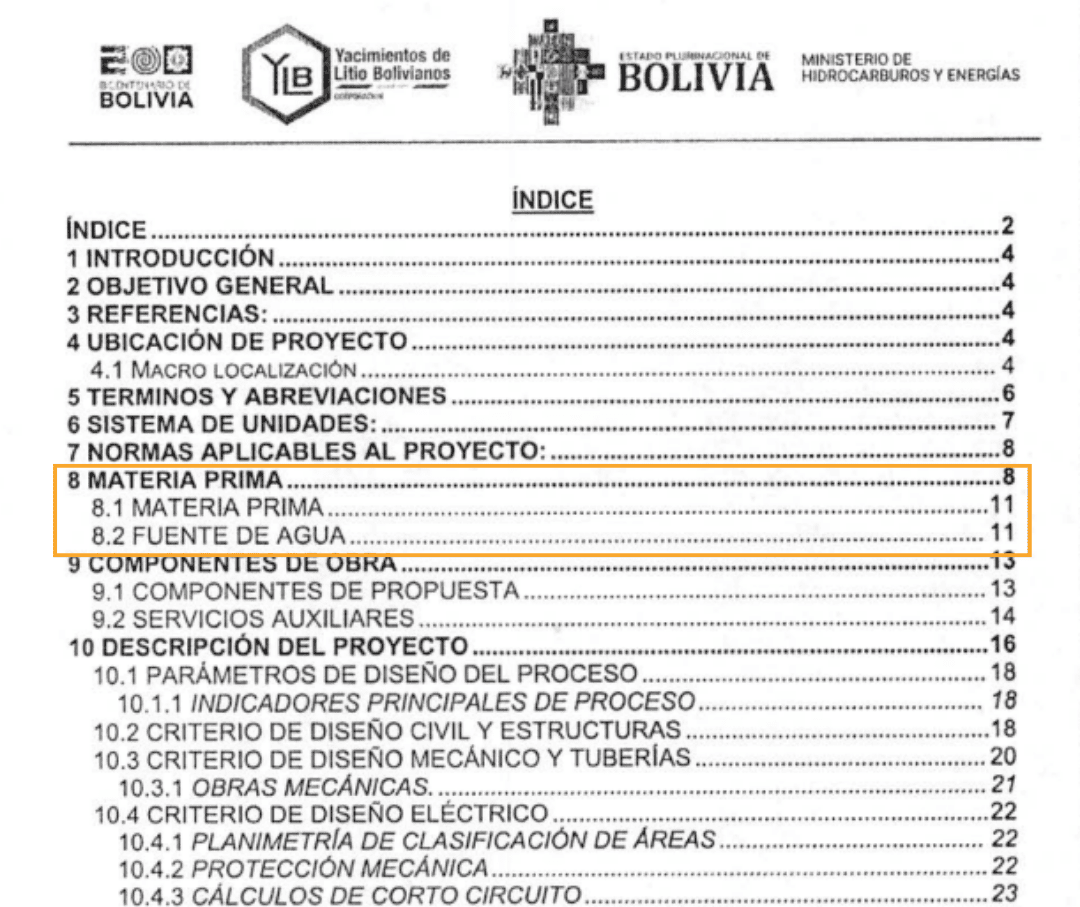
Several experts point out that the contract contains incomplete information — for example, the annex for the DLE plant lists a section called “8.2, Water Source,” which does not exist in the document.

In clause 9, Solón notes an interesting detail: if the plants fail to produce the agreed volumes of lithium carbonate for three consecutive months, both parties must investigate the cause. If one side is found responsible, it must compensate the other for the losses incurred.
The raw material for the residual brine plant will come from the evaporation ponds built during Evo Morales’ presidency. After more than 15 years, these have not achieved the promised industrial production. In fact, 18 of them are now “unusable,” according to former YLB president Karla Calderón.
As for the DLE plant, the brine to produce lithium carbonate will come from a section of the Uyuni salt flat bordering the road connecting the Indigenous communities of Chuvica and Colchani.
As with Uranium One Group, experts note once again that YLB’s projected prices are unrealistic. The reports accompanying the CBC contract — covering the plants’ 36 years of operation — estimate an average price of $24,600 per ton of battery-grade lithium carbonate in a pessimistic scenario, and $26,100 per ton in an optimistic one, while the current price is about $10,000 per ton.
“In every scenario, CBC secures greater benefits than YLB, because in addition to recovering its investment and operating costs, it will receive 12% interest (or more), $1,700 USD per ton of lithium carbonate (for the technical service license), and 49% of the profits,” Solón explains.
Other key disadvantages for Bolivia could be related to royalties, Indigenous consultation, and water use, he adds.
In the first case, the Mining Law establishes a 3% royalty for departments from which natural resources are extracted for export. Potosí — which hosted the largest silver mine in the world during the Spanish empire — has been demanding a law to secure higher royalties from lithium exploitation. But clause 24, section “c,” stipulates that “if, during the operation and maintenance stage, there is any legislative or tax change in the Applicable Laws (…), the parties may terminate this contract at the operator’s request.” In such case, YLB would be obliged to reimburse the amount invested in the plants’ implementation.

The Ministry of Hydrocarbons argues that prior consultation is not required “because the plants will not be located on Indigenous territories.”
However, the contract and its accompanying reports presented to lawmakers state that the water sources to be impacted are located within the Nor Lípez TCO — specifically in the Cieneguillas and San Gerónimo micro-basins. The same applies to the Uranium One Group contract, whose technical annex states that the industrial extraction zone will be in the Huasa Julaca basin, Colcha K, also within the Nor Lípez TCO. In other words, these projects could indeed affect Indigenous communities living there.

A Late Official Invitation
On the night of January 19, 2023, a text message arrived on the cell phones of the top Indigenous leaders of Nor Lípez. It came from the Office of the Presidency. It was an invitation to attend the official launch ceremony of the “industrialization of Bolivian lithium” the following day, at the Casa Grande del Pueblo in La Paz — 682 kilometers away.
“We had no time to mobilize; that’s how we found out what was happening. If it hadn’t been for that, we wouldn’t even have known. The invitation was for eight in the morning — how were we supposed to get there?” recalled Indigenous leader Néstor Ticona, former Kuraj Kuraca of the Quechua Ayllus of Nor Lípez, in an interview with Dialogue Earth in 2023, expressing his frustration with the central government’s decisions. Since then, the communities of this territory have resisted a process they say has excluded them entirely and fear losing their quinoa crops and camelid herds.
At the same time, holding on to hopes of job opportunities, they expect a simple explanation in their own language about what will happen to their water and the waste left behind by projects aimed at selling value-added lithium. “I wanted to know: how many [workers will there be] from the Lípez Nation, from all of Nor Lípez, from Sur Lípez? I went to La Paz and was never received, nor given any answers,” Ticona lamented.
In the salt flat region, vehicles belonging to Uranium One Group and other Chinese companies have been spotted — according to lawyer Fátima Monasterio, speaking to this journalistic alliance — though it remains unknown under what arrangements they are currently operating, exploring, or conducting studies.
In the Coipasa salt flat (Oruro), listed as one of the next sites to be exploited, lives the Quillacas Nation, composed of several ancestral Indigenous ayllus. “In their case, they are very organized (following assembly decisions), and in a community meeting they were emphatic in rejecting the contracts,” said researcher Mondaca.
The area contains sacred sites, making their disturbance deeply serious within the Andean worldview. “For us, Indigenous peoples, water is female — that is why we say Mama Yaku (in Quechua). It is the blood that flows through the body of Pachamama, or Mother Earth. And the salt flats are the spilled milk of a mother who lost her child,” explained Indigenous deputy Toribia Lero, who does not belong to the region but has studied Andean cosmovision.
A different perspective comes from young professionals in the area, such as Wilson Caral, an environmental engineer born in Colcha K, who worked at YLB and completed postgraduate studies on lithium production in Argentina. His position centers on making sound decisions in partnership with foreign firms. He acknowledges the impacts of this kind of mining, regardless of the method used, but believes they can be minimized. Just as he once left, he says many others leave due to lack of opportunities. “Resources can be harnessed in the best possible way, with fewer impacts on the salt flat and the environment,” he insists. His more than ten years of experience in lithium industrialization and a master’s degree in evaporitic resources have not, however, been enough for him to return to work at YLB.
This multiplicity of agreements with foreign companies may seem paradoxical given the Bolivian government’s desire to redefine the rules of mining extraction under a sovereign model “where the Bolivian state, through YLB, has control over the entire production chain, from extraction to industrialization and commercialization of products,” as president Arce explained. However, it reflects a significant shift between the initial strategy of Morales and then Arce, and its execution, which Argentine economist Martín Obaya describes in his analysis of the Bolivian model as a move from “the pursuit of a radical resource nationalism by the state” to a “moderate nationalistic approach, more open to collaboration with foreign firms.” In that process, foreign companies went from being almost unable to participate, save for direct technology transfer, to becoming key partners.
The fact that this shift has been accompanied by a marked lack of transparency also raises red flags for those who study the lithium industry. “It’s very concerning that the results of those negotiations and their clauses are not public. It means that regulatory agencies, Congress, civil society and regional governments, like Potosí, have no ability to participate as stakeholders in governance because they’re not aware of the contractual content,” says U.S. researcher Thea Riofrancos, a professor at Providence College and author of the recently published book Extraction: the Frontiers of Green Capitalism on the global lithium boom. For Riofrancos, comparable situations in other countries and with other minerals also deemed critical show that “corrupt quid pro quo relations are more likely when there is no transparency.”
In any case, decisions over who will exploit Bolivia’s lithium, where, and under what conditions may yet be reshuffled again.
At a forum organized by the Potosí Civic Committee (Comcipo), days before the first round of elections, the two candidates headed for the runoff — Rodrigo Paz (PDC) and Jorge Quiroga (Alianza Libre) — announced that, beyond rejecting the existing contracts, they would promote a new law on evaporitic and lithium resources, and guarantee the right to free, prior, and informed consultation, among other measures.
In an interview with AFP on August 26, Paz declared: “Even if we have the largest caucus [of lawmakers], if there is no clarity and transparency in communication with the Bolivian people, it will be very difficult to approve [the contracts].” For his part, Quiroga stated in an interview with CNN on October 1 that every Bolivian should have a title deed to the mineral. “The contracts signed by President Luis Arce and everything they have done have no recognition from us,” La Nación reported.
Meanwhile, once again Bolivia watches its promises of future wealth fade away, amid secretive agreements and an economy strangled by a shortage of diesel to power production and a lack of foreign currency in the formal market.
Lithium in Conflict is a project led by the Latin American Center for Investigative Journalism (CLIP) in partnership with Consenso (Paraguay), La Región (Bolivia), Quinto Elemento Lab (Mexico), Repórter Brasil (Brazil), Ruido (Argentina), Climate Tracker Latam, Dialogue Earth, Mongabay Latam, and Columbia Journalism Investigations (CJI), on how the lithium industry is operating in Latin America. With the support of the legal team El Veinte.