


More than 100 accounts are amplifying support for the reopening of First Quantum Minerals’ mine in Panama. Several of them have been linked to more than 500 instances of online harassment targeting environmental defenders. Behind the campaign are fake personas, pages posing as Panamanian news outlets, and employees of Cobre Panamá. Some of the accounts—which show signs of being managed as part of a coordinated operation—have spent nearly $60,000 on paid advertising through Meta.
By Sol Lauría (Concolón) and Pablo Medina (CLIP)
On November 28, 2023, Panama’s environmental movement achieved what many had thought impossible: it halted an open pit mine operating within a protected biological corridor. After weeks of unprecedented nationwide protests, the country’s Supreme Court struck down the law that had extended a concession allowing the local subsidiary of the Canadian mining giant First Quantum Minerals to extract copper and other metals.
The ruling sparked celebrations across the country. Near the border with Costa Rica, members of the Ngäbe Indigenous community played plenas in roadside camps along the Pan-American Highway, where they had held out despite police crackdowns. Along the coast near the mining project, boat operators who had carried the protest onto the water—blocking the company’s port—celebrated as though they had just won a world championship. Teachers and farmers, who had watched five of their own die during the unrest, danced and waved flags outside the courthouse, chanting “Yes, we did it” after weeks of vigils while awaiting the decision.
“We have unanimously decided to declare the entirety of Law 406 unconstitutional,” Supreme Court Chief Justice María Eugenia López announced.
The ruling appeared to close a chapter defined by years of conflict. The concession had already been declared unconstitutional once before, in 2017. The mine’s operations had accumulated hundreds of documented environmental violations in the mountains of Donoso, according to Panama’s environmental authority. And, as previous reporting has shown, the project benefited from political protection from the outset. The Supreme Court’s 234-page decision, which found that 25 constitutional provisions had been violated, seemed to settle the matter once and for all. A subsequent moratorium law reinforced the outcome by barring any new permits for metal mining.
Yet two years later, the fight over the mine is far from over. One of its most intense battlegrounds has shifted online, where a coordinated campaign has emerged against many of the people who led Panama’s environmental movement and continue to defend the court ruling against efforts to revive the project.
The political landscape has changed. A new administration, led by President José Raúl Mulino, initially pledged to respect both “the Court’s ruling” and “the will of our people.” But he later signaled his intention to revive the massive mining project, framing it as a source of jobs and economic growth. Mulino dismissed opponents of the mine as “a handful of people” and said the project could reopen through a direct contract, bypassing Congress altogether. In doing so, he ignored the very reasoning laid out by the Supreme Court, whose justices had concluded that concessions affecting fundamental rights—including the rights to life, a healthy environment, and children’s health—require both public bidding processes and meaningful citizen participation.
Soon afterward, social media accounts of dubious origin began multiplying across platforms, promoting the mine’s reopening, championing the idea of “responsible mining,” and attacking those who opposed it.
Digital Loggers—a cross-border investigation led by the Latin American Center for Investigative Journalism (CLIP), together with Concolón, La Prensa in Panama, and six other media organizations across the region—identified more than 100 accounts amplifying pro-mining narratives and targeting environmental defenders in support of reopening the Cobre Panamá project.
The investigation uncovered fake news-style pages, fabricated online personas, and coordinated advertising campaigns backed by thousands of dollars in spending. It also documented more than 500 instances of online harassment directed at environmental defenders, including defamation, smear campaigns, and the publication of personal information, a tactic commonly known as doxxing.
Disinformation on Three Fronts
The online attacks operate along three parallel tracks. The first consists of fake accounts and fabricated identities. Anonymous profiles on Facebook, Instagram, X, and YouTube publish defamatory content about environmental defenders, launch sexualized attacks against women leaders, and engage in doxxing. The second involves pages that present themselves as Panamanian news outlets while disseminating false or misleading information. The third is made up of accounts belonging to individuals with possible professional or financial ties to the mining industry who actively participate in the debate.
One of the most prominent figures in the first category is Wilson Jaramillo, a persona active on Facebook, Instagram, and YouTube. The profile appears carefully crafted to project an image of grassroots authenticity. It uses colloquial street language and claims to come from Barrio Sur in Colón, one of the poorest and most neglected neighborhoods in Panama. The account regularly attacks activists, students, workers, and legal professionals associated with the Movement of Lawyers for the Nation.
Women are its primary targets. Among those singled out are environmental advocates Camila Aybar and Raisa Banfield, as well as journalist Sabrina Bacal, whom the account accused of “extortion.” The posts claim that activists are being funded from abroad to destabilize the country, portray them as part of “woke communism,” and accuse them of acting on behalf of Chavismo. The account also promotes a conspiracy theory—without evidence—claiming that Spain sent more than $25 million to Indigenous communities involved in the 2023 protests.
The Wilson character relies heavily on nationalist rhetoric and conspiracy theories to undermine environmental defenders. Yet signs suggest that Wilson himself may not exist. His videos feature poorly synchronized lip movements and unnatural eye behavior, indicators that the footage may have been digitally manipulated rather than authentically recorded. AI-detection tools such as Hive Moderation, along with facial-recognition services PimEyes and TinEye, indicate a 99.8 to 99.9 percent likelihood that the profile images were generated by artificial intelligence. Beyond the videos themselves, there is virtually no public digital footprint associated with the individual—a pattern commonly associated with fabricated identities.
Despite having only a small following, the account managed to generate more than 100,000 views on one video by spending roughly $3,300 on advertising across Meta platforms. Between August 2025 and May 2026, it promoted 21 pieces of content. Wilson Jaramillo is far from an isolated case. As part of the investigation, Digital Loggers reviewed advertisements listed in Meta’s Ad Library—a public database of paid ads running on Facebook, Instagram, and Threads—using the keywords “copper” and “mining” in Panama between 2023 and 2026. The findings revealed a striking concentration of spending. Of the 462 advertisements identified, 351—roughly 76 percent—promoted narratives supporting the mine’s reopening or sought to discredit critics who opposed it on environmental, legal, or institutional grounds.
On YouTube, Wilson’s content generally attracts little engagement. Only a handful of his 23 videos received more than ten comments. Yet some of those comments came from a cluster of accounts all created on the same day—October 23, 2025—which repeatedly posted coordinated hashtags such as #Panama, #Panamá, and #YesToTheMine. Among them were users operating under names such as @WilliamsOconnor-m8e, @JoseMariscal-x8k, and @CuitlahuacCvc.
Who Is Behind the Account?
Meta’s advertising transparency records point toward a digital marketing agency based in Mexico. The contact email listed by the Wilson Jaramillo account in Meta’s advertising disclosures was webmkt[XX]@gmail.com (partially redacted here). According to previous reporting, the same email address was linked to accounts that purchased political advertisements attacking Claudia Sheinbaum during Mexico’s 2024 presidential election campaign.
But Wilson is not the only account connected to that address. More than 85 percent of all mining-related Meta advertisements identified by the investigation—excluding those purchased by politicians—were concentrated in two Facebook pages that belong to the second category of accounts uncovered by reporters: pages masquerading as news organizations while spreading disinformation and attacking people defending the environment. The pages are Diario de Panamá and Panamá en Directo. On their public timelines, both pages share links to articles published by legitimate media outlets, reinforcing the impression that they are conventional news organizations. Yet through paid advertisements—content that does not necessarily appear on their public feeds—they distribute videos and posts that mimic the visual branding of international media organizations, local news outlets, and even publications that do not exist. Together, the two pages spent an estimated $51,700 over a two-year period, according to Meta’s records. Alongside Wilson Jaramillo, they form a trio responsible for 95 percent of the direct attacks on environmental defenders identified by the investigation. They produce highly emotional, professionally packaged video content and, as this investigation found, appear to have their advertising campaigns managed by the same actor.


In Meta’s Ad Library, all three pages listed either the email address mentioned above or the contact number +507-685893[XX]. One or both of these contact details were also used by three additional Facebook pages that present themselves as news outlets but are primarily used to promote Wilson’s videos attacking those who oppose the reopening of Cobre Panamá on legal grounds, stoking fears about the consequences of the mine’s closure, and praising Salvadoran President Bukele for his pro-mining stance. These pages are Voces Panameñas, Gente del Canal, and Conexión Istmeña. Like the pages discussed earlier, they share a similar appearance and promote much the same content. Taken together, the evidence suggests that a single individual or company may be coordinating their advertising operations.
In the days leading up to the publication of this investigation, in early June 2026, advertising from these six pages focused on countering reports about the mining company’s contributions to the state during its years of operation, warning of the “risk of chaos” posed by protests, raising alarms about “criminal groups” engaged in illegal mining, attacking environmental activists, and—more recently—targeting politicians who had criticized recent decisions regarding Cobre Panamá. Among them were independent lawmakers from the VAMOS movement, former president Martín Torrijos, and Ana Matilde Gómez.
Outside this network of digital personas are two other pages with different contact information but strikingly similar narratives: Noticias de Panamá, which largely echoes the messaging of the other outlets, and Noticias Enfoque Nacional, which focuses on highlighting government actions while also emphasizing the company’s economic contributions and portraying critics as “paid destabilizers.”
Several other Facebook pages also attempted to run ads but had them removed by Meta for violating transparency requirements—specifically, failing to provide contact information—or for breaching advertising policies. Among them were Abriendo la Ponchera, inactive since 2024, and the now-defunct La Noticia Panamá and El Pana Noticias. Cobre Panamá and First Quantum Minerals have faced similar issues: Meta removed three of their advertisements for violating platform policies in June 2022 (see here and here) and December 2023 (see here).
The reporting team contacted all of the pages mentioned in this investigation using the contact details they themselves provided in Meta’s Ad Library. Wilson Jaramillo, Panamá en Directo, Diario de Panamá, Conexión Istmeña, and Gente del Canal were approached through the email addresses webmkt[XX]@gmail.com and panamanoticias@[XXXXXXX].com, as well as by phone at +507 6858-93[XX]. The phone number led directly to voicemail and was not linked to WhatsApp. The team also contacted Noticias de Panamá via redaccion@[XXXXXXXX]-panama.com and by phone at +507 6774-49[XX], a number that appeared to be inactive and likewise had no WhatsApp account. None of the pages responded. However, shortly after Digital Loggers contacted Noticias Enfoque Nacional through the phone number +507 6365-52[XX] and the email address davidteje[XXXX]@outlook.com, both its advertisements and its profile disappeared.

 The third category of accounts identified by this investigation includes individuals who openly advocate reopening the mine while attacking its critics. Some are employees of Cobre Panamá; others appear to have professional or financial ties to the company. More than twenty accounts fall into this category.
Several openly disclose their connection to the company. One is @ciudadanonacional, run by Jonatan Montenegro, a biologist described in media reports and on LinkedIn as a “Cobre Panamá ambassador.” Others include @KathsMarquez and @aminingwoman, whose social media feeds feature activities and experiences connected to the company. In other cases, the links are less obvious and require closer examination.
One such example is the Instagram account orgullominerolatinoamerica and the Facebook page Orgullo Minero Latinoamérica, both of which feature content centered on a character known as “El Profe Minero” (“The Mining Professor”). The character first appeared as an animated figure in videos alongside guests such as “Mr. Mine,” whose mismatched lip movements and cartoon-style dubbed voice resembled the artificial personas seen elsewhere in the pro-mining ecosystem. Over time, however, the character evolved into a more human-looking figure presented as a mining expert. His videos focus on copper prices, the reopening of the mine as a solution to unemployment, and what he describes as left-wing-funded movements responsible for economic losses of “$100 million a day” whenever protests occur. Behind the character is Jaime Torrero, a former employee of the mining company who administers the Facebook group Orgullo Minero, where pro-mining content is regularly shared.
“El Profe” has appeared in videos both as the animated character and using Torrero’s actual likeness. In the videos where the character presents himself as an expert, the face appears to be Torrero’s, digitally modified using artificial intelligence. “I work with artificial intelligence in the field of education,” Torrero told Digital Loggers.
During a phone conversation lasting more than an hour, Torrero said he had spent 15 years at Cobre Panamá coordinating community education programs before losing his position in the aftermath of the mine’s closure in 2023. He was unequivocal in defending the project’s reopening. According to Torrero, the mine created jobs, educational opportunities, and economic activity for surrounding communities. He explained that Orgullo Minero was launched in 2020, when the pandemic forced the mine to suspend operations, as a space where people who were “stuck at home and struggling” could share their frustrations. “It’s a serious page,” he said. He also described plans to launch Panama’s first mining magazine and create the country’s first professional association for mining specialists. Torrero rejected accusations that his content amounted to harassment. “I’m not here to attack anyone,” he said. “But if I see something being published that’s completely far-fetched, I have every right to comment on it.” Then, in a long and emotional defense of his own background, he added: “Don’t tell me that because I grew up in a thatched house, because I’m the son of a fourth-generation fisherman, because I struggled to earn a professional degree, because I fought in the streets for the student movement in my country and spent my life working for sports and community development—that I’m somehow on the wrong side.”
This reporting partnership also contacted First Quantum Minerals’ local subsidiary, Cobre Panamá, with a six-question inquiry seeking comment on several of the investigation’s findings, including the role of individuals with employment ties to the company. Maru Gálvez, Cobre Panamá’s Public Relations and Communications Manager, did not respond directly to the specific questions. Instead, she provided a statement saying that: “Like any company formally established in the country, we have every right to communicate openly and to participate in public, educational, community, and informational spaces. Our communications and outreach are based on verifiable information, citizen participation, active listening, and transparency.”
The oldest digital infrastructure within the constellation of pro-reopening accounts did not originate as a vehicle for defending First Quantum Minerals. It began in 2013 as a platform for promoting former president Ricardo Martinelli. The account, Bochinchón, now boasts more than 130,000 followers across Instagram, TikTok, and Facebook. When it first appeared on Facebook in 2013, it was called Candidatos del CD. Two years later, it changed its name to Prensa RMB—a reference to Ricardo Martinelli Berrocal and the political party, Democratic Change (Cambio Democrático), under whose banner he won the presidency in 2009. The page continued to evolve. At various points it operated under names such as Martinellistas and Martinellistas – Ricardo Martinelli, particularly during the run-up to the 2024 election, when Martinelli hoped to return to the presidency with José Raúl Mulino as his running mate. Those plans collapsed after Martinelli was convicted of money laundering and sought asylum in Colombia, leaving Mulino to head the ticket. The page adopted its current name, Bochinchón, in 2025. Today, it mixes government-friendly news coverage with pro-mining messaging and attacks on environmental activists. Digital Loggers attempted to contact those responsible through direct messages on Instagram, but the page administrator never replied and instead blocked Concolón’s accounts across all social media platforms.
Other accounts also reveal political origins.
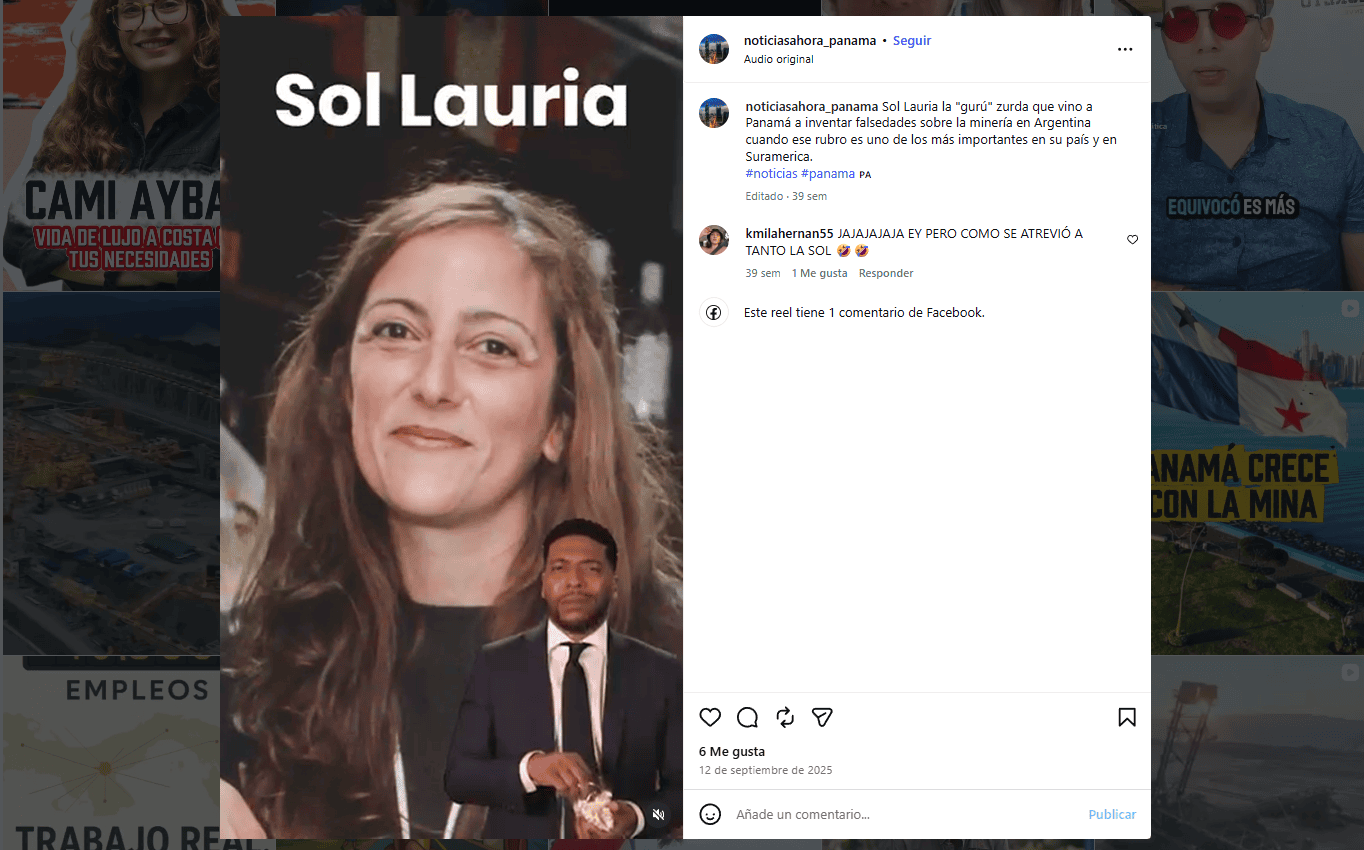
Among them are the Facebook page Progresa Panamá, the Instagram account @noticiasahora_panama, and the TikTok account @panamaprogresa_507. All three have changed names multiple times and are linked to Yuhariel Chávez. The accounts share identical content and use the same profile description: “Digital News Outlet #projects #culture #tourism #environment #Panama.” The Facebook page’s URL even ends with “yuhariel.chavez.” Chávez describes himself online as a digital content creator and has worked with figures associated with Panama’s Panameñista Party, including former mayoral candidate Willy Bermúdez. In 2018, his social media activity focused heavily on the administration and political campaigns of José Isabel Blandón, who served as mayor of Panama City from 2014 to 2019. At the time, Chávez even posted photographs of environmental activist Raisa Banfield planting trees. By 2025, however, the accounts had taken a markedly different direction. They began distributing the same videos circulated throughout the pro-mining ecosystem, including content attacking Banfield, other environmental defenders, and journalists.
Chávez told the reporting team that he had originally managed the accounts “for politics” but sold them in 2024 after receiving an unsolicited WhatsApp message from an unknown buyer offering $200. According to Chávez, the purchaser never identified themselves and paid via bank transfer. Although he insisted that he no longer has any role in running the accounts—“I’m not attacking anyone,” he said—he nevertheless voiced support for reopening Cobre Panamá and dismissed its critics. “Anyone who opposes it is obviously a leftist, an ecosocialist, someone who doesn’t want progress,” he said. He also appeared unusually familiar with the narratives promoted by the network of accounts. “They link you to Suntracs and say you have left-wing tendencies,” he told one of the journalists involved in the investigation during a phone conversation.


The eight Facebook pages identified as purchasing Meta advertisements—Diario de Panamá, Panamá en Directo, Wilson Jaramillo, Voces Panameñas, Gente del Canal, Conexión Istmeña, Noticias de Panamá, and Noticias Enfoque Nacional—were all created in 2024. Their advertising spending increased sharply in 2026. Collectively, the pages spent an estimated $24,600 in 2025. In just the first five months of 2026, that figure had already climbed to approximately $35,200. The timing coincided with a series of significant decisions by the Mulino administration. In January 2026, the government authorized the mining company—whose operations had been suspended under the Supreme Court ruling—to process and export thousands of tons of rock material that had already been extracted before the shutdown. The administration also granted First Quantum permission to restart its coal-fired power plant. According to a previous investigation by Concolón and CLIP, that decision violated at least three international commitments undertaken by Panama. The measures reignited public opposition.
A similar pattern emerged on X, formerly Twitter. Nearly two-thirds of the accounts identified within what researchers termed the “mining swarm” were created after 2024, representing 60.3 percent of the total. Among them were 21 profiles created between February and March 2024—roughly a quarter of all the accounts analyzed. They routinely posted using the same hashtags, including #Afram and #ResponsibleMining, interacted heavily with one another, and amplified content produced by @Cobre_Panama and company employees. Some directly attacked environmental defenders. Others adopted a more measured tone, promoting the supposed benefits of “responsible mining” while avoiding overt insults.
Two sources with ties to both the government and Panama’s political communications industry, who requested anonymity, told the reporting team that local representatives of First Quantum had privately discussed the need to build greater public support for reopening the mine. The concern was understandable. Throughout 2024, opinion surveys conducted by La Prensa, the International Center for Political and Social Studies of Panama (CIEPS), and La Estrella consistently showed that a majority of Panamanians opposed not only the presence of an open-pit mine in the country but mining activity more broadly. First Quantum itself acknowledged this public hostility in an internal communication. And, as documented in the cross-border investigation Mining Countries II, the company launched an ambitious communications strategy aimed at reversing those perceptions.
The publication of new polling data often triggered immediate responses from many of the accounts identified in this investigation. The most recent example offers a revealing glimpse into how the pro-mining messaging machine operates: a synchronized reaction in which nearly identical content is distributed simultaneously across a network of accounts that appear to act in concert.
The episode began with the publication of results from Vea Panamá, a recurring public-opinion survey conducted by La Estrella in partnership with Prodigious Consulting to measure attitudes toward major national issues, including mining. On April 23, 2026, La Estrella published a headline that read: “Opposition to Mining in Panama Rises to 74 Percent in April 2026.” Three days later, Panamá en Directo and Diario de Panamá launched Facebook advertising campaigns aimed at rebutting those findings. The ads cited an earlier poll claiming that 55 percent of Panamanians supported the return of Cobre Panamá. Conducted by Gallup and presented to Panama’s National Council of Private Enterprise (CONEP) on April 16, 2026, the survey received little attention from major news outlets. According to two media executives interviewed by the reporting team, editors were reluctant to publish the results because they could not verify the poll’s reliability and suspected that First Quantum may have commissioned it. Other public-opinion surveys had produced dramatically different findings.


Digital Loggers asked both Gallup and CONEP who had commissioned the survey. Analisa Montenegro, CONEP’s executive director, said the organization had merely provided a venue for the presentation. “Cid Gallup, a well-known firm, requested space [at a previously scheduled event] to present the survey results, at no cost to CONEP, given the importance of the issue for the country,” she said. To obtain comment from the polling company, reporters called Gallup’s Panama office twice and left messages for its director, including a mobile number where she could return the call. They also sent an email to her professional address. None of those inquiries received a response.
Asked directly about the survey, Cobre Panamá did not answer the question. Instead, through Gálvez, the company issued a statement saying: “Cobre Panamá does not comment on rumors, hypotheses, third-party interpretations, or alleged actions attributed to individuals, accounts, or external actors over whom it has no control, influence, or responsibility.”
Network analysis suggests that all three segments of the pro-mining ecosystem described in this investigation mobilized simultaneously to promote the Gallup poll: the accounts masquerading as news outlets and spreading disinformation, the accounts linked to individuals with professional or financial ties to the mine, and the anonymous or apparently fabricated profiles. Across all three layers, the goal was the same. Posts sought to discredit La Estrella, dismissing it as a “rag” or a “propaganda sheet.” Others attacked the survey itself and the people sharing it, branding them “obtuse” or accusing them of deliberately misleading the public. Employees of Cobre Panamá—both those who openly acknowledged their affiliation and those who did not—joined in, along with several newspaper columnists.
The same machinery is deployed against environmental defenders, only with greater intensity and involving a broader cast of actors.
Manufacturing a Scandal
On October 7, 2025, a previously unknown civic committee made public a letter it had sent to a donor of the Environmental Advocacy Center (CIAM), claiming that the organization’s funding was being used for political purposes. The following day, Panamá América published the story. Abel Oliveros, a representative of the committee of “communities surrounding the Donoso mine,” was interviewed on a radio program hosted by a commentator supportive of reopening Cobre Panamá, where he accused CIAM of “having harmed” local communities. After that, a wave of attacks followed.
Conversamos con Abel Oliveros del comité cívico de las comunidades aledañas a la mina de Donoso sobre la carta por la cual denuncian que fondos que le llegan al CIAM (Centro de Incidencia Ambiental) estarían siendo mal utilizados.
Entrevista: https://t.co/6T47H6rc0O@ARCA_Media… pic.twitter.com/194eO0eeCH
— Panamá En Directo (@panamaendirecto) October 8, 2025
What no media outlet pointed out was a crucial detail: Abel Oliveros had also circulated a letter addressed to President Mulino in which he identified himself as a supplier to Cobre Panamá and called for the mine’s reopening. He had also given notes about that meeting, and the mining company’s head of public relations had shared one of them on social media. On his own social-media accounts, he describes himself as a “mining contractor” and, since 2024, has posted photos from the First Quantum project, including one in which he poses alongside members of the company’s public-relations team. The suppliers’ argument was one of the points Mulino later used to advocate reopening the mine. In addition, the Donoso Civic Committee works closely and consistently with the mining company, according to its own social-media posts. In those interviews, however, Oliveros was never asked about the financing of his committee. The focus remained on the accusations against CIAM.
 CIAM is an organization founded in 2007 to defend “the human right to a healthy environment” through litigation, advocacy, and citizen participation. Since then, it has filed more than 200 legal actions, taken part in hundreds of public consultations, and provided free legal assistance to communities. It also opposes open-pit mining because of the irreversible damage it causes to a threatened ecosystem, and it challenged in court the contract-law that extended First Quantum Minerals’ copper concession in 2023—a contract later declared unconstitutional by the Supreme Court—as well as the ministers who signed it. Although CIAM publishes its donors on its website, including amounts, dates, and funded projects, the Donoso civic committee launched the accusation that, through the echo chamber of the disinformation accounts described in this investigation, was transformed into a scandal.
From Oliveros’s interview onward, the machinery moved as follows:
- First, anonymous accounts shared Oliveros’s interview.
@LoroVerdeDePTY shared Oliveros’s interview on Radio Panamá:
Fondos ambientales convertidos en bandera política: comunidades denuncian el costo social de la manipulación. pic.twitter.com/0iV1vWC5Vn
— El Loro De Panamá Es Verde (@LoroVerdeDePTY) October 8, 2025
La CIAM recibió financiamiento de la empresa Packard para ayuda social y ambiental en comunidades pero estos recursos se desviaron hacia agendas políticas que produjeron miles de desempleados, déficit económico y comercial en el país, en Coclé y Colón.#noticias #panama ?? pic.twitter.com/D53CEYvWVb
— Caminando Panamá 507?? (@Caminando507Pma) October 8, 2025
https://www.instagram.com/reel/DPjphSggNls/?utm_source=ig_web_copy_link&igsh=MzRlODBiNWFlZA==
- Then accounts presenting themselves as social causes or news outlets, such as @justiciasocialpma, published edited videos combining those statements, the letter, and footage from the 2023 protests in an effort to supposedly expose members of CIAM’s team.
@justiciasocialoficial_ #MineríaMásTrabajo #Panamá #ConMulinoMasChenChen #SiaLaMineriaResponsable ? sonido original – Justicia Social Oficial ??
3. @panamaprogresa_507 and other similar accounts distributed those materials.
@panamaprogresa_507 uploaded to TikTok the same video previously shared on X by accounts such as @Caminando507Pma and @LoroVerdeDePTY:
@panamaprogresa_507 El financiamiento de la empresa Packard para ayuda social y ambiental en comunidades se desvío hacia el financiamiento de protestas no en contra del contrato minero del PRD sino del proyecto minero en Donoso, el desvío de estos fondos es ilegal e irresponsable. #noticias #panama ? sonido original – Progresa Panamá 507
- Podcaster @xopabrian—who has more than 500,000 followers across platforms—posted an image bearing the caption:
“Well, well, well… $400k in donations from the Packard Foundation to @ciampanama. These ‘pseudo-environmental’ ventures seem pretty profitable (…).” The post included an image of the committee’s letter to the donor.
https://www.instagram.com/p/DPkTdMMCffr/?utm_source=ig_web_copy_link
- On X, pro-mining accounts shared the post, replied to it, and engaged with users who questioned the publication.
Baia baia baia… $400k en donaciónes de Packard Foundation para @ciampanama?
Los emprendimientos “pseudo-ambientales” se ven rentables ? pic.twitter.com/oQbxocKEgL— Brian L. (@emprendementeX) October 8, 2025
Qué ironía… ¡Este sí es un verdadero Escándalo Verde!
— El Loro De Panamá Es Verde (@LoroVerdeDePTY) October 8, 2025
Ya que la CIAM me bloqueo su página dice más de $578,000 pero falta los reportes de Fidelity Founding y Mining Watch es mi humilde opinión ?carbono 0 pic.twitter.com/Ce7j0vJyXJ
— KevinDavidPty (@KevinDavidpty) October 9, 2025
Matan al tigre ? y le tienen miedo al cuero??? No es lo mismo llamar al diablo ?. Una demanda y la CIAM ya está pidiendo cacao y aguacate ????Alguien que le envíe el correo a CMW en Canadá ?? que se están acabando los fondos @LoroVerdeDePTY @Caminando507Pma pic.twitter.com/r8XPFHkMUL
— KevinDavidPty (@KevinDavidpty) October 9, 2025
6. In the following days, the harassment continued.
Accounts such as @anonymous507pa, @grupoelite507, and @SoTruth1 repeated allegations that had already been introduced by others and kept them circulating.
Llamen a CIAM y a todos los anarquistas de Vamos y Políticos por recibir fondos para cerrar calles, empresas y precarizar el empleo.
Ya esta bueno.https://t.co/PpnywiVKSA
— @SoTruth507 (@SoTruth1) October 14, 2025
Ver esta publicación en Instagram
En un medio de comunicación televisivo, el periodista cuestionó Sobre el uso de fondos por parte de una fundación. @ciampanama y esperan alguna respuesta. pic.twitter.com/IKzqkw8SzC
— Grupo Elite 507 (@grupoelite507) October 10, 2025
Ya los medios internacionales están hablando del @ciampanama y de Packard Foundation, está vaina se está calentando. https://t.co/zfAsrUDZoE
— Franklyn Robinson (@frobinsonpty) October 10, 2025
7. On October 10, Panamá América—a newspaper that, according to court findings in the New Business case, was acquired by Martinelli with public funds—published another article under the headline: “CIAM Remains Silent on Donation; Community Members Demand Answers.”
The article was shared alongside another from the business website BNamericas—presented by those circulating it as an “international media outlet“—to lend credibility to the original story.
@ellorodepanamaesverde Circula en las redes… Ahora andan mudos… Será que cuando se habla de los fondos verdes y las agendas políticas, se les fue la voz. #EscándaloVerde #Hambrientalismo #HipocresíaVerde #Panamá #TransparenciaYa ? sonido original – El Loro de PTY
El CIAM todavía no rinde cuentas sobre los 400.000 dólares que les dio la Fundación David y Lucile Packard que eran para ayuda social y ambiental en comunidades, lo que sí está claro es que tienen una campaña bien orquestada en contra del proyecto de Cobre Panamá en Donoso. pic.twitter.com/9PISKSOVZG
— Caminando Panamá 507?? (@Caminando507Pma) October 13, 2025
https://www.instagram.com/reel/DPo3pwQkzT3/?utm_source=ig_web_copy_link&igsh=MzRlODBiNWFlZA==
? Silencio absoluto… pero el país exige respuestas ? ¿Dónde quedó ese “chen chen”?
El murmullo ya se convirtió en estruendo ??. Tanto @ciampanama como su misterioso fondeador están bajo la lupa internacional ?
? Todos esperan que hablen… ¿hasta cuándo el mutis? pic.twitter.com/CFD5Iwh6mw
— 24/7 Noticias Panamá (@247NoticiasPma) October 10, 2025
- Panamá en Directo and Wilson Jaramillo attempted to run advertisements that violated platform rules and were removed by Meta. Panamá en Directo persisted, however, and succeeded in promoting a video claiming that CIAM had shadowy donors.
https://www.facebook.com/ads/library/?id=1922363755016386
https://www.facebook.com/ads/library/?id=1330580544988270
- Accounts with links to the company—some openly acknowledged, others only possible—also joined in.
More than a dozen participated, but one of the most prominent was the former Profe Minero account, which on Instagram has published collaborative content with the civic committee that accused CIAM.
https://www.instagram.com/reel/DP17o6IEbr5/?utm_source=ig_web_copy_link&igsh=MzRlODBiNWFlZA==
- In late October 2025, @xopabrian expanded the accusations to include CIAM and other organizations such as Sal de las Redes, Colectivo Ya es Ya, and the local chapter of Transparency International, the Foundation for the Development of Citizen Freedom. Its president, Lina Vega, serves on CIAM’s board of directors. According to @xopabrian, CIAM does not disclose the donations it receives—even though, as noted above, it does publish that information on its website.
https://www.instagram.com/p/DQUrgWmiQtf/
The network of pro-mining accounts shared the allegations, responded to critics, and kept the story in circulation.
The sequence illustrates a pattern of alignment among apparently different actors, all promoting the same narratives and focusing their attention on the same people and organizations at the same moment.
At the beginning of June 2026, influencer @cris_abrego1 publicly described a practice that until then had largely been discussed in private. In a video, he said that an agency had approached him with an offer, “at a price above the market rate,” to speak about “the positive aspects” of reopening the mine and about “the people who are against everything.” Ábrego ended the video with a question to his followers: “Money or principles?”
Digital Loggers spoke with influencers, content creators, and people connected to Panama’s social-media industry. All described the practice as common: intermediaries approach them to express support without disclosing that compensation is involved, a practice increasingly criticized for its potential to mislead young audiences by presenting paid endorsements as “organic” support. Two content creators mentioned an agency located in the same building as First Quantum Minerals’ Panamanian subsidiary: Torres de las Américas.
This reporting alliance contacted the agency but received no response. The questionnaire sent to the mining company also included a question about Ábrego’s allegation and the statements made by other influencers regarding these arrangements. As noted earlier, Maru Gálvez declined to respond to the specific questions. In her email, she wrote: “As a legally constituted company duly established in Panama, we categorically reject the insinuations, assumptions, and unverified claims contained in your questionnaire, which appear to stem from preconceived conclusions rather than established facts.”
Back to the Streets
Harassment of environmental defenders is not new, but the current scale—measured by the number of accounts, the range of actors involved, and the resources invested—has reached an unprecedented level in Panama.
“It’s terrible because it becomes difficult to distinguish between those who choose to contribute to the country’s problems by opening spaces for debate and those who act as hired guns for the highest bidder,” said Lina Vega of Transparency International. “I spoke out, because I always speak out, but every time I did, another attack followed. The damage this does to democracy is enormous.”
“They did it during the 2023 protests,” Roberto Ruiz Díaz, of the Movement of Lawyers for the Nation, told this reporting partnership, referring to the harassment and online attacks received at the time. “Now they’re using even more social-media accounts that are clearly paid to attack on behalf of the mining company, which is the only actor that stands to gain anything tangible from it, beyond those paid accounts.”
“I can’t deny that it’s unpleasant to face this kind of digital harassment every day,” columnist Sabrina Bacal said. “But 25 years in the profession have taught me that if they attack me this much, it means I’ve said important things—and that I should keep saying them.”
More than twenty people targeted by the digital network whom this reporting partnership interviewed—activists, public-facing lawyers, and investigative journalists—said the attacks had affected them. Through frustration or anger. Through self-censorship. Through the time they lose having to explain themselves.
By ratifying the Escazú Agreement—which became law in 2020—Panama is obligated to protect those who defend their territory, punish attacks against them, and guarantee access to information, participation, and environmental justice. In practice, however, those rights are not being guaranteed. In its 2023 ruling, the Supreme Court noted that public participation had not been ensured during the mining-concession process.
The results of the environmental audit that Mulino said he needed before deciding the future of the Cobre Panamá mine were due to be released on Friday, May 29. A week later, they still had not been published. Instead, speaking from Greece, the president announced the creation of an interagency team made up of the ministers of Economy, Commerce, and Environment—two of whom have ties to the mine—to assess the situation and submit recommendations on the project’s future.
Despite that, Panamanian defenders are already back in the streets.
METHODOLOGY
Digital Loggers tracked advertisements containing the keywords “copper” and “mining” that were run on Meta platforms (Facebook and Instagram) and targeted audiences in Panama.
The search identified 462 advertisements that ran between June 21, 2022, and May 26, 2026. These were downloaded directly from the platform together with the information Meta records for each ad: advertiser name, publication date, amount spent, and original link.
To analyze the dominant narratives in this content, each of the 462 advertisements was reviewed and classified according to its primary message into one of the following categories:
| Narrative | Description |
| Attack | Portrays environmental defenders, public figures who question the reopening of the Cobre Panamá project, and journalists investigating the issue as “paid actors,” “eco-profiteers,” “communists,” and other similar labels intended to delegitimize their public advocacy. The ads also blame them for unemployment and the lack of foreign investment (see examples here, here, and here). |
| Disinformation | Advertisements that present claims as factual without verifiable evidence. This category includes videos that mimic the visual identity of international broadcasters or local news outlets in order to appear to be objective news reports (see examples here, here, here, here, here, here, and here). |
| Greenwashing | Presents extractive activities or environmentally harmful projects as inherently sustainable, responsible, or beneficial to the environment, while minimizing or denying their potential negative impacts. Examples include messages portraying the mining project as a solution for sustainability and the energy transition (see here, here, here, and here). |
| Pro-Reopening | Content whose primary message advocates reopening Cobre Panamá, using economic arguments such as local job creation and contributions to the state (examples here, here, and here). |
| Political Propaganda | Uses the mining debate in the context of the 2024 presidential campaign and the current political discussion to promote or attack candidates and political figures (examples here, here, and here). |
| Anti-Mine | Expresses opposition to the Cobre Panamá mine (see here). |
| Removed | Advertisements whose content is no longer available in the Ad Library and therefore cannot be verified. Reasons vary: Meta removed them for violating advertising policies or for lacking the disclaimer required for political advertising, or the advertiser removed them voluntarily (examples here, here, here, and here). |
Digital Poachers also compiled a regional database that analyzed 789 social-media posts and website publications containing messages of harassment and intimidation directed at 77 individuals, organizations, and communities defending the environment and their territories in Mexico, Honduras, Guatemala, Panama, Colombia, and Brazil. The methodology, along with the dashboard containing charts and infographics, is available at taladores-digitales.elclip.org.

Digital Poachers (Taladores Digitales) is an investigative project aimed at uncovering the interests behind online smear campaigns targeting environmental activists in six Latin American countries. The project is coordinated by the Latin American Center for Investigative Journalism (CLIP) in partnership with AFP (Brazil), Colombiacheck (Colombia), Agencia Ocote (Guatemala), Contracorriente (Honduras), Animal Político and Mongabay Latam (Mexico), and Concolón (Panama). It was carried out with support from the Global Initiative for Information Integrity on Climate Change and received legal review from El Veinte.


