

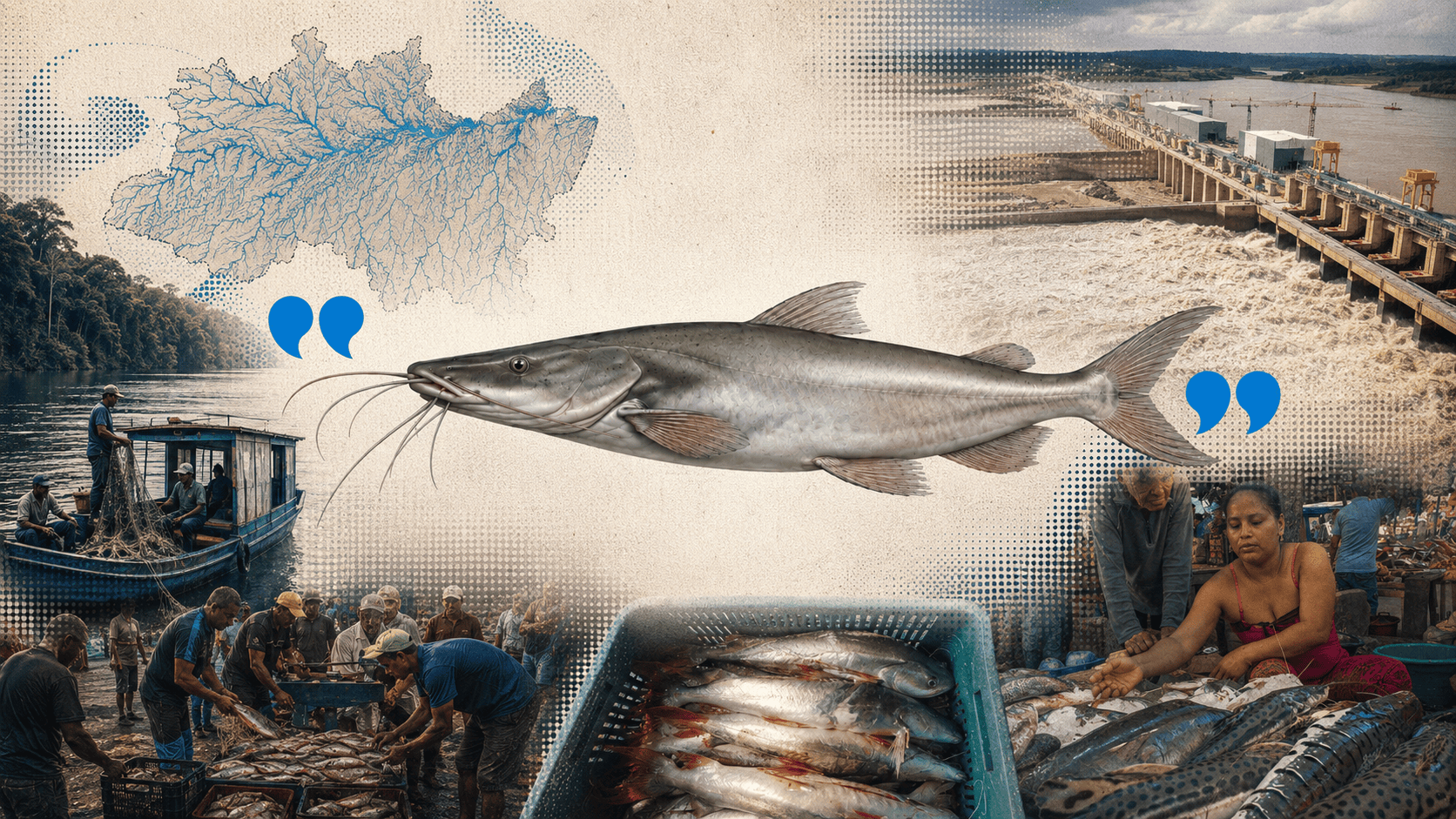
An animal capable of swimming more than 11,000 kilometers over the course of its life carries inside its head a microscopic archive of information that proved decisive in the approval of a new environmental action plan among six Amazonian countries beginning in 2026. Here is how assessing the ecological impact of hydroelectric dams and managing fisheries sustainably across borders could determine whether this giant catfish species survives or goes extinct.
Antônio Laranjeira (Agência Carta Amazônia)

A TASTE OF GOLD
A German tourist studies the gourd bowl for a few seconds, like someone eating something entirely outside his everyday experience for the first time. Facing a fried fillet of dourada, thick açaí and coarse manioc flour, he raises an eyebrow and leans in to smell the food. The gringo is having his first encounter with the local way of eating: the fried fish is dunked in the açaí, with flour added to taste.
We are at the century-old Ver-o-Peso market, in the center of Belém, Brazil — the largest open-air market in this Amazonian metropolis and nominated by Brazil as a UNESCO World Heritage site, laid out among vendors’ stalls and restaurant stands.
At the stalls of Pedra do Peixe, freshly landed catches are cut, weighed and sold throughout the early morning hours, bound for cities across Brazil. In the stalls of the Mercado de Ferro, dozens of street kitchens operate morning and afternoon, serving meals found nowhere else but the Amazon. Here, one of the most famous dishes is dourada.
In this epicenter of everyday commerce, few realize that the fish now on the tourist’s plate has completed the longest migration of any freshwater species on Earth.

Between the fish that migrates to feed and breed and the fish that ends up caught and served with açaí lies a story that begins thousands of kilometers from the Ver-o-Peso market.
Blocked by hydroelectric dams and pursued by fishing nets, this catfish species carries inside its head a crystallized secret: the scientific evidence that gave rise to an environmental protection plan spanning six countries, aimed at preventing its extinction.
This is a cross-border investigation, so brace for a read that may feel as long as the dourada’s own journey, but one filled with discoveries, curiosities and warnings that nature is capable of revealing to us.

THE PRECIOUS STONE
The life of the dourada served on that tourist’s plate in Belém began 5,000 kilometers upriver. As a migratory catfish, once it reaches adulthood it swims against the current to mate and spawn, setting out from the mouth of the Amazon River, in Brazil, toward rivers at the foot of the Andes in Peru, Bolivia, Colombia and Ecuador.
Over the course of its life, a dourada can travel as far as 11,600 kilometers: the longest freshwater animal migration on the planet. According to the Global Biodiversity Information Facility (GBIF) database, the leading platform for crowdsourced records of animal life on Earth, the dourada (Brachyplatystoma rousseauxii) is found in six Amazonian countries, with its first recorded sighting on the platform dating back more than a century, to 1901.
The most important ecological studies of the species were consolidated in the late 1990s by the researchers Ronaldo Barthem, a Brazilian ichthyologist at the Museu Paraense Emílio Goeldi, and Michael Goulding, an aquatic ecologist with the Wildlife Conservation Society (WCS).
In their book “Os Bagres Balizadores” (“The Bellwether Catfish”), the two authors established for the first time that smaller douradas turn up in rivers to the east, while larger, adult fish are found to the west. That pattern led to the first hypothesis of large-scale dourada migrations along rivers connecting three ecosystems: the Andes, the Amazon and the Atlantic.
This map of the river network highlights Andean and Amazonian rivers and the basin’s connection to the ocean, with distinct colors marking each sub-basin. Credit: Antônio Laranjeira
According to a 2017 study, also co-authored by Barthem and Goulding along with other researchers, the farthest recorded occurrence and spawning site from the Atlantic Ocean lies in the Madeira River basin, specifically in the headwater region of the Mamoré and Guaporé Rivers, where they emerge from the Bolivian Andes.
But douradas also live in other rivers, including the Ucayali and Marañón in Peru; the Napo and Pastaza in Ecuador; the Putumayo and Caquetá (called the Japurá by Brazilians) in Colombia; and the Orinoco in Venezuela, which has its own river basin but is connected to the Amazon River through an arm of the Casiquiare River.
The dourada occupies nearly every major river artery connecting the Andes to the Amazonian lowlands, favoring silt-laden rivers (also known as “white waters”), over the darker “black waters” and the translucent “clear waters.”
Each spawning event can produce more than a million oocytes, reproductive cells that depend on fertilization by males to become eggs. Of those, the ones that develop successfully pass through a larval stage before becoming fry, the fish’s first free-swimming, fully formed stage.

Drifting downriver, dourada fry — the larval stage of the fish’s life — begin their journey carried by the force of the current over the course of weeks. The young fish, between two months and a year old, swim toward the mouth of the Amazon, a stretch spanning the Brazilian states of Amapá and Pará and the Atlantic coast. In these waters, the douradas mature into adulthood, eventually swimming back up the same river they descended as tiny larvae.
Males and females reach adulthood starting at age 3. At this stage, schools of douradas swim up various Amazon tributaries against the current, a phase of the animal’s life that lasts one to two years. To survive that effort, the adult dourada’s body carries fat reserves built up over its lifetime, a crucial evolutionary adaptation that sustains the migratory journey and ensures the species’ reproduction.
The duration of that migration, downriver and back up through the Amazon’s waterways, remains recorded in the chemistry of “otoliths,” a word derived from the Greek otós (‘ear’) and líthos (‘stone’). These three small structures of calcium carbonate in the fish’s inner ear are known as “pedras do juízo” (wit stones), among fishermen, or “precious stones” among scientists.
Each dourada carries three pairs of otoliths in its head (much as humans have three tiny ear bones), which function as the organs responsible for the animal’s hearing. These structures absorb chemical elements from river water — such as strontium isotopes — creating a unique signature for every stretch of river each dourada has traveled.

In her research on the dourada, Marília Hauser, biologist and professor at the Federal University of Rondônia (UNIR), established chronologically how long each captured fish had lived in different parts of the basin, in her doctoral dissertation. That dissertation, published in 2018, helped change the way scientists look at otoliths — a key piece of evidence for understanding freshwater cycles through this species’ migratory behavior.
“To confirm my research hypotheses about the dourada’s breeding and spawning grounds, I had to collect specimens across the Amazon over the course of years. First I had to train fish vendors at different markets to measure the douradas before cutting them up for customers. Since it was too expensive a fish to buy whole, I would buy just the heads from them — what we call the field research ‘kit.’ After that stage, I brought the otoliths to a laboratory in France, where I did my doctorate, to run the analyses, which are also very costly,” Hauser says.
Drawing on the alliance between scientific knowledge and citizen collaboration, Hauser’s dissertation revealed that the blockage caused by hydroelectric dams produced two distinct profiles within the basin: fish that manage to maintain their natural migratory cycle, and those that have become forced residents because of the dams.

A CONNECTION IN CRISIS
River waters carry sediment and nutrients down from the Andes. These substances are essential to the biological productivity of the floodplains where juveniles grow. Dams, however, are a decisive factor in altering the migratory behavior of douradas.
The construction of the Madeira River hydroelectric plants, initiated in 2008, has become an emblematic case of the impacts associated with dam projects. A study published in 2024, led by Marília Hauser, documented a radical shift in fish behavior: every dourada collected in the Upper Madeira River (in the state of Rondônia, on the border between Brazil and Bolivia) was a resident fish — a generation of the species born and raised in a “hydrographic isolation” caused by the Santo Antônio and Jirau power plants, which control the rivers’ flow.
Another study, published in 2023, points out that dams affect connectivity, sediment flow and water temperature, degrading habitats and driving the decline of numerous fish species.
The global-scale research, co-authored by the Brazilian hydrologist Ayan Fleischmann, offers a synthesis of these problems and evaluates conservation measures to ensure more sustainable operations in the face of climate change and human needs.
“Every hydroelectric plant in the Amazon has a flow regime that varies over time; that determines how much water must pass through the floodgates during the flood season and the dry season. So to maximize a river’s environmental health, you need studies — including on the impact on migratory species like the dourada,” says Fleischmann, a researcher at the Mamirauá Institute for Sustainable Development in the Amazon.
Fabíola Katrine Cajado, a fisheries engineer at the Advanced Center for Research, Action, Conservation and Ecosystem Recovery of the Amazon (Capacream), says the Solimões River functions as a true ecological bridge between spawning grounds and growth areas. That river is fed by tributaries flowing directly from the Andes, carrying the dourada fry that have completed the journey upriver.
“Maintaining connectivity, the river’s natural dynamics and habitat quality along that route is essential for larvae to develop into juveniles, reach adulthood and eventually return to the Andes to reproduce, completing one of the most remarkable migratory cycles known among freshwater fish,” Cajado says.
This map shows the concentration of hydroelectric plants along the main axes of the Amazon basin and highlights the impact of these dams on river connectivity. Credit: Antônio Laranjeira
Ichthyologist Carlos Rodríguez, who directed the Tropenbos Foundation for three decades focusing on research with Amazonian Indigenous and fishing communities, warns that despite the Colombian stretch of the Caquetá River being free of dams, the basin’s migratory catfish fishery is facing collapse.
“The decline in the dourada catch — a fish that preys on some 60 other fish species living in the Caquetá River [known as Japurá River in Brazil] — points to a serious environmental imbalance. Today there is a much smaller supply of adult douradas traveling upriver [from Brazil to Colombia], which reveals gaps in binational environmental management and the toll these migrations take on catfish species,” Rodríguez explains.
According to data from the ichthyologist’s pioneering 1991 study, the town of La Pedrera, Colombia, logged 49,000 kilograms of fish caught in 1984—roughly 61% of which was dorado, the Spanish name for the dourada.
Years later, in 2019, La Pedrera recorded a drop to 30,000 kilograms of fish caught per year, with the steepest decline seen in the dourada, which fell to just 15 percent of the total — a 46 percent reduction. In all, over 35 years, the dourada catch in the Caquetá River basin fell from 30,000 to 4,600 kilograms. It is as if a fishing boat that once had the potential to catch seven fish at a time now had its odds reduced to just one.
The fragmentation of rivers and changes to flooding patterns also affect these predators’ feeding by reducing the supply of prey. The biologist Cristhiana Paula Röpke, of Brazil’s National Institute for Amazonian Research (Inpa), explains that if prey consumption is sharply reduced over a long stretch of the migratory route, the fish may end up without the energy needed to migrate and reproduce by the end of the journey.
“Reducing prey availability can lead to greater overlap in the catfish’s diet, especially if prey becomes concentrated in just a few habitats. Douradas, for example, can also grow thin and become less resistant to disease, or less able to withstand other risks that require energy to flee or recover from. That can lead to higher mortality among these pre-adult or adult fish over the course of the migratory journey,” Röpke explains.

On the Madeira River, the situation is considered the most critical. Scientific evidence of this crisis has existed for at least 20 years. A 2001 study by the hydraulic engineers Kikuo Tamada and Sidney Lázaro Martins found that the engineering technology in use still fails to replicate natural hydrodynamics, which has resulted in the species’ slow disappearance from the dammed stretches.
Although fish-passage systems have been installed within the walls of these dams, connecting a small flow of water between stretches of the Lower and Middle Madeira River, most douradas are unable to make their way back upriver, according to the hydraulic engineers’ research.
The Santo Antônio hydroelectric plant, for example, has a semi-natural channel roughly 900 to 1,000 meters long and 10 meters wide. That channel is meant to reproduce the speed and flow of the old Santo Antônio and Teotônio waterfalls that once stood on the site. In theory, it should allow fish — such as dourada, jaú, pirarara and curimba — to make the return trip in their life cycle.
“Dourada catches have plummeted since 2011. That decline in the catch of commercially valuable species has driven a diversification of catches, as has happened in the community of Humaitá, in Amazonas state, Brazil, where the catch of ‘salada’ [a mixed assortment of small, low-value fish] has been increasing among small-scale fishermen,” reports the researcher Igor Lourenço, an agronomic engineer with a master’s in environmental science from the Federal University of Amazonas (UFAM) and lead author of another 2024 study on migratory catfish, including the dourada.

Hydroelectric plants built on Brazilian territory (on the Madeira River) have severed the dourada’s migration routes and caused profound impacts in the Bolivian Amazon, for instance on the Mamoré and Beni Rivers. This was revealed in a 2019 study co-authored by scientists working across the Amazon basin, notably Brazilian biologist Marília Hauser and Belgian biologist Paul Van Damme, affiliated with the Bolivian non-governmental organization Faunagua.
The authors analyzed fish 1,500 kilometers from the Santo Antônio and Jirau plants and compared commercial fishing activity between 1998 and 2007 with what was observed between 2015 and 2017.
The results point to a reduction in catches — a 93 percent drop in fishing yield in Bolivia after the river was blocked. An analysis of the surviving douradas’ age shows that the current population is made up of older migrants that swam upriver before 2009, and a new generation of residents that remains trapped in the upper Madeira.
Unless fish-passage systems at the dams become more effective, Amazon-based science was already estimating two decades ago that the dourada could face extinction — a hypothesis validated with each new study.

THE WEIGHT OF THE FISH
The economic importance of artisanal fisheries was consistently downplayed during the environmental licensing of major hydroelectric projects throughout the Amazon basin.
“I learned to fish with my father, when I was a child, right here on the Ucayali River. The dourada was the first big fish I ever caught. It was so large it nearly knocked me out of the boat! I’ve never forgotten that day … But it’s been more than 50 years since I’ve seen one of these around the upper Ucayali,” Ruperto Fasabi Valera, 70, a small-scale fisherman who lives in Pucallpa, one of the largest cities in the Peruvian Amazon, said by telephone.
When the Peruvian fisherman recalls going years without spotting a single dourada, his memory stretches back to the 1970s, when he was just twenty. It was the decade industrial fishing took hold across the Amazon’s migratory rivers. Decades of unregulated exploitation have since pushed the species toward extinction, a crisis now formally acknowledged by governments across South America.
The red alert over predatory dourada fishing was triggered by a study by scientists at the Federal Rural University of the Amazon (UFRA), published in 2017. The research described how the fishing takes place in river channels, carried out by motorized boats equipped with ice storage. These boats use drift nets, operated through a technique known regionally as bubuia.

The study also found that industrial dourada fishing follows a seasonal pattern closely tied to the rivers’ cycle, with the peak harvest occurring as river levels fall.
Luiza Prestes, a fisheries engineer and professor at the State University of Amapá (UEAP), led a 2022 study in which migratory catfish specialists, including Ronaldo Barthem and Michael Goulding, confirmed that the Amazon’s dourada fisheries are collapsing throughout the basin.
The result of this dourada collapse is a shift in the very structure of the fishing industry: as the big catfish disappear, fishing turns to small, or juvenile fish — a process scientists call “fishing down” and fishermen call “salada.” The findings indicate that this kind of fishing, which involves catching smaller fish of less value to the end consumer, is directly linked to the scarcity of douradas in the nets.
An estimated average of 10,500 tons of douradas are now caught every year. This decline in the dourada’s life cycle caused by predatory fishing threatens the food security of roughly 50 million people living in the Amazon basin who rely on fish as part of their daily diet, according to the most recent report on the dourada, signed by more than 30 organizations in the Águas Amazônicas conservation network.
Heitor Amorim, a 13-year-old student, says by telephone that he “loves eating a little dourada” at his main meal of the day. He used to buy the fish near his grandmother’s house, at a small neighborhood restaurant run by Dona Teca in the Condor district, on the outskirts of Belém. “Last year, dourada disappeared from the menu for good,” he says.
He still remembers that in 2023, a serving of dourada cost 16 reais ($3.16). Then, it rose to 18 reais ($3.56). Today, the same dish can cost as much as 30 reais (nearly $6) in most of the city, a price increase that led the cook to stop preparing this fish, which is as prized as it is expensive.
Among the fishing regions, it is in the Amazon River estuary, near the Atlantic, that the subject of this story passes through the most critical phase of its life, since 28 percent of all dourada fishing takes place in that area. On the Madeira River, by contrast, landings of the species have plunged, leaving that river with just 2 percent of the total dourada fishing yield across the Amazon basin, according to the map.
The map shows that the highest potential yield for sea bream fishing is concentrated in the Amazon Estuary (to the east), accounting for 28% of the estimated total, while the Peruvian Amazon (to the west) accounts for 16%. Credits: Antônio Laranjeira
Between the sea and the river—especially among the islands—is where this fish spends most of its life (juveniles and subadults), a developmental stage before beginning its return to spawning grounds when it reaches 30 to 50 centimeters in length.
In the city of Barcarena, about 20 kilometers from Belém by river and 110 kilometers by road, the content creator Bianca Oliveira de Jesus, 24, posts videos of her work routine at a stall in the local fish market. Bianca shows remarkable speed cutting up various fish in a matter of seconds. Among dozens of posts on Instagram, the one that went furthest was a video of a dourada, which racked up millions of views.
“I’ve worked with my mother since I was a child, handling the fish we sell. All these years, dourada has always been one of the most sought-after fish at our stall. It never stops selling, but the price has changed. It used to cost 13 reais and now a kilo of dourada goes for up to 30 reais. People who can’t afford it choose other, cheaper options instead,” Bianca says.

Migratory fish account for an average of 93 percent of the fishing landings analyzed in the Amazon basin, according to a scientific study published in 2021. Trade in these fish totals approximately 2.228 billion reais ($436 million).
Beyond being a favorite fish across nearly the entire Amazon, on social media and in fishing nets alike, the dourada is one of the main sources of income for riverside communities, which rely on fish as their primary source of protein, with consumption rates among the highest in the world.
“Riverside communities in the Amazon consume about half a kilogram of fish per person every day, on average, and that consumption is roughly equal to the commercial catch. That is far above both the world average and the national average. In other words, if fish supplies run short in the future, we should be concerned about the food security of these populations,” says Victoria Judith Isaac, a professor at the Aquatic Ecology and Fisheries Research Group at the Federal University of Pará (UFPA) and co-author, with Igor Lourenço (UFAM), of the 2024 scientific study analyzing the relationship between migratory catfish and small-scale fishing.

Even so, the fish’s behavior has been shifting in ways that affect the yield of each day’s work. Fishermen in the city of Marudá, in the estuary zone of the Amazon River in Pará state, report that this year the douradas showed up unusually late, in May 2026, while this story was being reported.
“The dourada was supposed to head back up the Amazon River again in July. The season when the schools usually appear runs from January to June, you see? But they only showed up this month,” says Ernando Pinto, national representative of fishermen to Brazil’s National Ministry of Fisheries.
EXTINCTION LOOMING
For the dourada to keep running its continental marathon, science and diplomatic efforts needed to reach an agreement involving the societies and governments of six countries.
A historic milestone was reached at COP15 of the Convention on the Conservation of Migratory Species, held in Campo Grande, Brazil, in March 2026, with a consensus on the first draft of the Action Plan for Migratory Catfish, an initiative led by the Brazilian government and backed by all six Amazon basin countries — Bolivia, Brazil, Colombia, Ecuador, Peru and Venezuela.

The action plan was unveiled in March 2026 and acknowledged that the dourada is in a vulnerable state and that its preservation requires cross-border coordination.
When a species is classified as “vulnerable” on the IUCN Red List, it means the species faces a high risk of extinction in the wild, usually because of population decline or degradation of its natural habitat — in the dourada’s case, because of the harmful effects of hydroelectric dams and overfishing in the rivers of the Amazon.
To save the dourada from extinction, the nongovernmental organization Wildlife Conservation Society (WCS), based in the United States, works to protect the Amazon’s migratory catfish, focusing on international governance, citizen science and sustainable management to protect species in this genus (Brachyplatystoma), including the dourada, the piraíba and the piramutaba.
Peruvian environmental lawyer Dino Delgado, who directs the Amazon Waters program for the international environmental organization, is one of the leading voices in this push. He emphasizes that because it involves the planet’s longest freshwater migration, governance is inherently international.
According to Delgado, the goal is not necessarily a “complete harmonization” of each country’s laws, but rather strategic coordination. “Regulations need to be sufficiently aligned between the Andes and the Atlantic,” Delgado says, noting that these fish are a source of protein for millions of people who live in the basin.
Ultimately, the measure of this new policy’s success will be the recovery of fish populations. “The decline of these stocks is a warning sign that real agreements among the six countries are necessary,” Delgado concludes.

The newly proposed governance model is not confined to political offices and science laboratories. The program “Diálogos de Saberes” (“Dialogues of Knowledge”) has brought together delegations of fishermen from Brazil, Bolivia, Peru, Ecuador, Colombia and Venezuela to fold traditional knowledge into management decisions. That effort produced the manifesto “Amazônia em perigo de extinção” (“Amazon in Danger of Extinction”), with six points of action defined by the fishing communities themselves, echoing the urgent need to protect biological corridors.
“The catfish plan promotes sustainable management of the species to keep fishing on a sustainable footing, which is a matter of great interest not only to fishermen but also to fish vendors. From now on, they are actively involved in implementing coordinated fishing systems,” says the Colombian environmental scientist Silvia Benítez, Latin America freshwater director at the nongovernmental organization The Nature Conservancy, which is also part of the Águas Amazônicas network.

COP15’s guidelines aim to preserve the lives of migratory species and turn this plan, developed over the course of 10 years, into a participatory treaty. The ultimate goal is for the dourada not to be driven to extinction by the effects of dams, and for this and other migratory catfish species to be protected by a network of cross-border cooperation among the countries of the Pan-Amazon region.
Beyond industrial fishing, the biggest obstacle to the migratory catfish conservation plan remains the drive for power generation and the construction of new hydroelectric dams in the Amazon. The debate over how river dams affect the douradas’ lives is essential to planning any new projects.
Until those goals are met, the dourada will remain unevenly shared.
On one hand, it is abundant for hundreds of tourists on a day trip to the Ver-o-Peso market, in downtown Belém. On the other, it is completely absent from the plates of children on the outskirts of that same city, who live daily with the local fallout of the dourada collapse, a crisis deepened by the Amazon’s fractured waters.

REPORTING CONTRIBUTORS
Scientific support: Larissa Rayanny Sousa (UFSC), for recommending scientific findings; Natale Dias (UFPR), for recommending databases; and Renan Cassimiro Brito (USP), for recommending data curation. All three are fellows of the Serrapilheira Institute’s Quantitative Ecology Program (2026)
Citizen support: Johnattan Rupire (Pucallpa, Peru) and Cecília Amorim (Belém, Brazil)
Archival photos and videos: Gustavo Faleiros (InfoAmazonia), Flávio Forner (Repórter Brasil), Antônio Grutzmacher, Ernando Pinto, Bianca Oliveira (video), Álvaro Rezende
Illustrations, maps and infographics: Antônio Laranjeira, with the support of generative artificial intelligence (ChatGPT 5.5)
SCIENTIFIC REFERENCES FOR THIS REPORT
Barthem, R. B., e Goulding, M. (1997). Os bagres balizadores: Ecologia, migração e conservação de peixes amazônicos. Sociedade Civil Mamirauá; Ministério da Ciência e Tecnologia; Conselho Nacional de Desenvolvimento Científico e Tecnológico; Instituto de Proteção Ambiental do Estado do Amazonas. https://acervo.socioambiental.org/acervo/livros/os-bagres-balizadores-ecologia-migracao-e-conservacao-de-peixes-amazonicos
Barthem, R., Goulding, M., Leite, R. et al. (2017). Goliath catfish spawning in the far western Amazon confirmed by the distribution of mature adults, drifting larvae and migrating juveniles. Sci Rep 7, 41784. https://doi.org/10.1038/srep41784
García Vásquez, A., Alonso, J. C., Carvajal, F., Moreau, J., Núñez, J., Renno, J.-F., Tello, S., Montreuil, V., e Duponchelle, F. (2009). Life-history characteristics of the large Amazonian migratory catfish Brachyplatystoma rousseauxii in the Iquitos region, Peru. Journal of Fish Biology, 75(10), 2527–2551. https://doi.org/10.1111/j.1095-8649.2009.02444.x
Santos, M. H. dos. (2018). Migração dos grandes bagres amazônicos pela perspectiva dos isótopos de estrôncio em otólitos [Tese de doutorado, Fundação Universidade Federal de Rondônia]. Repositório Institucional da Universidade Federal de Rondônia. https://ri.unir.br/jspui/handle/123456789/2659
Chen, Q., Li, Q., Lin, Y., Zhang, J., Xia, J., Ni, J., Cooke, S. J., Best, J., He, S., Feng, T., Chen, Y., Tonina, D., Benjankar, R., Birk, S., Fleischmann, A. S., Yan, H., e Tang, L. (2023). River damming impacts on fish habitat and associated conservation measures. Reviews of Geophysics, 61(4), e2023RG000819. https://doi.org/10.1029/2023RG000819
Rodríguez Fernández, C. A. (1991). Bagres, malleros y cuerderos en el bajo río Caquetá: Commercial fisheries in the Lower Caquetá River (Estudios en la Amazonia Colombiana, Vol. 2). Tropenbos-Colombia. https://www.tropenboscol.org/app/data/uploads/sites/15/COL-Series-2.pdf
Tamada, K., e Martins, S. L. (2001). Ictiofauna, hidrelétricas e barragens brasileiras. In Anais do XIV Simpósio Brasileiro de Recursos Hídricos. Associação Brasileira de Recursos Hídricos. https://anais.abrhidro.org.br/job.php?Job=12345
Duponchelle F, Isaac VJ, Rodrigues Da Costa Doria C, et al. Conservation of migratory fishes in the Amazon basin. Aquatic Conserv: Mar Freshw Ecosyst. 2021; 31: 1087–1105. https://doi.org/10.1002/aqc.3550
Lourenço, I. H., Pelegrini, L. S., Nahum, V. J. I., e dos Anjos, M. R. (2024). Analysis of migratory catfish production from artisanal fishing in the Middle Madeira Sub-Basin using new monitoring methods, Southwestern Amazon. Journal of Applied Ichthyology, 2024(1), Article 6668857. https://doi.org/10.1155/2024/6668857
Van Damme, P. A., Córdova-Clavijo, L., Baigún, C., Hauser, M., Doria, C. R. C., e Duponchelle, F. (2019). Upstream dam impacts on gilded catfish Brachyplatystoma rousseauxii (Siluriformes: Pimelodidae) in the Bolivian Amazon. Neotropical Ichthyology, 17(4), e190118. https://doi.org/10.1590/1982-0224-20190118
Cruz, R. É. A., Isaac, V. J., e Paes, E. T. (2017). A pesca da dourada Brachyplatystoma rousseauxii (Castelnau, 1855) na região do baixo Amazonas, Brasil. Boletim do Instituto de Pesca, 43(4), 474–486. https://doi.org/10.20950/1678-2305.2017v43n4p474
Prestes, L., Barthem, R., Mello-Filho, A., Anderson, E., Correa, S. B., Couto, T. B. D. A., Venticinque, E., Forsberg, B., Cañas, C., Bentes, B., e Goulding, M. (2022). Proactively averting the collapse of Amazon fisheries based on three migratory flagship species. PLOS ONE, 17(3), e0264490. https://doi.org/10.1371/journal.pone.0264490
Convention on the Conservation of Migratory Species of Wild Animals. (2025, outubro). Plan de acción: Bagres migradores amazónicos (UNEP/CMS/COP15/Doc.25.6.5/Anexo 2). https://www.cms.int/sites/default/files/document/2025-11/cms_cop15_doc.25.6.5_annex2_action-plan-amazonian-migratory-catfish_s.pdf

This project is the result of a collaboration between Latin American journalists and scientists, spearheaded by Brazil’s Serrapilheira Institute and the Latin American Center for Investigative Journalism (CLIP), to explore the Atlantic-Amazon-Andes water pathway and the disruptions to the ecosystem services it provides to the continent.


