


In 2023, a group of indigenous persons took a carbon credit project that was structured behind the host community’s back to court. Two judges ruled in their favor and ordered its suspension. One year later, the initiative’s developers continue trading credits, despite the adverse court rulings and the fact that the accreditation body for this market withdrew its auditor’s accreditation. This journalistic investigation also found a new possible conflict of interest among its proponents. Meanwhile, the community in Cumbal continues has still not received the money it is entitled to.
In July 2023, a municipal judge suspended a carbon credit project among the cloud forests and páramos (high Andean tundras) of Cumbal, a municipality located more than 3,000 meters above sea level in the Andes, in the southwestern corner of Colombia. In doing so, he ruled in favor of twelve Pasto indigenous persons from the Great Reservation of Cumbal, who filed a legal action against the Redd+ Pachamama Cumbal environmental initiative in their territory, arguing that it violated their rights to prior consultation, effective participation and collective property.
In his ruling, which was upheld by a second instance, the judge ordered the suspension of the project as well as of the contract that underpins it until its promoters prove whether it requires a process of free, prior and informed consultation with the indigenous community that hosts and carries it out. It also obliged them to present to the inhabitants of the reservation “a clear and detailed report of the financial management”, including the amount of money received from the sale of credits and its destination. “Doubt arises as to the current whereabouts of said resources and even more so as to the purpose being given to such funds, which in theory were intended to encourage the care of the ecosystems and the fauna and flora of the indigenous territory,” he wrote. The judge gave the promoters a maximum period of two months to provide this report.
A year after the court decision became final, the indigenous plaintiffs feel that the proponents of the carbon credit project – Mexican company Global Consulting and Assessment Services S.A. de C.V., its Colombian subsidiary SPV Business S.A.S. and the governor of the reservation – have not been accountable to the community in the terms ordered by the judge.
On the other hand, one of the companies developing the project and the auditing company Deutsche Certification Body S.A.S. filed criminal complaints for slander against several members of the Cumbal Environmental Collective who, as an investigation published by the Latin American Center for Investigative Journalism (CLIP) and Mongabay Latam in June 2023 revealed, have warned since 2022 about the opacity of this carbon initiative. It was precisely these indigenous people who filed the legal action.
The visibility that the case has received had another consequence: in November 2023, the National Accreditation Body of Colombia (ONAC), the body that accredits all conformity assessment bodies in the country, decided to suspend the accreditation of auditing company Deutsche Certification Body. It did so after this journalistic alliance revealed that managers of these three companies have had business ties with each other: most notably, the CEO of the Mexican developer was a founding partner and shareholder of the auditing company, a fact which called into question whether the assessment process in Cumbal was impartial and independent, as it should be.
In this new investigation, we found that this was not the only link between these companies: the main shareholder and president of the auditing firm also had ties to the Mexican development company, thus configuring a new possible conflict of interest. This reinforces that the nebulous carbon bond deal executed very close to Colombia’s border with Ecuador moved forward among acquaintances, rather than with counterweights.
Héctor Villacriz, former governor of the Cumbal reservation, noted that the contract with Global Consulting was terminated by mutual agreement and amicably on November 24, 2023, four months after the court ruling. However, as of July 2024, the carbon credit project continues to appear on the ColCX certifier’s platform as registered, with no mention of its suspension by court order or a termination of the contract with one of the host communities. Moreover, almost 400,000 credits from the initiative have been redeemed after the ruling that suspended it and after the date of the alleged termination of the contract. Of these credits, 289,000 were used by US oil company Chevron, which had already purchased 849,000 credits when the initiative was not even known to the majority of Cumbal’s indigenous inhabitants. The company argues that the new purchase was made without their knowledge.
These are some of the findings made by the Latin American Center for Investigative Journalism (CLIP) and Mongabay Latam in this third installment on the Cumbal case, as part of the Opaque Carbon journalistic alliance that brings together 14 media outlets from eight countries to investigate how the carbon market is working in Latin America.

An accountability that fell short
In the early morning of September 21, 2023, an announcement blared on the community radio station around the cold mountain slopes around Cumbal: “The authorities of Cumbal would like to specifically invite the environmental collective, the indigenous people who filed the protection action and the community in general of the nine rural hamlets of the Great Cumbal Reservation, to participate in the call for compliance with the decision of the protection action,” the voice announced. It invited them to a public assembly of accountability for the Pachamama project, which would be held that same day, three hours later, in the cultural house of the Cumbal cabildo.
Several members of the environmental collective arrived and asked then governor Héctor Villacriz to postpone the meeting in order to make a broader call, including messages in other media such as posters, social networks, and loudspeakers throughout the territory where some 20,000 indigenous Pasto people live. Their request was rejected. Villacriz then gave the floor to his predecessor Ponciano Yamá, who signed the contract underpinning the initiative and explained to those present that Global Consulting had made two transfers in dollars to the reservation’s bank account, on December 6 and 16, 2022. However, Yamá said that shortly after, on December 27 “the Banco de Bogotá’s national management informed me that the transaction of these transfers could not be monetized in Colombian pesos”, and that therefore they were rejected and the money returned to the account of origin. “Henceforth I know absolutely nothing more. Neither I nor my family nor anyone else has used a peso from the community in this matter,” he added, according to the recording of the live transmission of the meeting that members of the community made and that this journalistic alliance viewed.
Barbara Lara Escoto, as representative of the developer Global Consulting, then spoke at the same meeting. Connected by videolink, she explained that the project had sold 475 thousand credits to that date and that, taking into account what she called “the marketing conditions (…) accepted by the reservation”, Cumbal was entitled to 130,844 credits. Also citing difficulties with the bank, she pointed out that Global Consulting had not yet transferred the amount again and attributed this to the court ruling against the project: “The payment has not been made again, as the reservation was fixing the status of the bank accounts and then the project was suspended by court order, so this prevents us from executing the payments associated with the project,” she said, according to the recording of the meeting.
Villacriz closed the presentation, stressing that “the situation is clear” and asking not to blame anyone for theft. “There has been no disbursement,” he finished off.
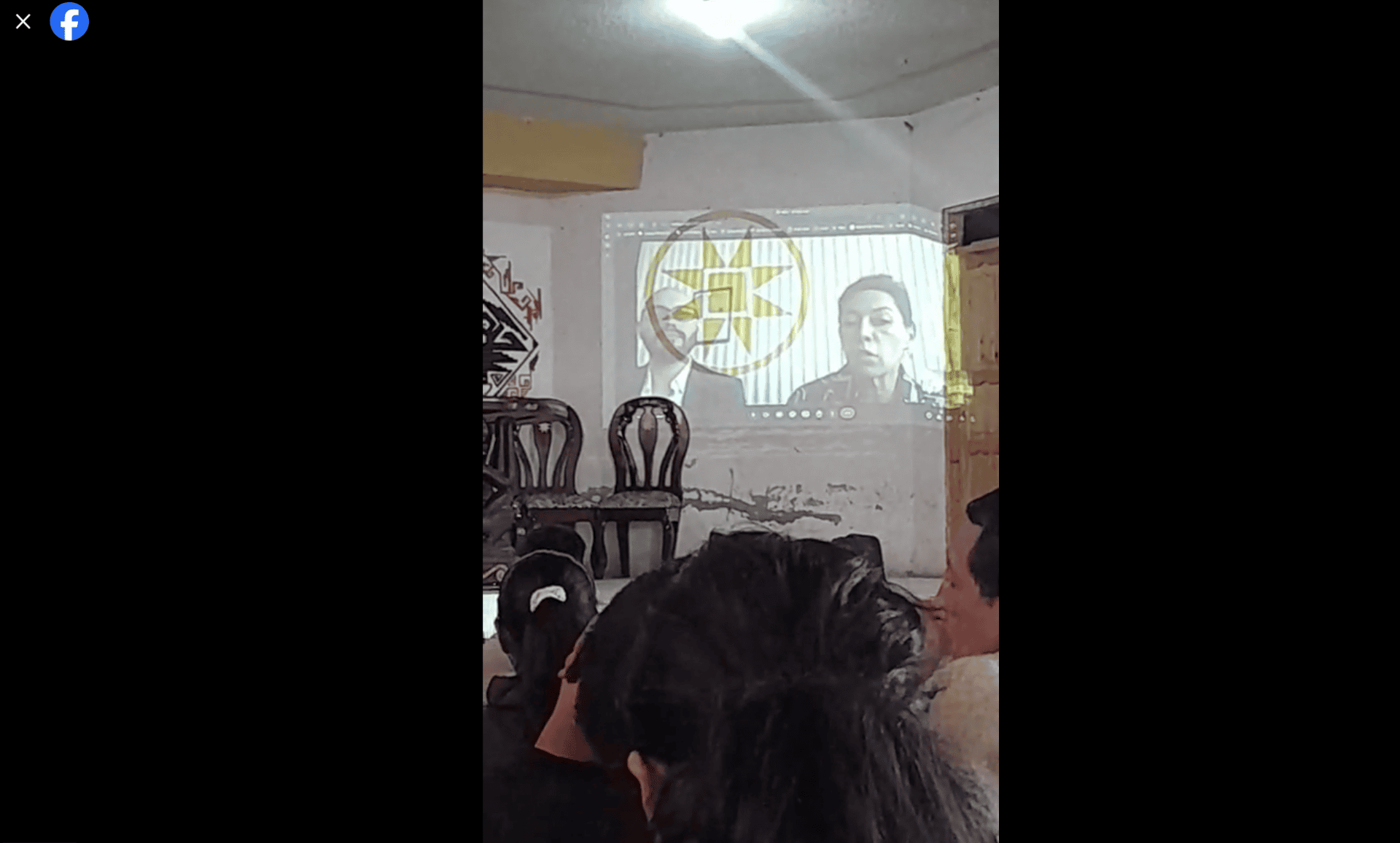
These answers from the indigenous authorities and the development companies were not satisfactory to the community members who took the project to court. “We still don’t know what happened [with the money]. There was almost no one at the community meeting. It was impossible to attend under those conditions, but they justify that they did make the call and the report,” says Omar Chiran, lawyer and member of the environmental collective. “It was so summarized that we don’t believe it met the judge’s conditions,” adds Álvaro Guadir, another member of the collective.
For this reason, in October 2023, they filed a request for an incident of contempt against the authorities and the companies. “They did not provide the community with any documentation of the financial situation, such as payments made by Chevron, bank deposits, returns made by the banks, account holders, account status, amount of funds (…) It was a report where the participation of the community was not guaranteed and it was not clear or documented,” they wrote to the judge of first instance.
Eight months later, on July 29, 2024, the promiscuous municipal court of Cumbal required the governor of the reservation and the defendant companies to “proceed with immediate compliance with the protection action ruling” or, otherwise, face the initiation of an incident of contempt that could result in a prison sentence and a fine. However, a week later, judge Dario Javier Muñoz (different from Judge Carlos Alexander Coral who signed the original ruling) denied the request, considering that “the respective representatives of the respondent companies have been complying with the protection action ruling”.
This despite the fact that everyone – indigenous authorities, the development company and the indigenous plaintiffs – seem to agree that the Cumbal community has not yet received any money for their share of the sale of 849,000 carbon credits to Chevron between 2022 and 2023.
Neither the previous governor Ponciano Yamá – who signed the contract – nor his successor Héctor Villacriz – who should have executed the project and complied with the rulings, but who is now also out of office – responded to interview requests from this journalistic alliance about the status of the project and its finances. Yamá gave a date for an interview, but then changed it and did not respond again. Current governor, Jorge Humberto Puerres, also did not respond to messages requesting an interview.
Global Consulting defended itself by claiming that “were it not for mechanisms such as the registration of Redd+ projects and the hard work of specialized companies such as Global Consulting, these communities would not have any recognition whatsoever”.
In written responses to a questionnaire from this journalistic alliance, sent through the public relations agency Crop, the Mexican company Global Consulting indicated that it came to the project in Cumbal “as a company with sufficient experience and ability to provide technical and commercial advisory services for the development of a project that would represent an economic benefit for the Indigenous Reservation of Cumbal associated with the conservation work carried out by its communities”. It explained that “it was contracted exclusively for the provision of technical and commercial advisory services for the registration of the project (…) and the commercialization of carbon credits generated by the project”, and that this contracting “was in accordance with the powers and functions of the authorities of the Indigenous Reservation of Cumbal, authorities legitimately elected and recognized by the Ministry of Interior”. (Read Global Consulting’s complete answers here).
In the company’s view, the Pachamama Cumbal project complies with the social and environmental safeguards established for these carbon initiatives. “Global Consulting is respectful of the regulations applicable to each of the projects it serves,” it added.
The company did not respond to questions about the current status of the project following the two adverse rulings, including whether it considers it active or suspended, stating only that “the status of the carbon credits of the Cumbal Indigenous Reservation is ‘reserved'” and that “it is a company absolutely respectful of Colombian justice and its legal framework”. Asked about the measures taken to comply with the order to account for the finances of the initiative, Global Consulting merely responded that it “has complied with the court rulings, following the precise instructions of the court and responding to all the requirements of its office”. Regarding the transfer of funds to the reservation, it said that “the information requested is part of the ongoing judicial process and it is not up to Global Consulting to disclose it without a court order”.
A community still without project documents
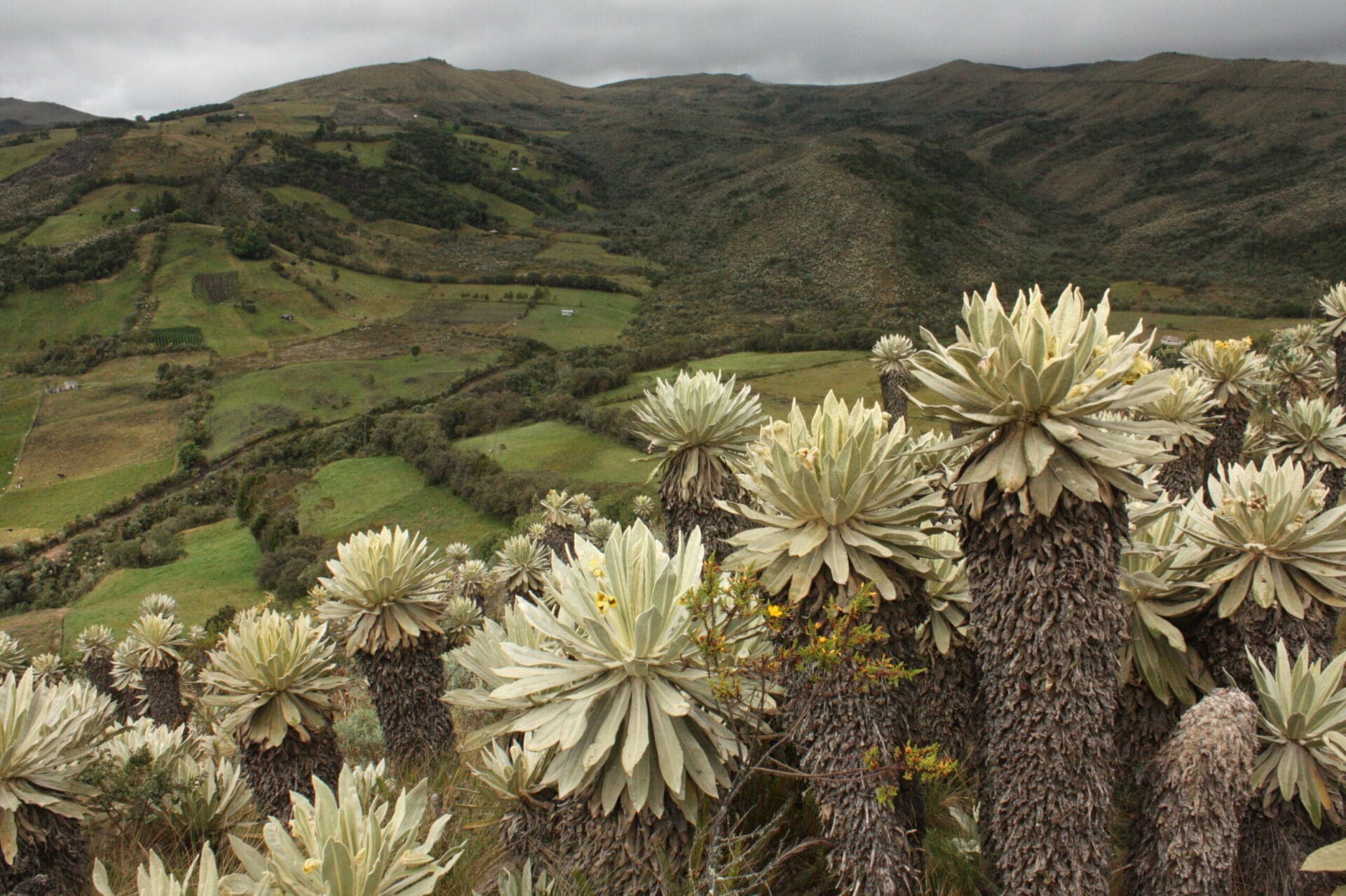
This is not the only information the community has not yet been able to access. One year after the court ruling, they still do not know the project design document (PDD, in industry jargon) or the audit report, the two basic documents of any Redd+ project, which are public in most environmental initiatives of this type.
Until mid-2023, ColCX – the certifying company that approved the Pachamama project – was the only certification standard in Colombia that did not publish these documents for all the projects it certified, as CLIP reported.
In an interview conducted in August 2024, ColCX – whose parent company Canal Clima is part of Valorem, the business holding of the Santo Domingo family, one of the richest and most powerful in the country – told this journalistic alliance that the conflict in Cumbal and the successive failings opened a process of self-criticism that led it to modify several of its procedures. “In part it was Cumbal, but we also studied what happened in the market in other standards,” explained its director Mario Cuasquen, referring to problems identified in initiatives certified by competitors such as Cercarbono, Biocarbon Registry or Verra. “The dynamics of the market changed and the processes are increasingly demanding, in a continuous improvement that for us does not stop with Cumbal”, he added.
Among these changes, ColCX noted that, as of August 2023, its methodology for Redd+ projects included the need to submit minutes of approval from local communities, as well as evidence of their free, prior and informed consent. It also noted that, as of June 2023, contracts with its clients make the publication of PDDs and project audit reports mandatory as soon as projects are certified. That change, however, does not apply to initiatives already underway unless authorized by the developers. Global Consulting, Cuasquen noted, has not done so.
Cuasquen explained that ColCX also strengthened its due diligence and transparency procedures, including hiring a compliance officer, adhering to the due diligence parameters of the Valorem group, of which it is part, publishing basic project information on its platform so that anyone can make comments or send alerts, prior to certification, and designing a new, more complete platform in alliance with the company XM, which it will launch in September. “What we have done these months is aligned with the ruling,” he says. On the fact that its platform does not mention the existence of adverse court rulings against the Pachamama project, Cuasquen said that “our older system does not have an explicit field where these types of situations are dealt with”, but “it is a point that I am taking with me to discuss immediately… We are in time to make adjustments,” he said.
When asked about the lack of access to project documents for members of the community, Global Consulting said that it “respects the attributions and functions of the authorities of the Cumbal Indigenous Reservation, authorities legitimately elected and recognized by the Ministry of the Interior, who are responsible, in any case, for handling this information”. These, in turn, did not respond to requests for interviews.
A terminated but active contract
There was no progress in the prior consultation. On November 3, 2023, the former governor of the reservation, Héctor Villacriz, presented a request to the National Authority for Prior Consultation to determine whether prior consultation was appropriate, according to a letter sent in April 2024 by that state agency’s deputy director to current governor Jorge Puerres.
However, barely a month later, Villacriz sent a new communication desisting from his original consultation. “I am kindly communicating to the technical deputy director of prior consultation that by letter dated November 20, 2023 I requested the entity Global Consulting and Assessment Services S.A. de C.V. the amicable termination of the mandate contract (…) since we do not want any more altercations, arguments or lawsuits in the reservation,” he wrote on December 5, three weeks before leaving his position at the head of the reservation. He then explained that as of November 24 “the contract is considered terminated”, so it would no longer be necessary to think about prior consultation.
On December 27, the National Authority for Prior Consultation confirmed that it accepted that the indigenous community desisted from pursuing the process initiated by the judge’s order. Then, in April 2024, the deputy director Wilson Villegas confirmed in a letter to the current governor that this explained why his government body had finally not issued any opinion.
Six months later, however, the Pachamama project, which according to the court ruling should have been suspended, became active: a credit redemption appeared on the ColCX platform. According to the certifier, on June 14, 2024, Chevron used 151 thousand Pachamama credits to be exempted from part of the payment to the Colombian State of the carbon tax for the use of fossil fuels. A month later, on July 12, ColCX registered another similar redemption: Chevron exchanged 129,513 credits, again for the carbon tax. It was not the only company to use Cumbal credits after its suspension: between June and August, gasoline distributor Zeuss used 92,500 credits, while Estaciones Innovadoras (Estinsa) – which operates Zeuss stations – used 13,500 thousand, Alberto Ochoa y Cía 1720 and OZ EDS, another 620.

As of July 31, 2024, the Pachamama initiative appeared on the ColCX platform with “full registration”. There were no visible annotations that the project was suspended, as the judge determined, or that the contract underpinning it had been terminated, as the former governor of the reservation argued.

“In ColCX it is reflected that there have been credit transactions and that there are companies that have used them as end users, but there is no traceability of where money is. Where has that money gone? Nothing is known,” says John Fredy Alpala, a 33-year-old environmental and sanitary engineer who is also part of the Cumbal Environmental Collective.
Regarding these recent project credits, Global Consulting stated that “the carbon credits referred to the months of June and July 2024 do not correspond to the Cumbal Indigenous Reservation”. When asked about the date of sale and to which reservations these environmental results correspond, the company replied that “due to our confidentiality and data processing policies, Global Consulting is not authorized to disclose any information related to the contracts signed with its clients”.
However, Global Consulting explained to the municipal judge of Cumbal, in its response to the contempt request filed by the members of the environmental collective, that those credits corresponded to the company. “The credits that have been withdrawn and commercialized during the year 2024, that is, subsequent to sentence No. AT2-2023-00095-01 dated August 23, 2023, correspond to the fees agreed and generated before the suspension order, between the Indigenous Council of the Cumbal Reservation and Global Consulting and Assessment Services S.A. de C.V., according to the Mandate Contract with Representation No. 002.2022 and do not correspond to the credits belonging to the Reservation to which the plaintiffs claim to belong,” the company wrote, according to the judge’s order denying to open the contempt.
Ironically, the same order of the promiscuous municipal court of Cumbal quotes the response of the current governor of the reservation, reiterating that they have not received any income from the project, neither previously nor this year. “Regarding the certification, issuance and commercialization of carbon credits made in 2022 and 2024, the community and the Cumbal Reservation as a territorial entity do not know the information on the transfer of resources, the actual value of each transfer, and the number and holder of the bank account or accounts in the name of the companies involved and the Cumbal Council to which they are assigned,” he wrote. “We emphasize that we have not received any money as a result of this contract”.
When asked if the contract with Cumbal was terminated and, if so, if this fact was notified to any entity in the carbon value chain, Global Consulting responded that it is not authorized to respond.
Certifier ColCX argued that it has no responsibility in the transactions: according to its director Mario Cuasquen, “we adhered to stopping the project, as the sentence says”, and that “in the commercialization we do not intervene at all: we do not know the price or the day they were sold, only the date of withdrawal”. Cuasquen explained that in its system, ColCX has separated the credits that belong to each partner of a project; in Pachamama’s case, which ones correspond to Cumbal, which ones to the other three reservations that share the initiative and which ones to Global Consulting as developer. “Great Cumbal has some 460 thousand credits that have not been touched. They are reserved,” he said. However, he acknowledged that the certifier did not make any publication informing of the suspension of Pachamama by court order. The director of ColCX promised during the interview to send a breakdown of who the credits traded in June and July 2024 corresponded to, but then responded by email two weeks later that “due to confidentiality policies with our client it is not possible to do so”. Cuasquen also said he was not aware of the termination of the contract in Cumbal, explaining that “they [the developer] must inform us.” “We don’t have the technical capacity to be on top of all the contracts,” he noted.
The largest buyer, Chevron, explained to this journalistic alliance that since it learned of the legal action, it decided to suspend the use of any Pachamama project credits, but that the new batch of 289,000 credits was purchased and redeemed without the company’s knowledge. “In June and July of this year, our supplier acquired without prior notice credits of said project for Chevron Colombia, a fact not adverted on time in our internal processes and because of which by mistake they ended up being part of the compensation process of said period,” said the company, adding that “today it no longer has a contractual link with the developer of the project, for reasons other than those mentioned here.” When asked about the identity of the supplier that traded the Pachamama credits on its behalf and without its permission, Chevron only responded that “when we talk about supplier we refer to the project developer” and that “the name could not be given to you, without their authorization, for reasons of confidentiality in the agreement”. (Read Chevron’s full responses here).
The oil company also stressed that, despite the fact that the use of those credits in 2024 “was not a decision aligned with the decision made by the directors of Chevron Colombia last year”, the fact of “accepting credits for that project was aligned with the regulations in force, since the request for prior consultation had already been filed by the project operator, in compliance with the second instance ruling issued by the Third Criminal Court of the Circuit of Ipiales”. When asked if it knew that the governor of Cumbal himself had withdrawn the request, Chevron said that “the supplier did not inform us of the withdrawal of the request for prior consultation nor of its implications in the project in question, nor did it share with us the documentation on the subject”.
Finally, the oil company stated that it implemented a strategy to “improve internal procedures and safeguards” and an “internal review to ensure the viability of the projects in which it invests”, including the advice of the company’s international experts to assess them.
Gasoline distributor Zeuss, the second largest credit user after the court rulings against the project, did not respond to a questionnaire sent on August 6 to the email address to which they asked to make the query. A message to its CEO Javier Plata, sent via LinkedIn, also went unanswered.
Meanwhile, the two court decisions on the Cumbal case – the first substantive decisions on voluntary carbon market initiatives in Colombia, even before the recent Constitutional Court ruling on the Pirá Paraná case – were included in the climate litigation database of Columbia University’s Sabin Center for Environmental Law, the best known of its kind in the world.
Indigenous plaintiffs accused of slander
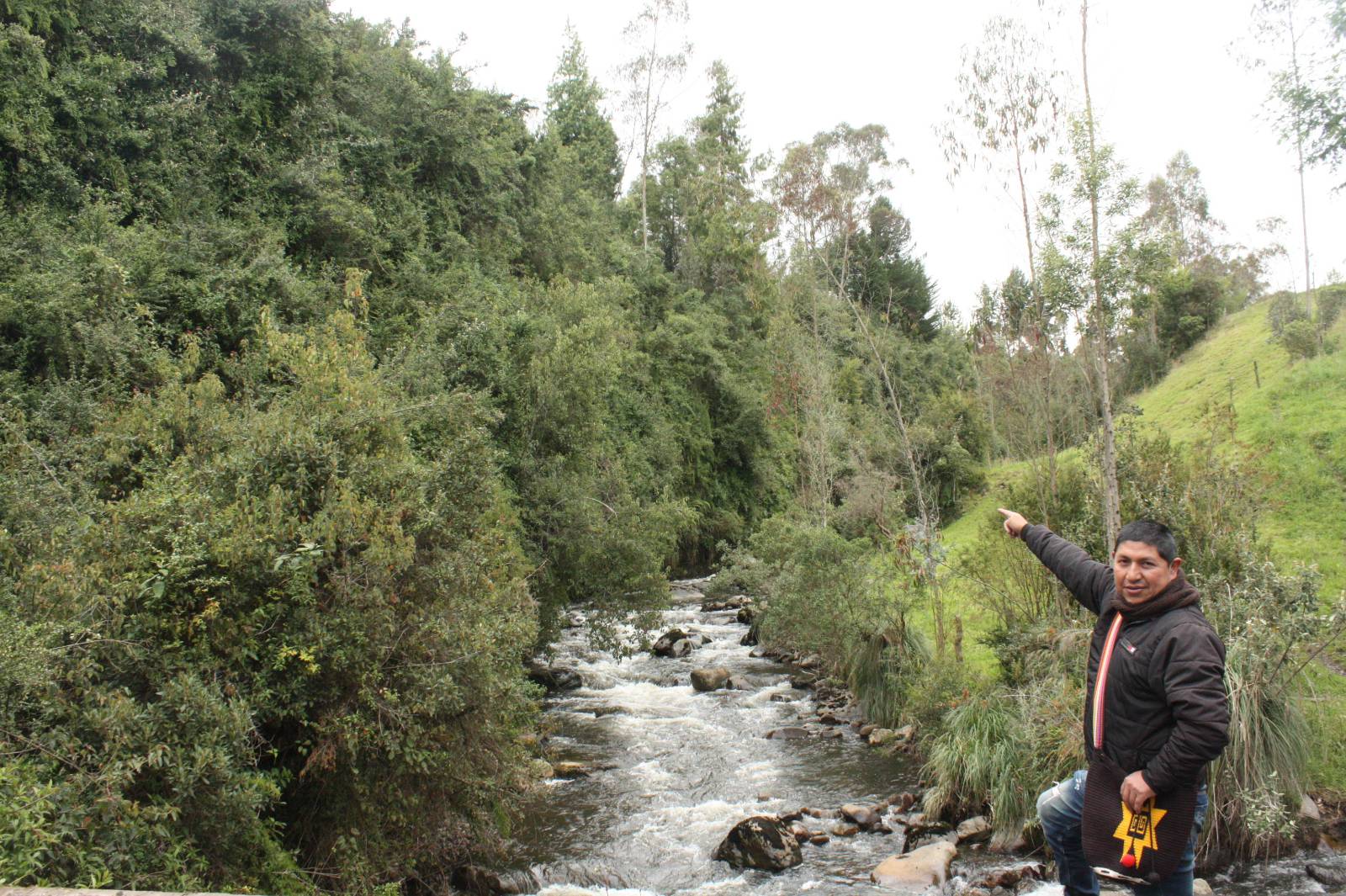
The legal victory over the nebulous project has, however, brought costs for members of Cumbal’s environmental collective who denounced the irregularities.
In early October, two weeks after the little-publicized accountability report and a month after the second court ruling, Diego Fernando Cuaspud, a 27-year-old geographer, received a communication from the Attorney General’s Office of a criminal complaint against him for slander. It did not inform who was denouncing him or the reason, but summoned him to a conciliation hearing at a courthouse in Mártires, in downtown Bogotá, 928 kilometers from where he lives. “The summons to this hearing is mandatory, but reaching an agreement only depends on the will of the parties,” the document said, warning him that if he did not attend the hearing, a criminal investigation would be initiated against him.
Two weeks later, Cuaspud managed to obtain a copy of the complaint, which identified the plaintiff: Global Consulting, through its attorney Bárbara Lara Escoto. In the complaint, to which this journalistic alliance had access, the developer of the project argued that the legal action filed by the collective is “full of assertions that disqualify the honor of the companies”. In particular, it disputed the indigenous people’s assertion in the protection action that the project was designed and implemented through “fraudulent maneuvers and artifices, in bad faith and contrary to the regulations in order not to guarantee the active and effective participation of the community”, that it was a “private negotiation with only one witness” with then reservation governor Ponciano Yamá and that the community still has not seen the basic documentation of the initiative.
In general terms, the Mexican company says that its project “has been planned, formulated and implemented correctly and without any irregularity”. In other words, the opposite of what the two judges who ruled on the case concluded. As CLIP reported, the first instance judge considered that “the shortcomings in the management of the Redd+ Pachamama Cumbal project affected the indigenous community, not at the physical level in the territory as one might think, but at the level of social cohesion, equity and good living”. In his view, the initiative had “minimal socialization” and “widely disregarded” the mandatory socio-environmental safeguards for carbon projects designed to protect local communities, including rules on consent, effective participation and accountability. The second instance judge agreed with him.
In the weeks that followed, several of Cuaspud’s colleagues in the environmental collective received similar messages. Diana Puenguenan was summoned to a conciliation hearing at the prosecutor’s office in the neighboring town of Guachucal, 20 minutes away, to “seek a peaceful solution.” Miguel Ángel Quilismal, a 39-year-old civil engineer who has been studying the history of the Pastos for a decade, was also summoned to Bogotá. As with Cuaspud, the communications didn’t identify the complainant or the reason for the complaint.
To date, only two of them have managed to obtain the complete document of the complaint. In both cases the texts are almost identical, from the language to the pagination. Only the complainant changes: while Diego Cuaspud was denounced by Global Consulting, Miguel Ángel Quilismal was denounced by auditor Deutsche Certification Body, through its alternate legal representative Jorge Andrés Avella Ostos.
On January 31, 2024, several of them went to the Guachucal prosecutor’s office for the conciliation hearing, after the group’s lawyer, Omar Chiran, managed to transfer the proceedings of all of them there. In the end, only Puenguenan’s hearing was held, as only one of the complainants’ lawyers arrived, without the power to act in the other cases. He asked the 26-year-old sociologist and public administrator to retract and pay 200,000 dollars in compensation for the damage he claimed she had caused Deutsche Certification Body. It was an unpayable and incomprehensible figure for an indigenous collective, whose concerns about the opaque project in their territory were upheld by the Colombian justice system.
Global Consulting told this journalistic alliance that “over the years (…) it has made an effort to provide quality services with professionalism, thanks to which it has developed a vast experience and reputation, in protection of which it has exercised and will exercise the actions that by law correspond against whoever attempts against its good name”. The Mexican company, it added, “does not litigate through the media, and therefore reserves the right to withhold information on legal proceedings that are in progress”.
Seven months later, the indigenous people of Cumbal have heard nothing more about these legal proceedings, which Omar Chiran describes as “retaliation and intimidation”. Several of them – including Puenguenan, the only one who had a hearing – do not even have a copy of the criminal complaint filed against them. “It has affected the group psychologically, because these complaints are latent and have not been closed,” says John Fredy Alpala.
A sanctioned auditor
On October 5, 2023, a month and a half after the second court ruling against the Pachamama project and two months after the criminal complaint against Miguel Angel Quilismal, the auditor Deutsche Certification Body received bad news. The Colombian National Accreditation Body (ONAC), which accredits conformity assessment bodies in the country, made the decision to withdraw the accreditation it had since 2021 to evaluate greenhouse gas reduction projects, including Redd+ projects such as Pachamama Cumbal. A month later, on November 9, ONAC’s appeals committee confirmed the decision.
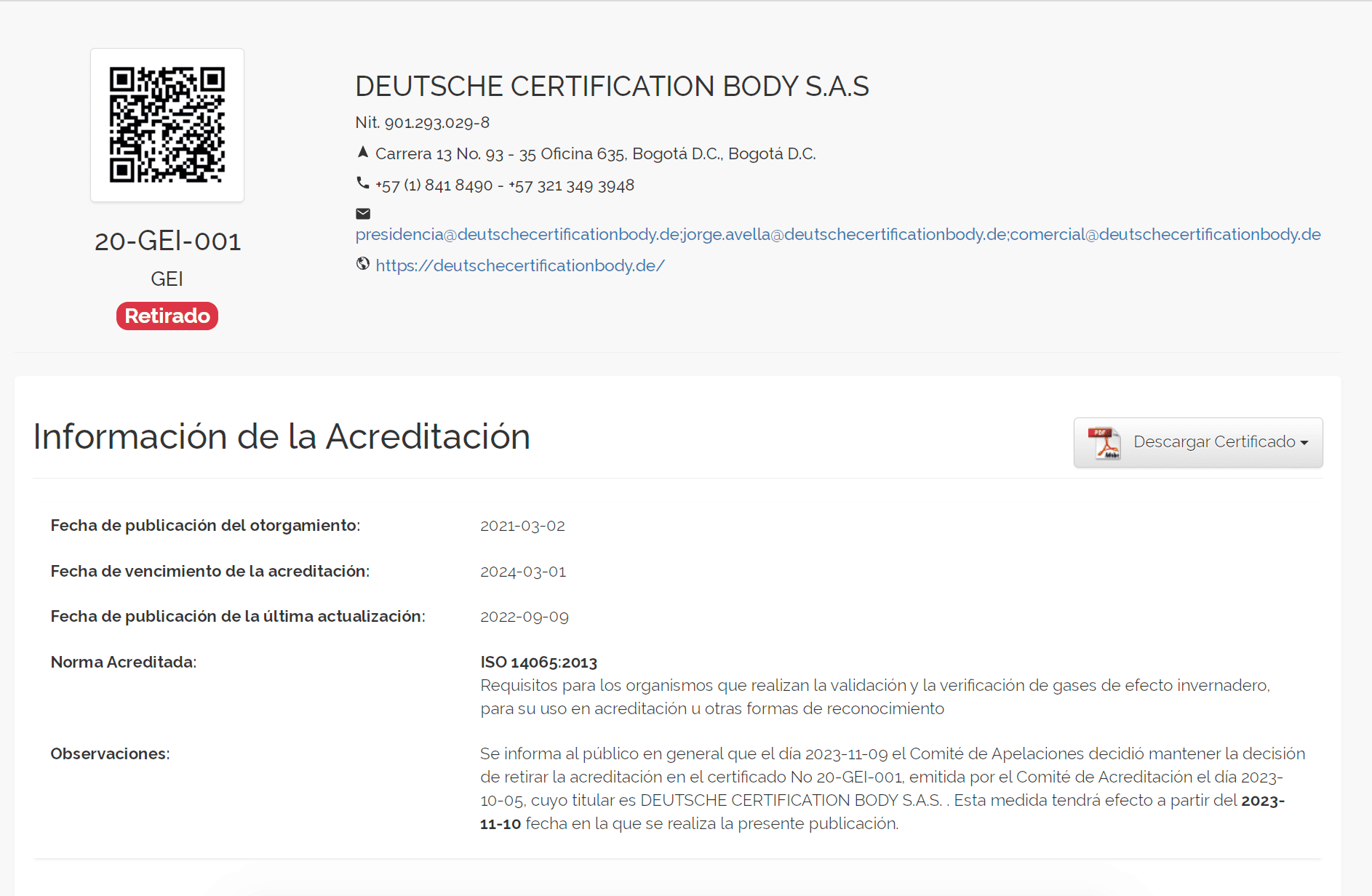
This means that Deutsche Certification Body can continue to audit projects in Colombia but, in the words of the ONAC, “is no longer authorized to issue reports or certificates under the accredited status, or use the accredited symbol, or make reference to the accredited status in any document or communication after the date of withdrawal of accreditation”.
The reasons for the sanction are less clear. ONAC denied a request from this journalistic alliance to access the minutes or the file that supported the decision, stating that “we can only share information that has been officially published”, due to international standards and confidentiality clauses signed with its accredited bodies. “We cannot provide details on the specific reasons or motives behind the withdrawal of accreditation,” responded its analyst Paula Andrea Tovar.
When asked if it received any complaint about the Cumbal project, ONAC replied by email that “we can neither confirm nor deny the existence of specific complaints”. Its director Alejandro Giraldo then explained via a Whatsapp message that “we can review the accreditations we have granted at any time, even if there is no direct complaint, if we find indications (wherever they come from) that the accreditation rules are being breached”, including those of impartiality. “I cannot answer anything specific related to Deutsche Certification,” said the director of the accreditation body, which was questioned by the Constitutional Court in its recent ruling on the carbon market for not having a special protocol to verify compliance with safeguards in these type of projects. It could only provide information, Giraldo added, by order of a judicial or administrative authority.
This journalistic alliance sought out Oscar Gaspar Negrete, president and legal representative of Deutsche Certification Body, through messages to his personal and corporate emails, as well as to the telephone number listed in chamber of commerce records, but he did not respond. Meanwhile, the company’s website ceased to be active sometime after April 2024.
The dates suggest that the information that led ONAC to suspend the auditor’s accreditation may have been the one revealed by the journalistic investigation led by CLIP: Bárbara Lara Escoto, manager of the Mexican company Global Consulting and legal representative of the Colombian company SPV Business (which signed the contract with the indigenous people and then ceded its contractual position to the former in August 2022), appears in minutes of the chamber of commerce as one of the founding partners of Deutsche Certification Body S.A.S. At the time of its creation in June 2019 in Bogota, Lara Escoto had a quarter of the shares, while Oscar Gaspar Negrete had an identical number and Raul Gonzalez Mitre had an identical number and Raul Gonzalez Mitre was one of the founding partners.A.S. At the time of its creation in June 2019 in Bogotá, Lara Escoto owned a quarter of the shares, while Óscar Gaspar Negrete had an identical number and Raúl González Mitre had half. It was precisely Gaspar Negrete who signed the validation and verification statements of the Pachamama project, dated October 2022, which appear on the ColCX platform, on behalf of Deutsche Certification Body.
Additionally, Diana Carolina Avella Ostos – who served as SPV Business’ alternate legal representative between March 2021 and November 2023 – also held the same position at Deutsche Certification Body between March 2021 and March 2022, according to the auditor’s chamber of commerce records. Avella Ostos, a chemical engineer who worked at palm oil industry group Fedepalma, was the one who signed the original contract with the governor of Cumbal in April 2022 and the first commercial offer to purchase credits in June 2022, documents to which this journalistic alliance had access.
Both facts suggest that the three companies could have a double conflict of interest, given that an auditor of carbon projects must “remain impartial with respect to the activity validated or verified, as well as free of bias and conflicts of interest,” according to one of the international ISO standards that regulate their work and are in force in Colombia. They could also explain why, in assessing the project in Cumbal, Deutsche Certification Body’s auditors seem not to have noticed that many of the inhabitants of the Cumbal Great Reservation did not even know of its existence and did not participate in its approval.
Global Consulting did not respond to this journalistic alliance’s question as to why it chose Deutsche Certification Body as auditor, limiting itself to stating that it “contracted the OVV [validation and verification body] in compliance with its contractual obligations”. When asked about Lara Escoto’s previous business relationship with the auditing company and whether it was brought to the attention of any actor in the carbon value chain, Global Consulting responded that “it is not authorized to provide information on its employees, personnel or managers, regardless of the position they hold” and that “Mrs. Barbara Lara, legal representative of Global Consulting and SPV Business, ceased to have any link with Deutsche Certification Body long before starting the project in question”. Likewise, the Mexican company stated that “Diana Avella ceased to have any relationship with Deutsche Certification Body before starting the project in question and (…) does not hold any position in Global Consulting with contracting powers”.
When asked if such relationships could constitute a potential conflict of interest, Global Consulting said that “in each and every one of its projects it ensures that in the provision of its services there is no impediment or conflict of interest that affects the quality, certainty and objectivity in the provision of such services”.
In their criminal complaints against Diego Cuaspud and Miguel Quilismal, both Deutsche Certification Body and Global Consulting acknowledged the relationship between them, although they argued that it did not generate conflicts of interest. “It should be made clear that the shareholder who (…) would generate the conflict of interest sold her shares before the validation and verification by Deutsche was carried out,” they both wrote. Therefore, they pointed out, “it is not true what the plaintiffs state” about a possible impediment.

A tangle of potential conflicts of interest
These may not be the only communicating vessels between the two development companies and the auditing firm.
In this new journalistic investigation, CLIP and Mongabay Latam discovered that Oscar Gaspar Negrete, the president and sole shareholder, as of June 2022, of Deutsche Certification Body that signed the validation and verification certificates for the Pachamama Cumbal project, also appears in two commercial registry folios for Global Consulting and Assessment Services S.A. de C.V. available in Mexico’s Public Registry of Commerce.
First, in June 2016 he appeared in a folio of incorporation of the company as a commissioner of its supervisory body, a role that is usually chosen by the assembly of partners. According to that document, its shareholders were Monica Lara Escoto (with 4,950 shares) and Yolanda Escoto Torales (with 50). Then, in November 2019, Gaspar appeared in another folio as “representative and/or delegate of the partners’ assembly”. In other words, Gaspar Negrete was not only a shareholder partner of Bárbara Lara in the Colombian auditing company, but was also linked to the Mexican company that she manages and that developed the project in Cumbal.
This new development suggests that the developers and the project auditor may have another potential conflict of interest.
When asked about the presence of Gaspar Negrete in the oversight body of the Mexican company Global Consulting, the Mexican company pointed out that “it has had several bodies, among them, bodies related to social, environmental, quality issues, etc” and that “in each and every one of its projects, it ensures that in the provision of its services there is no impediment or conflict of interest that affects the quality, certainty and objectivity in the provision of such services”. “Global Consulting respects the Colombian legal framework and understands the problem of a conflict of interest,” he added.
Certifier ColCX, which last year told this journalistic alliance that it was not aware of the possible conflicts of interest when it approved the project, said that after the adverse ruling it asked all auditors to submit a declaration of absence of conflicts of interest, evidence of their current accreditation and corporate documents that identify their shareholders. “From the gentlemen of Deutsche we had no response,” said its director Mario Cuasquen, so “it is not currently qualified to work with ColCX.”
The ColCX standard for certification of mitigation initiatives, dated July 2023, now stipulates that “under no circumstances may the proponent or holder of a mitigation initiative have a relationship with the [auditor] other than that covered by the service contract signed between the parties, and that could represent an employment, personal, professional, family or business interest that may affect the impartial and objective performance of its functions as conformity assessor”. Should this occur, the document adds, “it is considered a breach of the program criteria, resulting in the suspension or withdrawal of the mitigation initiative and the cancellation of the contract authorizing the [auditor] as an evaluator within the program.” Asked if ColCX has contemplated or decided on any suspension, withdrawal or contract cancellation measures in the case of Pachamama Cumbal, Cuasquen responded that the protocol came into effect in July 2023 and applies to both new projects and those entering the recertification process. “This project has been certified as of October 2022 and, since then, we have not taken any additional actions,” he said.
ColCX said it was not aware that the new link between Deutsche Certification Body and Global Consulting revealed in this investigation existed at the time of its original certification of the project. “At that time we were not conducting as complex a due diligence as we are this year. We would like to correct things, but bygones are bygones. Now we are doing it,” said Cuasquen in an interview with this journalistic alliance. Regarding the information gathered in the Mexican commercial registry, the director of ColCX said that “we are doing our best oversight effort, but doing research in other countries is a very complex job”.
These are not, however, the only companies in the carbon market in Colombia in which Bárbara Lara Escoto figures. The Mexican businesswoman is the legal representative of two other companies registered in Bogota: Suma Pakari S.A.S. and Taita Samay S.A.S. The first – whose name means ‘beautiful dawn’ in Quechua – was created in June 2019, while the second – ‘father’s rest’, in Quechua – was created in October 2019. Both list the same purpose of promoting the “development of projects for the reduction, mitigation, capture and/or sequestration of greenhouse gases, belonging to any sector recognized by the United Nations Framework Convention on Climate Change, as well as those recognized in international carbon standards”. Both have, since November 21, 2019, Lara Escoto as their legal representative.
This journalistic alliance found no information on Suma Pakari or Taita Samay carbon credit initiatives underway in any of the four certification standards operating in Colombia, nor any relationship with Global Consulting, SPV Business or their work in Cumbal. However, the former is mentioned in a list of companies with interest in this market in the Amazon published by the government’s Sinchi Amazonian Institute of Scientific Research, in a 2022 report on conflicts associated with Redd+ projects in the Great Vaupés Reservation.

Against the Constitutional Court
Although Global Consulting insists that its project complies with the social standards that govern carbon projects in Colombia, the criminal complaint it filed against one member of the Cumbal environmental collective hints at some of their ideas about these environmental and social rules of the game.
In its complaint the company argues that the initiative did not require a free, prior and informed consultation with the inhabitants of the reservation, as requested by the indigenous plaintiffs. “This form of protection applies when the decisions are exogenous to the community (for example, when a mining company intends to extract coal from a site considered sacred by an indigenous community),” argued Bárbara Lara in the complaint, adding that “the project was developed by the reservation” and that the company she leads is an “expert consultant” to move it forward.
Additionally, Lara argued that then governor Yamá was, as the legal representative of the reservation, “the legitimate and valid interlocutor of the reservation” and “was fully empowered to make such decisions and enter into such contracts as he deemed necessary”. “It seems that what the plaintiffs are seeking is that every decision taken and contract entered into by the legal representative and governor of the reservation be consulted with the more than 12,000 inhabitants,” she wrote.
Their vision differs with the regulation governing Redd+ projects in Colombia. The Ministry of Environment, in its resolution 1447 of 2018 that regulates the carbon sector, stipulates that all such initiatives must report on how they comply with the United Nations’ social and environmental safeguards. These rules of the game, known as the Cancun safeguards, and mandatory for projects in Colombia, speak of respect for the rights of indigenous peoples, as well as their full and effective participation. The Colombian government then made a ‘national interpretation‘, largely focused on how the relationship between projects and the local communities that host and implement them should be.
According to that roadmap published in 2018 (but made binding only until 2023), projects must provide them with clear information about their implementation and be accountable to them; never modify their territorial rights; guarantee both their full and effective participation and their free, prior and informed consent; recognize and strengthen their governance structures and traditional knowledge systems; and, of course, distribute their profits equitably. In other words, several of the things that the indigenous people who make up the Cumbal Environmental Collective denounce are not being fulfilled in their territory.
These are precisely several of the central points in the case examined by the Constitutional Court following a similar conflict in a carbon project in the indigenous territory of Pirá Paraná, in the Amazon. That case, ruled on three months ago, resolved the legal ambiguity that existed over whether Redd+ initiatives require formal mechanisms for prior consultation and how consent should be obtained. “If these [indigenous] communities are key players in the carbon market, it is imperative to guarantee their autonomy through the application of qualified standards, access to accurate information, effective participation in decisions, and free and prior consent,” the high court said in a ruling that could set a precedent for other similar initiatives in territories inhabited by indigenous or Afro-Colombian communities.
In this line, the Court ordered the defendant companies to have “minimum standards of due diligence for the operation of Redd+ projects in indigenous territories”, including clear guidelines on access to information, procedures to identify, prevent and mitigate negative impacts of their operations, and mechanisms for monitoring these risks. The Court did not establish the type of mechanism to be used to obtain the approval of the indigenous communities, but emphasized that it would apply prior consultation in cases of possible direct impacts or the highest standard of all, free, prior and informed consent (FPIC), if there might be an intense social, cultural or environmental impact, especially one that puts their existence at risk.
In the mountains of Nariño, however, the Pachamama Cumbal project continues to reap results in the market regardless of adverse rulings in first and second instances, despite court orders to suspend it while its prior consultation situation is clarified and to account for its finances, despite the former governor’s insistence that the contract was terminated and despite the fact that its auditor lost the accreditation of the national oversight body.
This contradiction underscores the limitations of justice in resolving socio-environmental conflicts. “Cumbal shows the two faces of what I call green judicialization: justice can make decisions with transformative effects, but also regressive ones – or, at least, innocuous given that the two rulings seem not to have been complied with in substance,” says María Adelaida Ceballos Bedoya, a researcher with legal think tank Dejusticia and a jurist specializing in access to justice who is writing a book about the case.
In her view, the fact that justice has become the predominant way to resolve them can generate potentially transcendental rulings, such as that of the Constitutional Court, but it can also result in decisions that do not address the complexity of a problem, give inadequate orders or are not complied with by the challenged authorities. They can also come when it is too late to mitigate harm to a vulnerable community. For this reason, she argues, other state entities are required to act preventively and not leave communities alone. “It is important to ensure that strategies to protect communities from the carbon market do not depend exclusively, or even primarily, on the judicial process,” he says.
When asked how it imagined that the socio-environmental conflict in Cumbal could be resolved as a result of the carbon project, developing company Global Consulting only responded that “it does not interfere in the governance, nor in the attributions and functions of the authorities of the Indigenous Reservation of Cumbal, authorities legitimately elected and recognized by the Ministry of the Interior”.
A year after the Colombian justice system agreed with the inhabitants of the reservation that the Pachamama project has multiple irregularities, the conflict in Cumbal continues and a multinational oil company like Chevron ended up using another 289,000 credits of what was already known to be a nebulous environmental initiative.

Opaque Carbon is a project on how the carbon market is working in Latin America, in partnership with Agência Pública, Infoamazonia, Mongabay Brasil y Sumaúma (Brazil), Rutas del Conflicto and Mutante (Colombia), La Barra Espaciadora (Ecuador), Prensa Comunitaria (Guatemala), Contracorriente (Honduras), El Surtidor (Paraguay) and Consenso, La Mula (Perú) and Mongabay Latam, led by the Latin American Center for Investigative Journalism (CLIP). Legal review: El Veinte. Logo design: La Fábrica Memética.

