

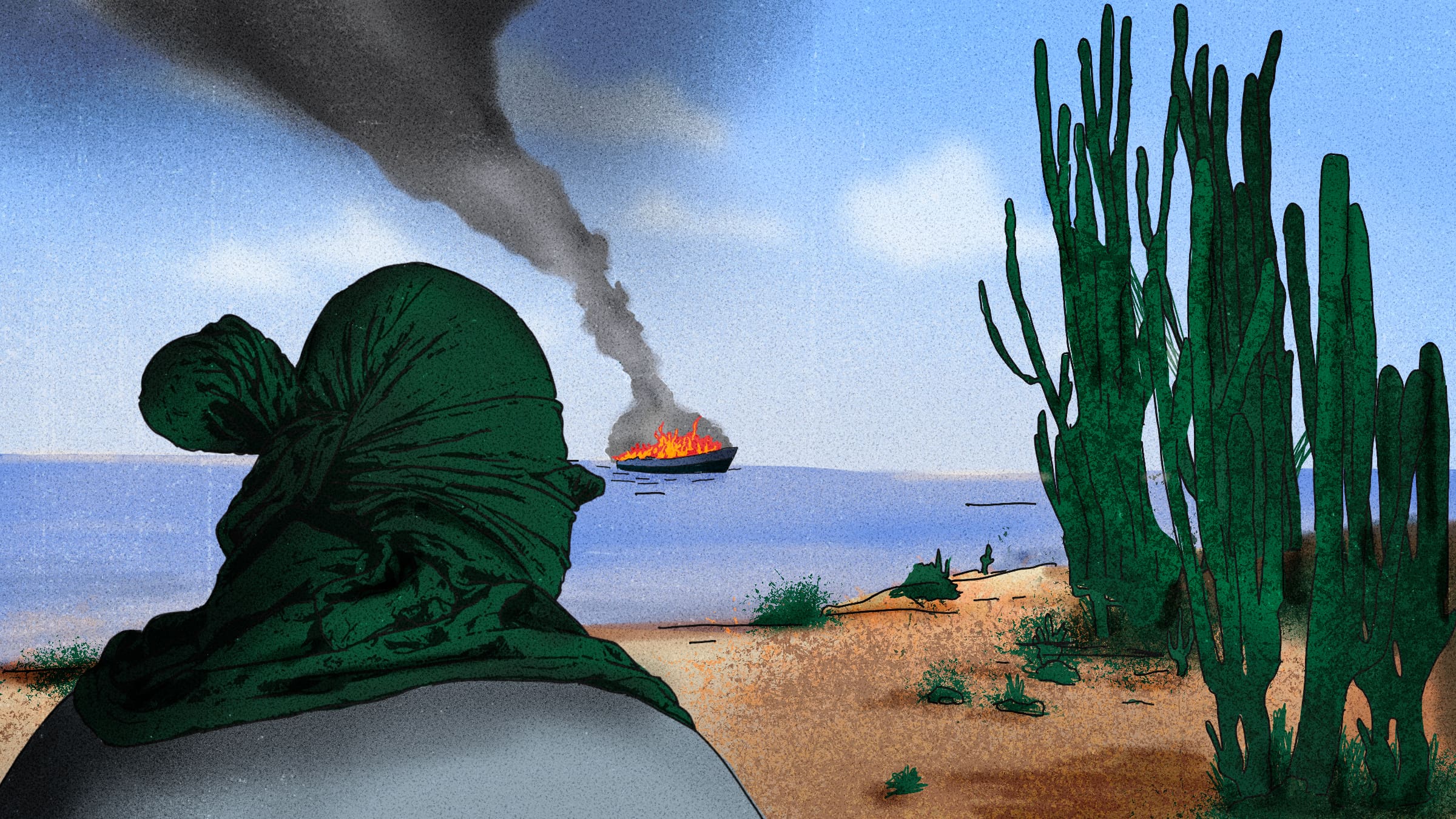
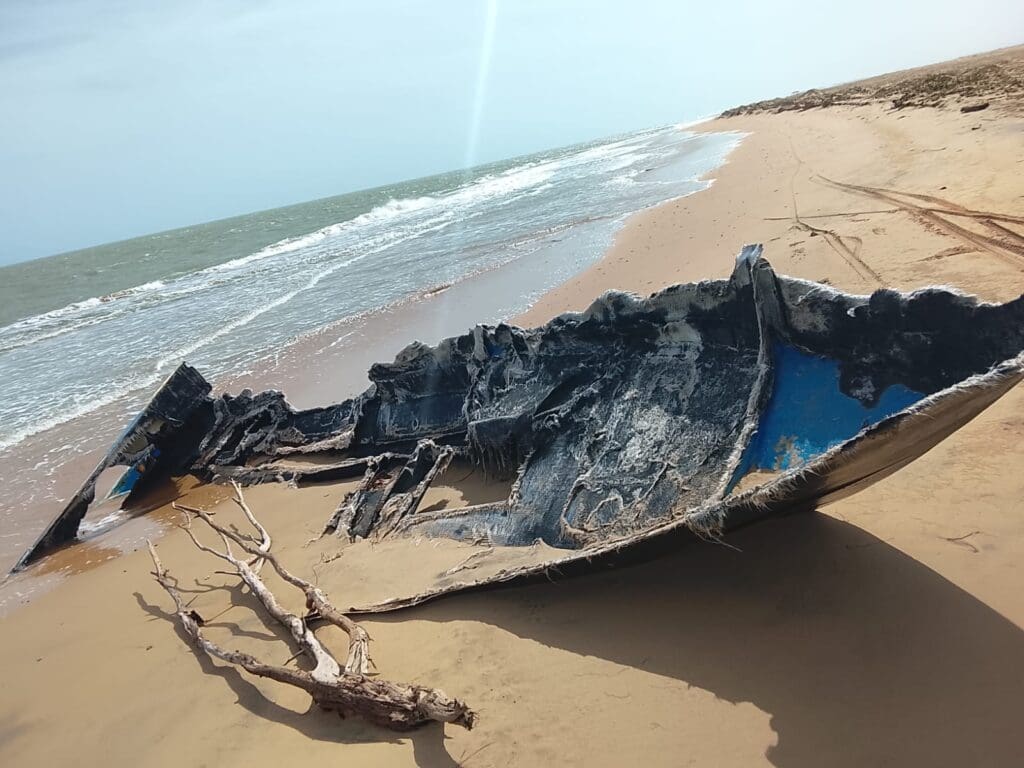
Between November 2025 and February 2026, after a series of bombings in the Caribbean Sea carried out by the U.S. government, the wreckage of two shipwrecks washed ashore along the coast of La Guajira. The vessels, allegedly loaded with drugs, had been destroyed by missiles while traveling north. This journalistic alliance confirmed the nationality and current whereabouts of six victims of those operations. Despite the gravity of the events, Colombian authorities have yet to officially identify all the bodies or facilitate their return to relatives.
By César Molinares Dueñas y Ramón Campo Iriarte (360-grados.co)
On December 13, 2025, a team from Colombia’s forensic institute and the Attorney General’s Office investigative unit, escorted by the Colombian Navy, exhumed the remains of two sailors who had been buried by a Wayúu Indigenous community in Alta Guajira after tides carried the bodies onto the Colombian coast.
The news first became public through a post on X by Colombian President Gustavo Petro, who described the bombings of boats carrying civilians in Caribbean and Pacific waters as “murders” of “defenseless Latin Americans.”
By the time of publication, more than 181 people had been killed in nearly 50 “kinetic” attacks carried out by U.S. Southern Command—operations that violate the right to a fair trial, one of the fundamental pillars of human rights, while also destroying any evidence that could determine the nature, origin, or destination of the targeted vessels.
 Much earlier, before the remains were found, U.S. Secretary of War Pete Hegseth had announced that his government attacked a vessel at an undisclosed location in the Caribbean on November 6, 2025.
“Today, under orders from President Trump, the Department of War carried out a lethal kinetic strike against a vessel operated by a Designated Foreign Terrorist Organization (FTO),” Hegseth wrote on X. “The vessel was trafficking narcotics in the Caribbean and was struck in international waters. No U.S. personnel were injured in the attack, and three male narco-terrorists aboard the vessel were killed.”
A month later, according to Colombia’s National Radio, broadcasting live from an Ameripol meeting in Bogotá on December 9, 2025, President Petro revealed new information during his remarks:
“I spend my time collecting corpses that wash in from the sea. The latest ones—which I only have indications about so far—are from the Dominican Republic. They left Venezuela and then boom, boom, their bodies were carried by the current and ended up in Colombia’s Guajira. It still has to be confirmed.”
Petro was referring to the remains that tides returned to the shoreline near Puerto López, a hamlet in La Guajira in northern Colombia, which prosecutors exhumed a week later.
The following February, 360, a member of a cross-border reporting alliance coordinated by the Latin American Center for Investigative Journalism (CLIP) and involving six other media outlets across the continent, traveled those desolate coasts to investigate the incident. Multiple sources in both Colombia’s La Guajira region and Venezuela insist that the bodies were most likely Dominican speedboat operators.
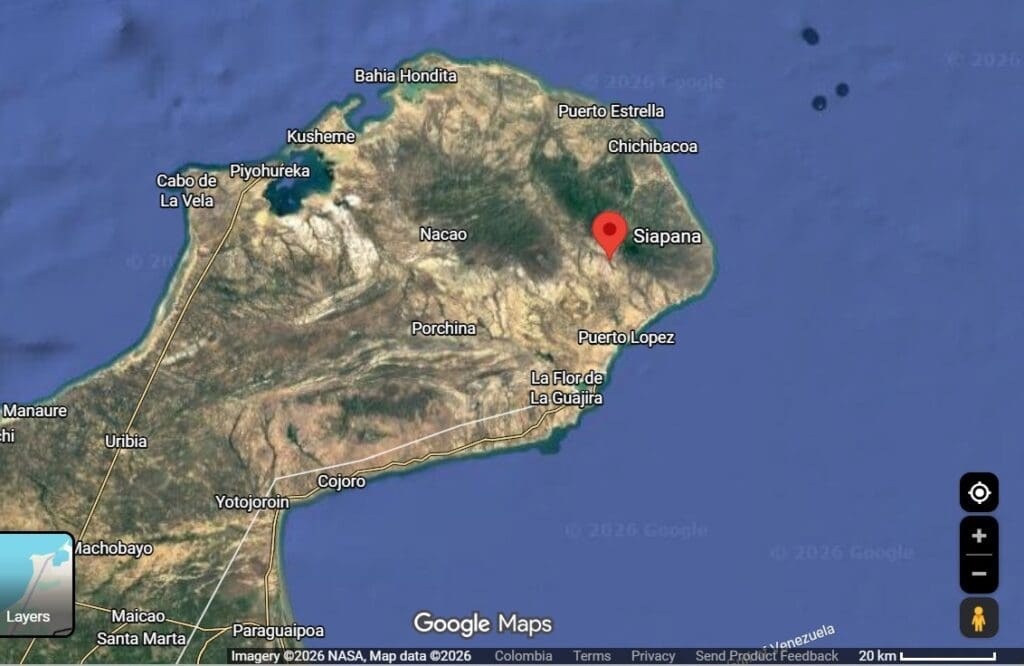
The first body appeared on November 10 in Uarpana, a remote outpost on the Colombian side of the border with Venezuela. It belonged to a light-skinned man whose body was burned; one arm was missing, and he carried no identification. He wore only a black navigation suit and a ring that, according to a local public official in La Guajira who requested anonymity, was stolen after the body reached shore. The first people to arrive at the scene were locals and others hoping to recover drug packages that waves had swept onto the beach.
Nearby, residents found a second body, already reduced to a skeleton whose flesh had been devoured by animals. Its jaw and part of the skull had been shattered by what appeared to be the impact of a projectile.
A source within the Attorney General’s Office, who also requested anonymity, said they believed the skeletal remains were unrelated to the bombing. However, the judicial source confirmed the existence of a third body that had been linked to the strike. That victim, according to the source, was discovered and buried on the Venezuelan side of the border, about 12 miles from the first site, near Castilletes, the settlement marking the boundary between the two countries. A second regional source confirmed this account.
A member of the local community told this outlet that because of the explosion, and after prolonged exposure to sun and wind, the bodies found in Colombia were no longer recognizable. A local boat pilot, speaking on condition of anonymity, reiterated that the victims were likely Dominican nationals.
That conclusion stems from the fact that several people in the region recognized both the wrecked boat and the cocaine as belonging to a local intermediary who had dispatched the shipment from the Venezuelan coast of La Guajira. After spending days unsuccessfully pleading with authorities to retrieve the bodies, the community decided to bury them to prevent scavenging animals from consuming them entirely. Five weeks later, following President Petro’s post on X, prosecutors finally arrived to take the remains away.
“They took so long because there was an armed shutdown,” said an official from the mayor’s office in Uribia, who heard the explanation given by investigators when they finally reached the site.
Since then, citing confidentiality rules, the Attorney General’s Office and the forensic institute have kept the investigation under wraps, refusing to disclose physical details that might allow relatives to identify the victims. According to a prosecutor familiar with the case, the forensic institute has not even uploaded the autopsy reports that could provide enough identifying characteristics for family members to come forward and claim the bodies.
The two dismembered and still unidentified bodies have now lain in a morgue in Barranquilla for more than five months, and the case—under the jurisdiction of prosecutors in La Guajira—has stalled completely: there are no witnesses, no relatives, and field reports have yielded no leads. The only hypothesis publicly floated by prosecutors is that the bombing occurred in Venezuelan waters and that ocean currents carried the wreckage to the Colombian coast.
According to two independent sources within Colombia’s Foreign Ministry, both of whom requested anonymity, President Gustavo Petro toned down his furious criticism of Southern Command operations after a bilateral meeting with President Donald Trump in Washington on February 3 of this year.
Despite the seriousness of the discovery, diplomatic and judicial coordination appears deadlocked. Sources at the Dominican Republic’s embassy in Colombia confirmed that the only information they have received regarding the possible deaths of two Dominican nationals came from President Petro’s public remarks. No formal steps toward identification have been initiated, however, with officials describing the matter as “politically sensitive.”
Meanwhile, a member of the diplomatic staff at Colombia’s embassy in the Dominican Republic said no relatives have come forward searching for missing speedboat operators. At the same time, the secrecy maintained by the forensic institute and the Attorney General’s Office has only deepened the uncertainty now hanging over the coastline.

Sources within the forensic institute, speaking on condition of anonymity, insisted that the standard procedure is DNA matching. But without publicly releasing physical descriptions of the victims, it is highly unlikely their relatives will ever realize where the bodies are or come forward to reclaim the remains.
Nor has it been possible to determine whether any foreign government agency—for example, the Dominican embassy in Bogotá—has issued alerts regarding nationals lost at sea whose bodies may have been swept by currents to Colombia.
A member of the Dominican delegation in Colombia, also speaking anonymously, said the consular corps would do nothing without a “direct instruction” from the country’s senior leadership because the issue is considered “geopolitically” sensitive. The Dominican government is one of the Trump administration’s closest allies in the Caribbean.
Tension in Alta Guajira
The handling of the two bodies discovered in Warpana is not an isolated case. Rather, it reflects a broader pattern of negligence—or outright incapacity—in dealing with similar incidents across Alta Guajira.
In late February of this year, another shipwreck occurred under circumstances that remain unresolved. Around that time, four men departed in a speedboat from the Cuatro Estrellas area, near the Anti-Narcotics Police base in Puerto López, allegedly headed offshore to transfer a cocaine shipment at sea.
On February 28, the ocean returned two of them, already dead. It remains unclear whether the boat they were traveling in was struck by U.S. missiles launched in the Caribbean on February 16—an operation that, according to Southern Command, killed three people—or whether the deaths resulted from another incident altogether. According to local residents, the victims were Robert Palmar Atencio and a young man from Bahía Hondita whose name sources declined to disclose.
In any case, by the end of April, when this story closed, prosecutors still had not traveled to the site to recover the bodies, open an investigation, or determine the causes of death, despite having been alerted. The other two men aboard the vessel remain missing, and their families continue to hope that, at the very least, the tide will return their remains.
With authorities absent, it fell to the victims’ relatives to transport the bodies themselves to the ancestral cemeteries of Siapana and Paraíso, near Pusheo. There, the men were buried according to Wayúu tradition, without any forensic examination that might have established how they died.

Paying for the Catch
In early February, a cold front sweeping across the Alta Guajira peninsula transformed sandy trails into mud pits and calm waters into towering waves, making overland travel difficult and sea navigation impossible.
The local Wayúu community fears that two fishermen who set out the previous day despite warnings may have drowned in the rough weather. “If you don’t fish, you don’t eat,” people here say. Survival in this region is a coin toss: fishing and the odd jobs generated by the drug trade are, broadly speaking, the only livelihoods available.
Official figures reflect that reality. According to Colombia’s National Administrative Department of Statistics, Riohacha—the capital of La Guajira—posted an unemployment rate of 13.6 percent between November 2025 and January 2026, above the national average and dramatically worse in rural areas. Informal employment and monetary poverty in the department both remain above 60 percent. Uribia, the municipality from which these boats depart, is the poorest in Colombia, with multidimensional poverty reaching 92 percent. As a result, many young people in La Guajira gravitate toward illicit economies.
Along the Guajira coastline, cocaine shipments continue moving north despite pressure from the Colombian Navy and the U.S. bombings ordered by President Donald Trump since October 2025.
Somewhere between the desert and the shoreline, this outlet managed to interview a man who coordinates the logistics of cocaine shipments passing through the region en route to other countries.
The man, who requested anonymity, said local workers involved in this link of the narcotrafficking chain operate as independent laborers. They are hired by the owners of the shipments according to the needs of each operation. Stash-house keepers, guards, packers, mechanics, and speedboat operators form part of a broader logistical network responsible for moving cocaine produced in regions such as Catatumbo and the Eastern Plains.
“Here it’s all logistics: transportation, storage, and dispatch,” he explained. “Most people here aren’t owners. The owners of the merchandise are almost always outsiders—we could even say international actors. They buy the product here and wait for it at its final destination themselves.”
The Trump administration’s new anti-drug strategy has deployed the military power of Southern Command to intercept what are, in effect, the weakest links in the chain: the speedboat operators. From the shores of La Guajira depart go-fast boats powered by multiple high-horsepower engines and captained, according to the interviewee, by men who are rarely Colombian.
For some time now, buyers have required that vessels be crewed by navigators familiar with the waters at their destination: Dominicans for the Dominican Republic and Haiti, Hondurans or Mexicans for Central America, and Venezuelans for the eastern Caribbean islands.
“There are always two captains on board,” the source explained, “a primary captain and a backup. And sometimes the owners put a cargo overseer on the boat—someone who acts as their eyes until the shipment reaches its destination.”
When preparing a shipment, logistics coordinators also illegally obtain restricted navigation charts used by the armed forces in order to plot routes that evade sweeps by the naval frigates patrolling the Caribbean.
“The boat operators are hired for a single trip, and because they want to get ahead, because they want to earn a living, they do it,” the man said. “It depends on the destination and how many miles they have to travel. From 300 miles onward, they’re paid about $100,000. If it goes beyond 500 or 700 miles, the payment rises to around $180,000 or $200,000.”
The testimony appears to reinforce what President Gustavo Petro has argued throughout his administration: that the real “narcos”—the owners of the product and the primary beneficiaries of the illegal trade—finance and monitor operations from abroad without taking on any personal risk.
“All the evidence gets sent to the owners of the merchandise,” the source said. “A video call is made showing where the shipment leaves from, the time, the date. They’re shown the entire procedure from start to finish: when the boats leave, when they check in, where they are, how many miles remain.”
Today, he added, traffickers use satellite phones and Starlink systems to track every stage of a shipment’s journey in real time.
As the brutal Guajira sun beat down overhead, the cocaine dispatcher closed our interview with a reflection:
“No one is going to defeat drug trafficking. This never ends. Anyone who thinks they can wipe out drug trafficking will go crazy—it’s impossible. Legalize it. That’s the only way to counter drug trafficking: legalize drugs. Otherwise, how many years have we been doing this? And who’s ended it? Nobody. Who’s reduced it? Nobody. Maybe it slows down a little because of the bombings and all that, but people stay active. Once one thing ends, it just keeps going. The routine continues.”
And part of that unbroken routine is the dead.
Colombian authorities have done very little to identify the bodies left behind along the way, in part because, as one government source put it, they fear further straining the already fraught relationship between the United States and Colombia.
Meanwhile, across several Caribbean countries, as one Dominican mother told us, families continue searching tirelessly for their sons, day after day, never knowing whether they were killed in a missile strike.
Los bombardeados: sin derecho a la defensa es una investigación sobre las víctimas civiles de los ataques de Estados Unidos en Latinoamérica, coordinada por el Centro Latinoamericano de Investigación Periodística (CLIP) en alianza con Casa Macondo, Verdad Abierta y 360 grados (Colombia); la Alianza Rebelde Investiga (Venezuela); The Guardian (Trinidad y Tobago) y con el apoyo técnico de Airwars (Reino Unido) y El Veinte.


