


The “flying rivers” that draw moisture from the Amazon River basin and the Amazon rainforest before traveling south toward the Río de la Plata basin play a vital role in Uruguay’s water cycle. Yet changes in land use across the region—and their impact on rainfall farther south—remain largely absent from the agenda of government authorities, academia, and local farmers.
Guillermo Draper (Búsqueda)
*Paso Severino reservoir affected by drought, Florida. Photo: Daniel Rodriguez / adhocFOTOS

“In the early stages of pregnancy, the evidence suggests an association with two categories of birth defects: those affecting the face and the cardiovascular system,” Cosse said. The preceding paragraph of the report—which the public official did not read aloud—warned that information on the possible effects of “environmental conditions” during pregnancy needed to be interpreted “with caution,” because “the multifactorial and complex nature of the analysis has resulted in contradictory publications, which must be interpreted with caution.” The mayor promised free drinking water for pregnant women at Montevideo’s public health clinics.
Those remarks, which years later would attain meme status, had immediate consequences. For Patricia, they meant buying bottled water and, for several weeks, even showering with the bathroom door open to prevent steam from building up.
The most recent water crisis did more than temporarily disrupt the hygiene and consumption habits of Montevideo residents. In a country whose economy depends heavily on agricultural exports, the lack of rainfall devastated the local economy. The rainfall deficit recorded in 2022 and 2023 alone caused “direct damage and losses” of US$1.883 billion in the agricultural sector—equivalent to roughly 3% of the country’s gross domestic product—according to figures from the Ministry of Livestock, Agriculture and Fisheries.
Rainfall—or rather, its absence—and climate change became everyday topics of conversation during those months. But in a country where only one meteorologist graduates from university each year, the debate was short-lived. Once the rains returned, the water crisis again became the exclusive domain of experts, who believe that more research and better climate data are needed to understand what is happening.
What received little attention during those days of crisis was the connection between the destruction of the Amazon rainforest and water shortages in Uruguay. Does what happens in the Amazon affect the country’s rainfall cycle?
Moisture Arriving from the North
Uruguay is a gently rolling peneplain. That is the description schoolchildren learn, and it could just as easily describe other aspects of the country’s social life—and even its climate. Rainfall in Uruguay is spread across all four seasons, averaging around 300–350 mm per quarter (or 1,300 mm a year), although annual rainfall totals vary considerably from one year to the next.
That pattern is not uniform across the country. The north generally receives more rain than the south during spring, summer and autumn, while in winter the east tends to receive more rainfall than the west. The El Niño–Southern Oscillation is the phenomenon responsible for the greatest variability in Uruguay’s climate.
The moisture that fuels Uruguay’s rainfall comes from three main sources: locally evaporated water, moisture arriving from the Atlantic Ocean, and moisture carried south from the Amazon rainforest.
Despite the geographical distance, the Amazon tropical rainforest makes a significant contribution to rainfall. A continental water system circulates back and forth between the Atlantic Ocean, the Amazon rainforest and the eastern slopes of the Andes, extending far enough south to supply moisture to the Río de la Plata basin. Scientists refer to this two-way pathway as the Atlantic–Amazon–Andes hydroclimate system, or AAA, although the name that has gained the most traction is “flying rivers,” a term coined by Peruvian meteorologist José Antonio Marengo.
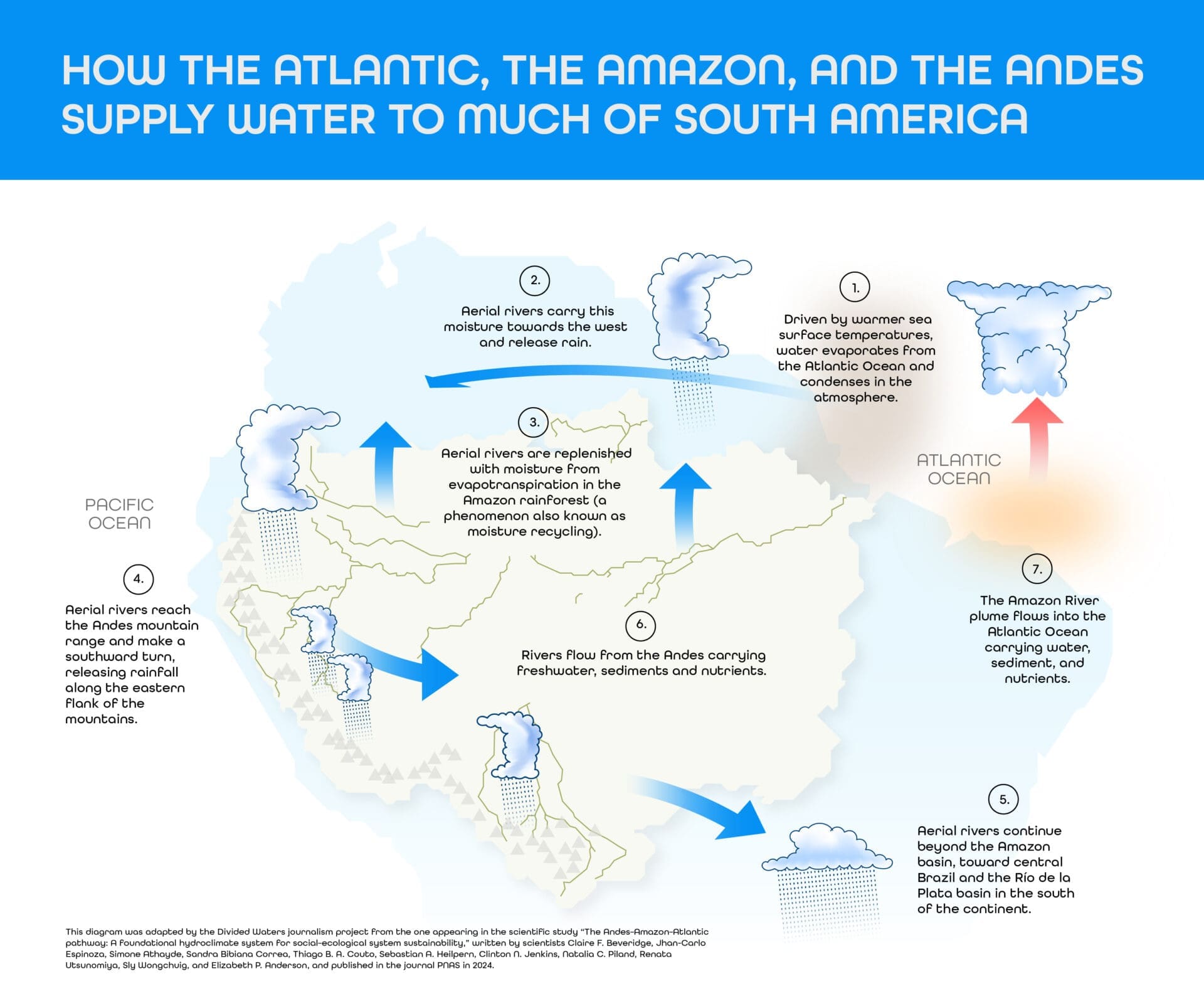
These “flying rivers” also feed rainfall in Uruguay. A study by hydroclimatologists Francina Dominguez and Zhao Yang found that 16% of precipitation in the Río de la Plata basin comes from Amazonian moisture transported by the South American low-level jet (SALLJ).
Another study, conducted by Brazilian and German scientists, found that the Amazon River basin is the direct source of between 18% and 23% of precipitation in the Río de la Plata basin during the wet season. By direct contribution, the researchers mean the share of rainfall originating in the Amazon through the pumping—or evapotranspiration—of water by forest trees, which then travels across the biome to the Río de la Plata basin.
That figure, they found, can rise by six percentage points during the wet season when “cascading moisture recycling” is taken into account. This type of precipitation, also known as an indirect contribution or cascading effect, originates as moisture in the Amazon, falls as rain in nearby regions and is then recycled back into the atmosphere before being carried by winds to the Río de la Plata basin. In other words, as the scientists put it, the moisture undergoes “re-evaporation cycles along the way.”
During the dry season, between 21% and 25% of the rainfall reaching the Río de la Plata from the Amazon may originate there.
Overall, one-third of the rain that falls in Uruguay comes from the Amazon, according to calculations by Sandro Pauli, a physicist at the Federal University of Santa Catarina who specializes in climate models that track atmospheric moisture: 19.8% comes directly from the Amazon and another 15.1% indirectly.

“There is significant year-to-year variation in moisture sources—phenomena such as El Niño have an enormous influence on wind direction—but because we only have a ten-year average, we cannot see those fluctuations,” says Pauli. He is part of the quantitative ecology training program at Brazil’s Serrapilheira Institute, a partner in the Divided Waters investigation coordinated by the Latin American Center for Investigative Journalism (CLIP) in collaboration with eight media outlets across the region.
To trace the path of the rainfall that reaches Uruguay, Pauli used UTrack, a computer model for tracking atmospheric moisture, which follows the trajectory of air masses step by step.
Oceanographer Marcelo Barreiro, head of the Department of Atmospheric Sciences and Ocean Physics at the University of the Republic, explains that “the Amazon plays this dual role: it is not only the evaporation of water that reaches these latitudes; it also creates the dynamic wind conditions that favor rainfall in our region.” Like Pauli, he notes that this moisture contribution can “be influenced by phenomena such as El Niño, La Niña and other natural phenomena.”
The Lack of Information
Barreiro and his colleague, chemist Emilio Deagosto, published an academic paper in January on Uruguay’s historic drought earlier this decade. Their findings show that La Niña played “a key role in creating the conditions for the rainfall deficit, but the exceptional nature of the event was due to constructive interference with other climate modes.” They add, more cautiously, that “other climatic and non-climatic factors may have contributed to the occurrence of the event.”

“This suggests that prolonged dry spells in the southwest require an unusual combination of climate anomalies, making them less frequent but potentially more persistent,” they explain. Later, they add that “the Amazon, another crucial source of moisture for southeastern South America, has been undergoing a significantly accelerated process of deforestation in recent years, which other studies have suggested may be a contributing factor to the prolonged drought in the region.” The historic drought could not be attributed to climate change, they add, although climate change likely exacerbated it.
Barreiro and Deagosto believe further research is needed to better understand the phenomenon. But there is a major obstacle: Uruguay collects relatively little climate data of its own and therefore depends on third-party sources.
“The lack of specific regional climate models and the shortage of long-term local historical datasets with adequate spatial resolution have made it difficult” to use climate information to inform decision-making, the Uruguayan government warned in December 2024 in its First Biennial Transparency Report, submitted to the United Nations Framework Convention on Climate Change.
“The climate-change scenarios produced by the IPCC provide a regional picture, not one specific to the country,” says María Fernanda Souza, director of Climate Change at the Ministry of Environment, who took up the post in March 2025. “Uruguay is included in a scenario it shares with Argentina, Paraguay and part of southern Brazil. That makes it very difficult to produce scenarios with a higher degree of certainty about exactly how much rainfall will decrease in Uruguay specifically—let alone in individual localities.”
The Amazon does more than supply moisture, says oceanographer Barreiro, who serves on one of the working groups of the United Nations Intergovernmental Panel on Climate Change (IPCC). Fuel alone is not enough without something to ignite it: wind. “The moisture is concentrated primarily in the layers closest to the surface, and you then need the associated atmospheric circulation to create conditions conducive to rainfall,” he explains.
“The Loaded Clouds”
In 2026, Uruguay and the wider region will face the effects of a super El Niño. On July 16, oceanographer Gastón Manta, a researcher at the University of the Republic’s Eastern Regional University Center, shared with Búsqueda a satellite image of South America and two posts on the social media platform X.
The image, captured by a NASA satellite on June 16, shows Uruguay almost entirely blanketed by clouds moving “down” from the center of the continent toward the Atlantic Ocean. “A picture is worth a thousand words,” Manta summed up.
The first post was by Vitor Goede, a Brazilian meteorologist and doctoral student at the Advanced Radar Research Center at the University of Oklahoma.
“A stout EML is being advected from the Andes towards the La Plata basin and will be one of the key ingredients for the upcoming severe weather in the coming days,” Goede warned in his post, which was accompanied by visualizations.

His fellow meteorologist Ernani de Lima Nascimento, of Brazil’s National Institute for Space Research, replied that forecasts for the following six days showed “very powerful and persistent ARs over the La Plata Basin, with some extreme IVT magnitudes over Rio Grande do Sul” at times. IVT, or Integrated Vapor Transport, measures the horizontal transport of water vapor through the entire atmospheric column, providing an indication of how much moisture is being carried over a particular area.
IVT forecast maps at every 3h from (**experimental**) CPTEC-INPE MONAN 10 km global model, init. 00Z 16 JUL, for the next 6 days. Very powerful and *persistent* ARs over the LaPlata Basin, with some extreme IVT magnitudes over Rio Grande do Sul (extreme southern Brazil) at times. pic.twitter.com/IPAixBt887
— Ernani de Lima Nascimento (@Ern_Nascimento) July 16, 2026
According to Manta, that exchange on X illustrated “with absolute clarity the importance of the Amazon.” The message was in the images accompanying the posts: while it is difficult to “put a number on” the Amazon rainforest’s specific contribution to rainfall in Uruguay, those maps should go a long way toward helping “the general public” understand it, he explained.
Two days later, on July 18, a cold, unstable air mass moved into the country and triggered severe thunderstorms, according to Uruguay’s National Institute of Meteorology. In the northwestern department of Salto, one person died during the storm. President Yamandú Orsi declared an emergency for the horticultural and small-farm sector.
National Emergency Director Leonardo Palomeque told the press that the storm in Salto was not specifically caused by El Niño. Even so, it prompted authorities to begin discussing what might lie ahead.
Nearly a month later, the government announced that it had secured US$750 million in contingent credit lines from the Inter-American Development Bank and CAF—Development Bank of Latin America and the Caribbean—to address the potential impacts of El Niño. “When you look at the forecasts and at data from similar events, international analysts and scientists say this one could be more severe. They estimate that as many as 25,000 people could be displaced and another 5,000 evacuated, with rainfall potentially reaching 500 millimeters over a 30-day period, compared with the 1,200 millimeters Uruguay normally receives over an entire year,” Presidency Secretary Alejandro Sánchez said at a press conference on August 11.
Challenging Scenarios
The 2022–2023 water crisis left a scar on the country. The IPCC projects that droughts in the Río de la Plata basin will become more frequent and severe, but shorter, in both the near and long term, although it assigns “low confidence” to that projection.
Chemist Emilio Deagosto explained that one of the “major limitations of the IPCC’s information is its spatial scale”: data for Uruguay are folded into projections for southeastern South America, a region where “there are, and will continue to be, very different trends.” According to the researcher, “very little is still known about projections for droughts and wet periods” in Uruguay and its different regions. His doctoral research, in fact, is focused on using high-resolution models to produce better local data.
Despite these gaps, some in Uruguay are already preparing for changes that have begun to arrive. The face of climate change is not drought or flooding itself, but the increasing frequency with which these events occur at extreme levels.
“In the immediate future, what concerns us most is that roughly the same amount of rain will fall, but over shorter periods, putting enormous strain on urban drainage systems. The flip side is hotter, longer summers with less water,” says Souza. Uruguay’s climate change director says the country is working to ensure that international funding mechanisms are ready to be activated, either to finance adaptation projects or to respond to the impacts of extreme events.
Floods often produce dramatic scenes, but drought is the greater concern for the country’s agricultural sector.
In recent months, the Central Bank of Uruguay has published two working papers on water shortages. One examined the financial system’s resilience to drought, which it identifies as the “most critical” climate risk facing agriculture because of its direct effects on crop and livestock production. Yields fall, quality deteriorates and productivity declines.
Agriculture and related industries account for approximately 10% to 13% of gross domestic product (GDP) and nearly 80% of the country’s goods exports, with beef and soybeans among the leading products. “Although its direct contribution to GDP may appear limited,” the Central Bank report says, the sector has strong direct and indirect links to other activities, including transportation and trade, creating spillover effects throughout the economy. The report also notes that between 2005 and 2024, bank lending to the agricultural sector accounted for almost a quarter of all business loans. At one financial institution, the share exceeded 40%, while the median among Uruguayan banks was around 19%.
The Central Bank’s other analysis warned that drought affects different parts of Uruguay’s agricultural sector in different ways. Crop production feels the impact sooner, but also recovers more quickly. Livestock and dairy farming, by contrast, suffer more persistent effects. These sectors, which account for around 10% of national GDP, can experience fewer animal births, a decline in the number of cattle sent to slaughterhouses and lower milk production. The impact, the paper’s authors write, “extends far beyond the farm gate.”
The Ministry of Livestock, Agriculture and Fisheries currently has an open call for family farmers to submit water-related projects. The program is aimed at the most vulnerable producers in the agricultural supply chain, explains agronomist Carlos Honorio, monitoring coordinator at the ministry’s Project Management Unit. Producers can receive up to US$10,000. The rationale behind the program is that, given the recent agricultural emergencies and “the urgent need to create conditions for adapting to increasingly frequent extreme events,” support is needed for producers with “higher levels of vulnerability to water shortages.”

The government will finance projects ranging from the construction and repair of wells, water intakes, excavated reservoirs and farm ponds to the installation of water storage and distribution systems for livestock.
In the wake of the historic drought, Uruguay has yet to resolve the debate over how to improve the drinking-water supply in the south of the country, particularly in the capital. Just days before leaving office, the previous administration of Luis Lacalle Pou signed a contract to build a desalination plant on the Río de la Plata. The new administration of Yamandú Orsi, from the opposing political camp, suspended implementation of the contract and is pursuing an alternative involving the construction of a new reservoir—a proposal that has its own detractors. The governing coalition and the opposition remain firmly committed to their respective projects, while the political confrontation drowns out the voices of technical experts.
Other Concerns Take Priority
Antonella Gordillo is the daughter of farmers. She is 32, and her time at a private university in Montevideo, where she studied journalism, only reinforced her conviction that she would never want to live in the capital. City life is simply not for her.
Gordillo remains involved in the family business, which focuses on horticulture, and in 2025 she was elected vice president of the Uruguayan Farmers’ Confederation (CGU). Her memories of the 2022–2023 drought are very different from those of people in Montevideo. “We had already been living through the drought for months, and the wells on our farm had run dry,” she says. It was only when people in the metropolitan area “started getting brown water from their taps” that alarm bells went off.
For Gordillo, one of Uruguay’s problems is that “there is no culture of water conservation,” because water has never been scarce in the country. That lack of concern, she says, extends to both the authorities and farmers themselves.
At least, that was the case until the worst drought in a century arrived, followed by further dry spells, she adds. “Farmers are a little more alert now, more cautious,” she says, recalling something she heard her father say a decade ago. During an interview, he was asked what his “worst enemy” was when it came to farming. His answer was “the weather.”
Gordillo says they now factor into their production planning that, at certain times of year, they need “three times as much” irrigation water to get the same crop established. As in other areas of agriculture, they have had to adopt new techniques. They now grow more during the winter and then keep carrots in cold storage from September through November. Why? “Because it is becoming increasingly difficult and expensive for us to get [seedlings] established between December and January.”
Farmers, Gordillo says, try to obtain information that can guide their decisions. But from there to considering how changes in land use across the Amazon basin might affect rainfall in Uruguay is quite a leap. Whatever the amount of moisture arriving from the Amazon, “nobody is thinking about that. In day-to-day life, there are plenty of other issues much higher up the list of concerns,” she adds.
Although few farmers—and few Uruguayans in general—think about changes in land use in the Amazon, how much rain falls, and whether it falls when they need it most, certainly keeps them awake at night. The scientific evidence shows that, to some extent, Uruguay’s rainfall depends on the rainforest farther north.
An Uncertain Future
A country’s infrastructure is designed to operate under conditions that are known, anticipated or already established, explains oceanographer Gastón Manta. As those conditions change, climate-change adaptation policies have become the norm around the world.
A paper published in the academic journal Nature in early June warned that global warming and deforestation of the Amazon biome could have serious consequences for the moisture it supplies to the wider region.
“Transitions in the Amazon would disrupt atmospheric moisture transport to downwind regions outside the Amazon basin that are under intensive agricultural use—such as southern Brazil, Bolivia, Paraguay and as far south as the Río de la Plata basin in Argentina—potentially threatening crop yields and regional water security,” says the study, whose authors include Brazilian scientists Marina Hirota, a mathematician, and ecologist Bernardo M. Flores, as well as renowned Swedish climatologist Johan Rockström.
That research follows other studies on the subject published in the same journal. In 2024, another study, led largely by Brazilian scientists, examined the impact of climate change and human activity on the biome. In an ecosystem this complex, the effects of individual events are difficult to predict, the researchers explained. But their cumulative impact could ultimately push the Amazon toward collapse. The research team, which again included Hirota and Flores as well as veteran Brazilian climatologist Carlos Nobre, warned that some 65 million years of “relative resilience to climatic variability” could be swept away.
Fernanda Souza, Uruguay’s climate change director, says there is an extensive body of literature on “flying rivers” and on how Uruguay and other countries in the region would be “arid or semi-arid” without them. Yet she acknowledges that Uruguay has conducted “no systematic study of how the country would be affected” if that water contribution were significantly reduced as a result of disruptions to the hydrological cycle caused by deforestation or by the extreme droughts that have become more common in the Amazon. “You need a national academic community producing data specifically for Uruguay, and so far that hasn’t happened,” she laments. Souza also acknowledges that the government itself does not provide enough funding to give Uruguayan researchers the tools they need.
The lack of research and the complexity of climate phenomena make it difficult to determine precisely how drastic changes in land use across the Amazon basin would affect the southern part of the continent. For Manta, it is clear that the impact “would be very significant,” given the Amazon’s central role in the hydrological cycle. Predicting exactly what those changes would mean, however, is far from straightforward because the system is so complex. It is difficult to isolate any one part of the phenomenon and assess what would happen if it changed.
“Taking the Amazon out of the equation would bring about many changes—not only in rainfall, but in the water regime as a whole,” Manta says. And if he had to write the headline for an article on the subject, he adds, it would be: “Failing to protect the Amazon could have drastic consequences for rainfall in Uruguay.”
Scientific References
Emilio Deagosto et al. “Climatological Analysis of the 2022–2023 Unprecedented Dry Period in Southwestern Uruguay.” International Journal of Climatology, Royal Meteorological Society, 2026.
Nico Wunderling et al. “Deforestation-induced drying lowers Amazon climate threshold.” Nature, 2026.
- C. Zemp et al. “On the importance of cascading moisture recycling in South America.” Atmospheric Chemistry and Physics, European Geosciences Union, 2014.
Zhao Yang and Francina Dominguez. “Investigating Land Surface Effects on the Moisture Transport over South America with a Moisture Tagging Model.” Journal of Climate, American Meteorological Society, 2019.

This project is the result of a collaboration between Latin American journalists and scientists, spearheaded by Brazil’s Serrapilheira Institute and the Latin American Center for Investigative Journalism (CLIP), to explore the Atlantic-Amazon-Andes water pathway and the disruptions to the ecosystem services it provides to the continent.


