


Inversiones La Oroza, the controversial Peruvian logging company banned from exporting timber to the United States, retains loyal customers in Mexico. The Ceballos Gallardo brothers —owners of a large timber emporium— keep their business with that company despite the fact that, in 2015, it sold them Amazonian timber of illegal origin. Other Mexican loggers preferred to switch to an exporter a partner in which is the uncle-in-law of Luis Angel Ascencio Jurado, the main shareholder of La Oroza. Others became clients of Miremi, a company linked to Inversiones WCA, a Peruvian company also banned in the United States.
Rumococha is a small town on the outskirts of Iquitos, a city known for the trade of Peruvian Amazonian timber. Brothers José Ernesto and José Sebastián Ceballos Gallardo, Mexican businessmen and lifelong loggers, chose the name of this community as that of one of their many companies.
The Ceballos Gallardo have a long and close relationship with Peru: in 2005, they partnered with Peruvian businessman Charles Ginhoven Holder to found, in Iquitos, Maderera Industrial Rumococha (MIRSA), a timber importer, exporter and marketer that remained open for a decade, operating until mid-2015.
But despite having their own timber exporter in Peru, the Ceballos did not use it to ship timber to Mexico. At least not since 2012, according to the export records consulted. They preferred to do business with a company also created in Iquitos in 2004: Inversiones La Oroza, a controversial Peruvian logging company accused of selling illegal timber from the Amazon.
In 2015, an investigation by Peruvian authorities —which stemmed from one of the largest timber seizures in that country dubbed Operation Amazon— revealed that La Oroza exported timber of illegal origin to Mexico and the United States.
Two years later, in 2017, the United States Trade Representative of the federal government (USTR) banned imports from La Oroza for three years, a sanction that was later extended until 2023, for lack of guarantees that the Peruvian company was complying with the legal requirements necessary to extract and market wood products.
La Oroza has received additional sanctions in Peru for violating forestry law. The justice system, however, has been slow in ruling on the cases involving it, and the company has had the chance to expand its operations with new concessions (see Timber Traceability in the Amazon: Government Backtracks and Justice against Transgressors is Slow, another chapter of this investigation).
Since being banned in the United States, La Oroza has centered its exports in Mexico and the Dominican Republic.
In Mexico, since 2017, two companies receive the shipments of Amazonian wood that La Oroza sends to the country: CG Grupo Forestal, whose main shareholder is José Ernesto Ceballos Gallardo, and CG Universal Wood, whose majority shareholder is José Sebastián Ceballos Gallardo.
Between 2017 and 2020, these two Mexican companies imported at least, 5,254 tons of wood from La Oroza, with a value of just over US$4.8 million, according to information from commercial database Panjiva.
Much of the imported wood comes from a tree that in Peru is known as cumala (Virola spp), but which in Mexico is sold under the name of banak. Because it resembles mahogany, cumala or banak wood is used mostly in furniture.
A family that collects companies
In 2005, when the Ceballos Gallardo brothers opened MIRSA in Peru, they already had a long history in the timber trade in Mexico. Their father, José Ernesto Ceballos Sobrino, had been a logger since the 1970s.
This family has also ventured into the real estate business, a sector in which they do not have a good track record. On September 19th, 2017, the San José residential building in Mexico City did not withstand an earthquake of magnitude 7.1, after which part of its structure collapsed. Two women died. The building in Portales neighborhood was only eight months old. The company that built it was Canada Building Systems of Mexico, among whose shareholders were José Ernesto Ceballos Sobrino and his son José Arturo Ceballos Gallardo, as investigated by MCCI at the time. As of May 2021, the legal process for this case was still ongoing, and no one had been sanctioned.

Judging by their companies, Ceballos Sobrino’s eldest sons are focused on the timber trade. Sebastián runs Grupo CG Maderas, and Ernesto runs Grupo Cebra.
Sebastián Ceballos —the eldest of the brothers— has been a shareholder in at least 14 companies, ten of which were liquidated between 2010 and 2014. As of early 2021, five were still active: one of them is CG Universal Wood, the company that continues importing timber from Inversiones La Oroza.
Ernesto Ceballos has also accumulated companies since the 1990s. Until March 2021, he was shareholder in twelve companies, most of them located in the metropolitan area of Guadalajara, Jalisco, and integrated into Grupo Cebra.
José Ernesto Ceballos Gallardo’s businesses are not only based in Mexico. In 2006, together with American Kenneth Peabody, he created Global Plywood and Lumber in Las Vegas, Nevada, a company that for several years imported Amazonian wood to the United States and bought it from La Oroza.
Turning a blind eye
The Ceballos Gallardo brothers import timber to Mexico from China, Uruguay, Chile, Brazil, Indonesia, Malaysia and Peru, among others.
In the case of Peru, their main supplier is Inversiones La Oroza: between 2017 and 2020, CG Grupo Forestal and CG Universal Wood each bought from them $2.4 million in Amazonian wood, according to data from Panjiva.
Mexican businessmen remain loyal to Inversiones La Oroza despite what was found on the ship Yacu Kallpa.
In 2015, Peruvian authorities tracked the timber that the vessel was moving on its trips to the United States, Mexico and the Dominican Republic, and proved that La Oroza owned the largest amount of illegally-sourced timber on the Yacu Kallpa.
In the United States, one of the companies that received the wood from La Oroza was Global Plywood and Lumber, owned by Mexican José Ernesto Ceballos Gallardo and American Kenneth Peabody.
In Mexico, companies of the Ceballos brothers bought the largest share of the timber that La Oroza moved on the Yacu Kallpa.
The last trip made by this ship ended in January 2016 at the port of Tampico, Tamaulipas, in the Gulf of Mexico. The timber it was carrying was seized after Peruvian authorities warned that most of the cargo was illegal.
At that time, the Ceballos and other businessmen members of the National Association of Importers and Exporters of Forest Products (Imexfort) pulled strings so that, in October 2016, the Mexican government would release the wood, as documented in a journalistic investigation published by Ojo Público, W Radio and Connectas.
On January 14th, 2016, twelve days before the Yacu Kallpa arrived at the port of Tampico —when it had already been flagged as carrying illegally-sourced timber—, José Ernesto Ceballos Gallardo and his son Ernesto Ceballos Ramos were in Peru. There, they met with Rolando Navarro, one of the agents in Operation Amazonas and who had documented the illegal origin of the timber. At the time, Navarro was executive president of the Forest Resources Oversight Agency (Osinfor).
Five years later, in an interview for this investigation, Navarro talked about that meeting with the Ceballos. “They arrived at about 4:30 pm. Ernesto (Ceballos Gallardo) told me that he was a Mexican businessman, that he had been working in Peru for many years, bringing cedar and mahogany, and that he never had any problems… They insisted that they had been working in Loreto for years.”
Navarro recalls that, at times, the conversation was tense. “At one point I said to Ceballos: ‘as a businessman coming to the country and wanting to invest, you should be concerned that an institution like Osinfor is warning you that the wood you are buying has an illegal status’… We told him: ‘you are buying an illegal product, because that product could be coming from a protected natural area or from a territory of native communities’. He replied: ‘We have to find a way out’”.
The meeting ended abruptly when Ernesto Ceballos Gallardo looked at his phone, read a message, smiled and said, “That’s it, we’re leaving.” After the Ceballos left his office, Navarro received the news that the government of Ollanta Humala, then in office, had made the decision to remove Navarro from his position as president of Osinfor.
Time for new companies
This journalistic alliance contacted the Ceballos brothers for an interview in order to ask them, among other things, how they guarantee the legal origin of the Amazonian timber they continue to import through Inversiones La Oroza. The only one who answered was Ernesto Ceballos Gallardo.
In an e-mail, the Mexican logger sent a brief response: “due to a lack of legal clarity on the part of the Peruvian forestry authorities, the company stopped importing Peruvian wood”. The findings of this investigation show that this is not the case: his company and his brother’s company continue to import timber from Peru and do so through La Oroza, according to databases Panjiva and Veritrade.
In fact, the databases from the reviews that the Federal Attorney’s Office for Environmental Protection (Profepa) conducted on shipments of Peruvian timber show that the companies CG Grupo Forestal and CG Universal Wood have indeed imported Peruvian wood between 2017 and 2020. Despite our persistence, Ernesto Ceballos did not reply again to our questions.
Since the investigations in Peru and the United States into the illegal timber found on the Yacu Kallpa, the Ceballos have closed some of their companies and have opened new ones.
In mid-2015, Ernesto and Sebastian Ceballos Gallardo approved the dissolution and liquidation of Maderera Industrial Rumococha (MIRSA). And in December 2017, José Ernesto Ceballos Gallardo and Kenneth Peabody closed Global Plywood and Lumber in the United States.
In January 2016, when it was clear that much of the timber transported by the Yacu Kallpa was illegal, Eduardo Ceballos Ramos —son of Ernesto Ceballos Gallardo— founded Zebra Pacific, LLC, in Delaware, United States.
Similarly, the company Britannica Woods LLC was created in August 2019 in Las Vegas, Nevada, with a board including Joaquín Rodrigo Cano Espeso and Norma Peabody, wife of Kenneth Peabody, Ernesto Ceballos Gallardo’s partner in Global Plywood and Lumber.
In late December 2019, the Ceballos Ramos brothers partnered with Joaquín Rodrigo Cano Espeso to create a sister company in Mexico, Britannica Woods Mexico.
Open road to Mexico
Following the trips of the Yacu Kallpa, the U.S. federal government banned Inversiones La Oroza from exporting timber to the United States.
In Mexico, the Federal Attorney’s Office for Environmental Protection (Profepa) did not file charges in this case, according to the reply sent in response to our request for an interview, which states that the wood “had all the phytosanitary documents (which mainly ensure that the wood is free of pests) issued by the Peruvian government”.
The companies of the Ceballos brothers continue to import Peruvian wood through La Oroza undisturbed. Mexican regulations do not require importers to verify the legal origin of the wood; they only have to present the purchase invoice, the phytosanitary certificate, the customs declaration and the CITES certificate in the case of a species listed in Appendix II of the Convention on International Trade in Endangered Species of Wild Fauna and Flora.
“As an importer, Mexican law does not require me to go to Peru to investigate whether the man cut the wood where he says he cut it,” explains a Mexican forestry engineer with extensive experience in importing wood and who asked not to be mentioned by name. “The exporter – he insists – is accrediting the legal origin when in his country he is authorized to export the wood… If the Peruvian authority says that this wood is illegal, they should not let them export it.”
In February 2018, non-governmental organizations such as the Mexican Network of Farmers Forestry Organizations (Mocaf), the Mexican Civil Council for Sustainable Forestry (CCMSS) and the Mexican Center for Environmental Law (Cemda) stressed that it was necessary for the country’s legislation and regulations to be revised in order to “incorporate those provisions that prevent Mexico from continuing to be a destination for illegal timber imports.”
On December 9th, 2020, Mexico published new regulations for the General Law for Sustainable Forest Development (LGDFS). They state that the legal origin of raw materials and forest products will be accredited —in the case of imports— by the customs declaration, a document declaring the taxes paid and other obligations related to the entry of goods into the country.
“We have been running into a wall for more than 20 years”. This is how Gonzalo Chapela, public policy coordinator of the Mocaf Network, describes the result of civil society attempts to instate mechanisms in the Forestry Law and its regulations that close the door to the import and commercialization of illegal wood.
This wall, according to Chapela, was built by the country’s timber industrialists and traders: “They have colonized the authorities and the legislature”.
Among the actions proposed by the Mocaf Network and other organizations is that the importers present all the documents that allow for the traceability of the wood before reaching Mexican territory. These actions, says Chapela, would have to be accompanied by bilateral agreements with the transit countries, to support the documentary verifications of legality that support the sworn declaration. Although the problem does not originate in Mexico, Chapela points out, the country can be part of the solution”.
For the time being, with the implementation of the new treaty between Mexico, the United States and Canada, T-MEC, on July 1st, 2020, all three countries committed to taking measures to combat and prevent the trade of wild fauna and flora that, “based on credible evidence, was taken or traded in violation of the law”, be it the law of those three countries or of different ones.
When one gets sanctioned, buy from the other
Following the turmoil with the Yacu Kallpa, Mexican companies that previously imported timber through La Oroza, began a new commercial relationship with the Peruvian P&O Exportaciones y Comercialización S.A.C. in 2016. This company emerged in February 2016 and has as its main partner the uncle-in-law of Luis Ángel Ascencio Jurado, a major shareholder of La Oroza, as documented by this transnational investigation.
Like La Oroza, P&O Exportaciones y Comercialización concentrates its timber exports in the Dominican Republic and Mexico.
Between 2016 and 2020, the Peruvian company shipped at least 1,292 tons of Amazonian timber to Mexico, according to Peruvian export data.
Mexican Customers of Peruvian Wood from P&O
These seven companies used to buy Amazonian wood from Inversiones La Oroza, but chose new providers after what happened with the Yacu Kallpa: P&O Exportaciones y Comercialización, a Peruvian company belonging to a close relative of the owner of Inversiones La Oroza.
- Maderas La Laguna
Member of the National Association of Importers and Exporters of Forestry Products (MEXFOR). Founded in Tlalnepantla, Edomex.
Among its partners is Victor Manuel Martínez Saavedra.
Peruvian wood imported into Mexico by Maderas La Laguna through P&O Exportaciones y Comercialización:
- Maderas y Materiales JR
Its manager and founding partner is Juan Ramón Padilla Martínez. Founded in Tijuana, Baja California.
Peruvian wood imported into Mexico by Maderas y Materiales JR through P&O Exportaciones y Comercialización:
- Imperial Herrajes y Maderas
This company is part of the group Maderas Polanco. Founded in Guadalajara, Jalisco. Its manager and one of its partners is Leonardo López Maciel.
Peruvian wood imported into Mexico by Maderas Imperial Herrajes y Maderas
through P&O Exportaciones y Comercialización:
- Muebles Finos Torres
This company shares partners with Maderas Torres, a customer of Inversiones La Oroza before 2016. Founded in Monterrey, Nuevo León.
Peruvian wood imported into Mexico by Muebles Finos Torres through P&O Exportaciones y Comercialización:
- Triplay y Maderas de Mayoreo
The shareholders of this company ar: Gerardo Huerta Madrigal, Rubén Castro Flores y Guillermo Salvador Huerta Leal. Founded in Aguascalientes, Aguascalientes.
Peruvian wood imported by Triplay y Maderas de Mayoreo through P&O Exportaciones y Comercialización:
- Triplay Azteca de Guadalupe y Triplay Azteca de Monterrey
Both companies belong to a single logging group. Founded in Monterrey, Nuevo León. Among its shareholders are Joaquín García Camacho and Leticia Viera Castellano.
Peruvian wood imported by Triplay Azteca de Guadalupe y Triplay Azteca de Monterrey through P&O Exportaciones y Comercialización:
- CG Universal Wood
It is a part of the group CG Maderas. This company has continued to purchase wood from Inversiones La Oroza and in 2017 and 2018 was also a customer of P&O Exportaciones y Comercialización. Founded in Guadalajara, Jalisco. Its main shareholder is José Sebastián Ceballos Gallardo.
Peruvian wood imported by CG Universal Wood through P&O Exportaciones y Comercialización:
Source: Data on wood exports from Peru
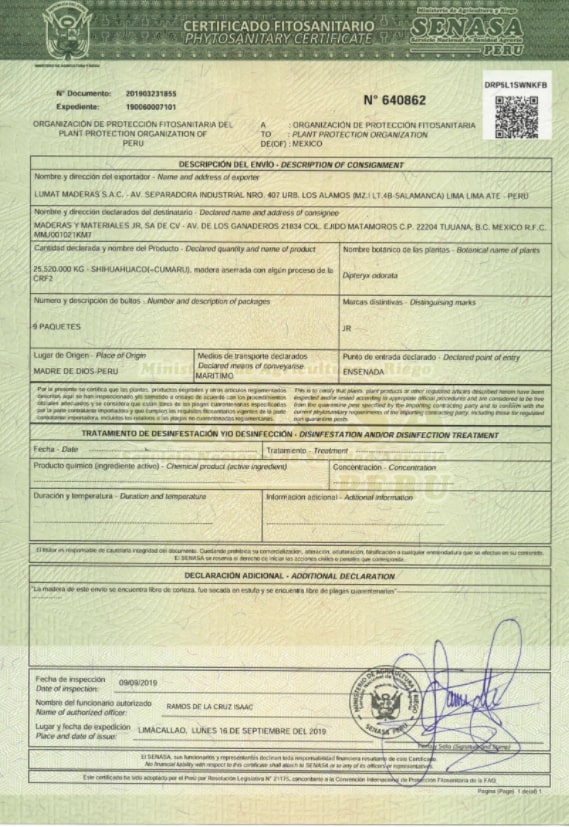
This news team asked all Mexican companies that have bought Amazonian timber from P&O Exportaciones y Comercialización for an interview. The only one who replied was Juan Ramón Padilla Martínez, founding shareholder and manager of Maderas y Materiales JR, a company based in Tijuana, Baja California, on the border with the United States.
“Why did you stop buying timber from La Oroza?”, Juan Ramón Padilla was asked over the phone.
“Because they no longer offer us material. We haven’t bought anything from them for four years. We stopped bringing a lot of wood from Peru, since there was a problem with a ship.”
“La Oroza is banned from exporting timber into the United States because of what happened with that ship…”
“I didn’t know that,” says Padilla, and also insists that he does not know the owners of P&O Exportaciones y Comercialización.
“Between 2016 and 2018 your company bought timber from P&O”.
“Very little. Now we already have another company called Lumat Maderas. We are buying some timber from them”.
“How did you come into contact with P&O?”
“We buy everything through a Peruvian who lives in Lima, his name is Adrian Bilbosa. All the wood we bring from Peru, he connects us to it”.
When asked how he ensures the legal origin of the tropical timber he imports, Padilla replies that his suppliers present him with documents where the Peruvian government certifies the legal origin of the timber. Days after the interview, the Mexican businessman e-mailed one of those documents: a phytosanitary certificate issued by Peru’s National Agrarian Health Service.
La Oroza is not the only Peruvian company banned from exporting timber to the United States. In July 2019, that same sanction was imposed on Inversiones WCA, as documented in this journalistic investigation.
Inversiones WCA was one of the Peruvian exporters that were moving timber on the Yacu Kallpa. In 2020 the company stopped sending timber to Mexico, but another company called Miremi S.A.C. continued to do so and even increased its exports to the country. Among its shareholders is William Castro Amaringo, who is also the head of Inversiones WCA and whose initials in fact give it its name.
Among the Mexican companies that, between 2019 and 2020, imported Amazonian timber from Peru through Miremi, are Comercializadora CG de Hermosillo (which belongs to José Ernesto Ceballos), Maderería Sierra Verde and Sud American Lumber.
La Oroza no es la única empresa peruana con prohibición de exportar madera a Estados Unidos. En julio de 2019, esa misma sanción se impuso a Inversiones WCA, como se documenta en esta investigación periodística.
Inversiones WCA fue una de las exportadoras peruanas que movió madera a través del barco Yacu Kallpa. Esta compañía ya no envió madera a México a partir de 2020, pero la empresa que sí lo hizo e, incluso, aumentó las exportaciones que ya realizaba al país fue Miremi S.A.C., la cual tiene como accionista a William Castro Amaringo, quien también está al frente de Inversiones WCA y cuyas iniciales de hecho le dan nombre.
Entre las empresas mexicanas que, entre 2019 y 2020, importaron madera amazónica del Perú a través de Miremi están Comercializadora CG de Hermosillo (que pertenece a José Ernesto Ceballos), Maderería Sierra Verde y Sud American Lumber.
Miremi’s customers in Mexico
These are the Mexican companies that have bought Amazonian wood from Mirermi, a Peruvian company with a the same shareholder as Inversiones WCA, banned in 2019 from exporting to the United States.
- Comercializadora CG de Hermosillo
Ernesto Ceballos Gallardo is a shareholder in this company; it is part of the Groupo Cebra.
Peruvian wood imported into Mexico by Comercializadora CG de Hermosillo through Miremi:
- Maderería Sierra Verde
Company created in 2001 in Tulancingo, Hidalgo. Among its partners is Cecilio Isidoro Cruz Pineda.
Peruvian wood imported into Mexico by Maderería Sierra Verde through Miremi:
- Grey Forestal
Company created in 2010 in Guadalajara, Jalisco.
Its shareholders are Diego Eduardo Reynoso Bazua and Alexis Reynoso Vachez.
Member of the National Association of Importers and Exporters of Forestry Products (MEXFOR).
Peruvian wood imported into Mexico by Grey Forestal through Miremi:
- Sud American Lumber
Company created in 1990, in Mexico City.
In its board is Eduardo Guiulfo.
Peruvian wood imported into Mexico by Sud America Lumber through Miremi:
- Grupo Tenerife
This company is part of Corporativo ACR. It is based in Guadalajara, Jalisco.
Peruvian wood imported from Mexico by Grupo Tenerife through Miremi:
Source: data on wood exports from Peru
This journalistic alliance requested interviews with the Mexican companies that export Amazonian timber through Miremi. None of them answered. However, we did receive a reply from William Castro Amaringo, manager of Inversiones WCA and Miremi.
“We don’t extract the wood… We defend our product because it has been purchased with everything that is required by law, with all the corresponding documentation. If the entities in my country did not do their job properly, at that time it was not our responsibility.” This is how the Peruvian businessman explains why WCA Investments was one of the companies involved in the transfer of illegal timber on the Yacu Kallpa and why due to a shipment to the United States in 2018, authorities in that country banned all exports of his company in 2019.
In addition, he adds that Miremi was already shipping timber to Mexico since 2015 and that his companies are not “big exporters”.
“How do you guarantee that the wood you export has a legal origin?”, we asked Castro.
“We verify the concession from which the wood is being extracted. We are practically doing the work of the State. Now, what we are doing is that we verify… from the moment of extraction we send a forestry engineer from the company to verify that the wood corresponds to the place from where it is being extracted… I am tired of saying that the problem is in the field, the moment the tree is cut down”.
From forest to flooring
The Amazonian wood that different companies import into Mexico comes from trees such as cumala (Virola spp), cachimbo (Cariniana domesticata), tornillo (Cedrelinga catenaeformis), panguana (Brosimum utile), aguanillo (Otoba parvifolia) and pashaco (Schizolobium sp).
Exporter Miremi, for example, sells a kind of wood that is commercially known as cumaru and comes from a tree that in Peru is identified as shihuahuaco (Dypterix odorata). It is a very slow-growing species: at least 700 years are needed for it to reach 50 meters in height and a meter and a half in diameter. Since 2015, Peruvian scientists have stated that this tree should be included in the list of endangered species of wild flora, as explained in another chapter of this investigation.
In Mexico, this Amazonian wood is used, above all, for the construction of furniture, windows, flooring and doors. Juan Ramón Padilla, of Maderas y Materiales JR, assures that in the northern cities of the country —the region where his company concentrates its operations— the Peruvian woods that are most sought after are tornillo and cumaru or shihuahuaco. “They have the characteristics that customers are looking for. Tornillo, for example, is a wood that is difficult for termites to get into, as is cumaru. It is difficult for a pest to get into them”.
Dr. Vera Rauber Coradin, collaborator at the Forest Products Laboratory of the Brazilian Forestry Service and who for six years was part of the scientific committee on flora of the Convention on International Trade in Endangered Species of Wild Fauna and Flora (CITES), stresses that the Amazon’s forest wealth was formed over thousands of years. Those trees that are being cut down, she explains, “cannot be recovered in one, two or thirty years. We will never see those trees with the thickness, with the width they have today. The more we can preserve this material, the better”.
In order to preserve these trees in the entire Amazon region —Dr. Rauber states— not only do countries in the Amazon region have to implement actions to prevent illegal logging and the commercialization of this wood, but “it is also necessary that other countries recognize the importance of this forest, the importance of the Amazon region in the environment. Everyone has to pitch in”.
The story of the Yacu Kallpa led the United States to enforce the Lacey Act, which prohibits the importation of illegally-extracted timber, and to ban exports from La Oroza and Inversiones WCA to the United States. In Mexico, a good start would be to establish the legality of the timber entering the country.
Articles Related
Los fieles clientes mexicanos de La Oroza
Also colaborated in this crossborder investigation :
Reporting: Sarena Snider, Ian James Hodgson
Production: Luisa Fernanda López Arias
Audience: José Luis Peñarredonda
Administration: Emiliana García
Data analysis: Rigoberto Carvajal
Webmaster: Diego Arce
Ilustrations: Miguel Méndez
Animation: Pardix
Video edition: Luis Gabriel Morales